All Activity
- Past hour
-
 нажмите ремонт офиса сочи
 -
Robertshugh joined the community
-

Increase Max Gatherers for 'Small' Ruins #8945
Thalatta replied to Baelish's topic in Applications and Contributions
Using those values for the function I proposed (rounding): G(200)=2, G(300)=3, G(400)=4, G(500)=5, G(800)=8. Would seem the behaviour is obvious, but, as expected, G(1000)=10, G(2000)=16, G(3000)=20, G(4000)=22 and G(5000)=24, for example. -
A little shuffling: I really don't like this one as a ranged Aura, since centralisation is quite global and fixed (that’s the point of it), so I changed its name and made it a tech. I also thought Sanctuary as a ranged Aura, alongside an alternative bonus inspired on the Maritime Silk Route tech (if this one is not wanted): Sanctuary: increased resistance for non-military units under Hero's aura (taking a longer quote now: “many skilled Roman silk workers immigrated to the Sasanian empire to find work after Justinian I’s tariffs and price fixing practically killed the industry in the Roman empire, and took with them, no doubt, motifs and imagery as well as technical expertise. Similarly, after Justinian effectively closed the Athenian Academy in 529, prohibiting the teaching of law and philosophy there and pagans from teaching anywhere, six prominent philosophers led by Damascius traveled to Ctesiphon to seek refuge at the court of Kosrow I. This sort of intellectual movement also occurred as a matter of diplomacy. Procopius records that Justinian I lent the sickly Kosrow I the services of a physician over the course of a year. Persian Christians traveled to the Roman empire because it was a center of Christian learning or to escape persecution”). Coastal Control: reduced enemy port capture resistance, either as Hero aura or global bonus (not only "control of all coastal areas" was already quoted, but "Sasanian control of the Persian Gulf prevented the Romans from having direct access to the Indian Ocean trade (Daryaee 2003: 1-16). Under Justinian they sought to circumvent Sasanian middlemen by allying with Ethiopians who would buy silk directly from the Indians. Procopius reveals that it was “impossible for the Ethiopians to buy silk from the Indians, for the Persian merchants always locate themselves at the very harbors where the Indian ships first put in (since they inhabit the adjoining country) and are accustomed to buy the whole cargoes” (Procopius, I. xx.12)", from The Sasanian ‘Mare Nostrum’: The Persian Gulf, by T. Daryaee). Centralisation: renamed Autocrat bonus to tech that increases stats of a given CC, but penalises all others. I wonder if the chosen CC can be determined either by being under the Hero’s aura when researched, or it can be researched at CCs, and where it's researched in particular becoming the chosen CC.
- Today
-
Increase Max Gatherers for 'Small' Ruins #8945
Thalatta replied to Baelish's topic in Applications and Contributions
Why not use a function for how many gatherers to have for any possible stone number? If I’m not wrong, the present behaviour seems to be: 5000 stone: 24 gatherers. 1000 stone: 12 gatherers. 500 stone: 1 gatherer. Which indeed seems too low for 500 stone. I managed to find something nice. As a very simplified model, since the amount of stone is proportional to its volume, and the number of gatherers G are proportional to (a fraction of, if sunk in the ground) its circumference, then naively one would have G=AS^(1/3), where A is some constant, but that’ll never work. Let's then include a "worthiness" factor 1-e^(-BS), meaning that the less stone there is, the less efficient would be to deal with its logistics proportionately (gatherers will soon need to be relocated anyway, for example, besides minimum upfront costs and infrastructure, etc), thus less gatherers than expected would be assigned to it (exponentially, going inversely, that is, the complement of exponential decay). The final formula is then G=AS^(1/3)(1-e^(-BS)), which for the initial conditions G(5000)=24 and G(1000)=12 returns A=1.4036 and B=0.001931. This means that G(500)=7, which might seem high but it’s because the initial conditions (24 and 12) are somewhat weird to begin with. One can check that for some extreme cases the function still behaves nicely: G(100)=1 and G(50000)=52. I’d propose to use a function like this but change one initial condition to G(1000)=10, as such one gets A=1.4064 and B=0.001242, resulting in G(500)=5. In conclusion: a very simple (non-linear) formula predicts 7 gatherers for 500 stone, but if for 1000 stone the number is tweaked from 12 to 10, one manages a more poll-friendly 5 gatherers, and can use that formula for any stone value to get the corresponding number of gatherers. -

Increase Max Gatherers for 'Small' Ruins #8945
Obelix replied to Baelish's topic in Applications and Contributions
Thank you for opening this thread and adding the poll afterwards, @Baelish! I voted for a maximum of 2 gatherers because I think they're more special than a small cut of rock (1000 Stone) or a normal cut of rock (5000 Stone). More specialized sources of stone or metal like ruins should be harder to exploit and not have a proportional <MaxGatherers> value. -
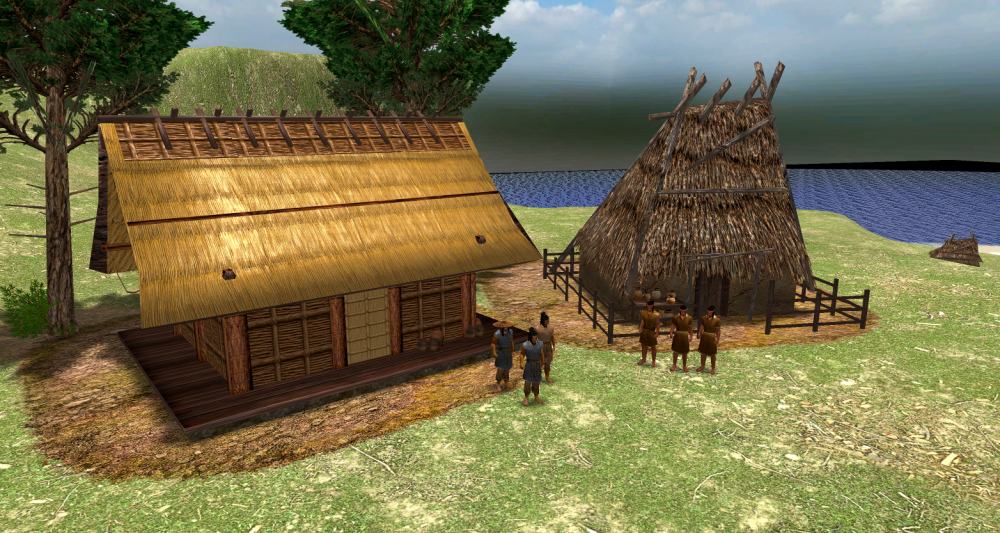
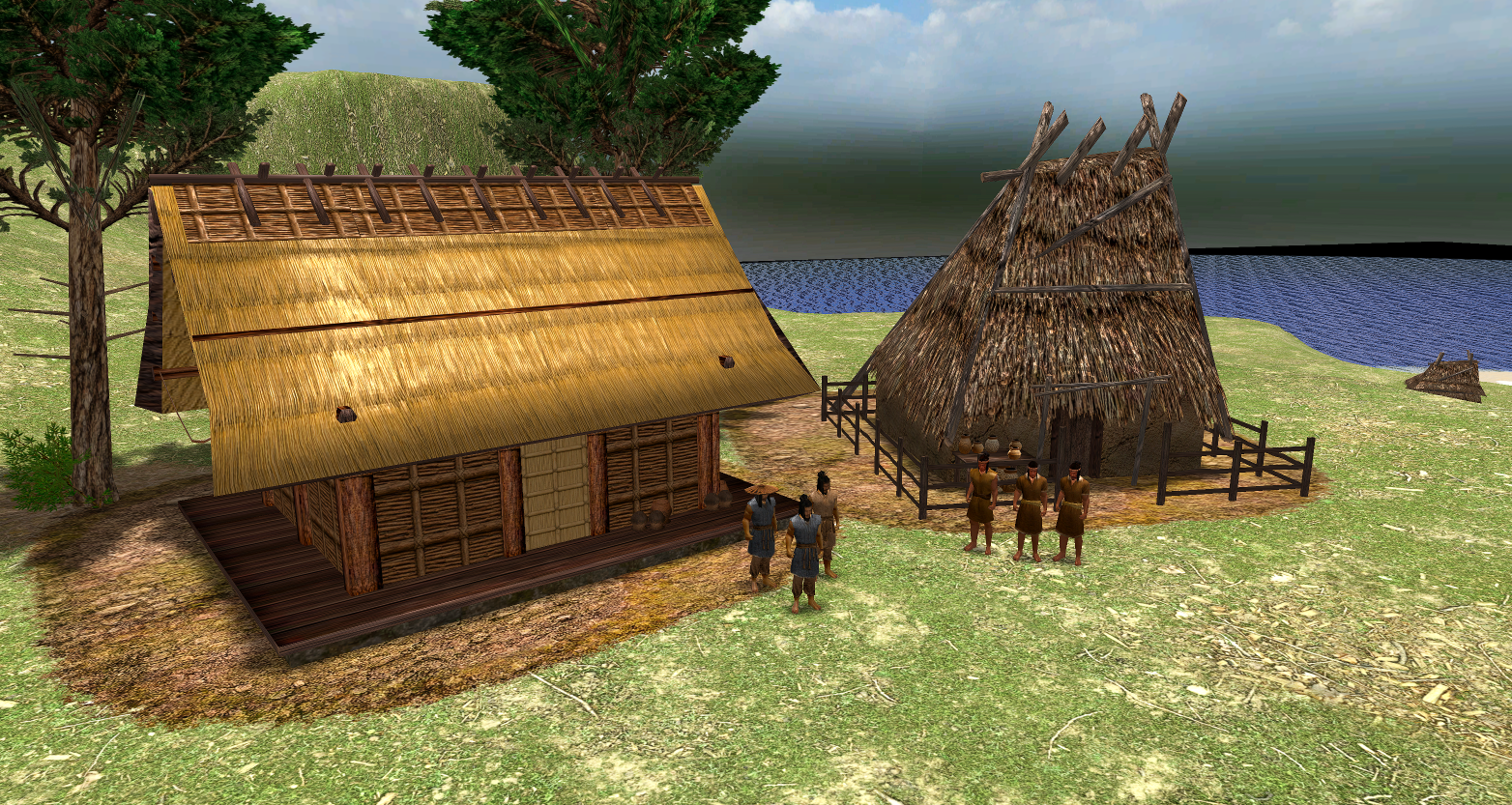
Hello everyone! Today I'd like to share a comparison between the Jomon Copper Age houses and the new Yayoi Bronze Age houses currently being developed for World Rising! The evolution between these cultures is already becoming visible, showcasing the transition from a more primitive society to more organized and advanced communities, with new construction techniques, architecture, and a unique visual identity. In addition to the buildings, we're also finishing units, clothing, armor, weapons, and many cultural elements to make each civilization feel unique and historically inspired. More World Rising development updates coming soon!
- Yesterday
-
Is there a reason that my autociv does not show ally stats in multiplayer games, only in replays? autociv.stats.alliesview = "true" is set in user.cfg Nevermind, had to update.
-
Previously I proposed that since Khosraw I Reforms fixed harvest tax, it could make Fields trickle metal. Also they “further elevated the figure of the sovereign above the nobles and centralized power around him”, which could be a Hero bonus and champion penalty. For my take, I'm getting quotes from the book I mentioned: The Two Eyes of the Earth, by M.P. Canepa (I went through all of it). I write down first Aura, then Bonus, then Tech. I only declined Auras in the first person, but do whatever. As usual, it’s your decision what exactly they would entail, and I’m not sure about what’s possible. “Additional” ideas I leave mostly without hints, since maybe they are unnecessary. Ardashir I Overthrower: capture bonus ("After his successful usurpation Ardashir", referring to the Parthians). Inheritance: capture resistance bonus (“Believing these regions to be his by inheritance he declared that all the countries in that area including Ionia and Caria, had been ruled by Persian governors (...). He asserted that it was proper for him to recover for the Persians the kingdom which they formerly possessed”, this was really big for him, plenty of mentions regarding his “rightful inheritance”). Holy Fire: temple tech (“Ardashir I increased the cults of the temples and ordered the fire of Ohrmazd, which was on the altar at Bagawan to be kept perpetually burning”). Shapur I Shamer: attack bonus (the defeated Romans regarded the terms of a peace treaty “shameful”). Indemnisation: loot bonus (“Philip sued for peace and paid a large indemnity to Shapur I”, leading to “his official formulation of Rome as tributary and subject”). Humiliation: enemy Hero penalty tech (he captured Valerian in battle, a first for a Roman emperor, although “despite the assertions of certain extremely hostile Roman texts that speculated on his fate, in the reliefs Valerian is not humiliated, and he keeps his insignia of office”). Additional: Universality (“he expanded his father’s claims of dominion over Ērān, to ascendancy over Ērān ud Anērān (literally, “Iran and Non-Iran”)”). Shapur II Persuader: bribing bonus, or occasional automatic conversion? (“Ammianus devotes a chapter to the defection of Antoninus, bodyguard of the dux of Mesopotamia, to Shapur II”). Recognition: champion bonus (“the Armenian commander in chief Mushel so impressed Shapur II with his chivalrous treatment of his captured wife and attendants that the Persian king of kings honored him at the royal bazm as if he were in attendance”, and at another instance he “gave the Roman defector Antoninus honorific headgear along with a designated place at the royal banquet table and a seat in the council of the king to mark Antoninus’s integration into the Sasanian court hierarchy”). Glory of Iran: Hero bonus tech (“created a province called “Shapur, the Glory of Ērān””, they were big in personality cult). Khosrow I Autocrat: capture resistance bonus for CC under Hero aura, penalty if outside (“Both empires saw increasing centralization at the expense of local power bases, with sixth-century contemporaries Justinian I and Khosrow I responsible for intensifying this movement to autocracy in their respective realms”). Royal Gifts: discount on resource transfer (“Roman-Sasanian diplomatic exchange reached its apogee in the sixth century with the long coeval reigns of Justinian and Khosrow I”, and this “included objects that were given and received as gifts, throne room rituals, as well as the entertainments, culinary displays, and sundry other activities with which the two courts regaled each other’s envoys”). Maritime Silk Route: sea trade tech (“Peaking with Khosrow I’s control of all coastal areas from the Red Sea to the Indus, the Sasanians soon dominated the Indian Ocean sea trade. Under Kosrow I, the Sasanians began to expand into Sri Lanka and even markets in Southeast Asia”). Additional: Sanctuary (“after Justinian effectively closed the Athenian Academy in 529, prohibiting the teaching of law and philosophy there and pagans from teaching anywhere, six prominent philosophers led by Damascius traveled to Ctesiphon to seek refuge at the court of Khosrow I”). Additionally, he liked hippodromes. Khosrow II Pious: regeneration bonus (“after his victory over Bahram Chobin, Khosrow II spent a week at the site circumambulating the fire while reciting the Zand and Avesta”). Royal Hunt: hunting or ranged bonus (“The Sasanian motif of the “royal hunter” was an exceptionally powerful, not to mention popular, image”, “The side relief panels of Khosrow II’s (...) are the most extensive sculptural representations of the hunt, and the dynasty’s last. On the right panel, mostly unfinished, the king of kings hunts deer in an enclosure with a bow. The left panel depicts the king of kings hunting boars…”). Monumentality: whatever-statues/monuments-do tech (“Monumental rock relief sculpture fell out of vogue as a medium of triumphal expression for the Sasanian kings of kings, not to return until Khosrow II’s final brilliant reprise of the genre two centuries later”). I like that there's some thematic sense: Ardashir I captures and keeps, Shapur I is aggressive, Shapur II charismatic, Khosrow I a trader, and Khosrow II is more versatile.
-
What Should New Players Know When Starting This Game?
Ramsés replied to onghyr's topic in General Discussion
-
 blindbarrels changed their profile photo
 -
 BeckMajors changed their profile photo
 -
 Knewelabel changed their profile photo
 -
I was trying to combine something we talked about in pm with the current game set up. I forget what game it was but if I recall correctly you said you start with a unit, you send the unit to the barracks and train it as either a swordman, spearman, archer etc? So when units are first created they should be identical health/resistances etc.. right? Then you train it to be an archer and it gets more dmg via the bow, and maybe a little extra amor than a regular unit ie civilian... where as if you want a peltast it would be equipped with a pelta and little to no armor. But a hoplite would have full , the shield (aspis) which would slow it down. But a roman legionaries shield (scutum) would be even heavier, slowing them down more. But then a hoplite would wear more armor overall/plus the fact that a spear is more cumbersome than a sword, and the hoplite ends up being slower than the legionary.
-
The Kingdom of Kush: A proper introduction [Illustrated]
BeckMajors replied to Sundiata's topic in General Discussion
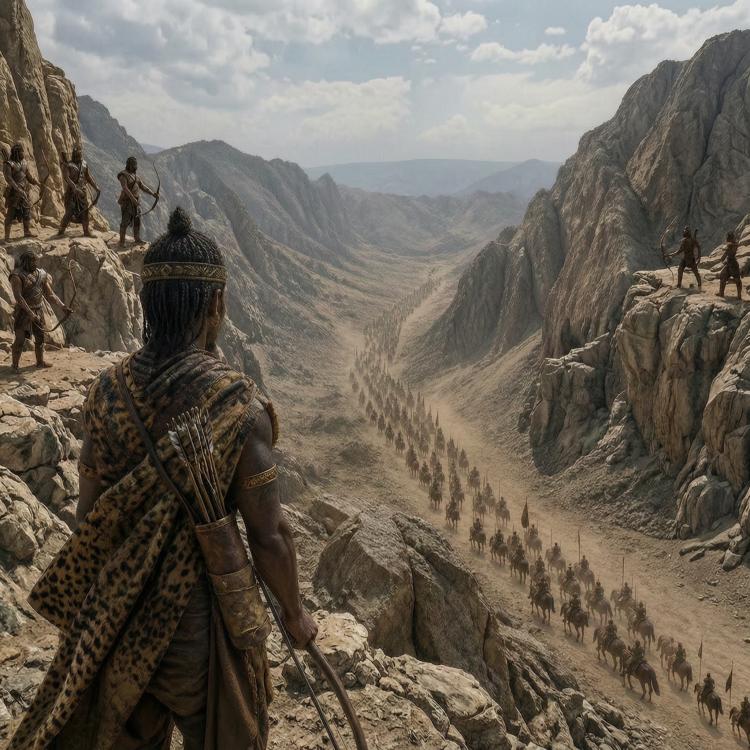
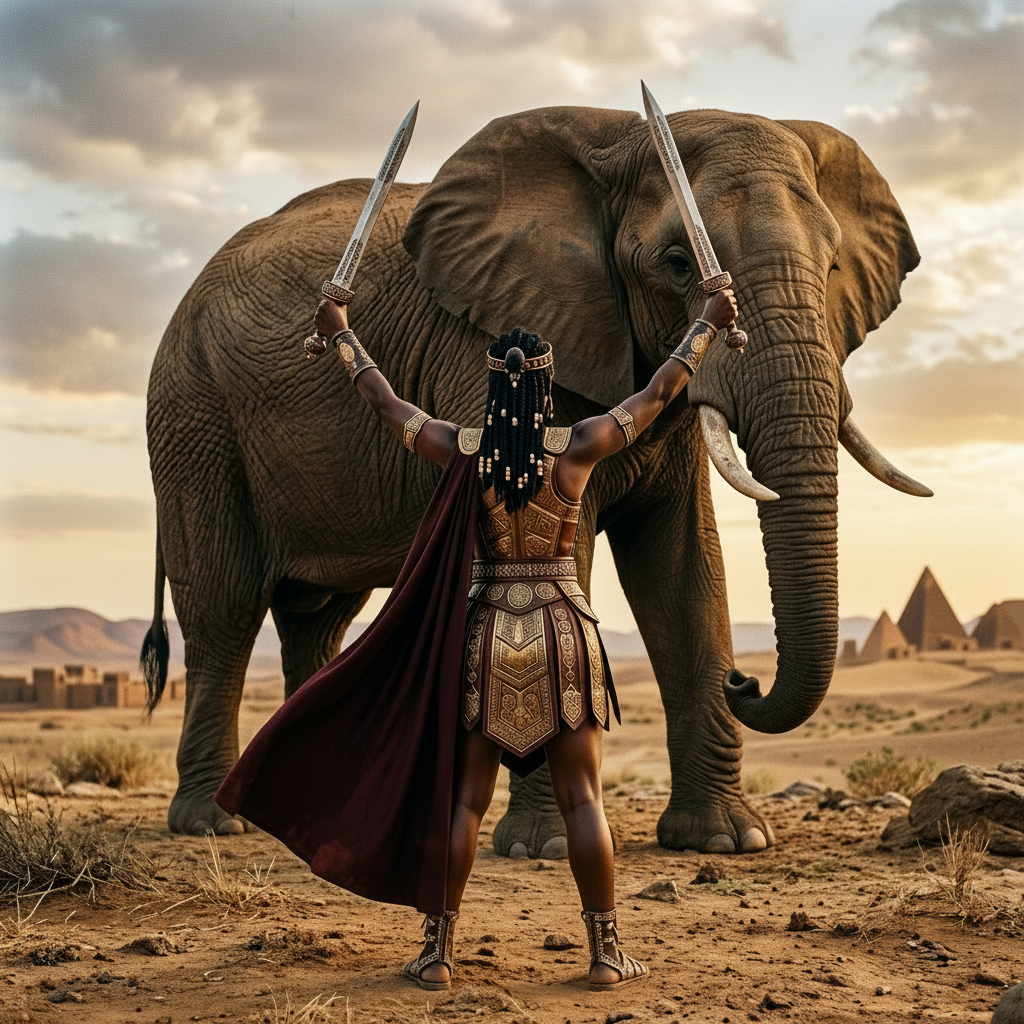
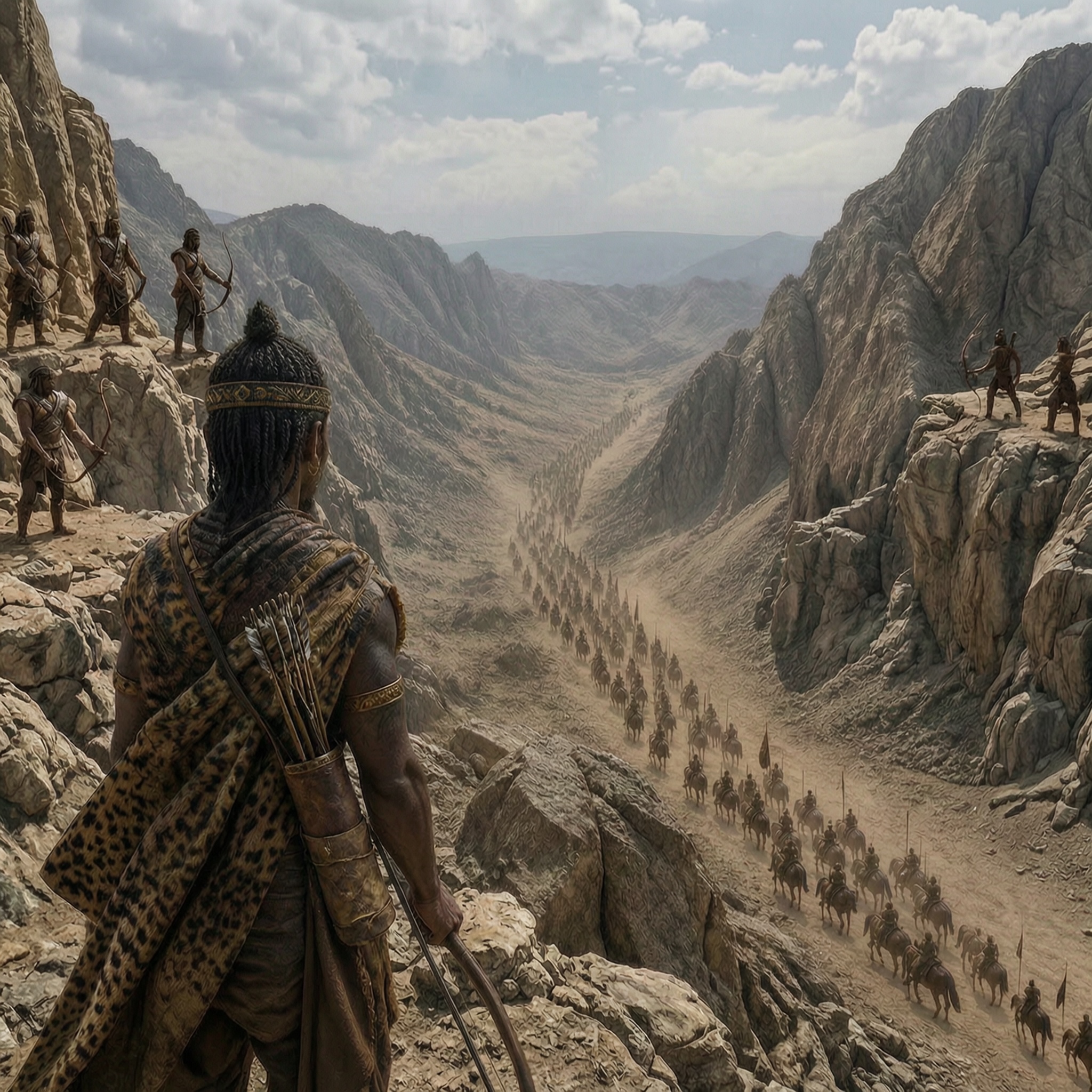
I just wanted to say THANK YOU for this thread. I have been creating some content (yes via AI, sorry) for a story I am writing about Amanirenas. Here she is with a matriarch elephant she will use in her calvary, and a Kushite Mercenary Archer force overlooking a Parthian calvary in the passes of Syria.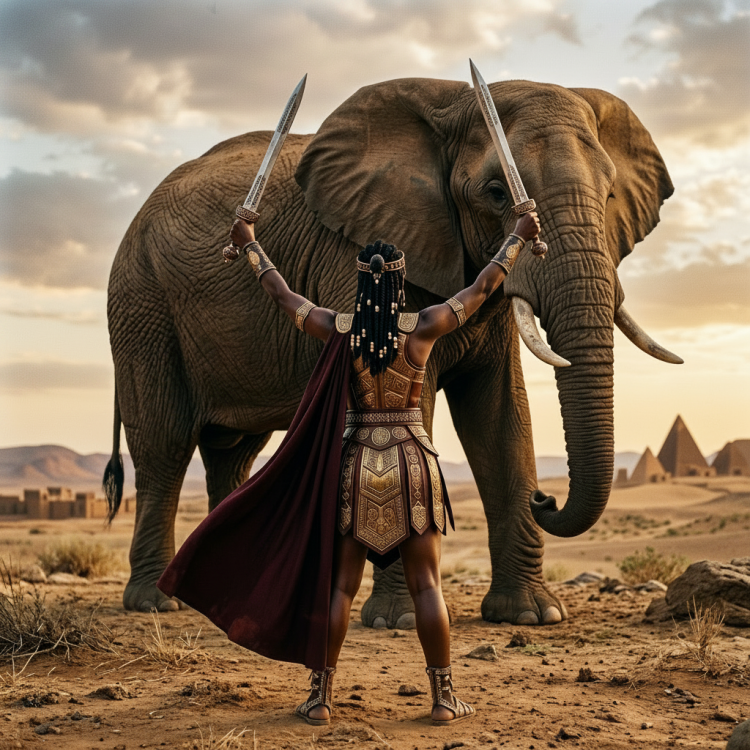
-
I’ve already written on historical shield and armor changes in Thoughts on the Spartans. “your unit starts off with "no armor" just a shield and weapon... and then you decide which ones you want to give which units, at a loss of speed”: we’ve already talked extensively about armor evolution, so it should be beyond clear to you that, from an historical standpoint, this just makes no sense, at all, and what happened was closer to the opposite of this.
-
If you find someone let us know Well, if you are familiar with 3D video for instance in Blender then the learning curve exists but isn't to steep either, no new concepts, just a new tool. The scripting part for making things lively might be the hardest.
-
Ardashir I: progenitor of the Sasanian dynasty, reinvigorated the idea of a Persian empire as a successor of Achaemenid Persia. May have an aura or tech about adding vigor to the civ, for example increases building construction speed. Maybe enables Immortals (Zhayedan). Shapur I: tolerance for religions other than the prevailing Zoroastrianism such as Manichaeism or Judaism may present an interesting opportunity. Especially Manichaeism as a potential world religion in a what-if scenario perhaps? May give increased influence over the map such as increased territory bonus. Maybe also enable some Armenian unit via his conquest of Armenia and governorship of his son and successor. Shapur II: counter to Shapur I, something about religious doctrine, such as stronger priests or temples? Also enables or strengthens war elephants. See the references in this article for reference: https://www.iranicaonline.org/articles/elephant-ii-sasanian-army/ Khosrow I: tax reform giving increased resources per resource obtained from sources, and bonuses to noble Aswaran cavalry. See: https://www.iranicaonline.org/articles/kosrow-1-parent/kosrow-i-ii-reforms/ Khosrow II: not sure, he appears to be partly responsible to bring the empire down? Why not something to represent quick expansion and loss, such as globally reducing building capture, or to make it a bonus, reduce own building capture and while reducing capturing enemy building even more.
-
Bildschirmaufnahme 2026-06-05 113133.mp4 I could add a person (or a donkey?) pushing the grindstone in a circle? Or maybe that's too much (performance wise and visually)? I can take a look into it. The han forge has something similar where we can get some inspiration.
-
 Okay, but what changes in DE would make that happen? I'm at a loss.
 -
Athenian Olives
wowgetoffyourcellphone replied to Thorfinn the Shallow Minded's topic in Gameplay Discussion
Nice. Which part are you animating? The grindstone? I wonder of you'd be willing to help animate the Sasanian farmstead. It has two sail-driven grindstones. Perhaps as with the forge smoke, the sails can turn when the farmstead is researching (rule of cool). -
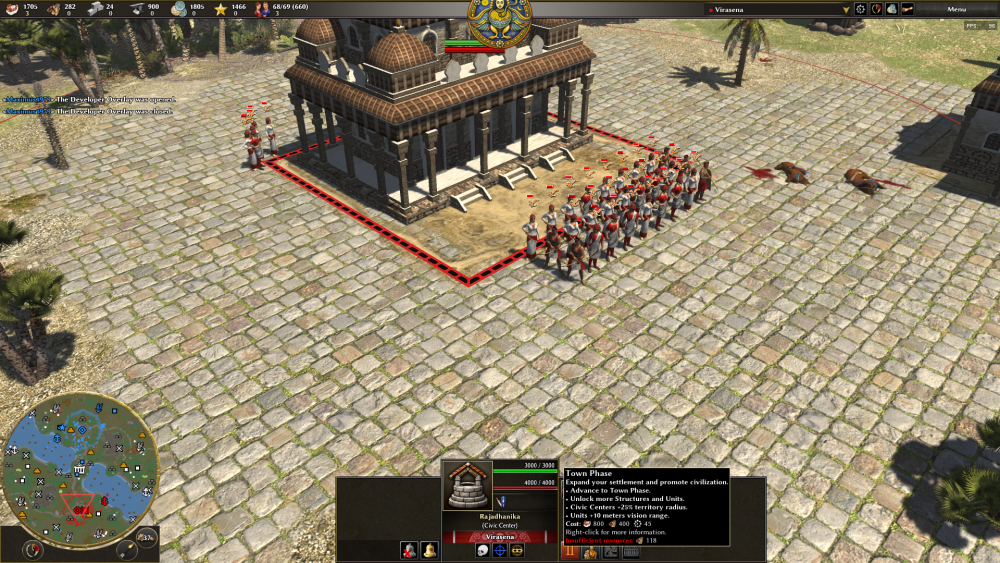
I fixed a few refs in research manager and had a match vs AI where their units didn't go idle. I'll attempt some more test matches tonight. EDIT: Nevermind. Still happening: I see they have plenty of food, but have stopped gathering the wood needed for phase-up for some reason.
-
You kinda could. They way I invivision it is a low kit unit would have the same actor for all 3 ranks…. Then if you get a tech for spearman increased body armor say, all spearman would “promote” they would have to go back to rank 1, but then the “new” unit would have a new actor…. So you may need 9 templates just for that civ’s units if you have 3 “kit” upgrades.
- Last week
-
Classical Warfare AEA
wowgetoffyourcellphone replied to ClassicalWarFareAEA's topic in Game Modification
Sadly, we can't currently only change props from techs, we can only swap in a whole unit actor. So, the best you could do is "levels" of gear, like "Basic Kit" -> "Medium Armor" -> "Heavy Panoply", which is fine and can definitely work. Then attack could increase by ranking. -

Increase Max Gatherers for 'Small' Ruins #8945
Atrik replied to Baelish's topic in Applications and Contributions
Best would be to add a poll to the thread @Baelish -
 For the context, please read https://gitea.wildfiregames.com/0ad/0ad/issues/8599. I want to explain why I choose 5 gatherers for small ruins. Many entities inherit from template_gaia_ruins.xml, with different amount of stone and metal. I will do a summary of them: STONE stone_statues_kushite_bird, stone_statues_kushite_lion, stone_statues_kushite_ram 200 standing_stone, stone_statues_egyptian, stone_statues_kushite, stone_statues_roman, stone_structure_small 300 stone_column_roman 400 column_doric, roman_rostrum, stone_statues_persian_lamassu, stone_structure_farmstead, stone_structure_house, stone_structure_tower 500 METAL metal_statue_discobolus, metal_statue_poseidon 400 metal_statue_apollo, metal_statue_isis, metal_statue_wolf 800 As reference a small cut of rock has 1000 of stone and 12 gatherers, so I thought that would be a good deal to set 5 gatherers for something that has around 400
 -
may even take it a step further, custCWA chart - Sheet10.pdfomize the weapons too (not the graphics though, just the stats, length, speed etc) based on this chart, if you find it fairly accurate.
-
correct, and all ranking up does for you is give you a little bit more health and a little bit more melee attack or range accuarcy.
-
If i remember correctly, Age of Mythology had this, and it looked pretty well. So ranking up does not impact visually except the rank icon right?








-
Latest Topics
-