All Activity
- Past hour
-

3D Modeler and Texture artist Application - Emma Anufrij
Emma replied to Emma's topic in Applications and Contributions
@nifa sounds great At the moment I am doing some tests to get familiar with importing models and textures and so on. - Today
-
See this lexicum : https://awb.saw-leipzig.de/?sigle=AWB&lemid=D01106 It seems clear in the case of Old High German that farmstead and farmland are the first meaning. And it is even clearer that Old High German retained different meaning and different expression related to this root suggesting a general shift from the singular to the collection. The direction of the change is obviously from a singular farmstead to a collection. The entry breaks down the definition into four distinct historical layers: 1. The Estate or Farmstead (Hof, Landgut) In this earliest sense, thorf refers to private property—essentially a "manor" or a "ranch." a) The Reluctant Guest: One citation describes a man excusing himself from a banquet: "thorph coufta ih... inti gisehen iz" ("I bought a farm/estate... and I must go see it"). This uses the Latin villam as a reference, meaning a private country estate. b) The Prodigal Son: In the famous biblical parable, the master "santa inan in sin thorf, thaz her fuotriti suuin" ("sent him to his farm/estate to feed pigs"). Here, the thorf is clearly a specific agricultural property owned by an individual. 2. The Village or Rural Settlement (Siedlung) This is where the word starts to describe a collection of houses, often defined by what it isn't (i.e., it isn't a fortified city). a) The Unwalled Town: The text defines dorf as a "vicus"—a place that has streets but "sine muris" ("without walls"). b) The Contrast with Cities: One example says, "manige uuesen in demo dorf, unmanige in dero burg" ("many people are in the village, but few are in the [fortified] city"). This shows dorf becoming a category of settlement size. c) Specific Locations: The text mentions "thaz thorf thaz dar giquetan ist Gethsemani" ("the village that is called Gethsemane"). 3. The Neighborhood or Quarter (Stadtviertel) This is a more niche use where thorf describes sections of a larger urban area, often in the plural (thorphun). a) Public Display: A warning against hypocrisy: "so thie lihhazara tuont in dingun inti in thorphun" ("as the hypocrites do in the assemblies and in the [streets/neighborhoods]"). Here, it translates the Late Latin vicos, meaning the public blocks or quarters of a town where people gather. 4. The "Crowd" or "Peasantry" (Menge von Bauern) This is the most "abstract" evolution. The word for the place starts being used to describe the type of people found there. a) The Rustic Multitude: One entry notes a scribe used dorf to translate rusticam manum ("a rustic hand" or "a crowd of country-folk"). b) The "Village-Dweller": The text even mentions a derivative: uillanus dorphere (literally a "villager" or "peasant"), showing how the word was used to build new social categories. Old High German retained the direction of this change in various ways. There is no doubt about that. The Gothic Bible uses the word haims to translate the Greek kōmē (village). Place names ending in -heim (in Germany) and -ham (in England) appeared frequently during the Migration Period (5th-6th centuries). There are also runic inscriptions that make more sense if the root is interpreted as meaning village or community. At least the shift looks more ancient. The codex Abrogans is a glossary, for example it is simply written the equivalence between 'uilla' (villa) and 'thorf'.
-
 SarahCarrasco joined the community
 -
@Genava55 The Codex Abrogans is from the 8th century. I shortened “villa worker” to “villager”, maybe changing the exact meaning, but the point remains that these things happened, even when they are later examples. I’m just trying to make sense of what the dictionaries actually say. Another issue could be how big these settlements are in context. You say the original meaning is farmstead, but what if a very small collection of farmsteads is also valid? At Proto-Germanic times this would have been the equivalent of a village (again, there has to be a reason why this has been reconstructed as such, besides commonality), and what meaning exactly had on the different branching languages could have turned out to be quite arbitrary and relative, Gothic could have retained a more farmstead position, while all the others considered the increased demographics. And related to this, coming back to the very beginning, what does say that þurpą has to be smaller than haimaz, which is primarily reconstructed as home? Maybe you can quote the relevant passages from the Codex Argenteus and Abrogans.
-
Again, as I said, in Codex Abrogans the meaning leans more towards a farmstead for Old High German. It is only later that the semantic shift happens for this branch. Your example with 'villain' is not correct. 'Villanus' doesn't mean 'villager' nor is equivalent for 'villager'. A villanus is a peasant or a worker in a farm estate, a villa rustica in the Roman perception. 'Village' is a semantic shift appearing much later during the medieval period and once again in the same direction: from a single farmstead to a collection of farmsteads. Villanus means 'villager' only in Middle English after a borrowing from French, where the semantic shift already happened. I don't see anything convincing for the moment to change my opinion.
-
@Genava55 But Euler’s work comes after Ringe’s. Downgrading happens particularly with things perceived as "less than": ‘villain‘ comes from Latin ‘villanus‘, meaning ‘villager‘ (which would give credence to ‘village‘ being downgraded to ‘farmstead‘ and not the other way around), or ‘sinister‘, coming from Latin ‘left-handed‘, obvious for Italian speakers. So, what happened? A downgrading for Gothic or a collection for West and North Germanic languages? Even if Gothic was the more conservative, a consensus considering many other variables was reached and written down in Proto-Germanic dictionaries. If we grab a time machine we might find out that this was the wrong call, but it wouldn’t be an error on our part, but the academic consensus, and what can one really do about that but guess.
-
 nssgfm joined the community
 - Yesterday
-
Euler and Maurer are certainly respected, but they represent the 'divergence' school of the mid-20th century. Modern computational phylogenetics (like the Ringe work I cited) suggests a much tighter 'Germanic Core' than Maurer’s 1940s theories allowed for. Regarding the 'Elephant in the Room': Gothic is likely conservative because of the direction of semantic change. It is a documented linguistic trend for words describing land or enclosures to expand into words for settlements (think of English 'Town' from *tuną 'fence/enclosure'). It is almost unheard of for a word meaning 'village' to suddenly be downgraded to mean 'dirt field' in a single branch. As for why dictionaries list it as 'village': Dictionaries are tools of commonality. Since the West and North Germanic branches (which cover 90% of our surviving texts) use 'village,' dictionaries list that for the sake of the user. But if you look at the etymological root *treb-, the meaning is clearly 'to build' or 'a dwelling.' A village is a collection of dwellings; a farmstead is a single dwelling. Gothic, being the earliest snapshot we have, simply catches the word before the 'collection' phase took over the West Germanic dialects.
-
Is there a mod to change it back? and if yes, how do you install it?
-
3D Modeler and Texture artist Application - Emma Anufrij
nifa replied to Emma's topic in Applications and Contributions
Maybe a new olive tree is something you would be interested in? There's already one in the game that you could use as a reference. We could use it for an ochard and for the erechtheion and the olive mill. https://wildfiregames.com/forum/topic/138517-erechtheion https://wildfiregames.com/forum/topic/125638-athenian-olives -
 deliriu0m joined the community
 -
The difference between the Persian women in the game & in the reality
deliriu0m replied to shiraz's topic in Help & Feedback
These are Zoroastrian priests or Magi depicted on the reliefs of Persepolis from the Achaemenid empire. These are not women. -
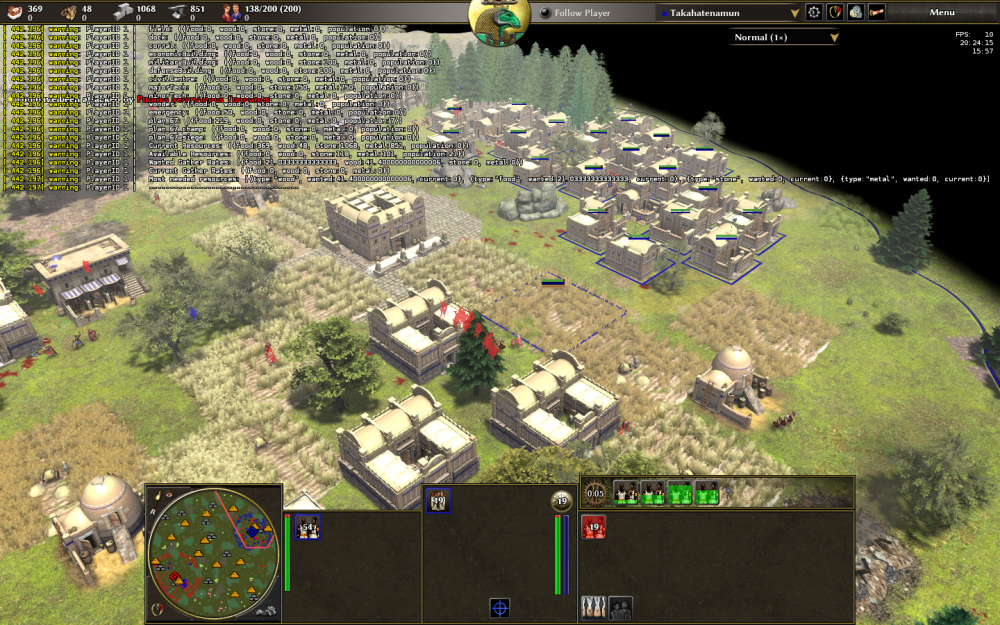
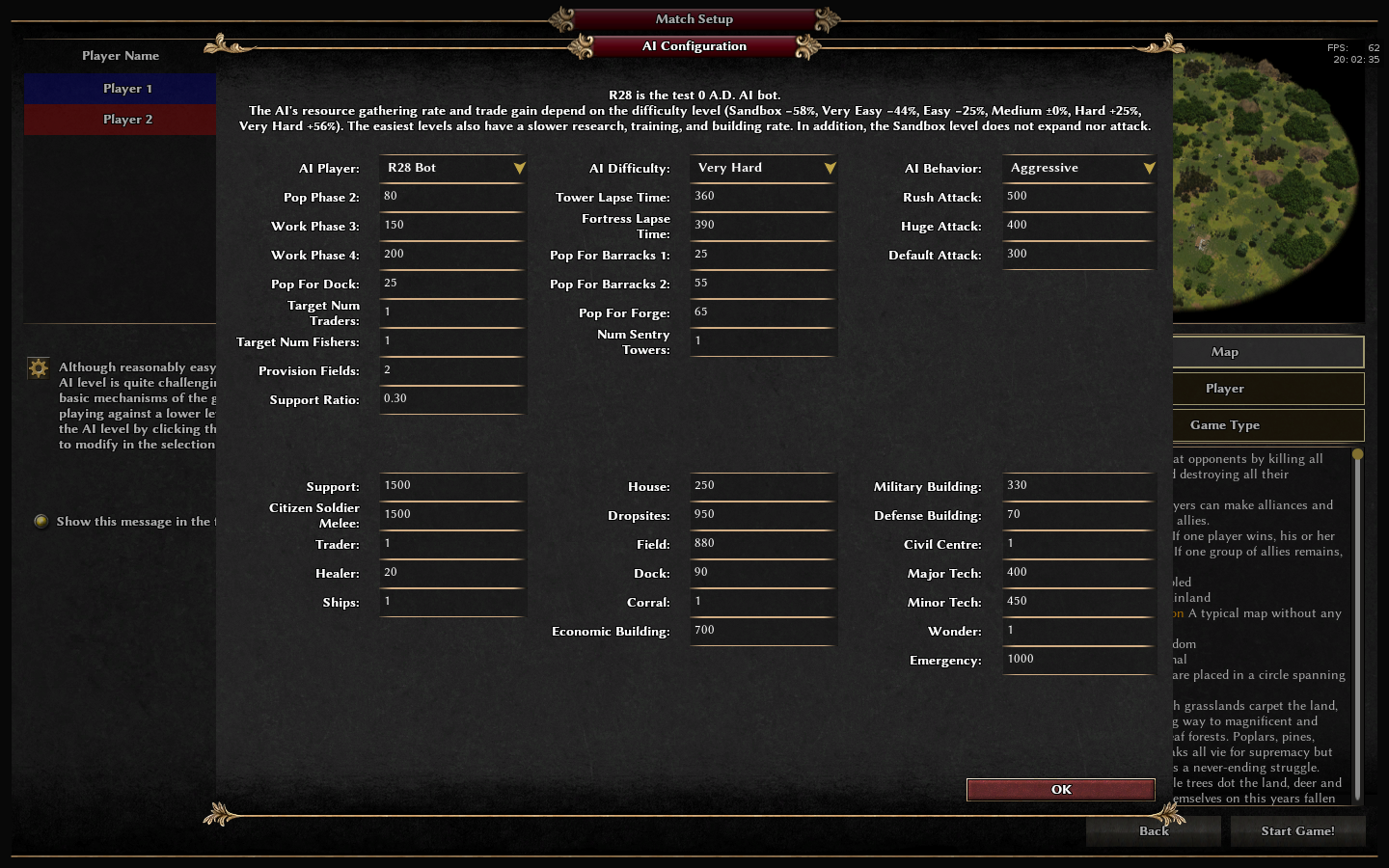
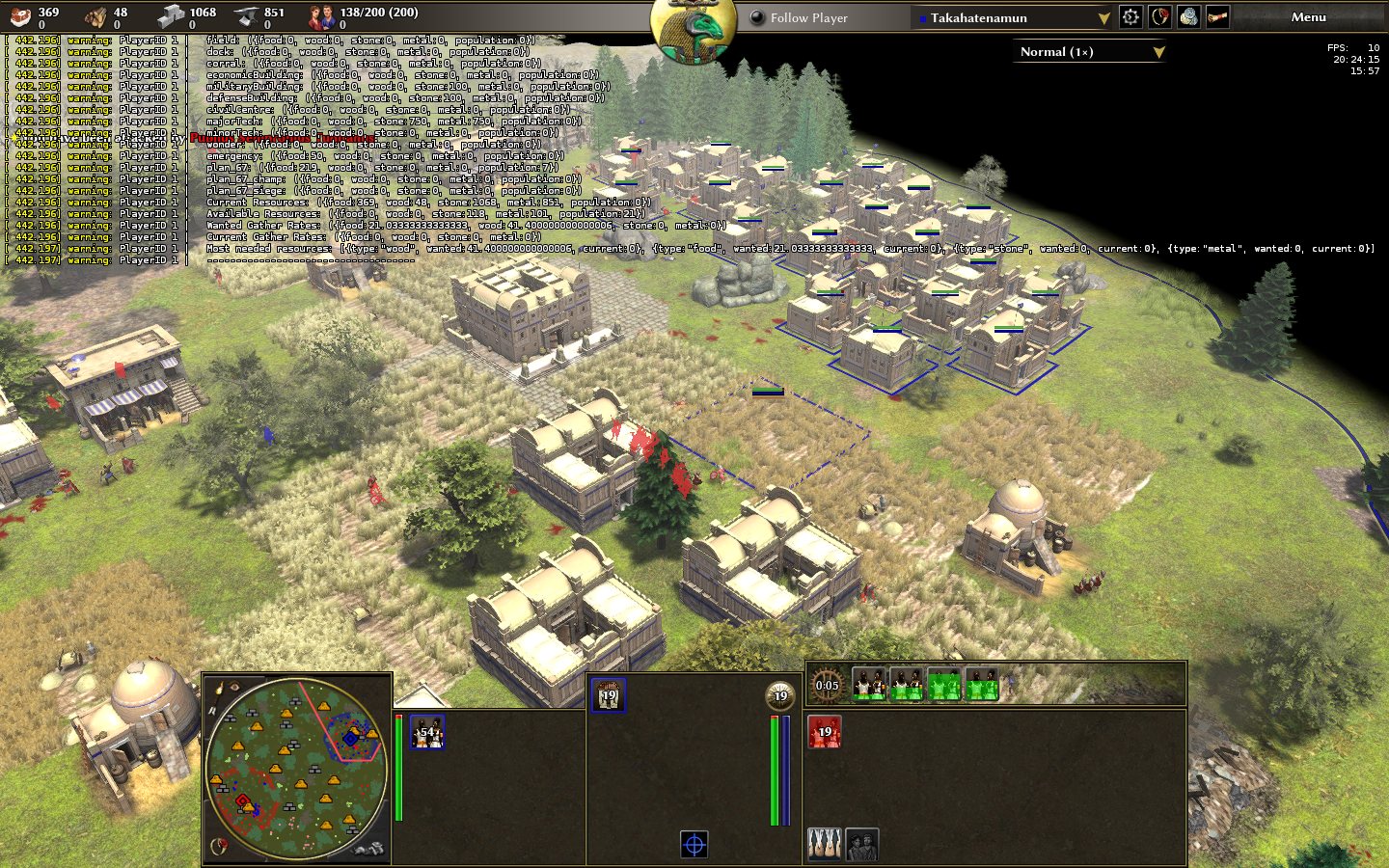
 Early access for players testing versions R28 or R29 of the game. It's basically Petra, but with customization options and for game >= R28. Some features from Petra_Expert have been added. Added the ability to customize the bot before starting the game. Values are not saved when exiting the game or returning to the previous menu. More detailed description of parameters: Added the ability to recruit support units from houses. The number of barracks has been increased to 5. The Research Manager has been slightly redesigned (instead of searching for technologies in a cycle, all technologies are stored in the cache and selected by a direct key: name or modifier by 1 step, the cache is updated when moving to the next phase or after the construction of a building is completed). Technologies from the Storehouse, Forge, and Champions remain in place, while the rest are currently disabled. With certain settings, the bot can reach up to 200 units in 11-12 minutes of play. Mod support: r28-bot.zip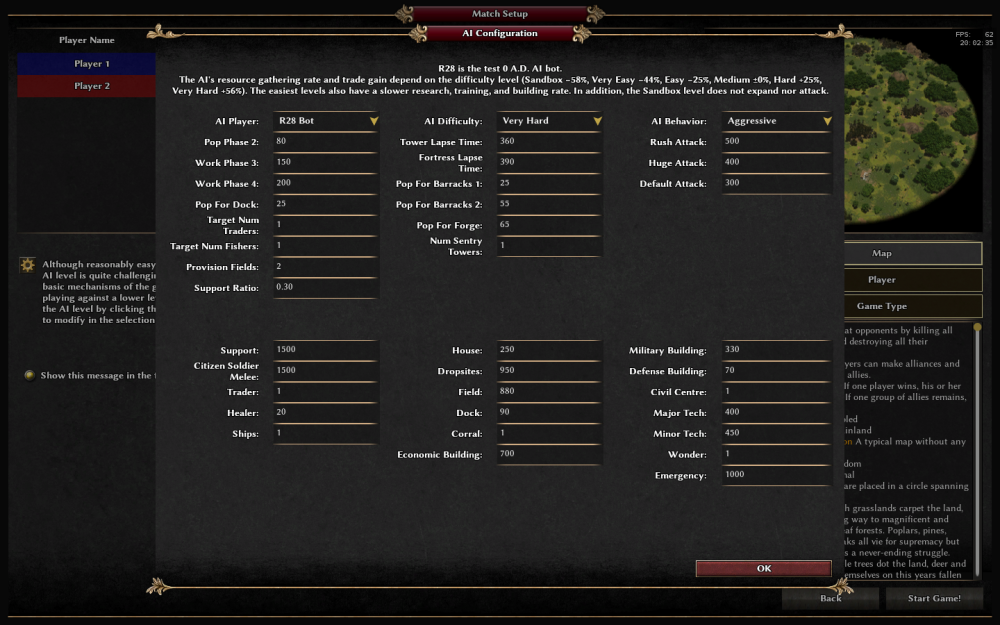
-
@Genava55 those books are over 20 years old (almost 40 in the first case), studies now support the notion that they were mutually unintelligible, for example linguist Wolfram Euler’s (curiously, yes, related to the famous mathematician) Das Westgermanische summary, https://www.verlag-inspiration.de/euler-das-westgermanische, already states “by the time of the Gothic translation of the Bible, Western and Eastern Germanic were already so dissimilar that Gothic and for example Frankish people could not have held a fluent conversation”. He got his PhD in 1979 but maybe you can send him an email stating that his work is BS anyway :P. Philologist Friedrich Maurer states that Old English, Old Dutch, Old Saxon, Old Frisian and Old High German (which has the word dorf) were already quite different early on, instead of just branching off from a common Proto-West Germanic, and for all those languages the meaning is village. In any case, even if we are dealing with scholars not agreeing among themselves (and we can cite their books ad infinitum), the elephant in the room is still the same: why not to think that Gothic was the one that suffered the semantic shift? And, more importantly, why has þurpą been reconstructed in PGmc dictionaries as village? (https://kaikki.org/dictionary/Proto-Germanic/meaning/%C3%BE/%C3%BEu/%C3%BEurp%C4%85.html).
-
I don't see it that way. It is mainly Old Saxon and Old Norse from the 8th century that show this semantic shift, while Old High German shows an interpretation closer to that of Gothic. And languages do not always diverge abruptly; Germanic languages continued to interact for a very long time, and certain semantic shifts can become popular in one language or another depending on the context of the time. And your claim that Gothic was already unintelligible to West and North Germanic languages is BS. I can suggest you the following readings: Hans Frede Nielsen: The Germanic Languages: Origins and Early Dialectal Interrelations (1989). He explicitly argues against early, sharp divisions. Don Ringe: From Proto-Indo-European to Proto-Germanic (2006). He supports a rather slow and gradual divergence and considers Gothic to be very close to Proto-Germanic as it has been reconstructed. This is the "gold standard" for the timeline of Germanic divergence. The Cambridge Handbook of Germanic Linguistics: Specifically chapters on "Proto-Germanic" and "Early Runic," which describe the 1st–3rd centuries as a period of relative linguistic unity.
-
@Genava55 but þurpą has been reconstructed as village because many other languages that come from Proto-Germanic have been studied and that was the conclusion reached. Gothic is an example of East Germanic languages, which were already unintelligible to West and North Germanic languages by around 200 AD, and for almost all of them the meaning is village, þorp in Old Norse for example. That Gothic is the "earliest Germanic language with significant information" doesn't mean it is the one that kept the original meaning, this would imply that all the others changed, even when they split before the time of the Codex Argenteus.
-
In some cases by mistake, for example if you press A and there are more than one player that the nickname starts with that letter, and you did it fast, I have seen it happen a couple times
-
Beware that a reconstruction doesn't really determinate its meaning. The meaning is generally deduced from the descending languages inheriting the root. A reconstruction generally means we have no evidence for this word in Proto-Germanic, we are relying on later evidence from descending languages. The Gothic language is well documented from the 4th century AD onwards. That's the earliest Germanic language with significant information. Most of the other Germanic languages are really documented from the 8th century AD only. The usage and meaning of certain words can have changed significantly between two Germanic languages simply because of the time that has passed. For example the word *þurpą became þaurp in Gothic, which means farmland or farmstead, since it is used in the Gothic bible to translate the word agrós. In Old High German, the word became thorp and it seems it is used in the Codex Abrogans (8th century AD) to translate the Latin vicus or villa, not in a large village meaning but more as a farmstead. But in Old Saxon, it seems the word changed its meaning and became used to designate a hamlet or a village.
-

Initial AppImages available for testing
fabio replied to hyperion's topic in Game Development & Technical Discussion
It works fine for me. I just had a minor issue, a "Invalid header" warning I reported here: Strangerly it no longer happens. -
Warją could be used for the fortress, it means fortification (also embankment or dam), and it's the root of the German "Wehr", meaning defence.
-
Thanks. I made a PR and went with "þurpą" -> "Wīhsą" -> "Burgz". "Haimaz" is also the root of the German "Heim" (which basically means home), that's why I decided against it in the end. "Burgz" is already used for the Germanic fortress, but that's not a problem, since that's the case for some other civs too already. https://gitea.wildfiregames.com/0ad/0ad/pulls/8722
-
Maybe wīhsą could be written like that. There’s also þurpą (the root of thorp and German Dorf), and alhs can also mean settlement. I’m not sure what would be the size ordering for all these and haimaz, which sounds too much like home for me, but it apparently did mean village also.
-
Yeah, it helps to remember why one banned him in the first place.
- 481 replies
-
- 2
-

-
- hotkeys
- autoassign civ
- (and 9 more)
-

Initial AppImages available for testing
guerringuerrin replied to hyperion's topic in Game Development & Technical Discussion
@diagonalo check this thread. I think this is the right one -
 newtoki joined the community
 -

Initial AppImages available for testing
diagonalo replied to hyperion's topic in Game Development & Technical Discussion
I wasn't aware of that from the title, thanks for clarifying. -

Initial AppImages available for testing
hyperion replied to hyperion's topic in Game Development & Technical Discussion
@diagonalo, this thread is about the AppImage only, anything that isn't related this obviously please take elsewhere where it is in context. -
Initial AppImages available for testing
diagonalo replied to hyperion's topic in Game Development & Technical Discussion
Hi, I and several others including @Arup tried rc2 and rc3 in a handful of games. I don't think much has changed on the user facing part since when I had a first look when I got aware of the branch about half a year ago. Do we know how many of the balancing advisors and "player-testers" if those do exist made TGs in the rcs like there were before the others alphas ? The Germans are quite cool but we noticed some balance issues (1 severe one is fixed now). Unfortunately there likely won't be any changes before release because "strings ought not to be changed" anymore. Even if the last commits I can see do exactly that ... https://gitea.wildfiregames.com/0ad/0ad/issues/8694 The game is otherwise looking stable from what I can tell. I will download rc4 now and I expect it to be similarly stable. -

Initial AppImages available for testing
berndinger replied to hyperion's topic in Game Development & Technical Discussion
Hi, I tried rc3. Just noticed there is a rc4. I will install it now... With rc3, there are no problems, as far i noticed. (I play wiith random gigantic maps) cheers, Bernd
.thumb.jpg.b21ca1d0c15fb56b42c39b25a0a40815.jpg)







-
Latest Topics
-