
All Activity
- Past hour
-
Just in case, I meant when taking a screenshot. For the player to constantly see it could be optional.
-
 And then after the wooden one is done, maybe remove the tiled rooftop from the skene of the 'stone' theater? Make it a flat roof (with a small lip around the edge) with a trap door on top and a crane? So, keep the U shape of the skene, but remove the angled tiled roof. We can keep the tiled actor to give to the Seleucids and Ptolemies or something, while Athenians get the new flat-roofed+crane version.
 -
Sorry if I overloaded something, I uploaded the files a couple of times trying to find out the problem
-
Is the mod structure supposed to be like this: modname.zip --mod.json --modname.zip ----mod.json ----modfiles or: --modname.zip ----mod.json ----modfiles
-
Top Panel UI Opinion
wowgetoffyourcellphone replied to manowar's topic in Game Development & Technical Discussion
Right, if we really wanted it to, we could have the option to toggle off the logo, but the build info would always show up (no option to toggle off). -
Top Panel UI Opinion
wowgetoffyourcellphone replied to manowar's topic in Game Development & Technical Discussion
It would show up by default when taking a screenshot, but have a toggle to turn it off in the Options menu. - Today
-
Considering what @Stan` just said (I'm in the same page of wanting to know the version, particularly in a state of constant development), what about having the option of not to show the game's logo, but always show the version below it? I'm in favour of the rest of what you said.
-
Just to be clear, I'm not strictly against it. My point is that you can't assume how people will take screenshots. And so if the presence is conditional then it might not be here
-
That's cause all mods have to be signed prior to being visible and compatible. Each new version has to be signed.
-
 dlabreu joined the community
 -
Top Panel UI Opinion
wowgetoffyourcellphone replied to manowar's topic in Game Development & Technical Discussion
https://gitea.wildfiregames.com/0ad/0ad/issues/9171 I'd like to advocate some more for the About page and moving the build information there. If it's useful for screenshots to show the build info, then have it show up with the game's logo at the bottom right corner (currently Alt-K toggle, but it could be automatic for screenshots) when the screenshot's taken. Any chance to keep the HUD clean and organized I'd like to take it (within reason of course, which is why we're having this conversation). (Put it in the bottom right) *I'd actually like to have a new Options section for Screenshots (Show UI? Show Version? Target Folder, etc.) -
Guide for publishing mods on mod.io
wowgetoffyourcellphone replied to Itms's topic in Game Modification
What's the mod.json file look like? -
 Hi, I would like to thank everyone, I have never had so much collaboration for a project that was just a simple idea. I'll be honest with you, the biggest risk in this project is myself, and developing this campaign is going to be a marathon for me. The initial goal of this project is to introduce 0.AD and promote the game on various platforms. The aim is to develop projects for myself, should I ever be able to return to work. It's a way to stay active, as I've been on sick leave for three years. My request is : if anyone would like to design the maps for this campaign; that would be a huge help. Thank you!
 -
 That's nice, but it applies just to a couple of later Hellenistic theatres. After reading it I see that because of that chronological mix up I misinterpreted the parts of your theatre. In any case, I think what you've done could be useful if a later Spartan theatre is wanted (as I'll explain). Following chronological order: early theatre development is what I've already mentioned. My latest picture would be a nice point to represent developed wooden theatres. After that, "the logeion (stage) was raised higher and higher over time" (https://spac.or.jp/en/facilities/mmtheatron/text/01_greek_roman), resulting in the proskenion. Meaning, you weren't missing a stage, because you are showing a later theatre with the stage already raised, and what I called your episkenion is actually the skene. So, for an earlier wooden theatre, stick with my latest picture, and other comments, although there were many variations of them through Greece, obviously. Here a video showing (in general) this evolution, and concentrating more on the workings of this later phase: Athens' theatre became more monumental, and this is what's represented in the game. It seems Sparta, according to your link, followed another path, since they conclude: "the movable stage of Greek theatres was discovered in Messene and Sparta only; however, it might be too early to argue that the movable stage was a regional Peloponnesian phenomenon", and could be Roman inspired: "Recently, Spawforth advocated the Augustan dating of the Sparta theatre and explained the movable stage in connection with Roman theatrical devices". This means that the theatre you made would be the one Sparta had in Roman times. Because of that, I guess the present Sparta theatre will just be removed, which is good because it has another problem: it doesn't have a skene, but a temple, because someone found a theatre in Sparta looking like that, not realising that this was a Roman theatre built to see the bloody rituals at the temple of Arthemis Orthia (https://pausanias-footsteps.nl/regios/laconia/sparta/?lang=en), meaning that when one also builds the Spartan Wonder, the temple of Arthemis Orthia is actually appearing twice.
 -
I getting messages on my email supposedly from the forum, the title is like "apple river [something] crystal"
-
When I go into 0 A.D., and turn filter compatible mods off, then I see it. But, when I click on it, I get , and there is 0ad dependency version. How can I fix this?

-
^^
-
Narrative Campaign General Discussion?
lilypoppy replied to Lion.Kanzen's topic in Gameplay Discussion
Hi everyone, @Thalatta and I are working on a narrative campaign for 0 A.D. Burning Heart, about Viriathus and the Lusitanian resistance against Rome. If anyone wants to join or help out, it would be really appreciated! -
So, I published a new version for an active mod, and I went into 0 A.D., and it wasn't there. I then switched the file back to an old one, and it was there. Is this a problem on my end, or does it need to be verificated first?
-
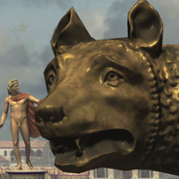
===[TASK]=== Wooden Theatron for the Spartans (and Thebans)
nifa replied to wowgetoffyourcellphone's topic in Official tasks
It's a drawing that I saw in book, but I just rediscovered it here on page 123: https://publications.dainst.org/journals/aa/article/download/1936/5967 -
Of course. I understand your frustration and your sense of injustice. The developers have gone in with a sledgehammer without warning, and they’re ignoring any prior discussion whilst criticising others for not discussing things beforehand. But we must also understand that they have their own reasons, and the only way to change their minds is through dialogue. In this situation, where you’re the one at a disadvantage, you need to be better than them. You also need to be convincing to the others who are reading your posts here.
-
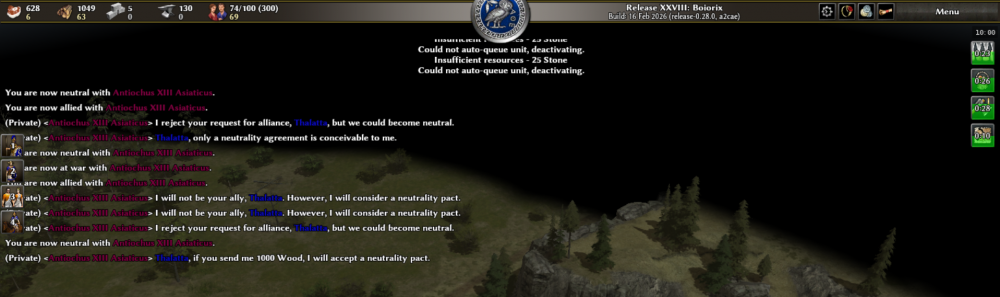
Agh, my bad, I forgot about those... Well, for starters, there are some things that are already quite suboptimal in vanilla: The upper left is reserved for system messages. There are so many things that could be fixed that I don't even know where to start, but to keep it simple right now, I would place those tech icons lower, at the same level as the group icons on the left, and with the same separation. Then you would have space for your notifications.
-
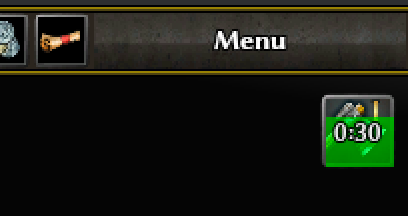
You don't have these tech research progress indicators ?
-
How would it look exactly with deactivated unit colouring? I wonder if that would become too noticeable. An alternative I proposed is that "the enemy would see as its own", but of course not control, and it could be attacked as any enemy. Regarding "sounds more like scouting and less than spying", limited speed and FOV would solve that, with a larger FOV reserved only for Heroes (from gossip and such).
-
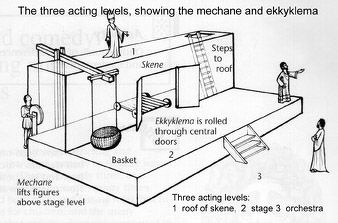
Can you share? More from the Oxford Classical Dictionary (previously I mentioned that "the stage was about a metre high with a flight of steps in the centre communicating with the orchestra"): "The stage was entered from either side (and some plays exploit the contrast), and from a central door in the stage building, representing palace, temple (and sometimes pavilion, tomb, or cave) in tragedy; for comedy, three doors are certain for the 4th cent., and were probably available in the 5th. The central door also housed the ekkykléma, a wheeled platform perhaps measuring c.2.5 1.5 m., and in any case large enough to display set-pieces of events that had taken place inside, like Ajax's torture and slaughtering of the animals in his tent in Sophocles's play Ajax. Towards the right (western) end of the stage area a crane (méchané, machina) could be manipulated from behind the stage building to bring gods or heroes through the air onto the stage, or to have them fly up from it, like Bellerophon on Pegasos in a scene of Euripides which Aristophanes parodies in Peace. The roof of the stage building was also accessible: it was used for the watchman on the roof in Aeschylus’ Agamemnon, but in later tragedy mostly for the appearance of gods. The contrast between the hidden interior of the stage building and the daylight outside, between the gods on high and the actors on stage, and between these and the chorus, half-way to the audience and virtually within its territory, are all physical facts which the playwrights exploited. It is possible that the stage building had wings already in the later 5th cent. but the evidence is uncertain. In the 4th cent. the most important development was the so-called Lycurgan theatre with its stone stage building faced with semi-columns." The most clarifying picture I could find: Then: -You can leave the episkenion (second skene level), it was present by the late 5th c. BC, but maybe modified to have space for a hatch and stairs. -You could add a small 1 m high stage with central stairs leading to the circular orchestra. Your three skene doors look too similar to panels. -Your stone semi-columns seem from the post-350 BC Lycurgan phase. By then, the seating would have been of stone also. I'd stick with wood. -You could leave the central door open to show the wheeled plataform. Maybe another door could be (partially) open, revealing clothes and masks. -That crane doesn't seem accurate (no counterweight), but there are plenty of options around, which would improve the rear skene looks. -I'm not really sure how the "interior" was used, seems a bit too hidden for me, maybe it's just that the stage has some shadow from the skene. EDIT: maybe the first row of seats could be made of stone, that was one of the first stone additions, and it was maybe present by the time there were three acting levels, after all "some think that there was no stage building till shortly before the Oresteia in 458 BC", at least using the Theatre of Dionysus at Athens as reference.




.thumb.jpg.b21ca1d0c15fb56b42c39b25a0a40815.jpg)


-
Latest Topics
-