

Thalatta
-
Posts
604 -
Joined
-
Last visited
-
Days Won
15
Everything posted by Thalatta
-
Interesting. It makes me wonder about the possibility of future terraforming: instead of trees needing to be cut for that, if workers could modify terrain level, for ditches and other uses, which reminds me of Morrison's statement in his Greek and Roman Oared Warships: "Agrippa cut channels to the Lucrine Lake to produce a large and safe inland harbour".
-
Seems like a bug to me. And I wonder how many other mod options have this issue.
-
I see there are some typo corrections, which reminds me I did propose some in More specifically (the first a typo, the last 3 mix up plural with singular): -Tyrtean Paeans -> Tyrtaean Paeans. -Perioikoi Hoplite -> Perioikos Hoplite. -Perioikoi Cavalryman -> Perioikos Cavalryman. -Skiritai Commando -> Skirites Commando. And the most necessary (upcoming) fixes regarding the Athenians: -In the civ description, “fell in 330 BC” should be “fell in 338 BC”: a mistake regarding the Battle of Chaeronea. -Catafalque names should be given in two lines: for the Athenian one I’m reading “THENIAN CATAFALQ” because it’s in one long line. Those given in two lines look much better, being kept inside their crest. The Germanic one is missing “Germanic”. Maybe these obvious things should be posted somewhere else? And why is this even posted as "Hidden"?
-
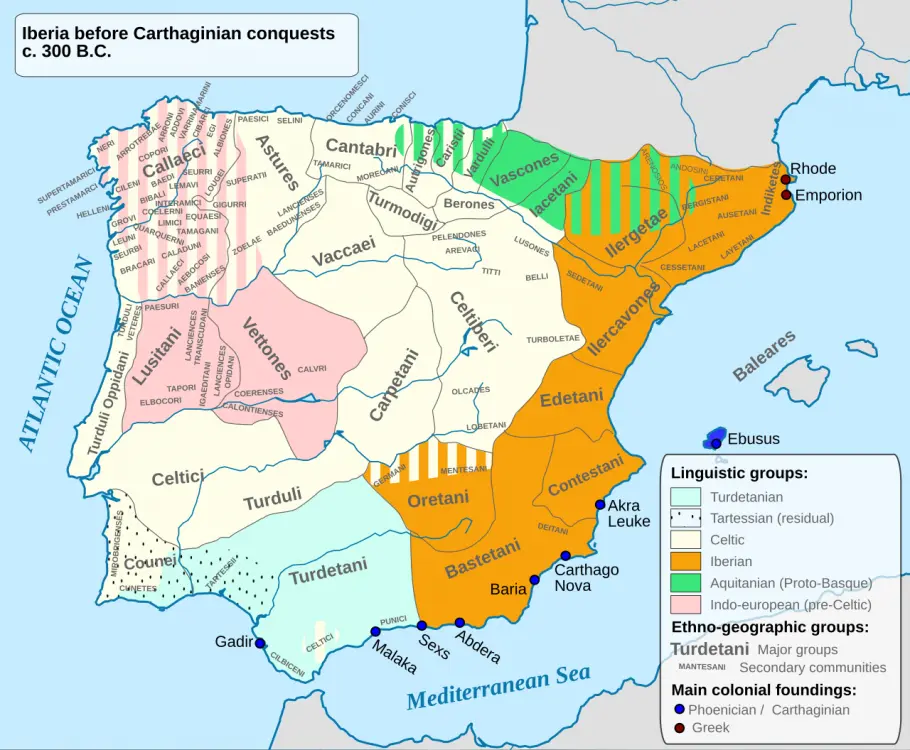
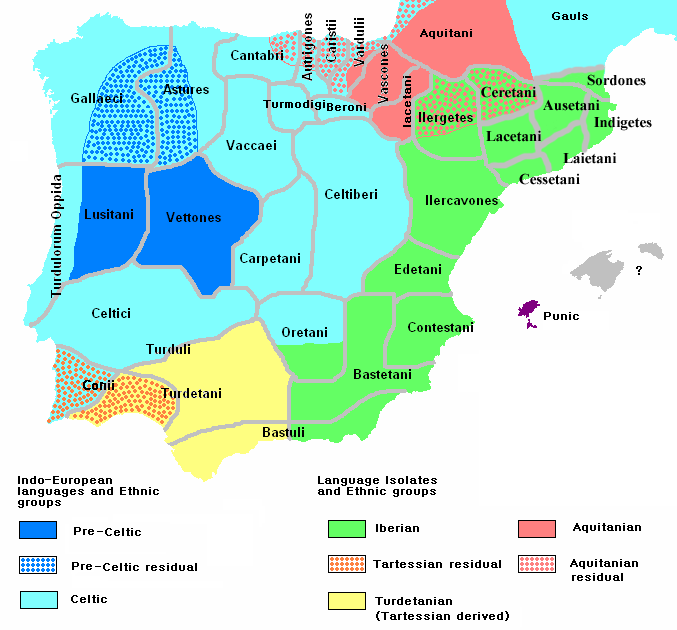
@lilypoppy, I'm not sure what's going on with that writing format, but it took me a lot of time to try to edit a quote, just to lose everything like 3 times just by doing CTRL+Z on text that wasn't even in the quote. Also, I wonder if you are tagging incorrectly, since I saw your post by chance, it doesn't appear in my notifications, and also I didn't see it under Unread Content, which is even weirder... Anyway, regarding potential allies, the source states that the Romans hired the Celtiberians (Belli and Titthi) against the Lusitanians, even after the death of Gaius Vetilius. It's later on that Viriathus detached them "from their allegiance to the Romans". I'd say first read all that's said there about Viriathus, and then think about how you want to organise the whole campaign. I wonder if you really have to limit yourself to just 3 scenarios. Also, the Vettones are pre-Celtic, like the Lusitanians (both were usually allies), thus not Celtiberians (although some claim otherwise, but doesn't seem the main view). All of them appear in this map (these things might not appear on ancient sources, you have to read modern texts also): EDIT: that map represents the situation 150 years before Viriathus, but 100 years later (200 BC) the situation was still quite similar:
-
My recommendation would then be to try to make it historically accurate. You can check Appian in https://www.livius.org/sources/content/appian/appian-the-spanish-wars, where Viriathus' story covers from §60 to §75. I can help you with the distillation and writing of information if you need that. You could for example paraphrase Livy (who didn't write a lot about him) by stating somewhere "From shepherd to hunter, from hunter to bandit, from bandit to leader".
-
Seems to me that units should have an ungarrisoning cooldown after garrisoning. This could also be used by Traders and Markets to avoid continuous horrid looking caravans.
-
Well, looks like the Mediterranean, which is not an ocean but a sea But what I had in mind is that "Celtic regions of northern Europe", "had been constructing ships in a manner very different", "to withstand the rigors of the northern climate, the sails were of hide and the anchor cables of chain". Thus, if some "oceanic" waters (meaning, choppier, which could even appear on the usual "sea" waters if there's a storm, if eventually added) were to be considered, the different types of ship could react differently to it.
-
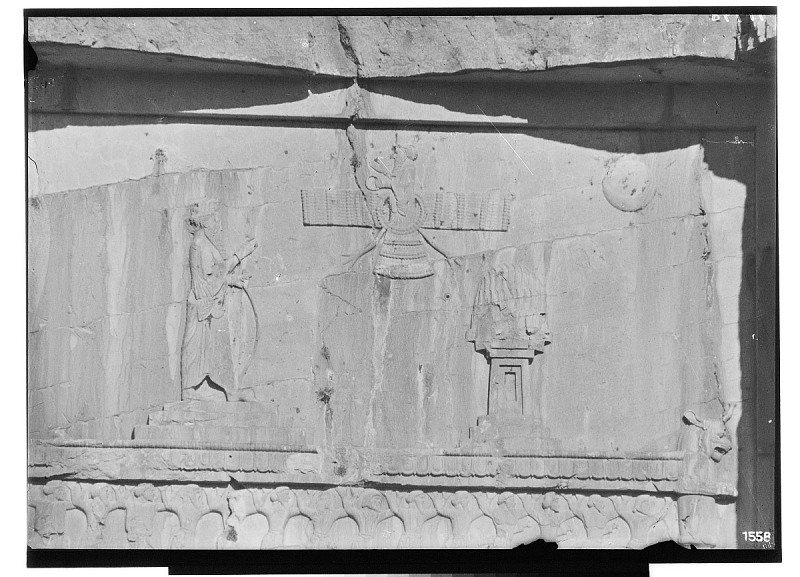
If the religion to be represented is Zoroastrianism, the fire-holder could look more like this (coinciding with the "three-stepped top and base" description given in https://www.iranicaonline.org/articles/achaemenid-religion): Sadly, it's not really known how Achaemenid temples looked like. Zoroastrian fire-holders seemed to be in the open, while, regarding some towers that were previously thought as temples, "the hypothesis positing a religious function for the tower-temples in the Urartian period is generally accepted, despite certain differences in the architectural environment of several of them; by contrast, the function of the two Achaemenid towers remains totally enigmatic. The only hypothesis that is not a matter of contention, as a result of both environment and architecture, is that of a deposit for objects, very probably of a royal and not a religious nature", from Studies on the Architecture and Archaeology of the Achaemenid Empire, by R. Dan. It is also thought that other religions were influential.
-
That would be hard, at most I know Schmitt has done plenty of work on the matter (https://www.iranicaonline.org/articles/scythian-language-2), but I doubt there's enough for all the words needed. But I didn't mean that, what I meant is alternatives for things like "Advanced Metallurgy", which is not clear to what it refers to, exactly. "Goldsmithing" comes from before, and many others had it, maybe I'd go with "Sophisticated Goldsmithing", referring to Stage 2 ("second half of the 6th to the first half of the 4th centuries BC") and Stage 3 ("mid-4th to 3rd centuries BC") Animal Style themes (just saying something like that would be too technical, but could be mentioned in its description). I'd call "Gorytos Bow-and-Quiver System" just "Gorytos", the rest is just part of the tech description, unnecessary for its title (at most adding "bow case"). You mention Goldsmithing as Market bonus, but in truth (from the book I mentioned) "what was traded and transported from the forest-steppe to the Greek colonies and possibly from there the Greek homeland is still an enigma, and thus any suggestion is (again) rather speculative. What is known more definitively is what was provided in return for these trade goods. Across temperate Europe and the Pontic forest-steppe and steppe, there was a growing demand for wine and Attic Greek drinking and serving equipment, including silver, gold, and black figured vessels, such as the rhyton and kylix. Nadezhda Gavrilyuk suggests that the wine trade with the inhabitants of the Pontic region, including the steppe and forest-steppe groups, was especially prolific and, as a result, highly profitable". So, wine was an import, not an export, that's why I'm not sure if to actually consider it for a tech. Regarding export speculation, slaves rank high in the time-frame of the game: https://antikmuseet.au.dk/fileadmin/www.antikmuseet.au.dk/Pontosfiler/BSS_1/BSS1_08_Gavriljuk.pdf. Honey seems to have been another export (https://www.cambridge.org/core/journals/classical-quarterly/article/abs/export-of-slaves-from-colchis/AF78278141AA9AA6877B702240B161F3), while grain is quite controversial, when comparing those links with https://www.iranicaonline.org/articles/black-sea.
-
Just checked again for buildings and organic units (since I did it only with ships before), and the answer is still no
-
Maybe it's getting better, I remember last year it would quote from non-existent sources. If you want you could have a look at the book "Masters of the Steppe, The Impact of the Scythians and Later Nomad Societies of Eurasia", it's a compendium of the latest research. I can't do it myself because I know me and I'll end up just reading every word... best would be if you just check the "Conclusions" subsections. There's a lot about goldsmithing, felt textiles, etc, which I see you have considered already (maybe more specific names could be thought about eventually, but that's not clear for me right now). Something that I couldn't find in that book though is the Enarei, transexual priestesses that could also be an opportunity for representation (for which there have been some archaeological discoveries also).
-
But also pretty anachronical as a tech being researched after 500 BC, I wonder why that even made it in the game
-
Just checked, and it doesn't seem so. I think you are confusing it with Self-Destroy for a building that has not been completely built yet. In that case I think the resources recouped are according to the unbuilt fraction, which makes perfect sense if one thinks of it as the resources having been set apart beforehand for construction, the resources already used being lost since Self-Destruct is (when not just a cancellation of plans) a fast destructive way to get rid of stuff (making things collapse or setting them on fire, maybe some graphics representing that would be nice, not so much for the suicide of organic units though...), quite different from salvaging.
-
I see. Well, things don't have to have "clearly defined steps", I just gave a guide. If those things more or less already happen on a continuous level, then it's like @Gurken Khan said and "there's everything in the game already", or mostly. It's just that it's not intuitive, and until which depth land units (or from which depth water units) can transverse water should be stated somewhere, or maybe the cursor could change when a destination is not allowed because of this, or whatever similar. Only choppier waters (oceanic, or during storms even) would seem missing from what I mentioned, which is not a big deal but a possibility.
-
Still some time remaining for my Athenian post, but in the meantime I'd advise against using the trident as a shield device, since that's very strongly associated with the Mantineans (actually, one of the best attested cases of an uniform shield device used by a city-state). On the other hand, "A" or "AΘΗ" have been found in representations, possibly used by some Athenians. If some "marine" symbology is wanted, an (ancient) anchor could be used, considering this particular case told by Herodotus: To this deme belonged Sophanes, who showed himself the best of all the Athenians in this battle; and of him there are two different stories told: one that he carried an anchor of iron bound by chains of bronze to the belt of his corslet; and this he threw whensoever he came up with the enemy, in order, they say, that the enemy when they came forth out of their ranks might not be able to move him from his place; and when a flight of his opponents took place, his plan was to take up the anchor first and then pursue after them. This story is reported thus; but the other of the stories, disputing the truth of that which has been told above, is reported as follows, namely that upon his shield, which was ever moving about and never remaining still, he bore an anchor as a device, and not one of iron bound to his corslet.
-
Indeed, "salvage" seems the correct option for this, which was obviously common, from reshaping metal tools (an advantage over stone ones) to reuse stone from many great wonders for new structures. Ships would be sunk to make the base for port extensions, and some think Archaic Greeks would turn over and raise their ships to build wooden temples, while the Rhodians dismantled and sold siege machines to finance the Colossus, since you mentioned them. I would implement this in reverse to their production: salvageable units should have a salvage button when garrisoned on the building that produced them (and take maybe the same as production time), while builders should be able to salvage structures (this working in reverse of building them). The return should be some fraction of the materials used in the first place (maybe except food). An independent thing could be the ability to sell certain units to other players, for metal.
-
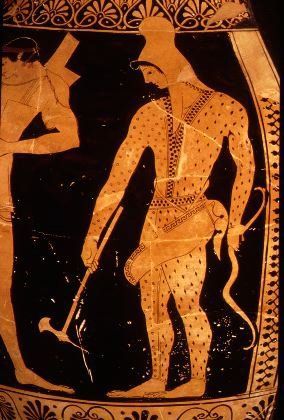
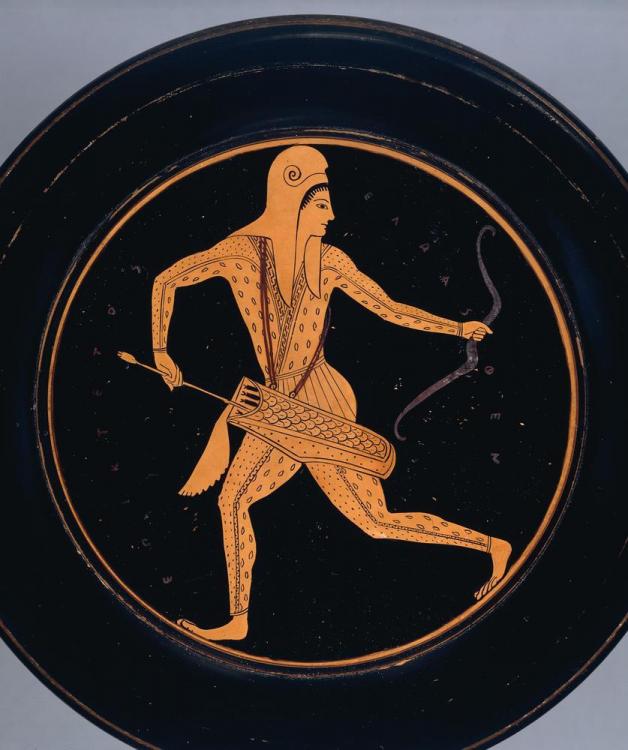
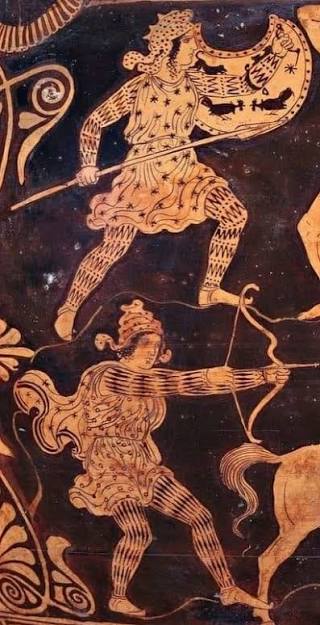
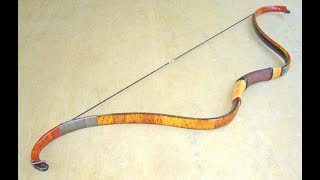
Something to improve should be that the Scythian bow is more characteristically curvy:
-
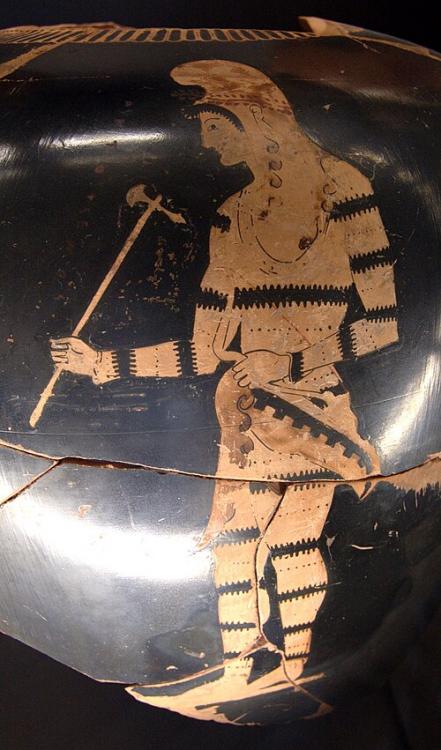
Well, Persians did use Scythian battle axes, or sagaris, so they would look similar, just not like that AI image, but way more slender: Here some discussion about it (and more representations): https://www.oeaw.ac.at/ifi/blog/detail/the-scythian-sagaris-single-or-double-bladed-axe. But I'm not sure where the idea of Hyrcanian Cavalry using the sagaris comes from, Herodotus states in his Histories that the "Hyrcanians were armed like the Persians", which coincides with https://alexander-the-great.org/warfare/hyrcanian-cavalry ("they typically used light armor, spears, and bows"), but maybe I've just not found the source from where this comes from. On the other hand (if a name different from "Scythian" wants to be used for some unit), Herodotus mentions that the Saka (closely related to the Scythians) did use the sagaris: "The Scaran (sic) Scythians had about their heads caps which were carried up to a point and set upright and stiff; and they wore trousers, and carried native bows and daggers, and besides this axes of the kind called sagaris. These were called Amyrgian Sacans, being in fact Scythians; for the Persians call all the Scythians Sacans". And, something interesting that some could have noticed in my first link: many representations show these warriors being women, the idea being that the Amazons were inspired by mounted female Scythian (and Saka, among others) warriors. According to Diodoros Siculus, "at that time the Sacae were ruled by a woman named Zarina, who was devoted to warfare and was in daring and efficiency by far the foremost of the women of the Sacae. Now this people, in general, have courageous women who share with their husbands the dangers of war". The archaeological evidence seems to support the existence of Scythian (and similar) female warriors, I think this being one of the clearest cases to increase their representation in this respect (if this has not been mentioned already in the 15 pages of this topic that indeed I have not read).
-
I just realised, even better would be for Emperors and Empresses (only) to upgrade to using an Imperial Carriage (which would be kind of slow). Some of its characteristics, taken from Records of the Grand Historian: "I have always been told that only the most distinguished men of the empire are privileged to ride with the Son of Heaven in his six-foot carriage", "Your Majesty proposes to gallop down a steep slope in a carriage drawn by six horses", "He then began to ride about in a carriage with a yellow top, decorated with plumes on the left side, and to call his orders “edicts” in imitation of the Han emperor, all of which was intended to show that he was an equal of the ruler of China".
-
I didn't pay attention to that part, but for Han Xin an obvious upgrade could be "Marquis of Huaiyin" then. For Emperor Wu you can't really go higher (and strictly, it's a mistake to use that, since that's the posthumous title, but whatever, it would be a headache otherwise), so I guess a mount would be fine, but, although a horse and hunting enthusiast, he probably never rode to battle (maybe Expansionism should be a Global Aura, and Builder a Ranged Aura instead, to keep him more "domestic", in opposition to others like Han Xin). And, although I'm not really focusing on the Han right now (still at least 600 pages to go for the Athenians, as I've said, things I do to myself), an obvious Unique Tech (or even Unique Building?) for the Han should be the Blast Furnace ("The oldest extant blast furnaces were built during the Han Dynasty", whose effectiveness was enhanced by Du Shi in 31 AD using bellows operated by waterwheels, helping mass produce cast iron, which was already known in China, but unknown in Europe until Medieval times). It could speed up Forge techs and soldier recruitment. Since they are "most efficient at a somewhat larger scale of production", maybe some cumulative effect could be considered in case of making it a Unique Building (https://www.scribd.com/document/248548406/2-Iron-Making, https://donwagner.dk/EARFE/EARFE.html).
-
The Hero naming nomenclature is quite inconsistent. For example, one is "Liu Bang" "Emperor Gaozu", and another is "Emperor", "Wu of Han", when I think that last one should be (considering how the first was written) "Liu Che" "Emperor Wu" (adding "of Han" seems unnecessary given the faction in question). The others, following this nomenclature, would be "Lü Zhi" "Empress Gao", "Han Xin" "God of War" and "Wei Qing" "Grand General" (where I swapped the last one, and I don’t think "God" is a good translation for "Xian"). I'll just check characteristics for the Heroes you asked for. I'm not sure if some things can be done so I give a few extra ideas. As usual, I leave exact values to you. Using "The Early Chinese Empires: Qin and Han" by M. E. Lewis for Emperor Wu: Builder (Global Aura): faster construction ("The last great builder in Chang'an was the fifth ruler, Emperor Wu", "renovated the two existing palaces and filled out the space within the city walls by building three new palaces. He also constructed a massive sacrificial center to the northwest of the capital", "filled it with dozens of new structures, carved out a large artificial lake, and erected statues of the Weaving Maid and Cowherd stars", etc). Despotism (alternative Global Aura): if the Han are more a quantity over quality civ, this would double down on that by penalising somehow all units, in exchange of a metal trickle as a function of civilian population ("The wars of Emperor Wu required taxes that drained the meager resources of the peasants", "Mercantile wealth was taxed at twice the rate of land, so merchants seeking to protect their wealth bought up real estate", "Thus, large numbers of peasants ruined by the government had to sell their land to merchants and officials pushed by the same government into buying them out. The result was social inequities on a vast scale", while "old ruling houses that had formed the Warring States elite. Such families had served as figureheads for many of the rebellions against Qin and had been forcibly resettled in the capital. They were eliminated during the reign of Emperor Wu", "moved these powerful families to the capital region, he forbade their living near one another precisely to avoid this kind of dangerous alliance"). Expansionism (Ranged Aura): attack bonus ("the emperor turned his attention outward", "Decades of peace had given the Chinese time to develop a new style of army based on cavalry and crossbows that could successfully engage the Xiongnu in the field. In 134 b.c. Emperor Wu finally undertook to destroy the Xiongnu through military action"). Cult Reform (Special Technology): healer and Hero buff bonus ("introduced several new cults, most importantly those to the Grand Unity (Tai Yi) and the Empress Earth", "describe Tai Yi as the embodiment of the state of non-differentiation that existed prior to the division of the world into Heaven and Earth, yin and yang"). Market Supply (Economic Bonus needed?): slow barter price depreciation ("Emperor Wu established an "equal-supply system" intended to stabilize prices by buying up products when they were abundant and cheap and then releasing them onto the market in times of scarcity"). Using the "Records of the Grand Historian", translated by B. Watson, for Han Hsin (Han Xin): Intransigence (Global Aura): units much harder or impossible to bribe ("When Hsiang Yi heard that Lung Chi’s army had been defeated, he was fearful and sent Wu She, a man of Hsü-i, to attempt to bargain with Han Hsin, but Han Hsin refused to listen"). Leadership (Ranged Aura): large aura with combat bonus ("in leading an army of a million men, achieving success with every battle and victory with every attack, I cannot come up to Han Hsin"). Bait (alternative Ranged Aura): small aura that makes enemies attack, even when garrisoned and from behind walls ("As Han Hsin had anticipated, the Chao forces finally abandoned their fortifications completely in their eagerness"). Dummies (Special Technology): again quantity over quality, unlocks unit that looks like some normal soldier (for other players at least), but it's way cheaper and weaker ("Han Hsin thereupon planted a dummy army and lined up a number of boats as though he were about to attempt to cross the river"). Reprieve (additional "Hero ability" idea): he disappears and is recruited again if HP drops below a certain value, but after this, the probability he will suddenly die increases with time, or something similar if this is hard to implement ("Lord T’eng was struck by his words and saw that he had a brave appearance, and so he did not execute him but set him free". "When he returned to Lo-yang he pardoned Han Hsin and made him marquis of Huai-yin". "Han Hsin, the marquis of Huai-yin, began to plot a rebellion in the area within the Pass. Empress Lü followed Hsiao Ho’s advice and executed Han Hsin"). Back to "The Early Chinese Empires: Qin and Han": Banishment (possible civ tech, didn't search for these, but there could be ideas in these books): reduce recruitment times, more so if quantity over quality is the idea ("In the centuries following the Qin conquest, the gradual demilitarization of both peasant and urban populations and the delegation of military service to marginal elements of society reversed an earlier trend among the competing states which had extended military service throughout the peasantry. In 31 a.d. universal military service was formally abolished, not to reappear until after the end of the last empire in 1911. In place of a mobilized peasantry, military service was provided by non-Chinese tribesmen, who were particularly skilled in the forms of warfare used at the frontier, and by convicts or other violent elements of the population, who were transported from the interior to the major zones of military action at the outskirts of the empire", "during the last century b.c. the Chinese army began to shift away from peasant levies to an army based on professionals, nomads, and criminals").
-
Should units from siege towers be able to ungarrison over walls?
Thalatta replied to Obelix's topic in Gameplay Discussion
Indeed this should not happen, but I also think siege towers should be used for what they were actually used. Then, some other things would need to be changed, like making siege towers extremely slow and expensive. -
Should the Health of Units influence their Speed?
Thalatta replied to Obelix's topic in Gameplay Discussion
Yes, I also was thinking this, considering that the snowballing increase and formation depreciation are good arguments against the whole idea. Still, I'm somewhat in favour of it, more as to set in place the mechanism (for mods to tinker with), and because it's good that new players realise there are things going on besides what's obvious in most RTS. I was thinking then that: -All penalties should be minor, and apply only for very low HP (thus present gameplay is not that drastically changed). -Lowering attack speed (or/and damage) first, and later movement speed (something like at 30% and 15% of HP, or whatever makes sense). -That wouldn't "make hunting overly easy", but it has also been proposed to make animals faster (and weaker), which would work hand in hand. -It would indeed work hand in hand with my proposal of "use an area as target", which was intended to be applied also to many other things. -Would make healers more useful and retreats possible (except for those who are too wounded... understandably). -Penalised units should be sent to the back of formations, whose speed should not be affected by them (they should struggle to keep up instead). -In conclusion, things would mostly "behave as expected", except on extreme circumstances, which is useful for some variation in tactics. That issue has the worse consequence of making some things really funky, but I don't think penalising a bit very hurt units is such an over-realistic game-averse concept as many other concept would be. -
I'm not sure if this refers to the variant you made, or vanilla.
-
I would like to share this small mod for contruction keybindings
Thalatta replied to Caroby's topic in Game Modification
Hi @Caroby, indeed I feel hotkeys for certain things like the ones you mentioned are needed (and indicated with button tooltips or whatever), I have it written down for my future suggestions. Since there are some I've always used in AoE and StarCraft, I have to constantly remind myself that in 0 A.D. pressing H won't cycle between Civic Centres (nor could I find a key that does this yet).