
All Activity
- Today
-
Happy New year guys
-
Bonne année 2026!
-
Feliz ano novo a todos! Muita paz saúde e prosperidade!
-
@ffm2 I assume Arch has the latest Blender which deprecated (removed?) the DAE import and export because they no longer wanna support this. This means 0 A.D. is probably the last big open source project to use the Collada format. I haven't checked if the settings allows you to restore it; Doing a bit of 3D printing myself, NIFA is right, unless you get a way to get the normal map details from the textures, your models will look very bland, and they clearly are not meant for printing, because of their non manifold nature.
-

Engine.GetSimRate/SetSimRate from JS script
Stan` replied to CulturedCait's topic in Scenario Design/Map making
Have you seen -> https://gitea.wildfiregames.com/0ad/0ad/wiki/GettingStartedReinforcementLearning -
Build instructions for A28
Stan` replied to Seleucids's topic in Game Development & Technical Discussion
The Vulkan renderer is on by default, for the shaders, you can either compile them yourself (which is a bit annoying) or you can use the script to download the current built ones https://gitea.wildfiregames.com/0ad/0ad/src/branch/main/source/tools/spirv/get-nightly-shaders.sh (on Linux) -

Build instructions for A28
Seleucids replied to Seleucids's topic in Game Development & Technical Discussion
Another question: how can we compile and use the Vulkan renderer on the main branch of gitea? -
You could use this for import: I think you might have to modify the meshes though, because the game meshes are often just "flat planes" and they need some thickness for printing. Also keep in mind that a lot of the details is stored in a normal map. I think there is a way to turn the normal map into geometry via nodes editor.
-

Build instructions for A28
hyperion replied to Seleucids's topic in Game Development & Technical Discussion
Don't use cargo but install the distribution package instead. -
Hope 2026 will be good for us all.
-
I looked a bit in to it. The files are stored as .dae files. You should learn how to convert them to .stl so you can do it yourself and chose which model you like. Blender can export to stl and here is the wiki for blender. However I couldn't import it easy in blender since import .dae wasn't listed (arch linux) and I couldn't solve it in a reasonable time (tried searching addons inside blender, packages in the arch repo and chatGPT). I found this: https://docs.blender.org/manual/en/4.5/files/import_export/collada.html But it was a bit tl;dr at one time. I could load the models in FreeCAD which can also convert it to stl. Your slicer then should be able to scale the unit up or down. Tbh. there might be nicer models to print on thingyverse or so which take in to account that arms/arrows aren't so thin so they don't break. But converting the 0ad models shouldn't be too hard and also feasable. Other question that comes up: What's 0ad's plan if .dae support ends?
-
@Stan`
-

Build instructions for A28
Itms replied to Seleucids's topic in Game Development & Technical Discussion
The update to the build instructions is planned, but it will only be done for the release, not before. Right now, users are still downloading 27.1 from the website. Thanks for the reminder anyway! - Yesterday
-
In order to build A28 on a Linux system, after installing the dependencies, it's necessary to use cargo to install the cbindgen module. This wasn't specified on the build instructions page of gitea but you would encounter mach build errors if you don't install cbindgen. You must execute this command before building the libraries. cargo install cbindgen Please can someone update the build wiki on gitea thanks.
-

Engine.GetSimRate/SetSimRate from JS script
CulturedCait replied to CulturedCait's topic in Scenario Design/Map making
Well, I wanted to avoid creating a mod. Actually I just wanted to make scripted map in plain "vanilla" 0 A.D. SetSimRate, as helpful as it would be for automating few things, is not that critical in the end. I can always invoke the command from the console. Thank you. Ok. This is very long story, but to the details what I'm working on... I'll try to explain. I've always wanted to know which types of units and formations are best in a given case. Also, how my formation should look like considering shape and direction vector of the enemy during tactical clash (in second stage of the project my idea would be also to find precise polynomials that should represent formation lines that should be used). On the one hand these are pointless questions (what we're dealing with are differential equations... that's why some say that strategy is rather an art than something you can calculate). But for a long time it's been bugging me and I had some ideas how to crack this problem with genetic algorithms. Or at least to try finding approximate or partial answers in some cases. Since I found some time during the Christmas I developed very tiny genetic algorithm framework in JS that operates only on 0 AD triggers in asynchronous way. Since the objective function in my problem is the result of single combat, and GA requires to perform many of such clashes for single generation, this is "the lengthy calculation" I was talking about. GA has to wait for each of such "entities" (i.e. clash of two armies) results to pick parameter candidates for next generation. That's why I was interested in SetSimRate to speed up the process a little. As you can see there are many asynchronous calculations (actually thousands...) that need to be processed sequentially. Speeding up simulation helps much. I know what you say. You could always grab units statistics, calculations etc from the code and write a program in faster environment to achieve similar results. But I wanted to utilize exact 0 A.D. engine as it is. There would be many mistakes in this process if I did otherwise. Maybe it would be easier, and you wouldn't have to resort to some quirks, but since scripting support in 0 A.D. is very comprehensive it is possible to achieve all I described above. GA's are very slow by definition so technology doesn't matter that much. The algorithm itself is the bottleneck. This is of course very lengthy project. Absolutely nothing to brag about, more like a hobby actually Hope this now sheds little light where my question came from. Now, to simulate how SetSimRate helps, just try to invoke something simple that spawns itself each 100ms in a sequence using DoAfterDelay. You can assume this "100ms" is aforementioned sequenced lengthy atomic operation that you don't know the result yet. You'll be notified of the result later when it finishes, and you'll utilize the result later to spawn next iteration "somehow". testTrigger.DoAfterDelay(100, .....) You'll see the difference if you speed up simulation to x20. This "100" would become ~5 in real life time. Maybe not really 5, but much faster. -
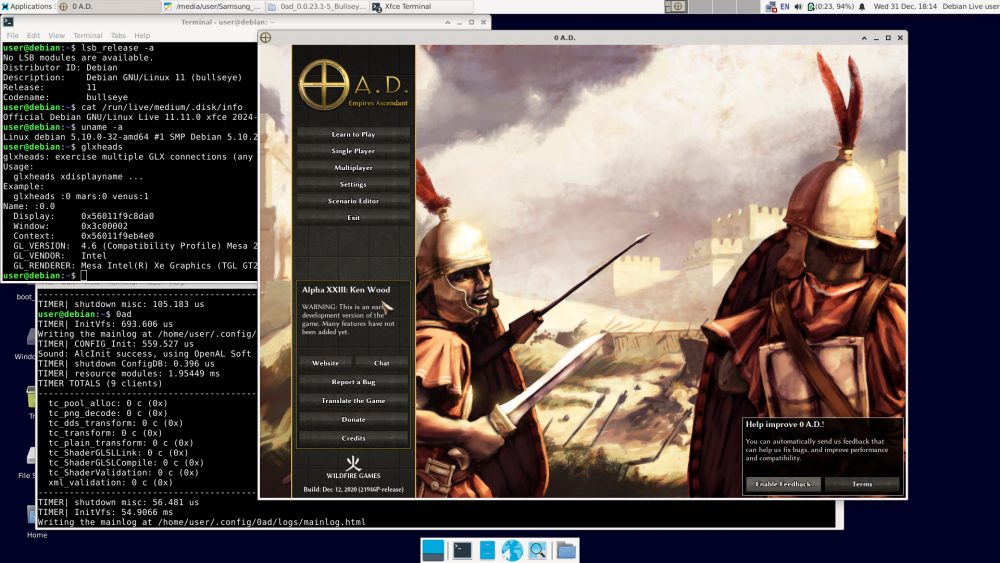
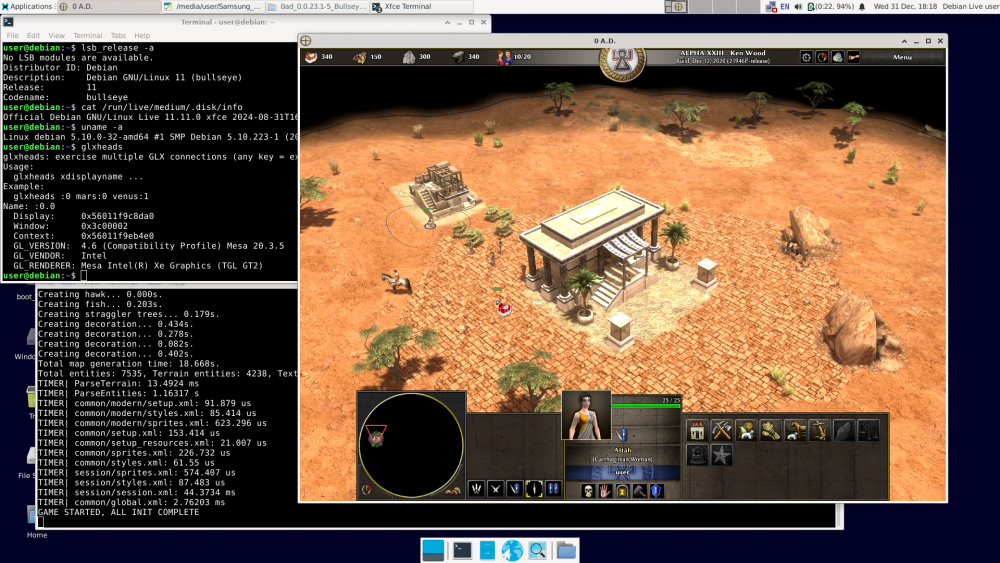
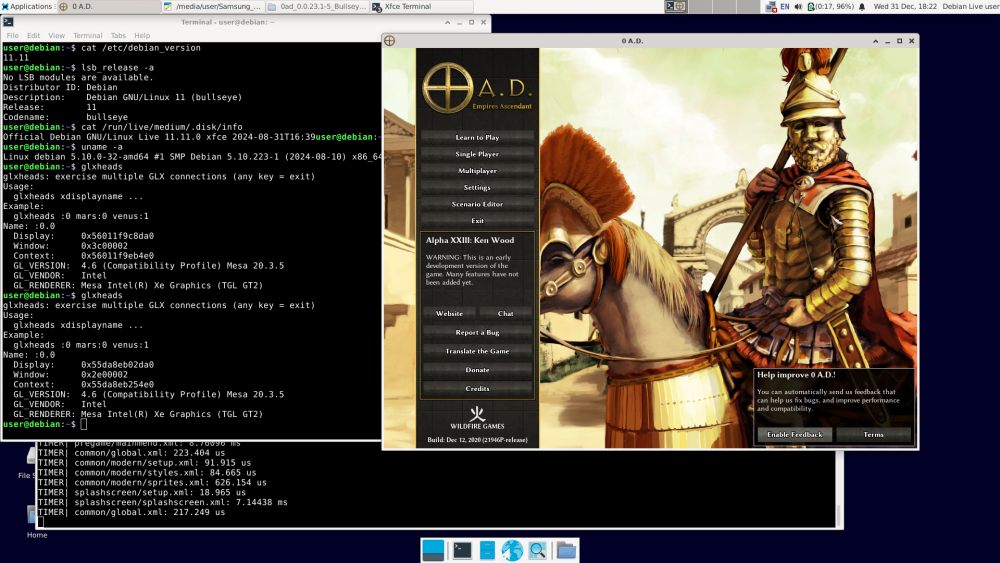
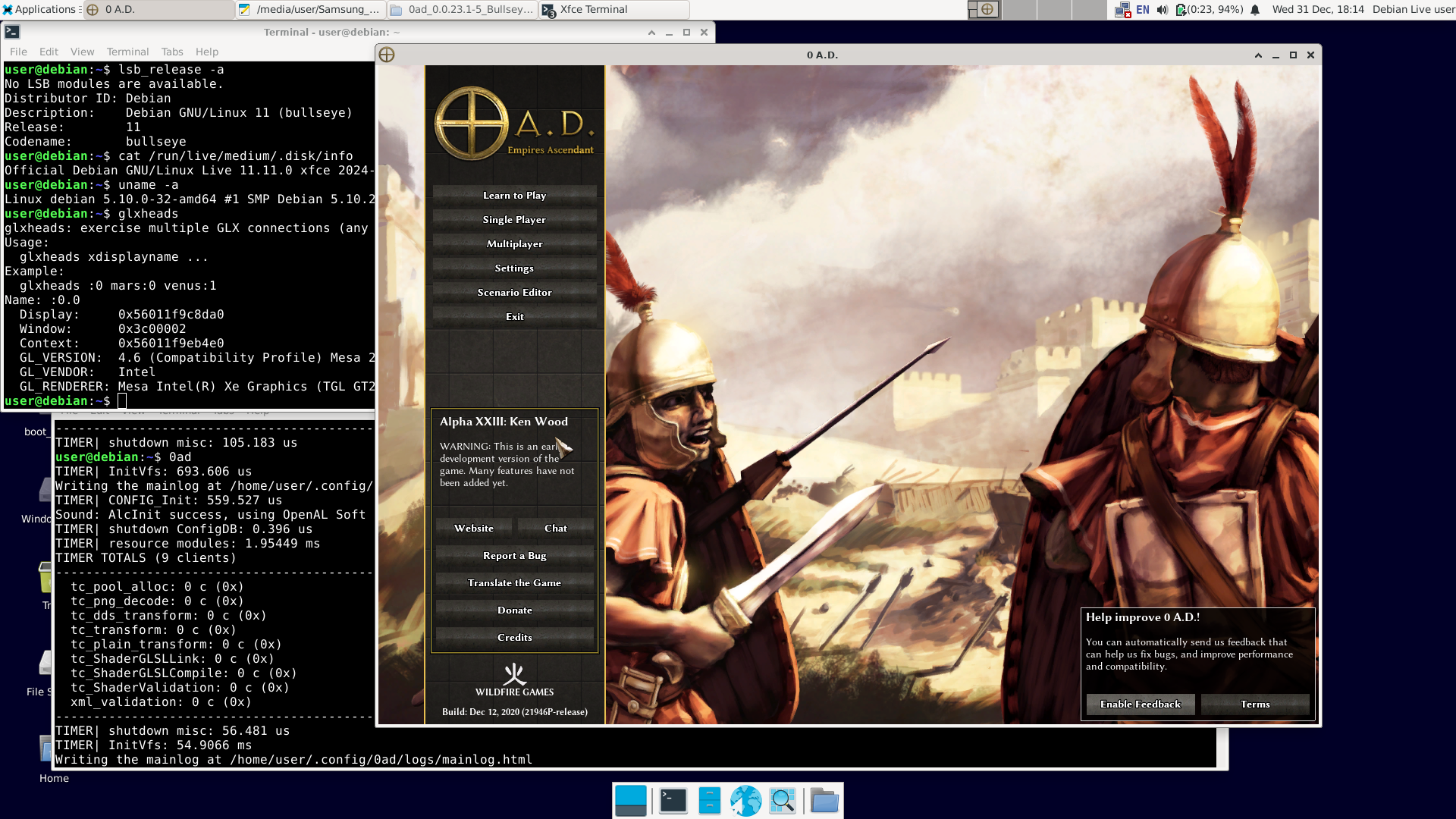
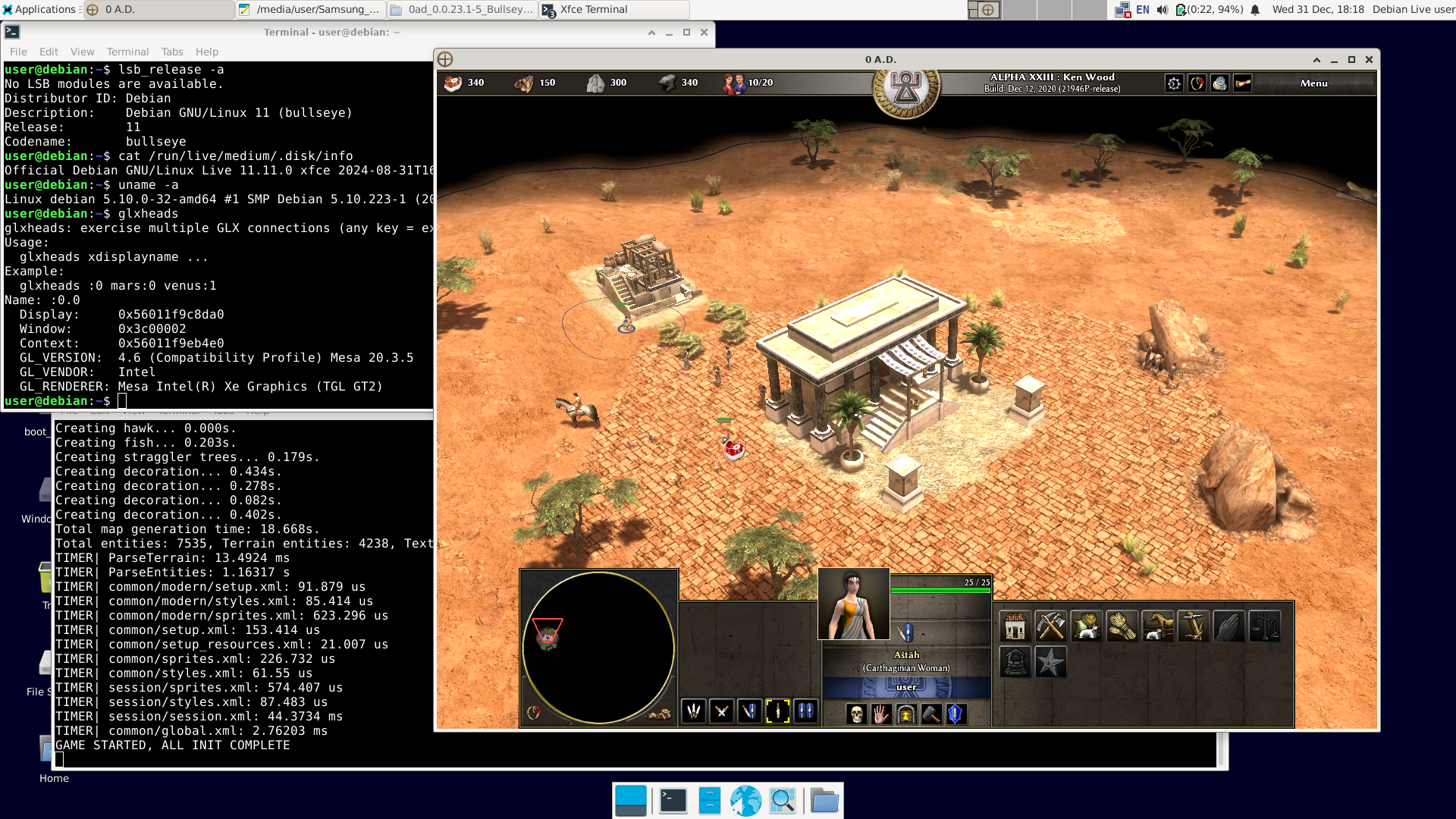
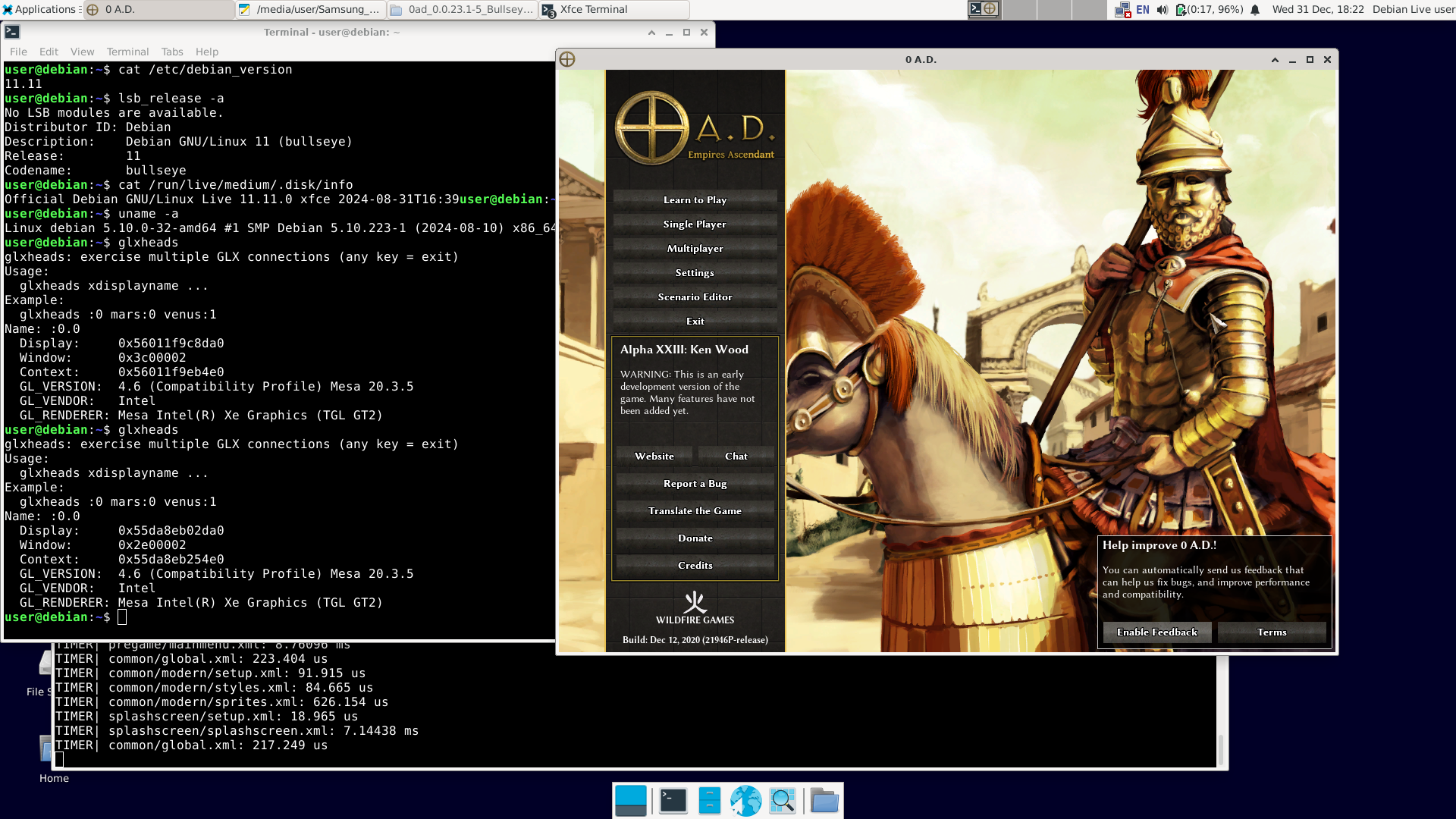
There have already been 12 posts, and "NewWorldHero" only wanted one answer: how to run the older version of 0ad – ver. 0.0.23 (Ken Wood). I figured out a way to do it: https://wildfiregames.com/forum/topic/139802-must-have-xxiii23-ken-wood-linux-only/?do=findComment&comment=616373 But I only figured it out, not tested it. It was bothering me. So I did this: 1. I downloaded Live Bullseye version 11.11 (+non-free) https://cdimage.debian.org/cdimage/unofficial/non-free/cd-including-firmware/archive/11.11.0-live+nonfree/amd64/iso-hybrid/debian-live-11.11.0-amd64-xfce+nonfree.iso 2. I copied it to a USB drive with Ventoy installed and booted it.. The laptop was even relatively new – Intel TigerLake (11th gen.) + Intel Xe. Debian booted, and Wi-Fi was available (Wi-Fi on Intel too). Good news: the Bullseye repositories are still available. You can use 'apt install'; you don't need to install anything manually. 3. After connecting to the network, I issued the command: apt-get update apt-get install 0ad I had to wait a while because one of the packages ('0ad-data_0.0.23.1-1.1_all.deb') is about 670 MiB. 4. After installation, in the terminal as a regular user, type '0ad' + Enter or click Menu – Games – 0ad. Done. I'm attaching the images. A short summary: user@debian:~$ cat /etc/debian_version 11.11 user@debian:~$ lsb_release -a No LSB modules are available. Distributor ID: Debian Description: Debian GNU/Linux 11 (bullseye) Release: 11 Codename: bullseye user@debian:~$ cat /run/live/medium/.disk/info Official Debian GNU/Linux Live 11.11.0 xfce 2024-08-31T16:39user@debian:~$ user@debian:~$ uname -a Linux debian 5.10.0-32-amd64 #1 SMP Debian 5.10.223-1 (2024-08-10) x86_64 GNU/Linux user@debian:~$ glxheads glxheads: exercise multiple GLX connections (any key = exit) Usage: glxheads xdisplayname ... Example: glxheads :0 mars:0 venus:1 Name: :0.0 Display: 0x56011f9c8da0 Window: 0x3c00002 Context: 0x56011f9eb4e0 GL_VERSION: 4.6 (Compatibility Profile) Mesa 20.3.5 GL_VENDOR: Intel GL_RENDERER: Mesa Intel(R) Xe Graphics (TGL GT2) user@debian:~$ dpkg -l | grep 0ad ii 0ad 0.0.23.1-5+b1 amd64 Real-time strategy game of ancient warfare ii 0ad-data 0.0.23.1-1.1 all Real-time strategy game of ancient warfare (data files) ii 0ad-data-common 0.0.23.1-1.1 all Real-time strategy game of ancient warfare (common data files) user@debian:~$ 0ad TIMER| InitVfs: 860.322 us Writing the mainlog at /home/user/.config/0ad/logs/mainlog.html TIMER| CONFIG_Init: 559.181 us Sound: AlcInit success, using OpenAL Soft TIMER| shutdown ConfigDB: 0.239 us TIMER| resource modules: 2.12809 ms TIMER TOTALS (9 clients) ... etc. Best regards. Happy New Year.
-
Ok, got it, thanx!
-
By any chance do you have a STL file of units ? so you can share with me ?
-
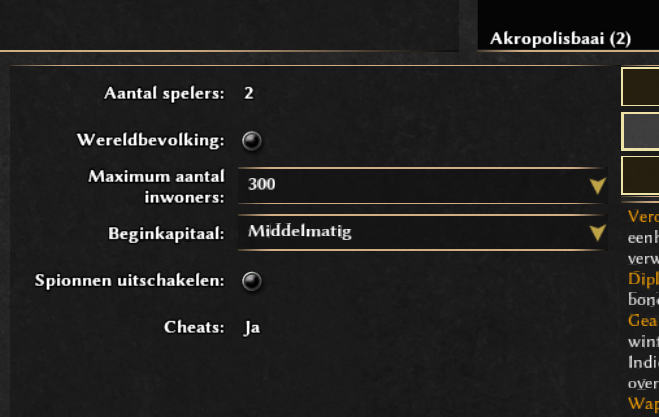
you can only select the number of players with random maps
-
Try another map. If you choose a map for two players ["(2)"] you can't change that.
-
The problem is, i have no dropdown menu to select more players...
-
I imagine you will need to pose the body mesh the way you want to with the armature and then import the props and combine them with the body mesh to make one mesh to print it. But, mind you, I'm no 3D printing expert.
-
It would be useful if in Ui we could see which bonuses were applied to some price/time
-
Engine.GetSimRate/SetSimRate from JS script
Vantha replied to CulturedCait's topic in Scenario Design/Map making
Yes, notifications are the best way to communicate stuff like this from the simulation to the GUI (and it works just as @phosit said). What kind of calculations? A "tick" in the GUI happens for each rendered frame, so the tick rate won't go up if you increase the sim rate (in fact, it'll probably go down a bit, since the game is busier with the simulation and has less time for rendering). -

Engine.GetSimRate/SetSimRate from JS script
phosit replied to CulturedCait's topic in Scenario Design/Map making
Yes, I think that is correct. But @Vantha has more knowledge.


.thumb.jpg.b21ca1d0c15fb56b42c39b25a0a40815.jpg)










-
Latest Topics
-
