
.jpg.4d575d1d330147616620e755ddb4c44a.jpg)
Genava55
-
Posts
2.478 -
Joined
-
Last visited
-
Days Won
88
Posts posted by Genava55
-
-
1 hour ago, phosit said:
While at it, the Seleucids could have a longer history-description. Currently it's only:
The Seleucid Empire emerged as one of the largest successor states to Alexander the Great's conquests, playing a pivotal role in disseminating Hellenistic culture across the Near East and beyond. Founded in 312 BC by Seleucus I Nicator, it initially spanned from Thrace and Anatolia in the west to the Indus Valley in the east, though eastern territories were soon ceded to local powers like the Mauryan Empire. At its height under Antiochus III (r. 222–187 BC), it encompassed the eastern Mediterranean, Mesopotamia, and parts of Iran and Central Asia. The Seleucids governed a multicultural populace through a formidable military - featuring innovative units such as Indian war elephants for shock tactics and heavily armored cataphract cavalry - alongside claims of divine kingship and the establishment of Greek-influenced cities, such as Antioch-on-the-Orontes, which evolved into a vibrant cultural hub. However, the empire grappled with internal dynastic conflicts, protracted wars against the Ptolemaic Kingdom (the Syrian Wars), and challenges in administering remote provinces. By the mid-third century BC, regions like Bactria (c. 250 BC) and Parthia (c. 247 BC) seceded, initiating gradual fragmentation. A major setback came with defeat by Rome at the Battle of Magnesia in 190 BC, followed by the Treaty of Apamea (188 BC), which stripped away western Anatolian holdings and imposed heavy indemnities. Persistent civil strife, rebellions (including the Maccabean Revolt, 167–160 BC), and incursions from Parthia and Armenia further diminished its power, culminating in Roman annexation of the remaining Syrian core in 64 BC by Pompey. Despite its eventual collapse, the Seleucid Empire endured for nearly 250 years and left an enduring legacy by blending Greek and Near Eastern traditions, influencing art, governance, and trade routes that shaped the Hellenistic and subsequent eras.
-
 3
3
-
 1
1
-
-
If I can provide a longer summary, I would suggest this:
Ancient Athens rose to imperial power in the mid-fifth century BC after the Persian Wars by transforming the Delian League into the Athenian empire. This empire, which dominated the Aegean through tribute and naval supremacy, collapsed in 404 BC at the end of the Peloponnesian War.
Athens later regained some influence in the fourth century BC through the Second Athenian League (378–355 BC) and remained a leading city-state. However, it lost its political independence after the defeat at the Battle of Chaeronea in 338 BC, when Philip II of Macedon imposed the League of Corinth upon Greece.
Although Athens subsequently attempted to recover its autonomy -most notably during the Lamian War (323–322 BC), the Chremonidean War (267–261 BC), and its revolt in the First Mithridatic War (88–86 BC) - all efforts failed. The city never regained full sovereignty and eventually became a Roman protectorate.-
1
-
-
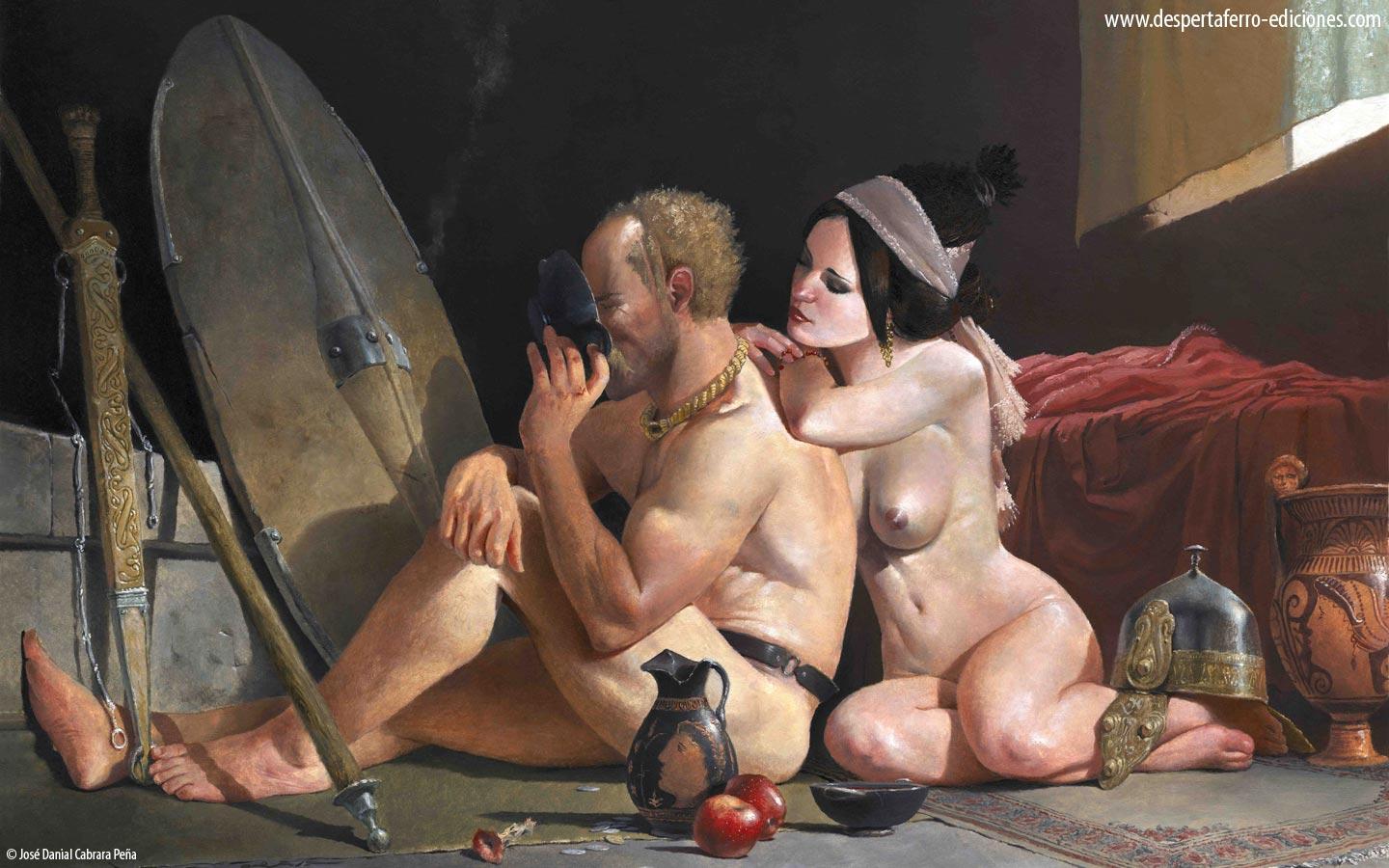
Reconstitution d’un ancien domaine aristocratique gaulois à Batilly-en-Gâtinais (Loiret), sur le site des Pierrières.-
1
-
-
1 hour ago, Deicide4u said:
This indicates that they were standing at least for 12 000 years, even before the last Ice age.
Not really, the dating of such structures is clearly falling in the Holocene. They are dating the underwater structures thanks to the dating of the environmental changes, notably a marine transgression in the case of Britanny.
1797401694_Fouquetetal_2025_IJNA.pdf
1 hour ago, Deicide4u said:And we shouldn't narrow the field by calling the people that built them hunter-gatherers.
It is not undermining the consideration we have for them. It is simply a description of their lifestyle. Using another label requires proving they are not hunter-gatherers.
-
3 hours ago, Deicide4u said:
Just your average 120-meter long granite block built or carved by some ancient, primitive tribe thousands of years ago.
"Nothing suspicious about this, move along." - Mainstream archeology.
I don't see why it should be unbelievable. It looks similar to the Blinkerwall structures in the Baltic Sea which was mostly used to trap animals.
Also the idea that hunter-gatherers were unable to build massive structure should be revised. See the Carnac stones for example.
-
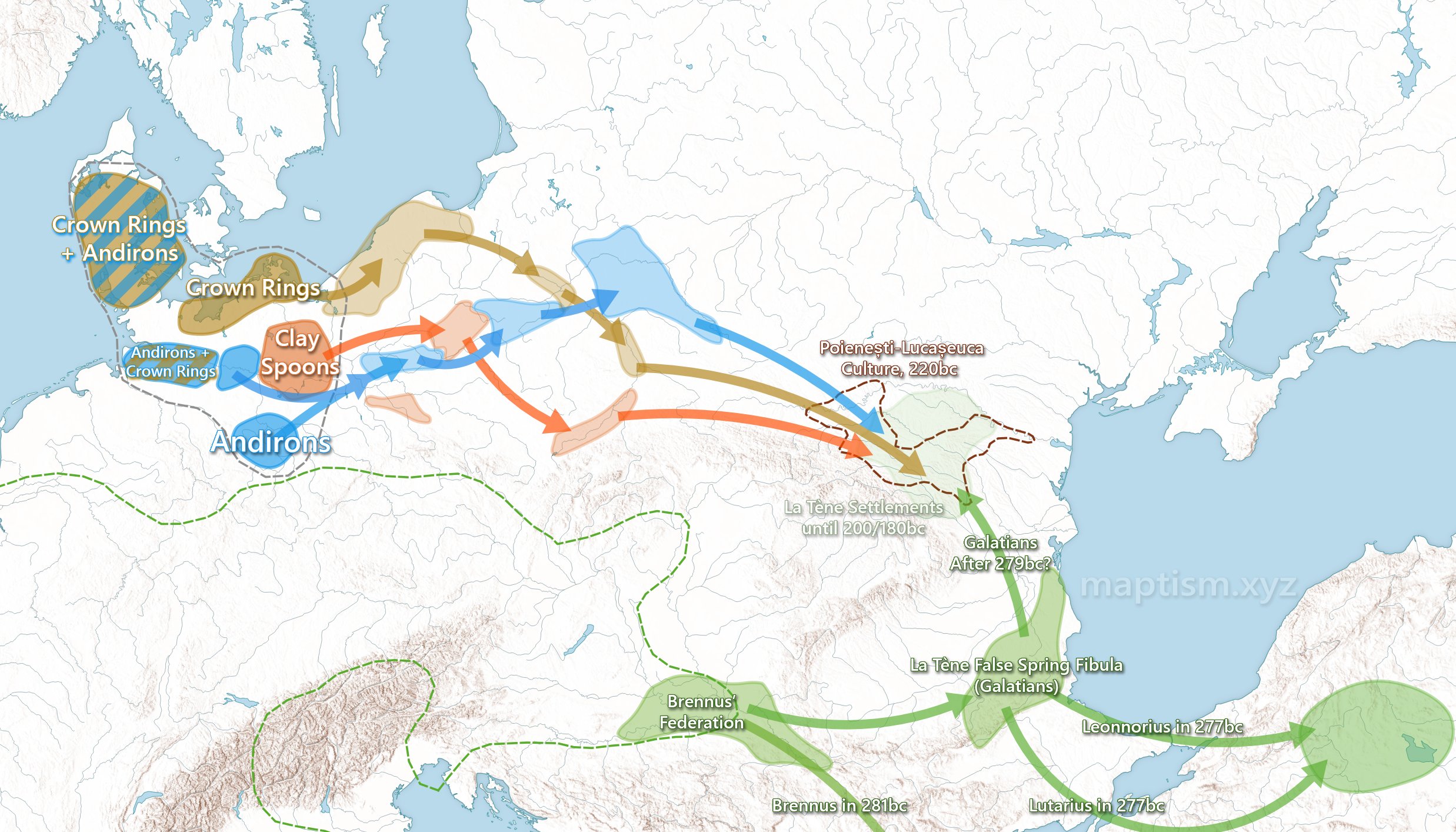
Map by Maptysk illustrating the various contributions from different material cultures to the formation of the Bastarnae (related to the Poienesti-Lucaseuca culture)
-
Excerpts from Gimbutas' book on the Balts:
SpoilerNow we must revert to the archaeological remains in the areas where we do find a continuum of culture in the upper Oka, upper Dnieper, and upper Nemunas basins. Many hundreds of fortified hill-top villages are reported from this region, located on the highest banks and promontories of lakes, by small rivulets or at their confluence with larger rivers. They usually appear in groups at a distance of about 5 km. from one another. As they are situated on the highest spots in the vicinity, it is sometimes possible to see from one hill-fort one or two others. It seems that a group of about five to ten villages belonged to a unit, which may have formed a tribal district. This type of layout of hill-fort groups apparently continued here long after Chalcolithic and Bronze Age times. There are no traces of larger settlements or towns.
Such accumulations of villages are known on the upper Oka and its tributaries Zhizdra, Ugra, Upa, Nara, and others. I purposely enumerate these river names because they are considered to be of Baltic origin. Hill-forts are also grouped on the River Protva south-west of Moscow, and around Smolensk, Vitebsk, Minsk, Homel, and other towns in Byelo-Russia where a number of Baltic river names can be identified; there are many groups in eastern Lithuania and Latvia as well. For the Early Iron Age and for the first centuries A.D. fortified hill-top villages are the basic sources of information. In contrast to the earlier periods and to the area of the western Balts, cemeteries are as yet hardly known here. We are thus better informed about the pattern of settlement and economy than about the burial rites, cults, social stratification, and representative artifacts.
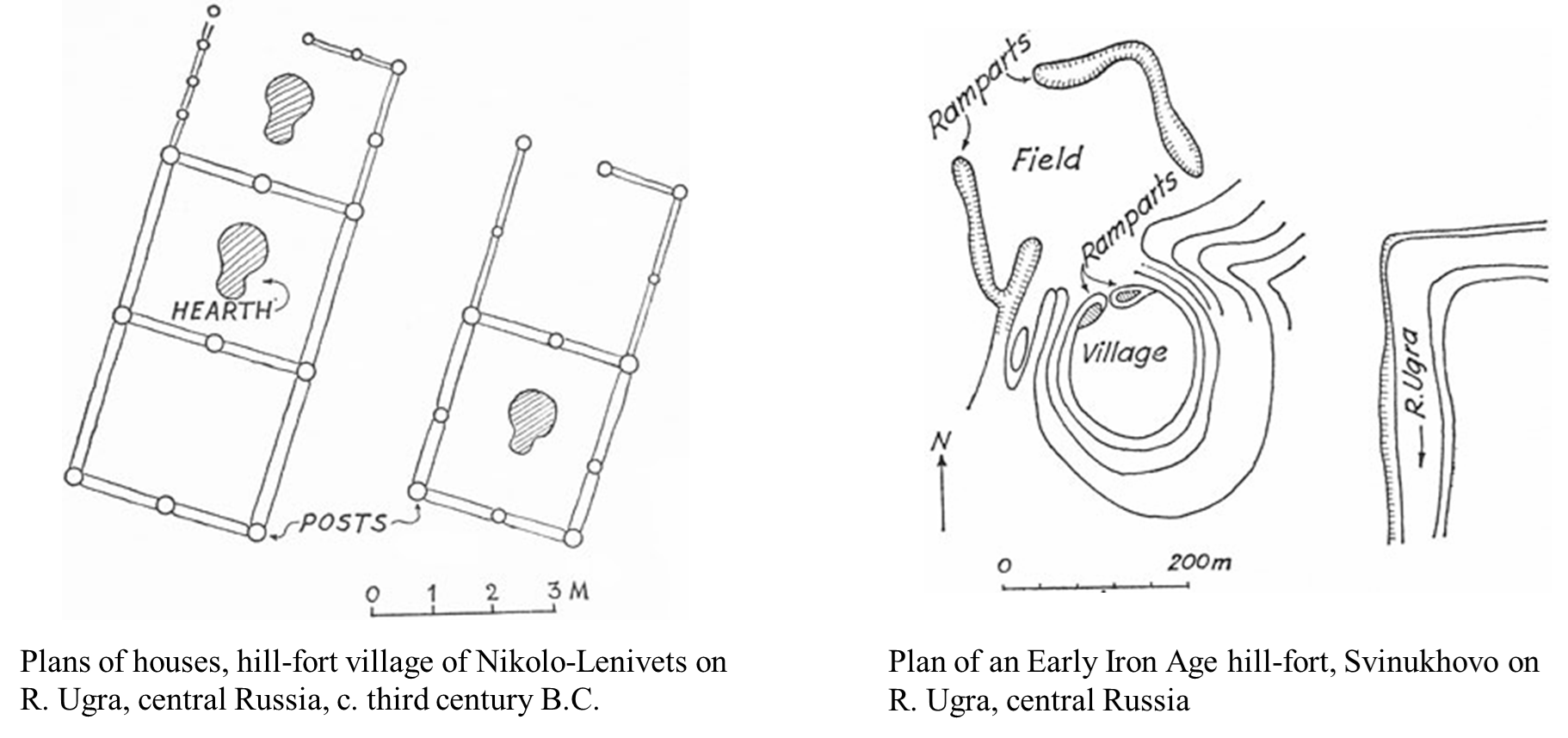
Villages were fortified with ramparts and ditches, and occupied an area of some 30–40 × 40–60 m. or more, on which about ten houses were built. The ramparts, 1–2 m. high, were built of stone, earth, or clay. Very often ramparts were of baked clay, and these were interwoven and solidly covered with timber. These were the most durable and still exist. Some of the recently discovered ramparts have “mysterious openings,” which are the subject of many legends. The ditches outside the ramparts sometimes reach 3–7 m. in depth and 10–15 m. or more in width. In plan the village was of various shapes: oval, elliptical, triangular, or even rectangular, depending on the natural shape of the river bank or the promontory into the lake. Before the houses were built the area was leveled, the lower parts being raised. Ramparts were normally on the inland side which, if not fortified, was accessible to enemies and wild animals. Sometimes ramparts encircled the whole village or protected it from several sides.
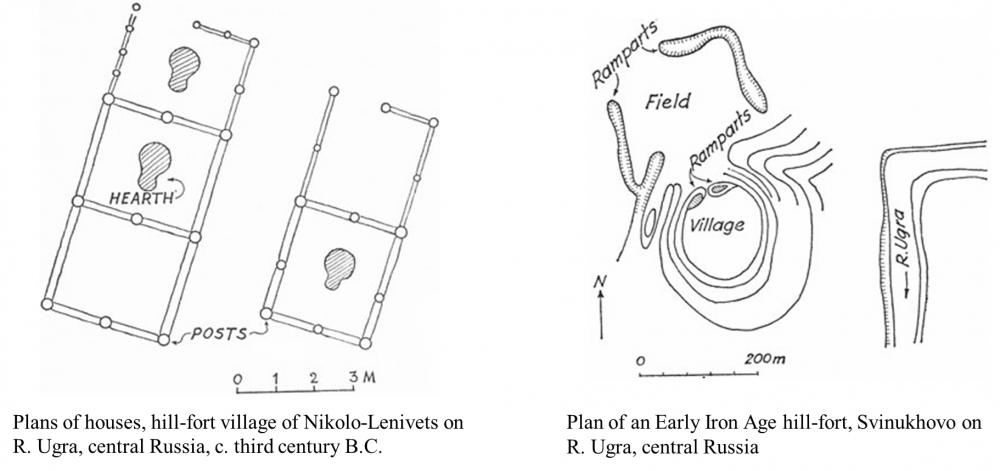
Frequently, hill-forts have yielded cultural layers of many periods; some of them were used for millennia. Their character and defence structures changed very slowly. In 1957 a whole village of ten houses dated to the third century B.C. came to light as a result of excavations by T. N. Nikol’skaja at the hill-fort of Nikolo-Lenivets on the bank of the River Ugra, tributary of the Oka. Aboveground, timber houses stood in two rows very close to each other, oriented NE–SW. Between the two rows was a street about 3 m. in width. Houses were rectangular and of about the same size, either 9 × 3 m. or 6 × 3 m., and most of them had hearths inside. Those without hearths presumably were for housing livestock, and for barns. The living-quarters were divided into two or three compartments, each probably occupied by a family. Houses were built of vertical timber posts placed in the corners and at the middle of each wall; the space between the posts was filled in with horizontal logs or interwoven twigs, after which the walls were thickly daubed with clay. The roofs were pitched, and supported by strong posts in the middle of the house. Floors were tamped with clay, and open hearths were somewhat below floor level and surrounded by a clay wall.
Iron sickles and grain impressions on pottery found in many villages indicate that agriculture was universal. The people maintained their farms and kept their animals in small areas beyond the villages, which occasionally were enclosed with ramparts as in the hill-fort of Svinukhovo. Grain was kept in round pits, about 1 m. in diameter. In most of the hill-fort sites over 70 per cent of the animal bones were those of domesticated, and less than 30 per cent those of wild animals. A particular abundance of horse bones, in some cases more than half of all the bones found, may indicate that the horse was used for food. Domestic animals constituted the basic food supply, although wild animals were hunted both for fur and for food. In some sites bones of furred animals such as the fox, hare, squirrel, marten, and beaver predominate; in others, those of bear, roe-deer, and wolf. Fishing was an important subsidiary activity. The presence of small net-sinkers shows that floating nets and seines were used in addition to iron or bone hooks and bone harpoons.
A bronze industry is attested by stone moulds and crucibles. Bracelets, pins, and ornamental plates of bronze or copper were made locally. Hill-forts dated to the period between the fourth and second centuries B.C. have yielded a large number of spiral-headed bronze pins and pins with leaf-shaped, fret-worked heads. Below the leaf were one or two loops apparently for the attachment of chains. Convex plates with several holes were used for attaching to the dress or to belts. Bracelets were embellished with a curving design in relief. The majority of the finds in hill-forts, however, are of bone and ceramic. Bone was used for harpoons, arrowheads, awls, needles, perforators, handles for knives and rods, buttons, children’s toys, and disc-shaped whorls; clay, for net-sinkers, variously shaped whorls, horse figurines, toys, and pottery. Pots were thin-walled, made of grey clay tempered with gravel or sand. That iron smelting was done in the villages is shown by iron knives, fishhooks, and sickles, some in unfinished shape or broken, and iron slag and clay ovens. Iron ore was obtained from the local swamps, meadows, lakes, and lake shores which abound in the forested areas of eastern Europe. The ore had to be dug out in the summer, and in the autumn and winter it was washed, dried, heated and reduced to small pieces. After that, the ore was placed in small clay ovens in layers alternating with charcoal, for smelting. Starting somewhere in the middle of the first millennium B.C., iron production gradually increased, but not before the first centuries A.D. did it replace the tools and weapons of stone and bone.
The changeless life of the, eastern Baltic tribes in the Dnieper basin was disturbed in the second century B.C. by the appearance of the Zarubincy (the name “Zarubincy” coming from the cemetery of Zarubinec south of Kiev on the River Dnieper, excavated in 1899). They invaded the lands possessed by the Milograd people along the River Pripet and up the Dnieper and its tributaries, and the southern territories inhabited by the Plain Pottery people. The Zarubincy were a peasant folk on a cultural level similar to that of the invaded cultures, but their archaeological remains contrast in every detail with those of the older population. Their settlements were larger and they lived in semi-subterranean huts as opposed to the small villages and aboveground houses of the Milograd and Plain-Pottery people. Their urn-fields are in contrast to the inhumation and cremation graves in pits or in barrows of the Milograd people. The Zarubinec urns and other pots were burnished, had a more or less angular profile, frequently possessed handles, and were decorated with a ridge applied around the neck. Their prototypes are found in the Vysockoe and Chernoleska culture of the western Ukraine (Podolia and southern Volynia) dating from the seventh–fifth centuries B.C., and its inheritors during the succeeding centuries. The most frequent finds in graves were fibulae, derivatives from the Middle and Late La Tène types of central Europe.
-
1
-
-
6 hours ago, Arup said:
there are already so many european civs, atleast show a little less bias towards the continent??? we need an asian or african civ after this
Duileoga is working for a mod. Don't worry, there is little chance they would be integrated in the main game.
9 hours ago, Duileoga said:-¿Usted vería viable una facción "Dnieper-Dvina" con auxiliares :Milograd,Zarubinstsy, Chernolesetc... y mercenarios Bálticos y Przeworsk, o es muy caótico y rebuscado?
The Chernoles culture disappeared a long time ago, around the 6th century BC. The Milograd culture existed in northern Ukraine and southern Belarus for several centuries. But it was replaced by the Zarubintsy culture, which represents a bit of a cultural break. There are elements of the Zarubintsy culture that originate from Germanic cultures. This culture of Zarubintsy appeared around 200 BC and existed up to the 1st century AD. After that, there is a transition period when the culture of Zarubintsy decays and a sharp reduction in the number of settlements. The Kiev culture is a reemergence of a Balto-Slavic culture which appeared around the 3rd century AD. The question of the Slavic origin is tied to how the Kiev culture appeared.
If you want to portray the Venedi/Veneti, they are probably further in the North. Pliny and Ptolemy locate them near the Baltic sea region. So we can suppose the Venedi/Veneti were a confederation of different Balto-Slavic tribes. Generally, the Brushed Pottery culture, the Milograd culture and the Dnieper-Dvina culture are seen as a continuum of similar populations. So if you want to suppose the testimonies from Pliny, Tacitus and Ptolemy are also valid for a more ancient period, then you can suppose these cultures were related to the Venedi/Veneti.
Like this you can use evidence from the Milograd culture, Dnieper-Dvina culture and Brushed pottery culture.
And you can add Germanic mercenaries from the Przeworsk culture (Lugians) and from the Zarubintsy culture (probably the Scirii). You can also add Sarmatian and Scythian mercenaries.
-
1
-
-
-
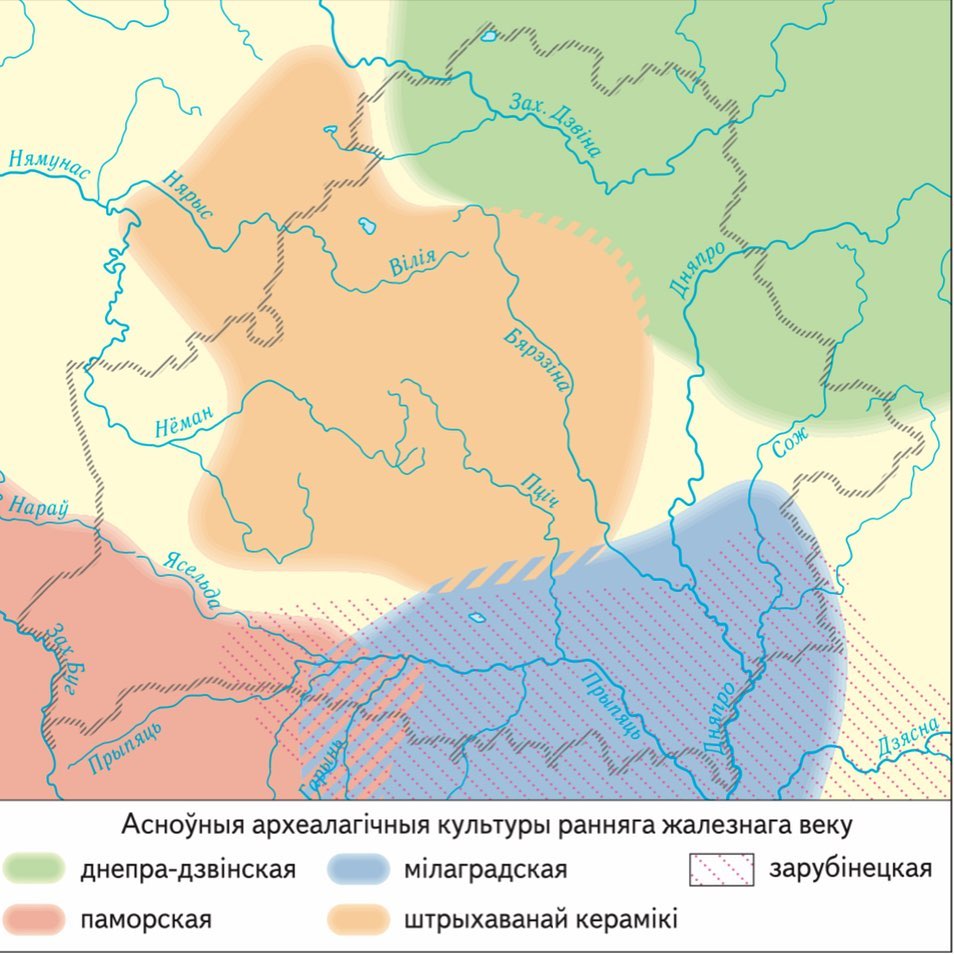
It is difficult to know when the Slavs separated from the Balts. The Kiev culture is the only one that can be definitively attributed to the Proto-Slavs. Regarding earlier cultures, there is no certainty. There are many contradictory and contested hypotheses. There is no consensus concerning their relationship with the Proto-Slavs. The cultures most frequently discussed are the Milograd culture, the Dnieper-Dvina culture, the Zarubintsy culture, and the Chernoles culture.
In my opinion, the Kiev culture derives mostly from Dnieper-Dvina (Днепро-Двинская культура).
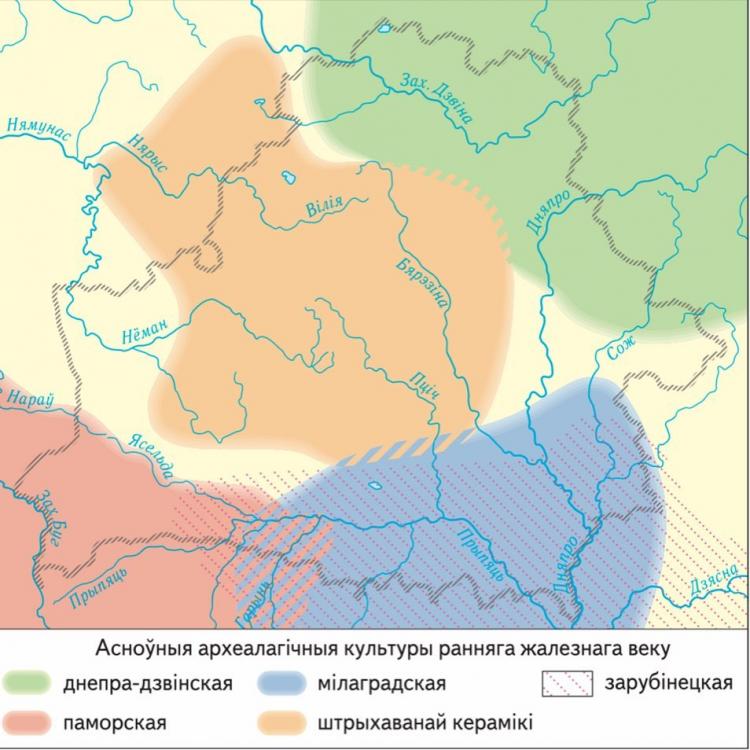
- Green = Dnieper-Dvina
- Orange = Brushed pottery culture
- Red = Pommeranian culture
- Blue = Milograd culture
- Hatched and dashed lines = Zarubintsy culture
On 12/12/2025 at 6:56 PM, Duileoga said:Venedi
The earliest mentions of the Baltic Venedi are from Pliny the Elder and Tacitus, both writing in the 1st century AD. Too old for your mod?
-
1
-
-
@Stan` c'est possible d'intégrer la vidéo ?
-
1
-
-
Une très bonne conférence par Matthieu Poux qui présente les spécificités uniques aux Gallo-Romains et comment elles proviennent des anciennes traditions gauloises. Il y a tout une partie sur les sanctuaires et les temples, comparant les similitudes entre Gaulois et Gallo-Romains.
-
1
-
-
On 03/12/2025 at 8:09 AM, Classic-Burger said:
https://interactivepasts.com/civilized-barbarians-in-0-a-d/
Another article.
It's good to see that people are noticing. Changing the image that people have of the past is important.
-
1
-
-
36 minutes ago, Deicide4u said:
Maybe it's better to focus on smaller changes first. Like implementing a "special attack" mechanic by giving some units either passive or active special abilities.
These are even described on some documentation pages, but they're still not implemented.
Perhaps the most famous is the ability of Hastati to throw pila at nearby enemies, before going into melee.
Special abilities are indeed something lacking. Regardless of the direction the game takes in its design, having special abilities would be an asset in any case. And it's something that's realistic to implement.
-
3 hours ago, wowgetoffyourcellphone said:
Okay, so what is the Total War vibe, then? Why does Total War use battalions? Why not just have hundreds or thousands of little dudes running around individually? It's because battalions give the opportunity for greater control for the player, including directional attacks, flanking, charging bonuses, fatigue*, morale*, formation bonuses (and weaknesses)... all of the things that make ancient warfare interesting.
That's exactly my point. Total War has its own features, its own mechanics. Code-wise, it is very different from Age of Empires and other RTS.
You are giving the example of BFME2, which is both very different from Total War and very different from 0 A.D. in its mechanics.
Implementing charging bonus, morale, fatigue, ammo etc. do not require battle formations. It is actually the battle formations which require new features to make sense. All the mechanics in battle should make sense with the formations. It requires a holistic approach.
The challenge is to produce a well rounded design and balanced mechanics based on battle formations. While keeping the other features and design of 0 A.D., notably on the economy.
And also making all that with the current engine, notably the pathfinding.
This is a major overhaul. Total War and BFME2 were designed with this idea from the start, don't underestimate the ramifications.
It would be great but I don't see how it is feasible with the current ressources and management.
-
What is the point of formations? Or more precisely, what are the motivations behind this wish?
It seems to me that the motivations are mostly cosmetic. To give a total war vibe.
-
1
-
-
-
In French but nice and interesting video
-
1 hour ago, wowgetoffyourcellphone said:
Maybe because that was 4 years ago and my views and understanding have evolved.
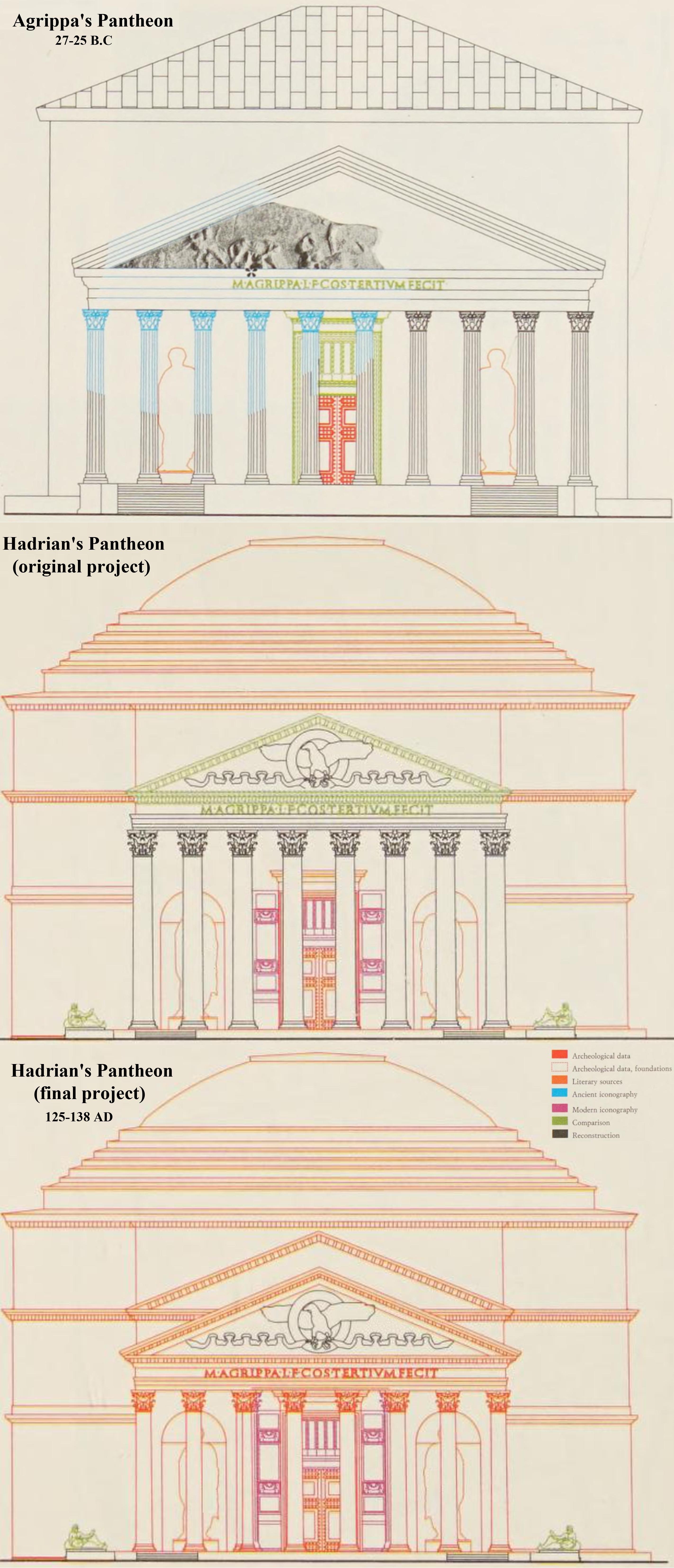
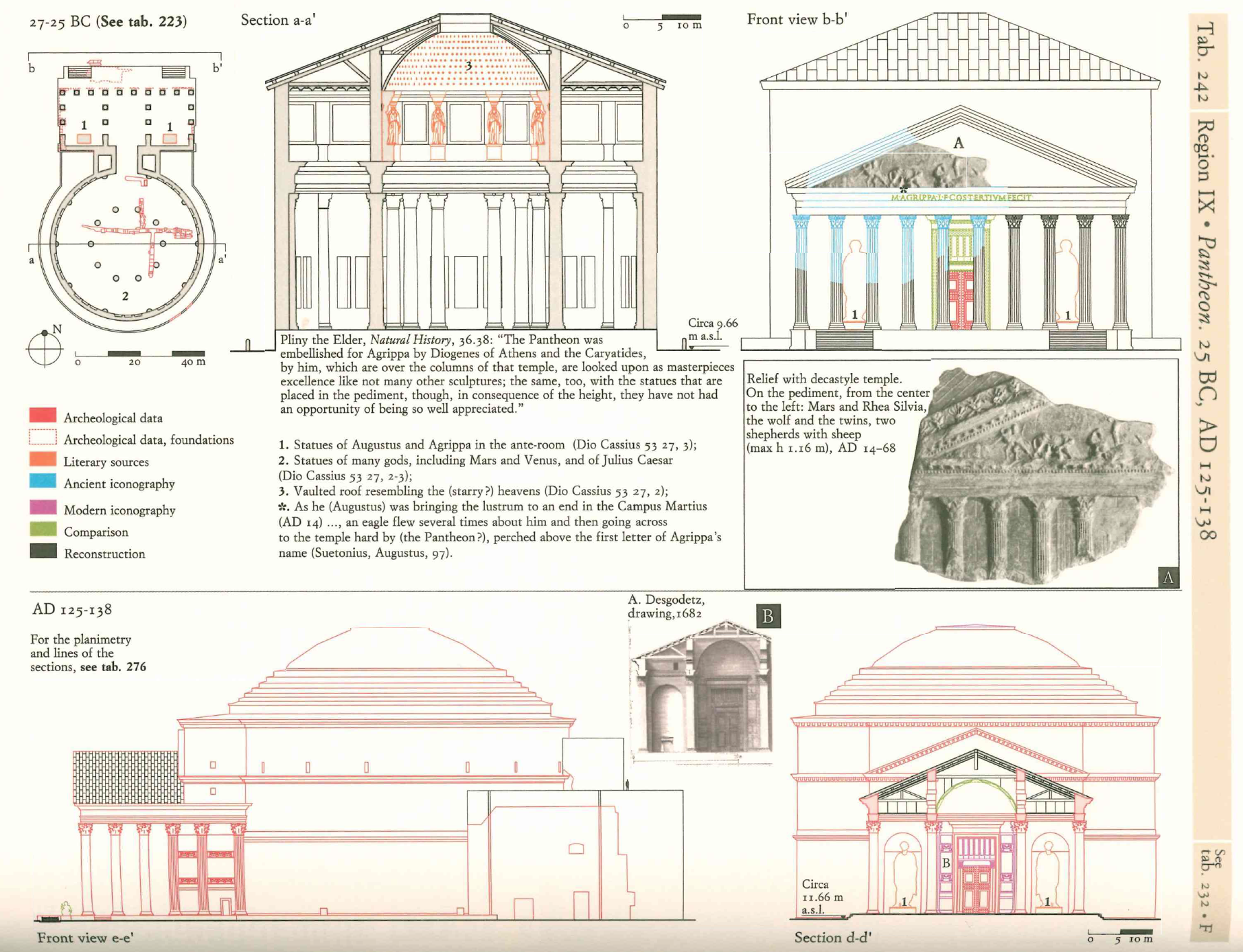
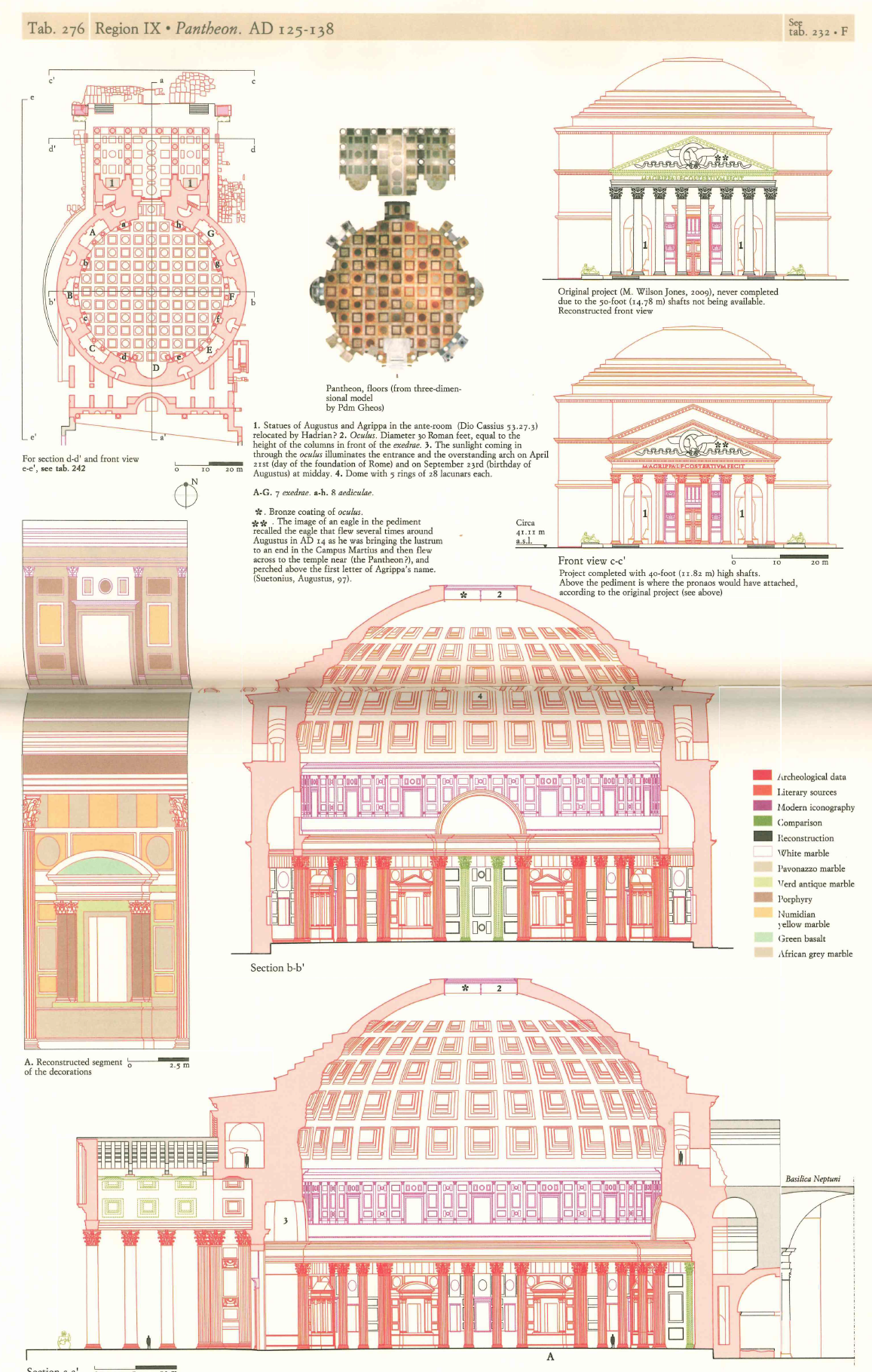
The way you approach things is very off-putting. What an idiot I was 4 years ago to not realize the two versions of the pantheon looked different!
Good to know
-
On 02/07/2021 at 2:31 AM, wowgetoffyourcellphone said:
For DE I'd like to use it for Augustus' wonder
By Augustus, I assume you mean Gaius Octavius the first emperor? Then why asking for a later version of the pantheon when it has been reconstructed by Hadrian ?
-
1
-
-
3 hours ago, Duileoga said:
-Me inspiré sobre todo en las tribus de Asia central ,como los Massagetae(Uzbekistán),así que solo requiere un ligero cambio de nombres y los empezaré a denominar como "Masagetas". ¿Mejor así @Genava55?
The Massagetae are neighbors of the Dahae. They live near the Aral Sea. The Persians mention several peoples among the Saka/Scythians:
-
Sakâ Haumavargâ – Scythians who prepare the sacred drink haoma
-
Sakâ Trigraxaudâ – Scythians with pointed caps
-
Sakâ tyaiy paradraya – Scythians from beyond the sea
-
Sakâ tyaiy para Sugdam – Scythians from beyond Sogdiana
It is very likely that the Sakâ Haumavargâ are the Amyrgians, a people difficult to locate but who must have lived close to the Massagetae. The Sakâ Trigraxaudâ are generally identified as the Massagetae. The Sakâ tyaiy paradraya are the Scythian peoples of the Pontic steppe, north of the Black Sea. They are divided into several groups, but the most powerful call themselves the Royal Scythians. Finally, the Sakâ tyaiy para Sugdam are probably distant Scythian peoples located north of Sogdiana, perhaps the Saraucae, who would invade the kingdoms of Bactria and Sogdiana in the 2nd century BCE.
For me, there are several Scythian-related events that are particularly interesting. First, the campaigns of Cyrus the Great against the Massagetae and the Amyrgians. Then the campaigns of Darius against the Pontic Scythians—a long expedition around the Black Sea. There are also the campaigns of Philip II and Alexander the Great against the Scythians near the Danube, difficult wars that even caused a few defeats for the Macedonians. There are the wars between the Scythians and the Greek Bosporan Kingdom in Crimea. Finally, the destruction of the Greek kingdom of Bactria, the successive deaths of Phraates II and Artabanus I, and the eventual creation of the Indo-Scythian kingdom in northern India. It is a very rich history spread across a vast territory with many peoples. Most remain nomadic, but some Scythian groups do become sedentary.
I think the Royal Scythians, the Massagetae and the Sakaraukai/Saraucae are all three interesting nomadic Scythians from different areas.
3 hours ago, Duileoga said:(Los Dahae serían una facción nómada plena ,pero con la descarga de una tecnología cultural única ,se podrían convertir en la facción sedentaria de los Arsácidas/parthians,mudando la apariencia de los edificios , unisdades etc... )
This is a good idea but maybe it should be directly integrated into the Parthians civ. Starting as a nomadic tribe and becoming a Persian empire is original.
-
1
-
-
-
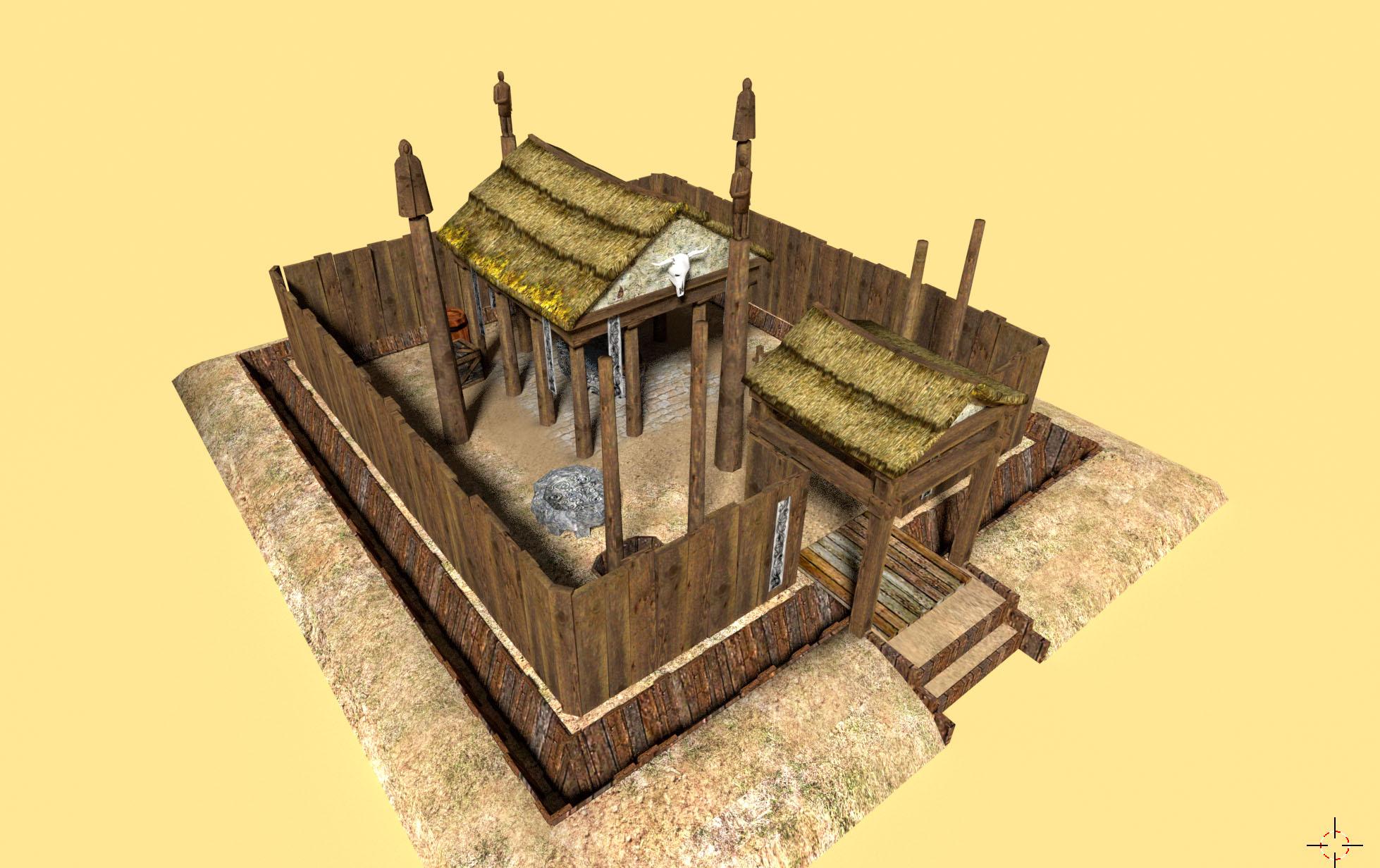
@Sundiata started a concept based on the sanctuary from Gournay sur Aronde but never showed it publicly, it was meant to replace the current Gallic temple:
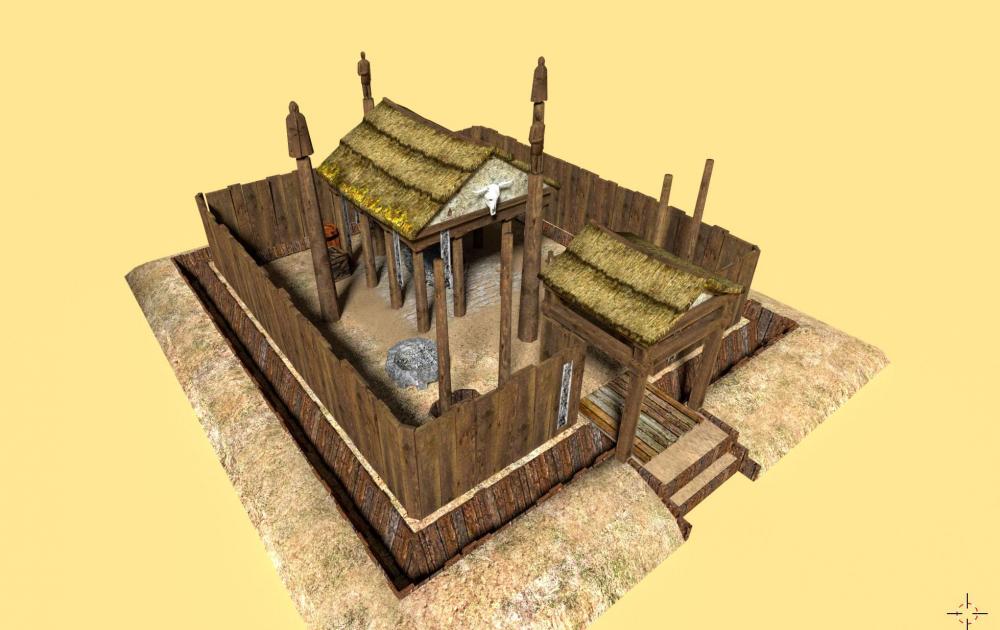
Edit: I added the blend file from Sundiata
Gaul_Sanctuary_Gournay_sur_Aronde_V2.blend
-
2
-


Civ: Imperial Romans (Principates)
in Delenda Est
Posted
Model of the Roman fortress at Ockenburgh