
.jpg.4d575d1d330147616620e755ddb4c44a.jpg)
Genava55
-
Posts
2.478 -
Joined
-
Last visited
-
Days Won
88
Posts posted by Genava55
-
-
1 hour ago, Ultimate Aurelian said:
It is not described what weapons they had; but swords are possible.
Sure but why the Germans should have elite swordsmen and other civs not?
It is the comparison and the coherence across the different rosters I am referring to.
-
On 27/07/2025 at 2:27 PM, Deicide4u said:
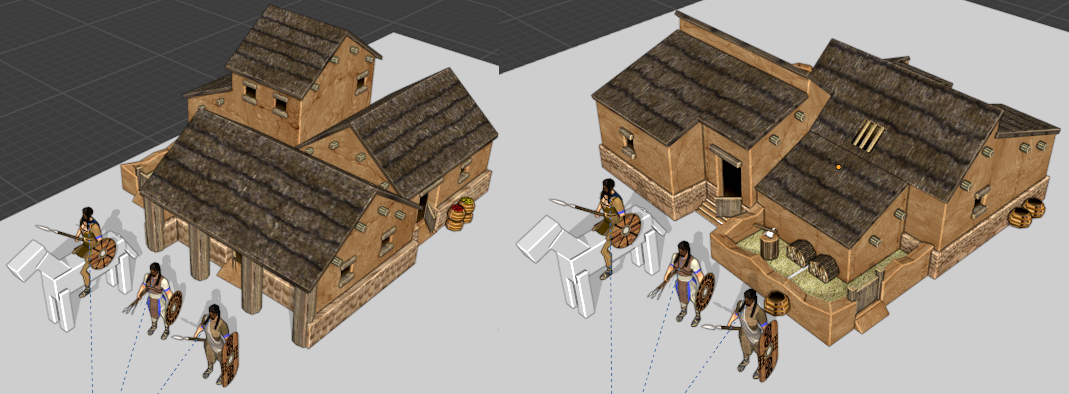
Give Iberians "embassy" like structures, that will train Lusitanian and Celtiberian units.
A good reason to make them more unique.
That's the idea and I think we can even go a bit deeper than simple embassies, as Duileoga made a few good designs:
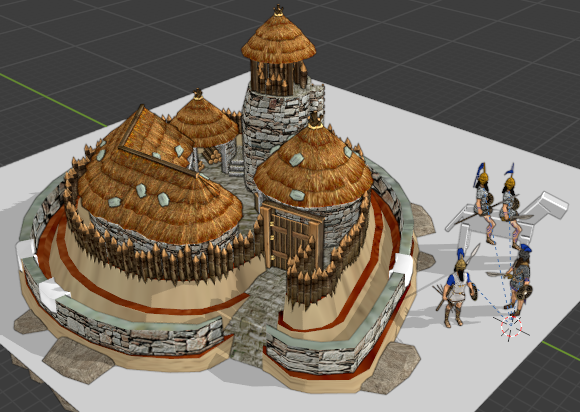
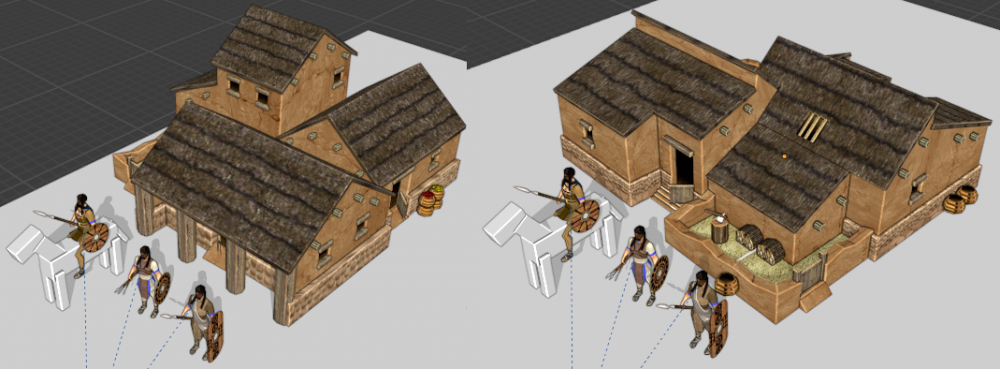
-
 1
1
-
-
Top new gameplay features in this release:
-
New Celtic Factions:Britons and Gauls will now replace the generic Celtic faction. Each faction features some unique characteristics, along with shared Celtic units and buildings:
- The Britons have chariots, longswordsmen and powerful melee soldiers. Their special building is the kennel, which can train war dogs. These are both inexpensive and great for hunting and combat. Also, their heroes include Boudicca, queen of the Iceni, who led a revolt against the Roman Empire.
- As experts of metalworking, the Gauls have heavy swordsmen and heavy cavalry. Special building: The Rotary Mill, which is available in Town Phase, and is set to increase the food production of nearby farms in mid- and late-game. (This feature has not been implemented yet.) One of the Gauls’ heroes is Vercingetorix, chieftain of the Arverni tribe and enemy of Julius Caesar.
https://play0ad.com/alpha-11-kronos/
Top new gameplay features in this release:
-
New Hellenic Factions:Athenians, Macedonians and Spartans will now replace the generic Hellenic faction. Each features some unique characteristics along with shared Hellenic units and buildings:
- Receiving significant naval bonuses, the Athenians are the rulers of the waves. Special Buildings: Gymnaseion, Prytaneion (“Council Chamber”) and Theatron.
- Macedonians have a wide selection of units and siege engines, for a combined arms approach. Special buildings (in planning): Lighthouse and library.
- The Spartans can’t build stone walls, but as their soldiers are top-notch, their men serve as their walls instead. Special Building: Syssiton (“Military Mess Hall”).
(Also, along the same lines, we have decided to include more factions in 0 A.D., beginning with the Mauryan Indians! Read on to find out how you can help.)
-
New Celtic Factions:Britons and Gauls will now replace the generic Celtic faction. Each faction features some unique characteristics, along with shared Celtic units and buildings:
-
In 2012:
On 17/07/2012 at 8:16 PM, Zeta1127 said:There are actually two Celtic factions depicted in the game, the Gauls and the Britons, and as I understand it, have been split in preparation for Alpha 11.
I wonder if it would work better if the Gauls were given a new set of urban structures, while the Britons can just keep the existing rural set.
On 18/07/2012 at 1:18 AM, historic_bruno said:Right. It should be noted we always intended a single "Celts" faction, the idea originally was you could choose between either Gauls or Britons once you reached the city phase (we were going to do this with other factions as well, like the Hellenes). Really the only art difference we officially intended was the fortress design. Otherwise they would have been a blend of aspects of both cultures. It wasn't until recently that they were split up on a whim without a lot of discussion beforehand.
I wasn't privy to the original discussions or designs, so I don't know what to tell you about why the current design was chosen, but I can say it was never on the art team's radar to redesign Celts yet again http://www.wildfiregames.com/forum/uploads//emoticons/default_smile.png Probably this discussion should be moved to the new Art Development forum.
In 2013:
-
2
-
-
This thread has been initiated to revisit the discussion concerning the historical accuracy of the Iberian civilization as depicted in the game. The aim is to consolidate relevant information, provide a comprehensive overview of the issue and its origins, and facilitate constructive dialogue focused on identifying potential solutions.
At present, the primary concern regarding the Iberian civilization in 0 A.D. (A27 at the time of writing) is that it represents a composite of various groups from the Iberian Peninsula, encompassing populations with distinct languages and distinct historical backgrounds.
This issue emerged early in the development of 0 A.D., largely because the Iberians were favoured by one of the project's key early contributors:
https://play0ad.com/interview-of-tonto_real/In this interview, there appears to be notable confusion between Celtiberians and Iberians, which may have been intentional.
Geography and languages
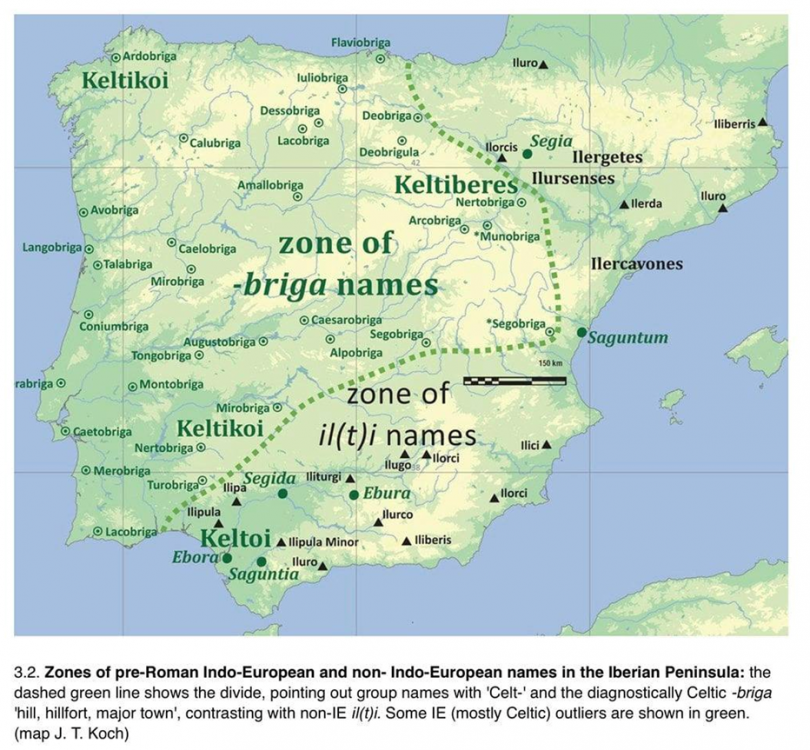
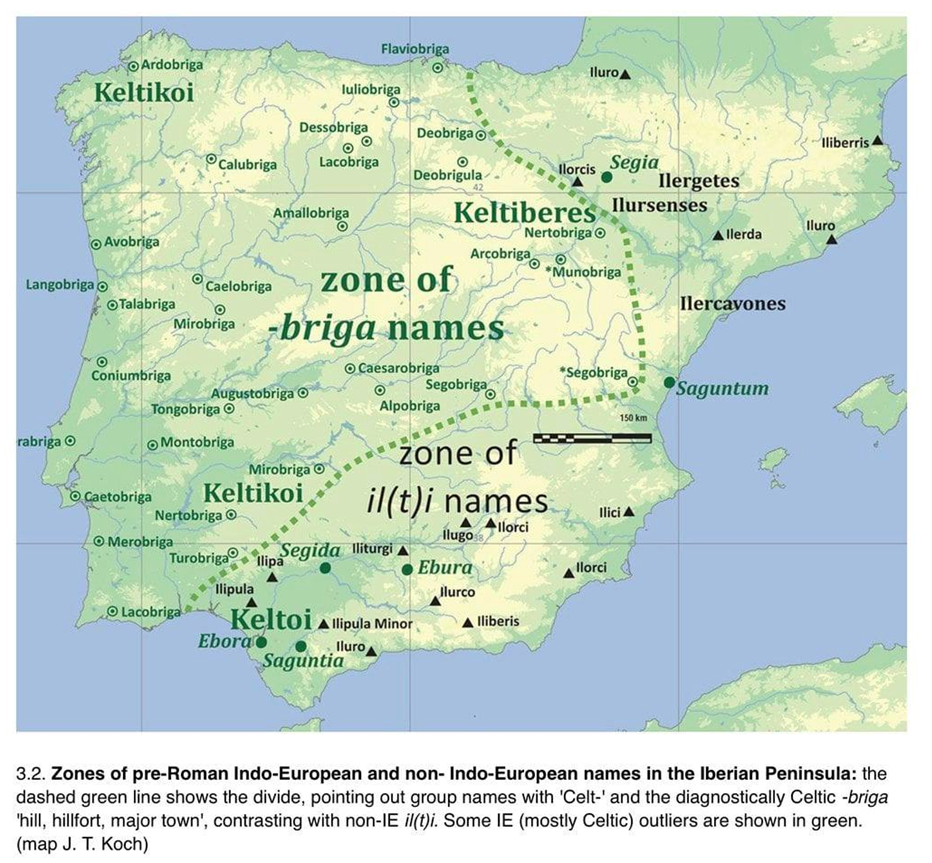
SpoilerI will give a quick look at the geography of the people and of the language from the ancient Iberian Peninsula. As you can see from the figure below, Iberian was a denomination used to speak about several people from the eastern coast. In the center, slightly on the East, a second group was called Celtiberians. And in the West, there are multiple single tribes but they didn’t belong to a larger group and there is no denomination known for them above their tribal names. Although Lusitanians could have been a confederacy of tribes, they are generally mentioned as a single political entity. Thus, we know only two regional-scale ethnonyms used by the ancients to categorize different political entities together: Iberians and Celtiberians. However it doesn’t mean it is exhaustive and accurate, it is simply what the classical literature reports.
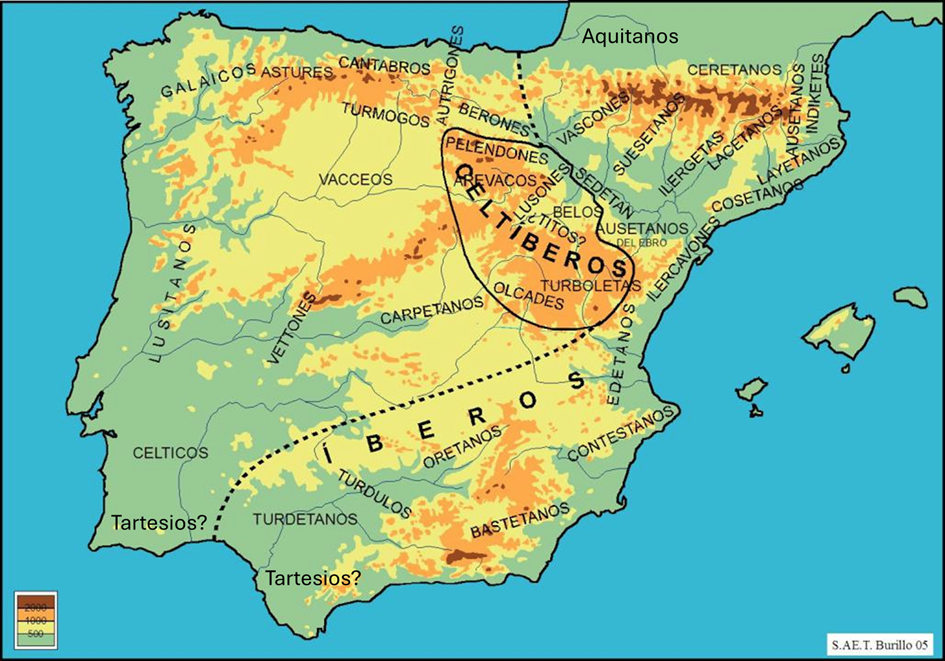
Below, here is a second map we can see a simple division of the toponymy of the Iberian Peninsula. It has been understood early on that the various people can be easily divided in two parts, one side speaking Indo-European languages and characterized by the ending -briga in multiple toponyms and another side speaking non-Indo-European languages with names starting with ili-, ilu-, ile- and ilo- for the toponyms. The Indo-European languages arrived in Spain around 2300 BC, with people carrying steppe ancestry and following Bell Beakers customs. The non-Indo-European languages probably derives from the Neolithic expansion which first arrived in the peninsula around 5700 BC. This explain the diversity in the Iberian Peninsula, there are at least two different and unrelated linguistic families.
This third map below shows the various inscriptions in the different languages of the Iberian Peninsula. It is strictly reporting inscriptions in the language mentioned, it doesn’t include Latin inscriptions and other lines of evidence from the Roman period. First we can see in blue the inscriptions written in the North-Eastern Iberian script, a writing system used regionally to write the Iberian language or at least a dialectal form of the Iberian language. Then we can see in red the inscriptions written in Celtiberian, using the Celtiberian script which derived from the North-Eastern Iberian script. It corresponds to the area of the Celtiberians from the first map but it also suggests that the language was spoken by a few nearby people like the Berones, while they weren’t mentioned explicitly as Celtiberians by the classical authors. In yellow, the Iberian inscriptions written with the South-Eastern script. In green, an uncertain language, sometimes related to the Turdetans but the relation to the Iberian language is unclear and uncertain. It could be another family. In orange, another uncertain language. Originally it was associated to the legendary Tartessos, but the location of the inscriptions doesn’t match the location of the city and of the material culture. Furthermore, the inscriptions suggest some relation to Indo-European languages which is disturbing and difficult to explain. Finally there are the few inscriptions from the Lusitanian language, in dark blue.
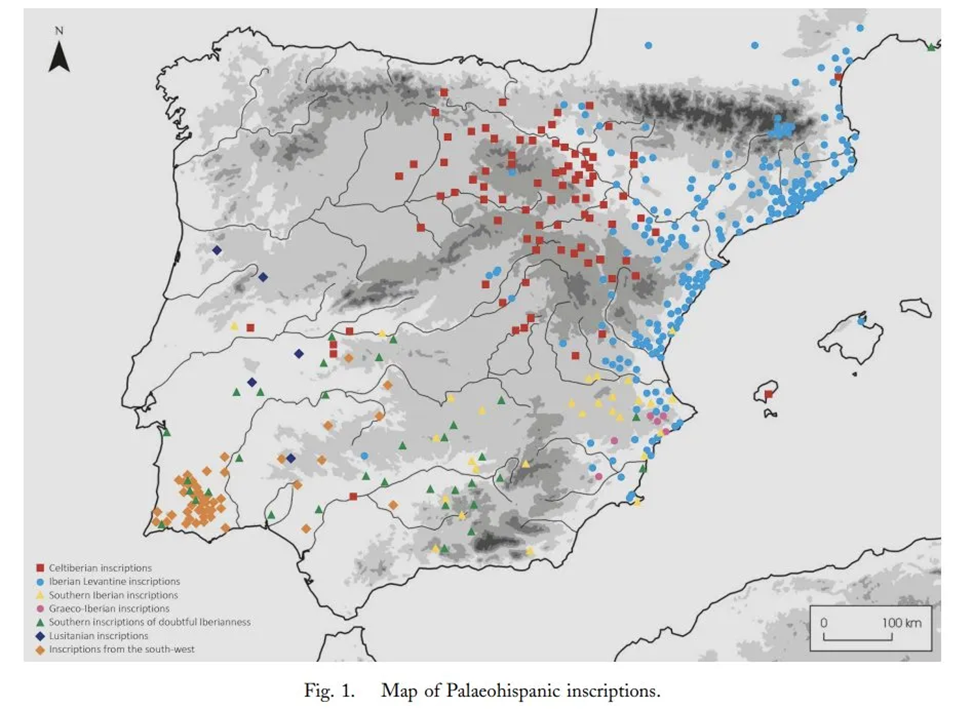
The Lusitanian relations to the Celtic languages has been a long debate but it seems that the consensus among experts is that they were a different branch of the Indo-European languages. Here the abstract of a chapter titled “Language and writing among the Lusitanians“ in the book Palaeohispanic Languages and Epigraphies published in 2019:
“The number of inscriptions written totally or partially in Lusitanian is limited: only six or seven with Lusitanian vocabulary and/or grammatical words, usually dated to the first two centuries CE. All are written in the Latin alphabet, and most are bilingual, displaying code-switching between Latin and Lusitanian. There are also many deity names in Latin inscriptions. The chapter summarizes Lusitanian phonology, morphology, and syntax, though entire categories are not attested at all. Scholarly debate about the classification of Lusitanian has focused on whether it should be considered a Celtic language. The chapter reviews the main issues, such as the fate of Indo-European */p/ or the outcome of voiced aspirate stops. The prevailing opinion is that Lusitanian was not Celtic. It must have diverged from western Indo-European dialects before the kernel of what would evolve into the Celtic and Italic families had been constituted. An appendix provides the text of extant Lusitanian inscriptions and representative Latin inscriptions displaying Lusitanian deity names and/or their epithets.”In the end, we have a bunch of different languages attested, a few uncertainties and a lot of unknown. There is the Iberian language clearly attested by two kinds of scripts, mostly located on the Eastern coast of the Iberian Peninsula. There is the Celtiberian language clearly located where were mentioned the Celtiberians. The Lusitanians is another branch of the Indo-European languages in the peninsula. There are one or two uncertain groups in the South-West. Maybe another branch of the Non-Indo-European language with the Turdetans who could be different from the Iberians. And for the unknown, there are numerous people with no certain inscriptions. The Proto-Basques or Vascones notably, there is no doubt they are not related to the Indo-European language, but it is also clear that Basque language doesn’t match the Iberian language, except for a few similarities in numerals. So, it seems they were related to another branch of the Non-Indo-European language of the peninsula. The Vaccaei and the Carpetani, while having no inscription of their language, have similarities with the Celtiberians. However, it could be a simple influence without necessarily meaning a similarity in their language. The relationship between the Vettones, the Gallaecians, and the Lusitanians is unclear; however, their geographic proximity has led some scholars to propose a possible connection. Notably because they shared some deities during the Roman period.
Unravel the origin of foreign assets
The Iberian civ in 0 A.D. has three heroes: Caros is a Celtiberian chieftain leading the coalition during the second war, Viriato is Viriathus, a famous Lusitanian war leader who resisted Roman hegemony and finally Indibil is a chieftain of the Ilergetes, an Iberian people from the North-Eastern part of the peninsula. Therefore, only one of the three heroes is properly Iberian.
The regular units are also making direct reference to other people with the skirmisher called “Lusitano Ezpatari” (which means Lusitanian swordsman but whatever), “Kantabriarko Zaldun” (Cantabrian cavalryman), the priestess of Ataekina/Ataegina (Ataegina was a goddess worshiped in the western part of the peninsula, probably a Lusitanian cult originally). There is also the “Leial Ezpatari” (loyal swordsman) which is a direct reference to the “devotio” reported by Romans to describe the vow of Celtiberian warriors to their patron/chieftain.
There is also the issue that the chainmail body armor is used extensively by the units, while there is no evidence that the Iberians used it. It seems to have been adopted much later by a few Celtiberian and Lusitanian warriors, simply because those peoples have been subjugated after the Iberians.
Both the wonder and the temple are based on the sanctuary of Cancho Roano, related to the Tartessian culture and abandoned around the 5th century BC. So, it is not purely Iberian, it depends on the interpretation of the Tartessian culture. It is a minor issue but I think it was important to mention it.
For me, the problem with the current representation is that it is misleading. Players do not understand the differences between the various peoples mentioned, particularly the Lusitanians and the Cantabrians. Portraying them as an original component of the Iberians is awkward. Especially since it is historically confusing because the Lusitanians and Cantabrians appear quite late in the conflicts with Rome. Many wars between the Iberians and the Carthaginians and Romans never involved the Lusitanians or the Cantabrians.
What are the possible solutions?
1. Clean up all foreign elements from the civilization and make it a purely Iberian civilization. This simply means removing and replacing assets.
2. Split the civilization into two or three. In particular, create a Lusitanian civilization and a Celtiberian civilization. This means removing and replacing assets for the Iberians. Then create new assets to make one or two other civilizations.
3. Keep the foreign elements within the Iberian civilization but separate them by having them appear in specific buildings, specific technologies, etc. to show that they belong to another culture neighboring the Iberians.
My opinion
Solution 3, keeping the foreign element but separating them and distinguishing them for the Iberian core, is the most compatible with the original vision of tonto_real (aka Ken Wood). It would also bring more diversity in the Iberian civ. We can for example add specific Lusitanian buildings to integrate them properly as allies, to distinguish them from the core roster. The effort is moderate.
-
5
-
-
12 minutes ago, borg- said:
The great Celtic towers served as accommodation for kings, for example.
What do you mean by "great Celtic towers" ? The brochs?
-
8 hours ago, real_tabasco_sauce said:
What is a good specific name for the Cimrbi Raider?
slōgijanaz / slōgijanōz based on slahaną, meaning slaughterer, striker
-
1
-
 1
1
-
-
6 hours ago, Foxooo said:
A catchy, memorable name helps with word-of-mouth marketing. "0 A.D." isn't particularly catchy or easy to recommend quickly without further explanation
I disagree with you.
-
2
-
-
A video about RTS games in French
-
Did the Mamluks really ride on camels, like we see in Age of Empires II? Did they fire arrows or throw scimitars? From the exhibition "Mamluks 1250-1517," curators Souraya Noujaim and Carine Juvin analyze this video game franchise and the representation of this warrior elite, described by Adam Isgreen, Creative Director of World's Edge, the studio behind the "Age of Empires" franchise. From June 10 to July 11, an exceptional program of content and events produced in partnership with World's Edge, Xbox and the Louvre Museum is available to the public!
-
-
-
-
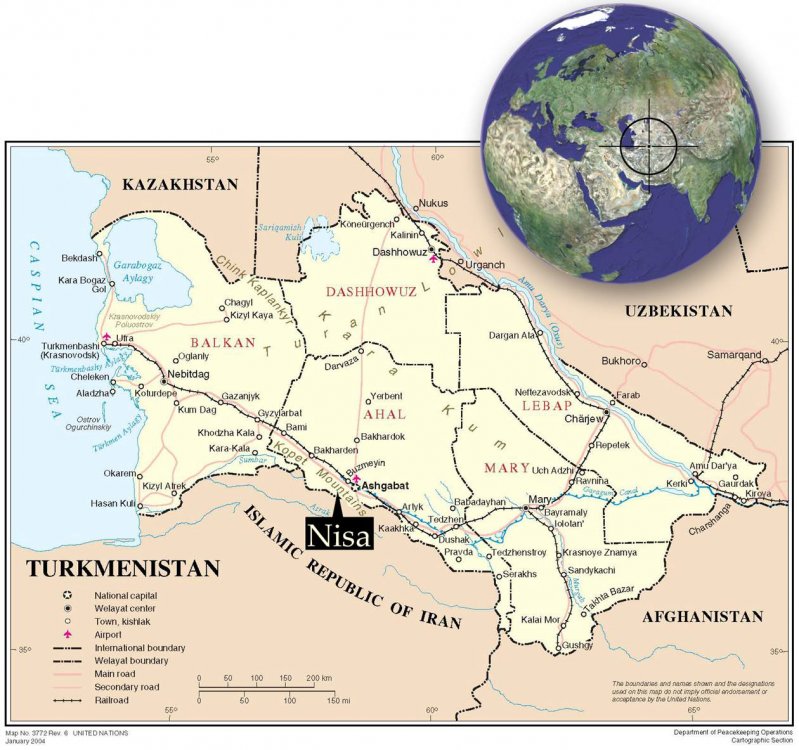
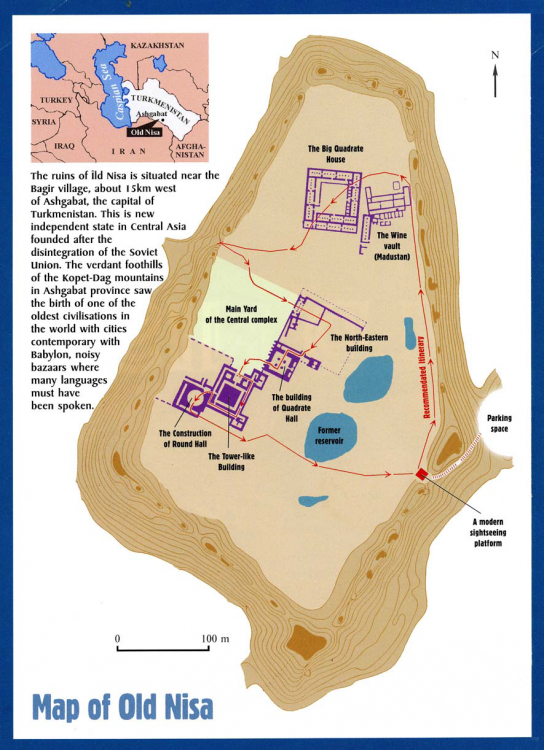
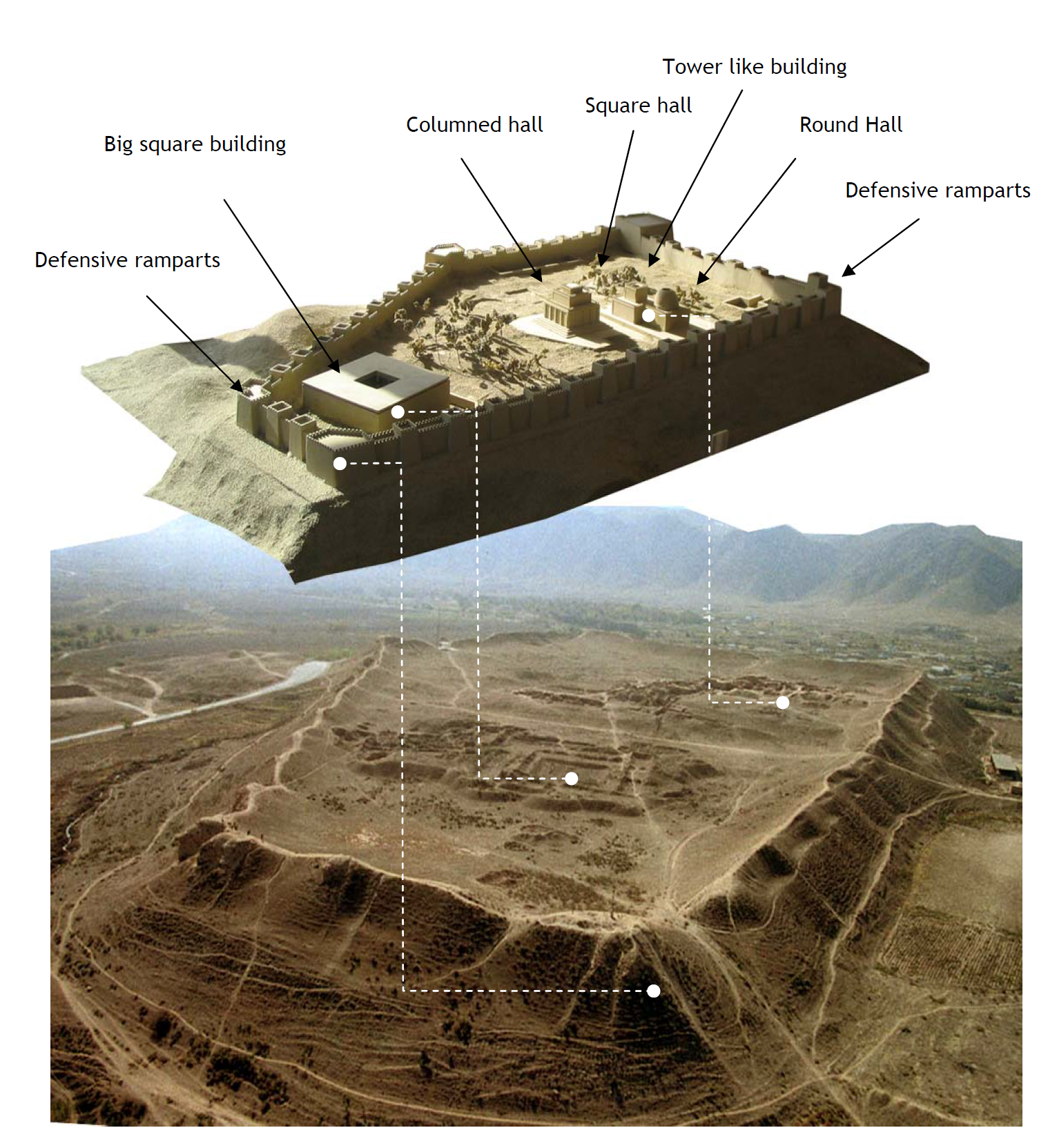
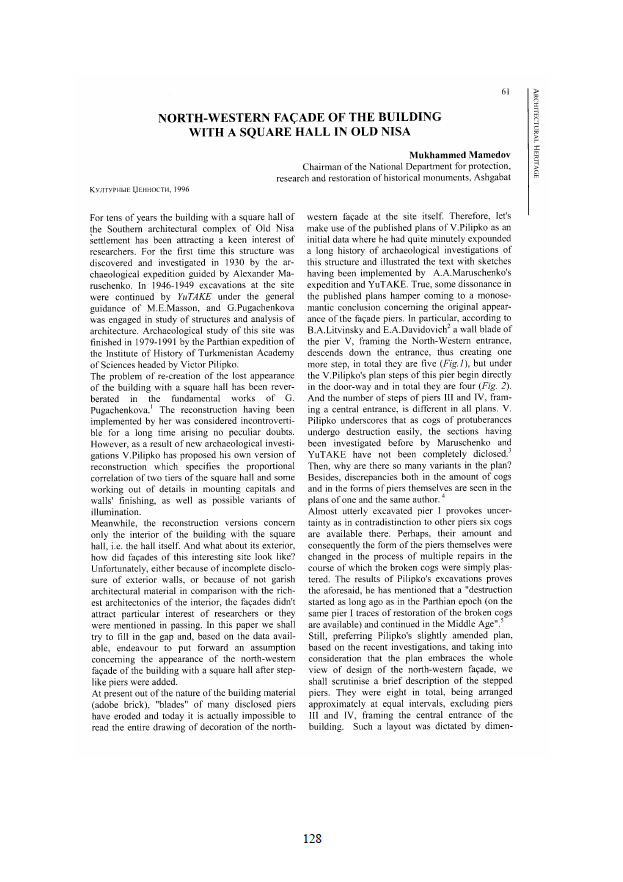
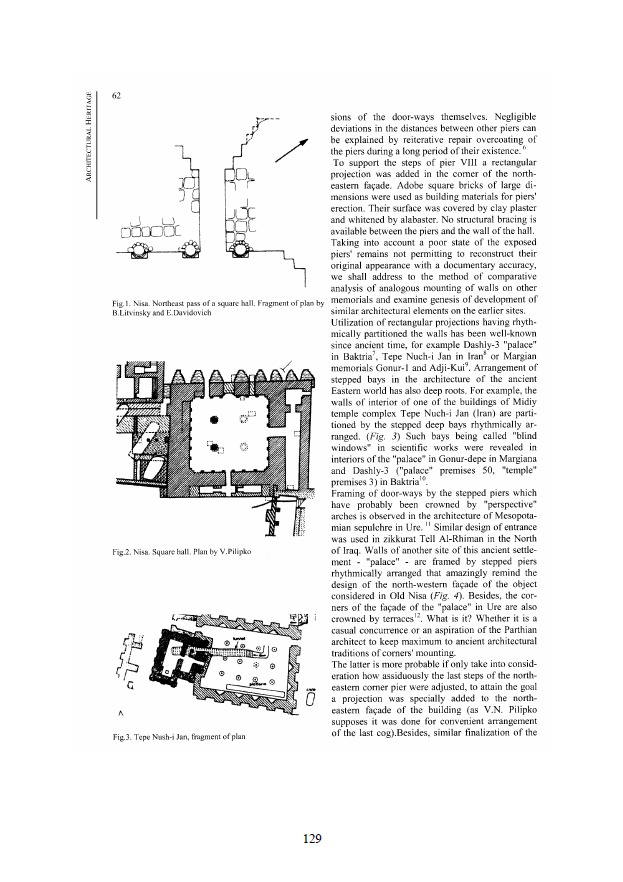
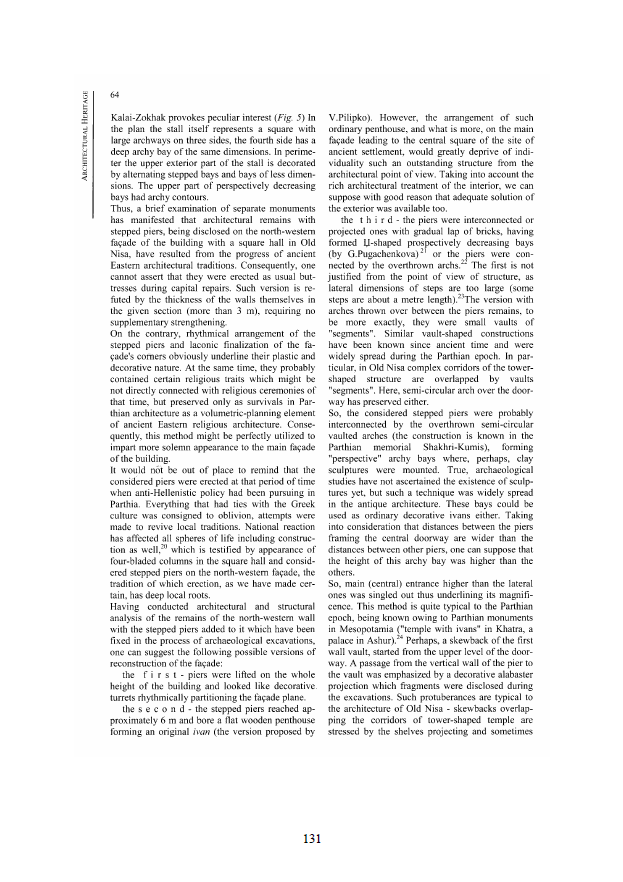
A useful document:
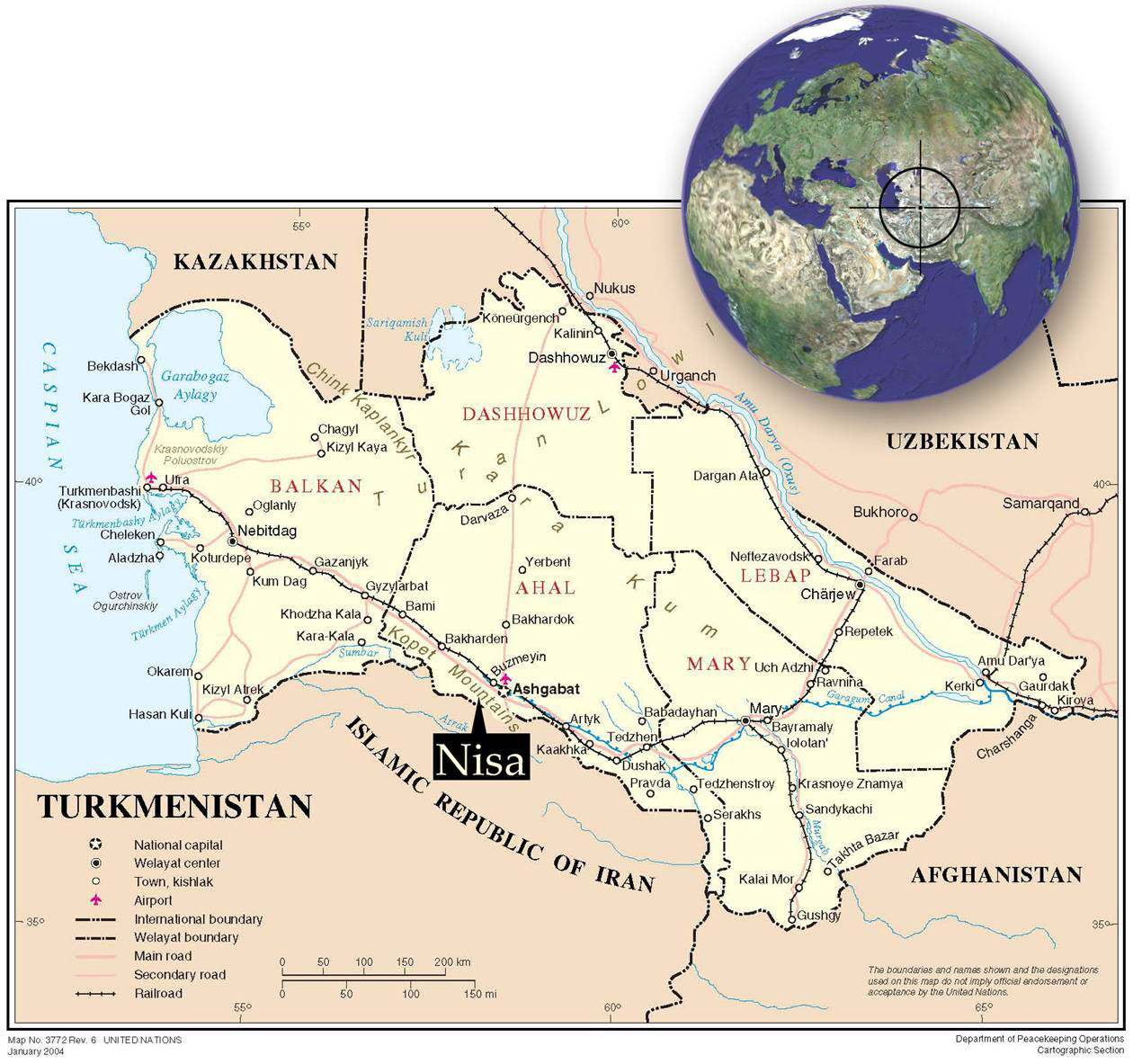
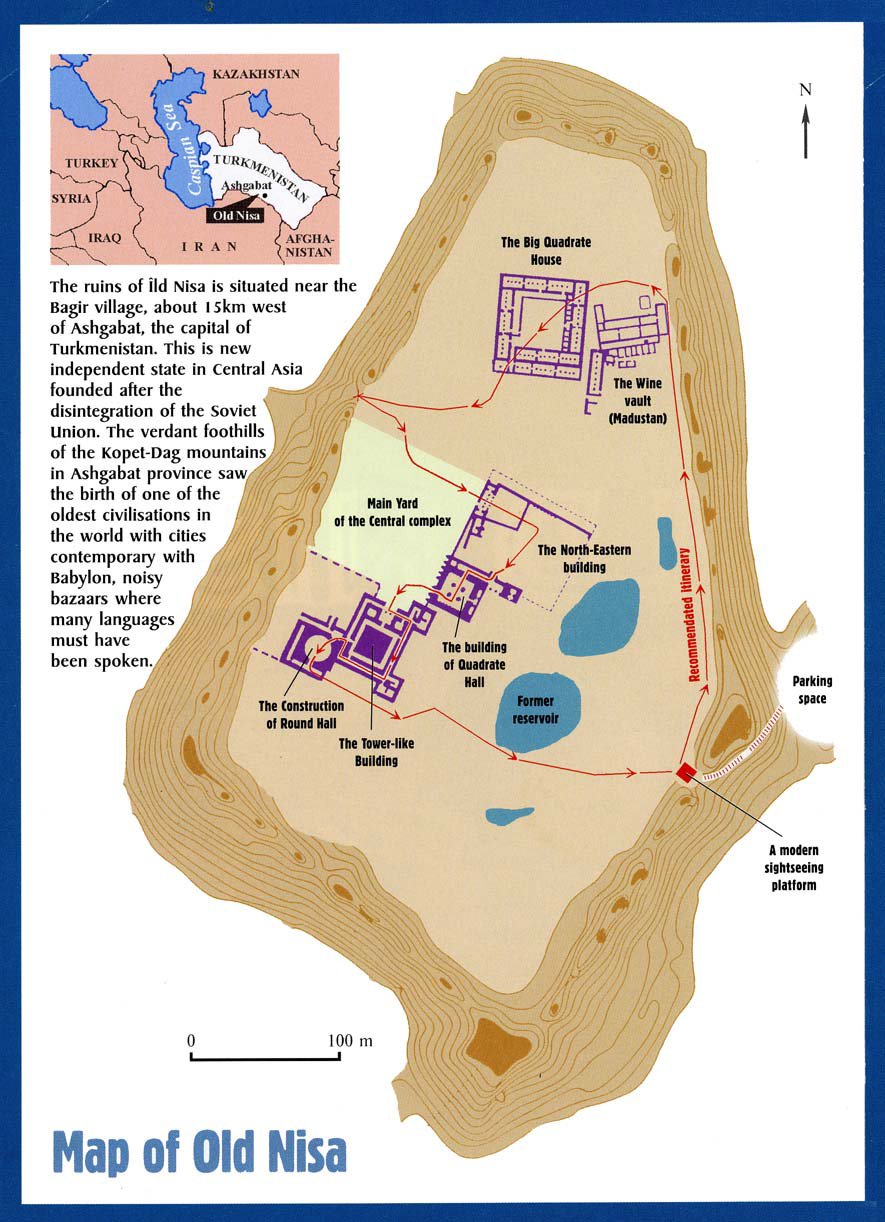
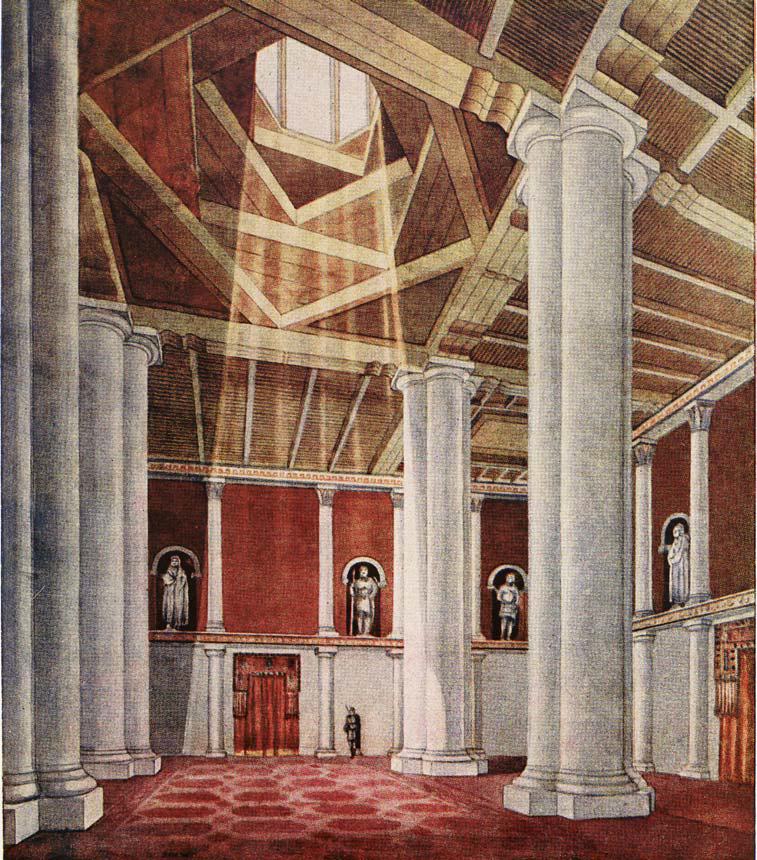
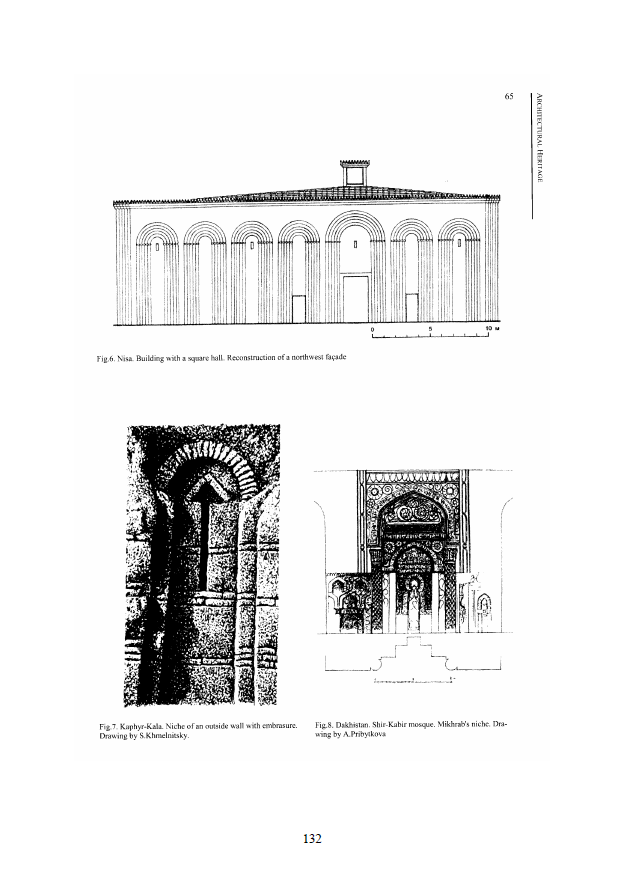
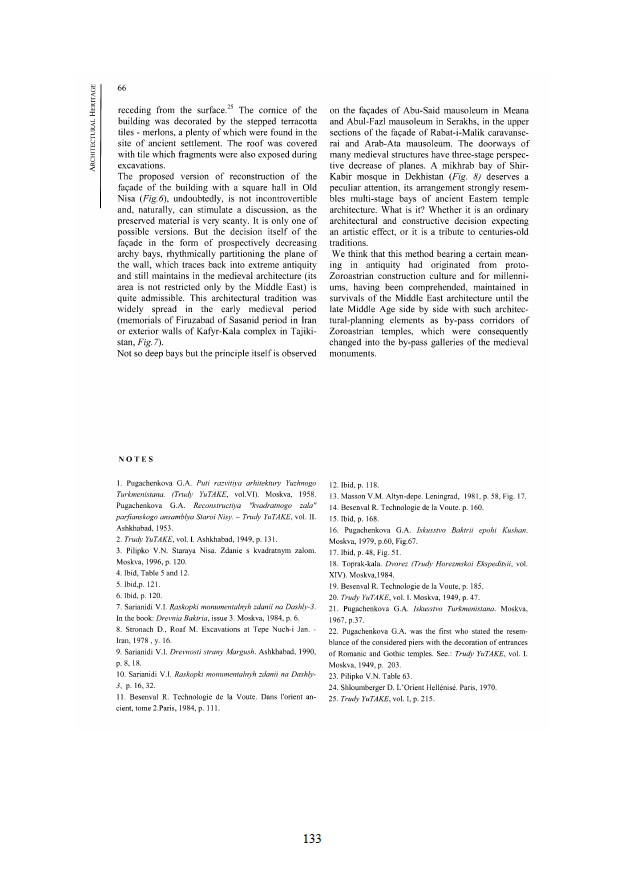
https://hal.science/hal-03117028v1/file/Proposition d'inscription Nisa TURKMENISTAN.pdf
This is for adding the Fortress of Nisa to the UNESCO.
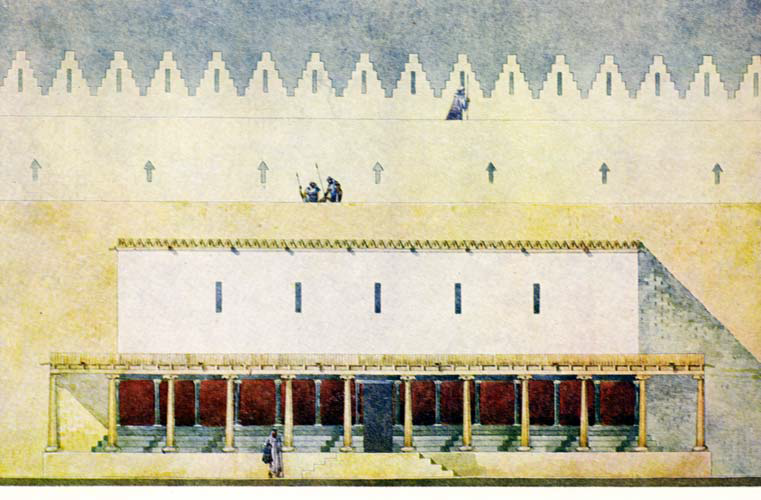
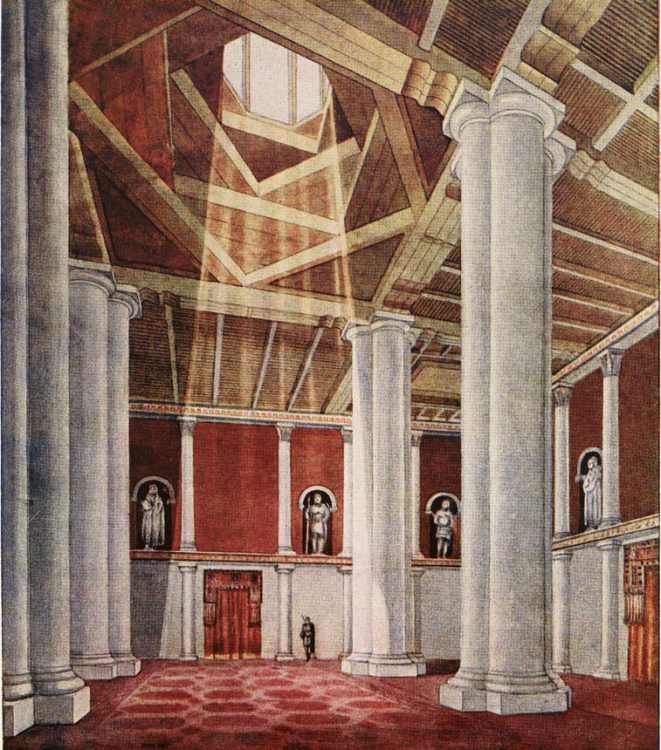
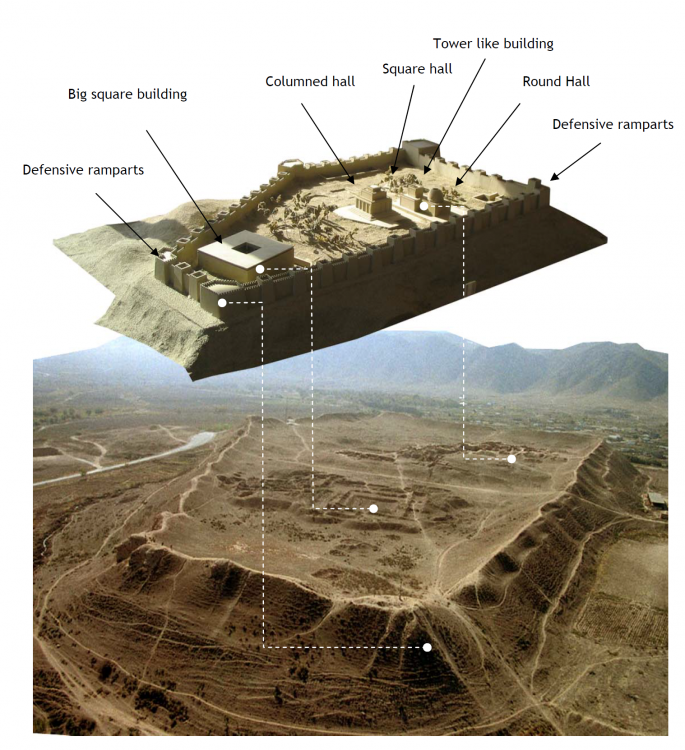 Spoiler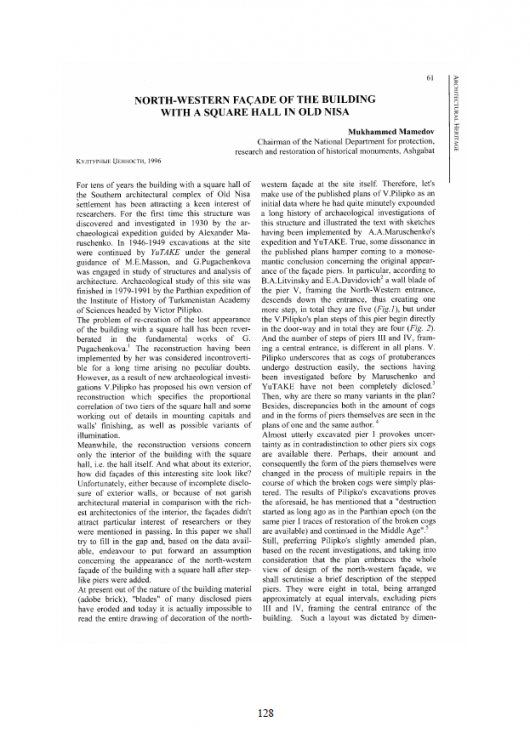

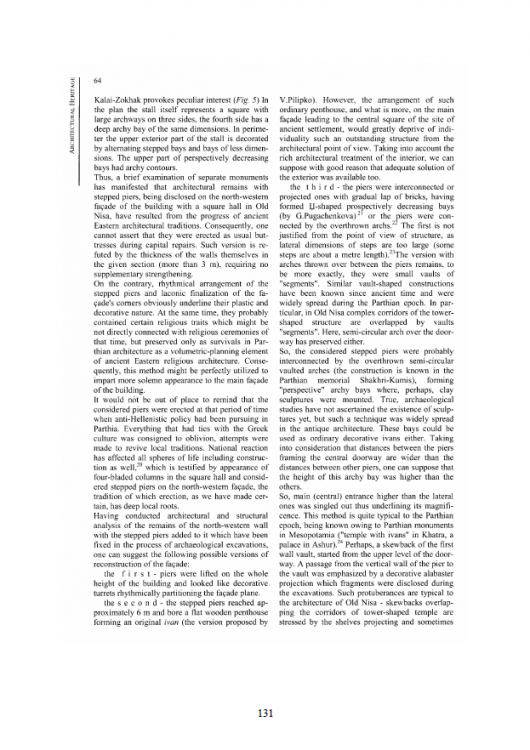
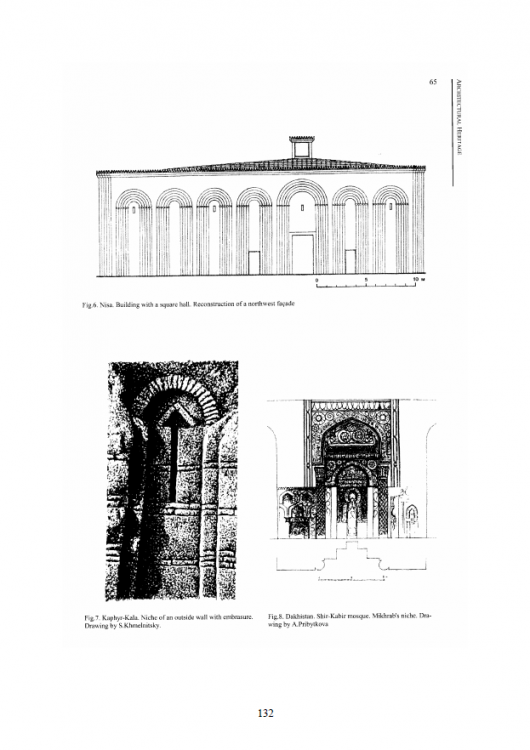
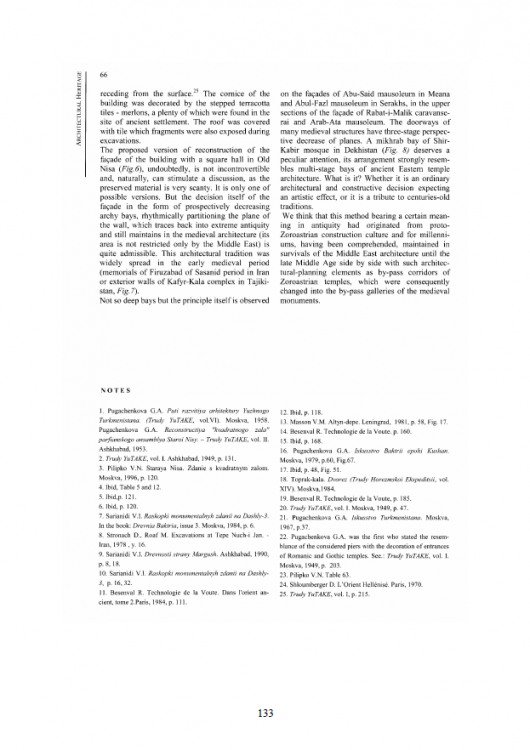
Better version can be found in the pdf link above
-
2
-
-
On 29/03/2025 at 12:08 AM, Grautvornix said:
In DelendaEst there is the additional concept of slaves (with a limited lifetime due to the hard life they are forced to endure). Could that be the additional working unit you are looking for?
Implementing a feature based on slavery could make a lot of differences. Firstly, it would be much more realistic and historical. Secondly, it would bring more differences between civilisations because they didn't practice slavery in the same way. Thirdly, slaves could be much more efficient at harvesting resources. The citizen soldier would therefore be more versatile and more defensive.
-
4
-
-
14 minutes ago, Deicide4u said:
While I'm in the minority that believes the change was good, attacking buildings without siege or a good number of elephants is currently a waste of time (in vanilla version, not Community mod).
Change is not inherently bad. It's just bad execution.
There is clearly room for improvement in the implementation of territory and capture features. Changing the default is understandable.
-
1
-
-
22 minutes ago, Deicide4u said:
AoE is not open-source. It is also rather bland with every civilization feeling the same. I'm talking mostly about AoE2 here. AoE3 and 4 are not my cup of tea.
Age of Empires has always had many excellent mods. The only constraint is that the definitive edition now receives numerous updates, which discourages modders.
-
Honestly, it was probably one of the clumsiest and most immature changes ever made.
Currently it is a hidden feature most new players won't see and understand.
The information is buried in the manual and the list of hotkeys.
Clearly, it should have a button in the UI.
Don't forget that you're in a bubble and that other people don't follow all your discussions all the time.
-
2
-
-
-
4 hours ago, Emacz said:
but were they actually used to fight enemies or more purely entertainment for Rome?
Not really. Most of the accounts are rebellions against Rome, like Spartacus and Sacrovir.
I think there is an account when Otho and Vitellius fought against each other, they recruited gladiators. But I don't think they fought with their gladiatorial weapons.
We know however that experts from the Gladiatorial schools participated to the training of legionaries in the army, to teach them the use of weapons.
-
1 hour ago, Stan` said:
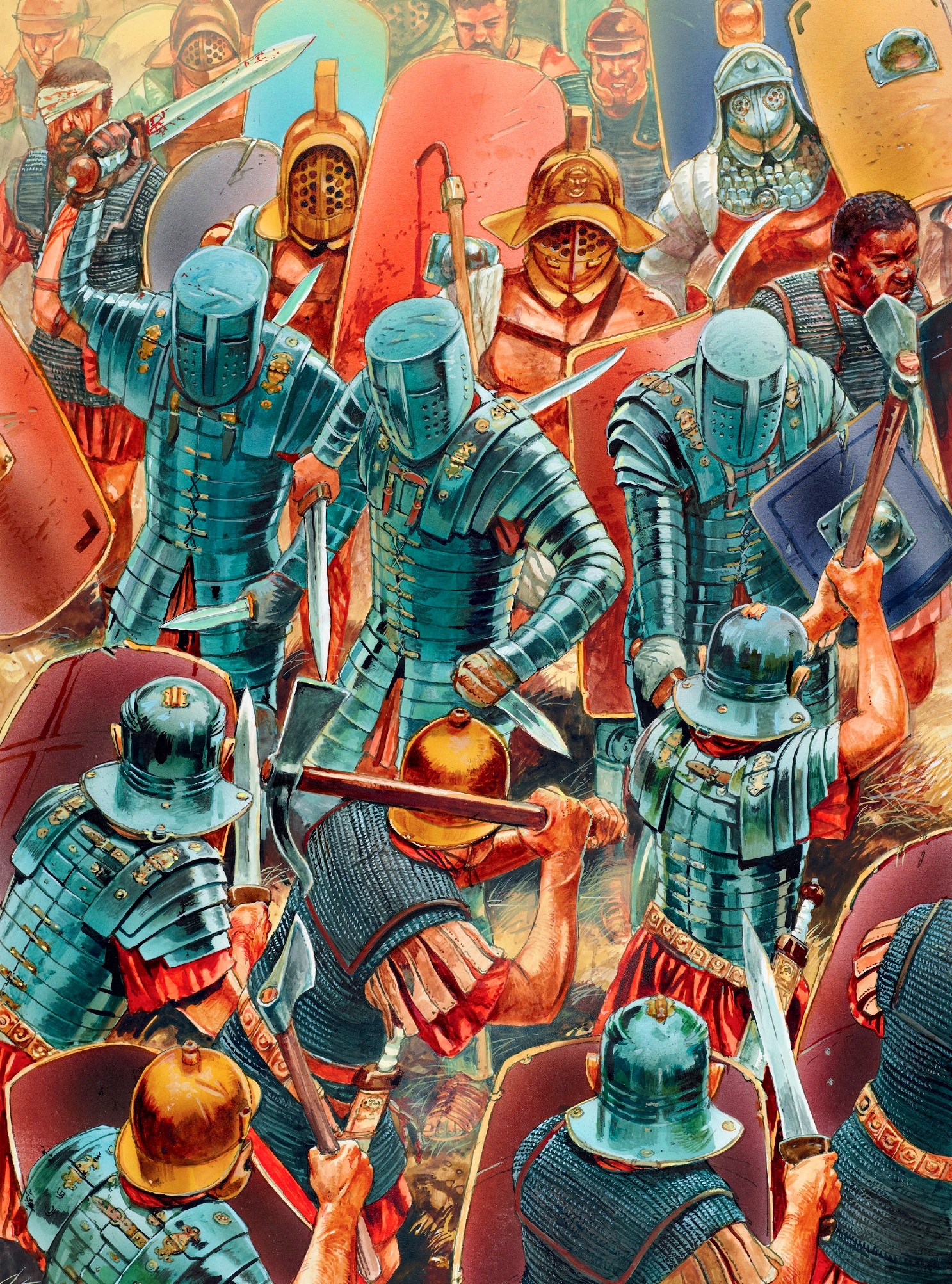
@Genava55 that last image, the helmets are medieval not roman right ?
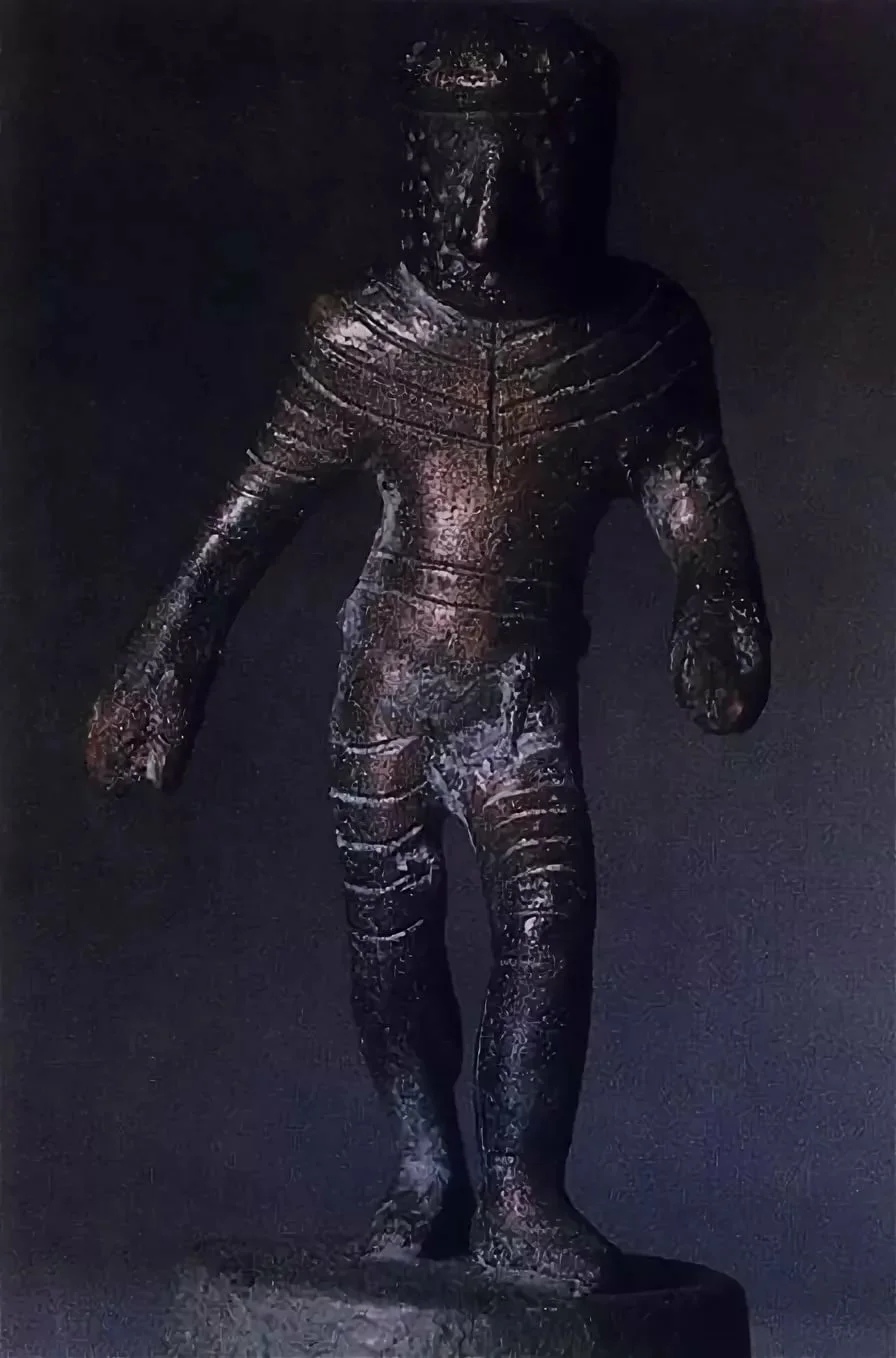
It is based loosely from a Roman bronze figurine depicting a sort of gladiators, generally interpreted as Crupellarii:
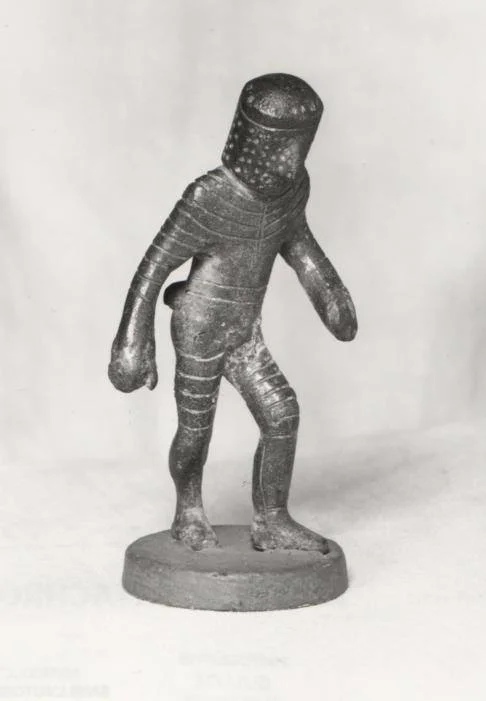

In 21 AD during the reign of Emperor Tiberius, two Gaulic nobles named Julius Florus and Julius Sacrovir revolted against the Roman Empire. The revolt was a result of the denial of frequent petition for tax relief and debt forgiveness among Gaulic debtors. Florus and Sacrovir managed to raise an army of 40,000 rebels, some of whom were professional gladiators. Among those gladiators was the Crupellarius, a class of gladiator that was particularly popular in Gaul. The Crupellarius was a heavily armed and armored gladiator who was typically a very tall, large, and muscular man. Florus and Sacrovir placed the Crupellarii as the front ranks of their army, where they were to act as human tanks, pummeling and bashing through the Roman ranks. Once in battle, the Romans found that their gladii and pilum (javelins) were practically useless against the Crupellarius’ heavy armor. Thus, Roman soldiers retrieved their engineering tools such as axes, adzes, and pickaxes. Using them as weapons the Romans were able to pierce the Crupellarius’ heavy armor and batter down the behemoths. Once the Crupellarii were defeated, the remaining Gaulic rebels were slaughtered.
QuoteIn addition were some slaves who were being trained for gladiators, clad after the national fashion in a complete covering of steel. They were called crupellarii, and though they were ill-adapted for inflicting wounds, they were impenetrable to them [...]
the cavalry threw itself on the flanks, and the infantry charged the van. On the wings there was but a brief resistance. The men in armour were somewhat of an obstacle, as the iron plates did not yield to javelins or swords; but our men, snatching up hatchets and pickaxes, hacked at their bodies and their armour as if they were battering a wall. Some beat down the unwieldy mass with pikes and forked poles, and they were left lying on the ground, without an effort to rise, like dead men.
- Tacitus, Annales, III, 40-46
-
Une vidéo en français sur le Cirque Maxime:
-
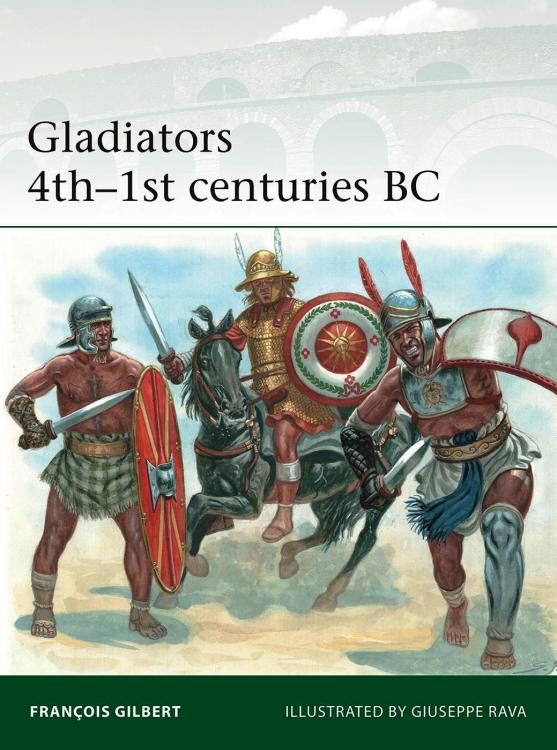
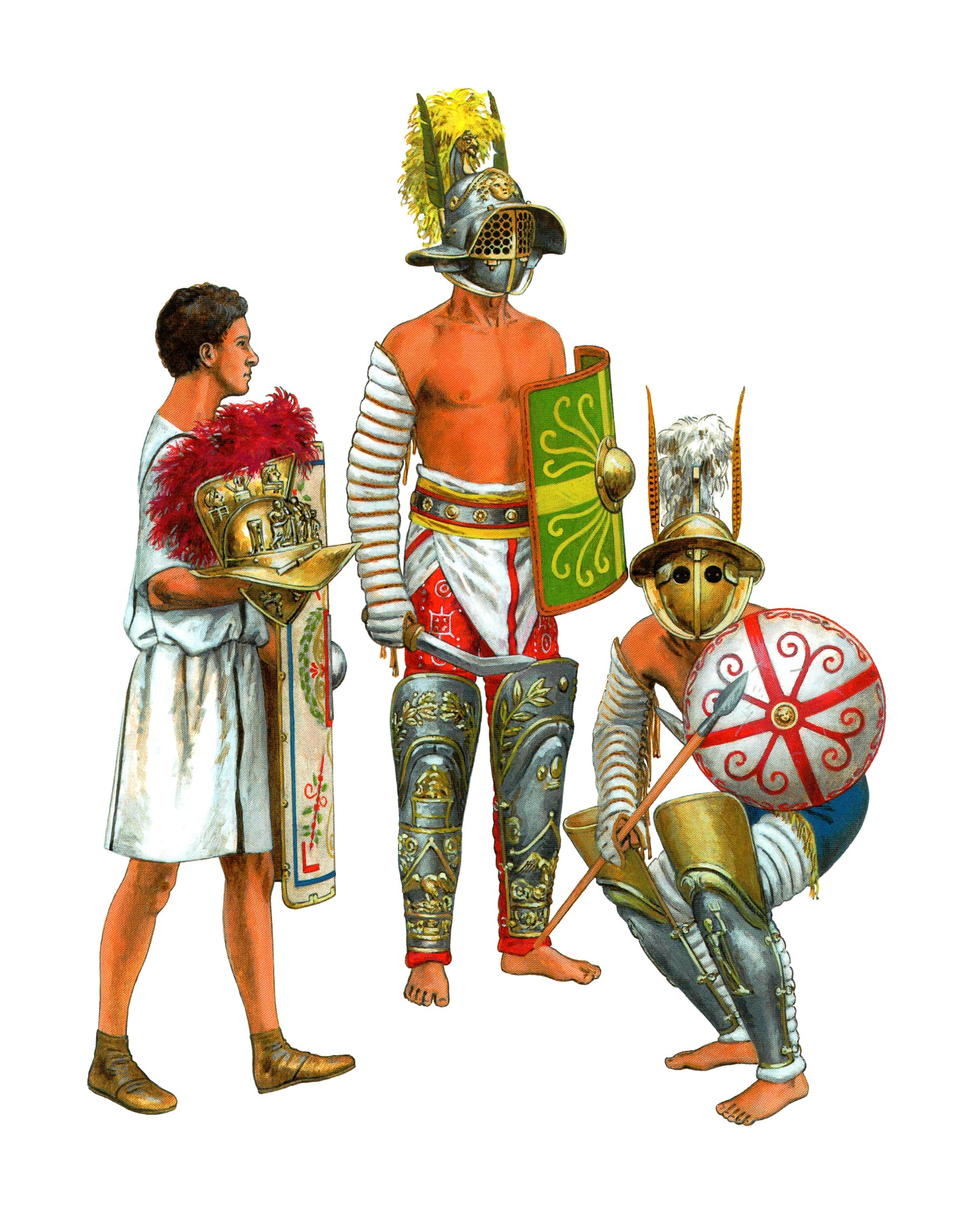
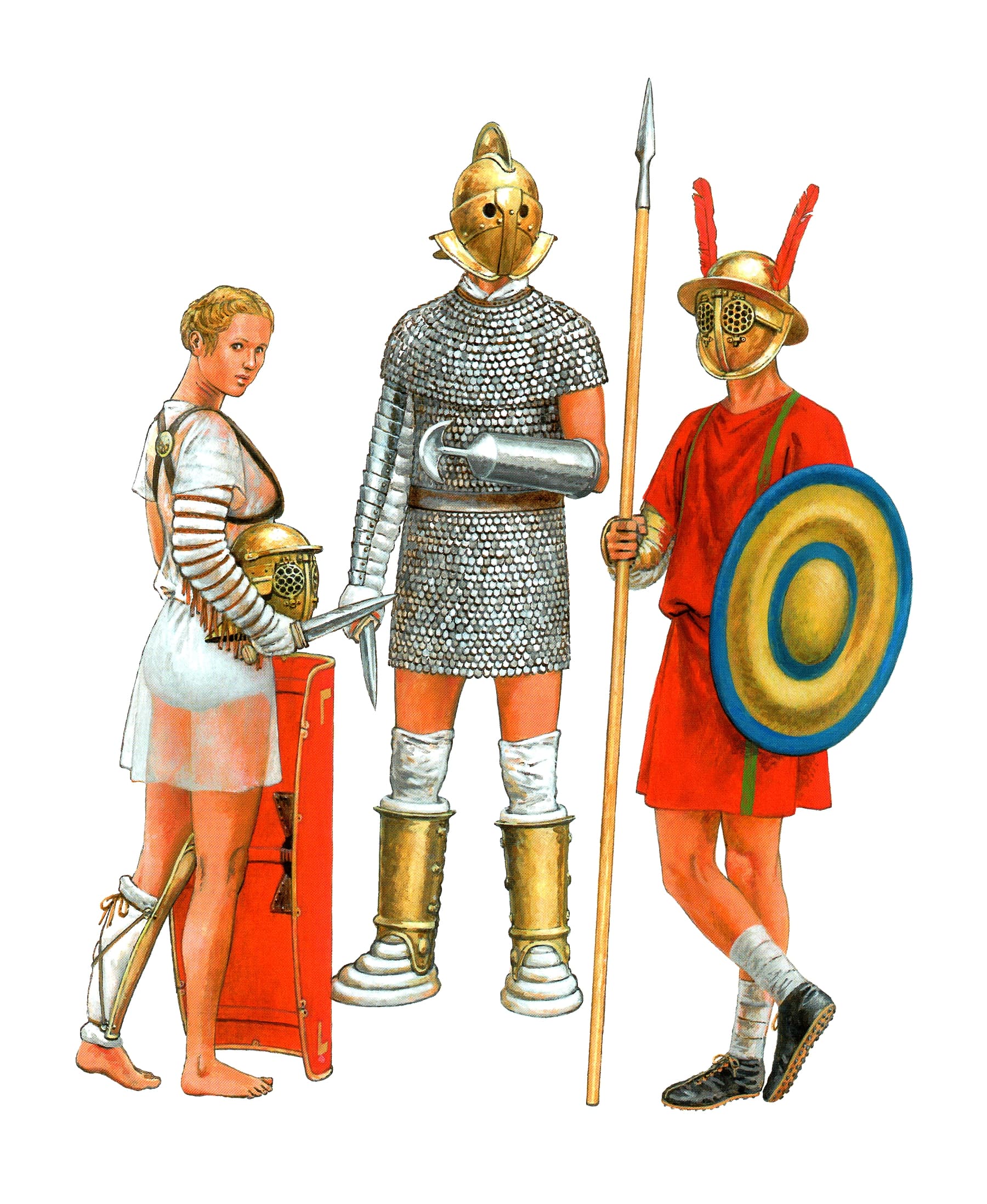
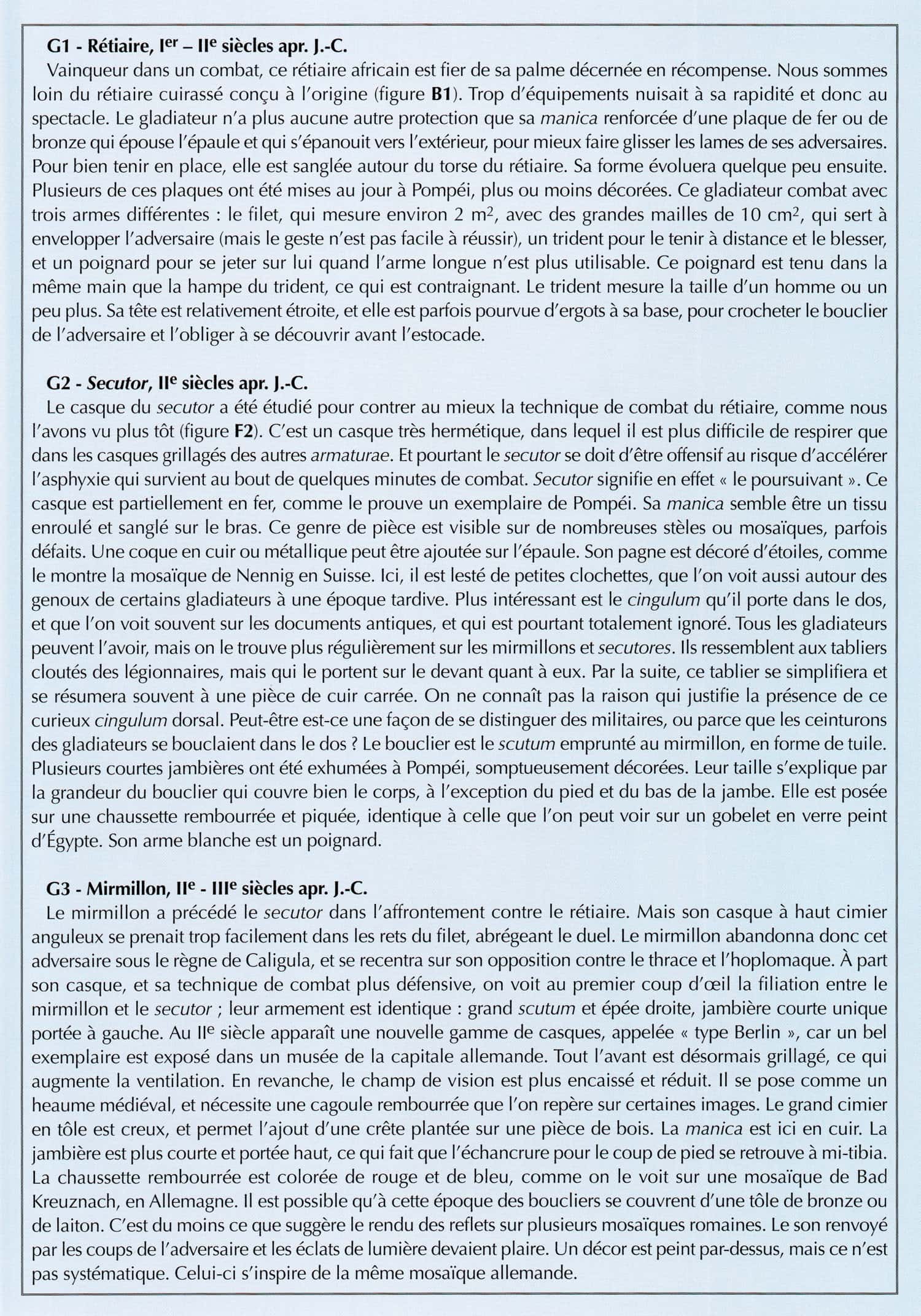
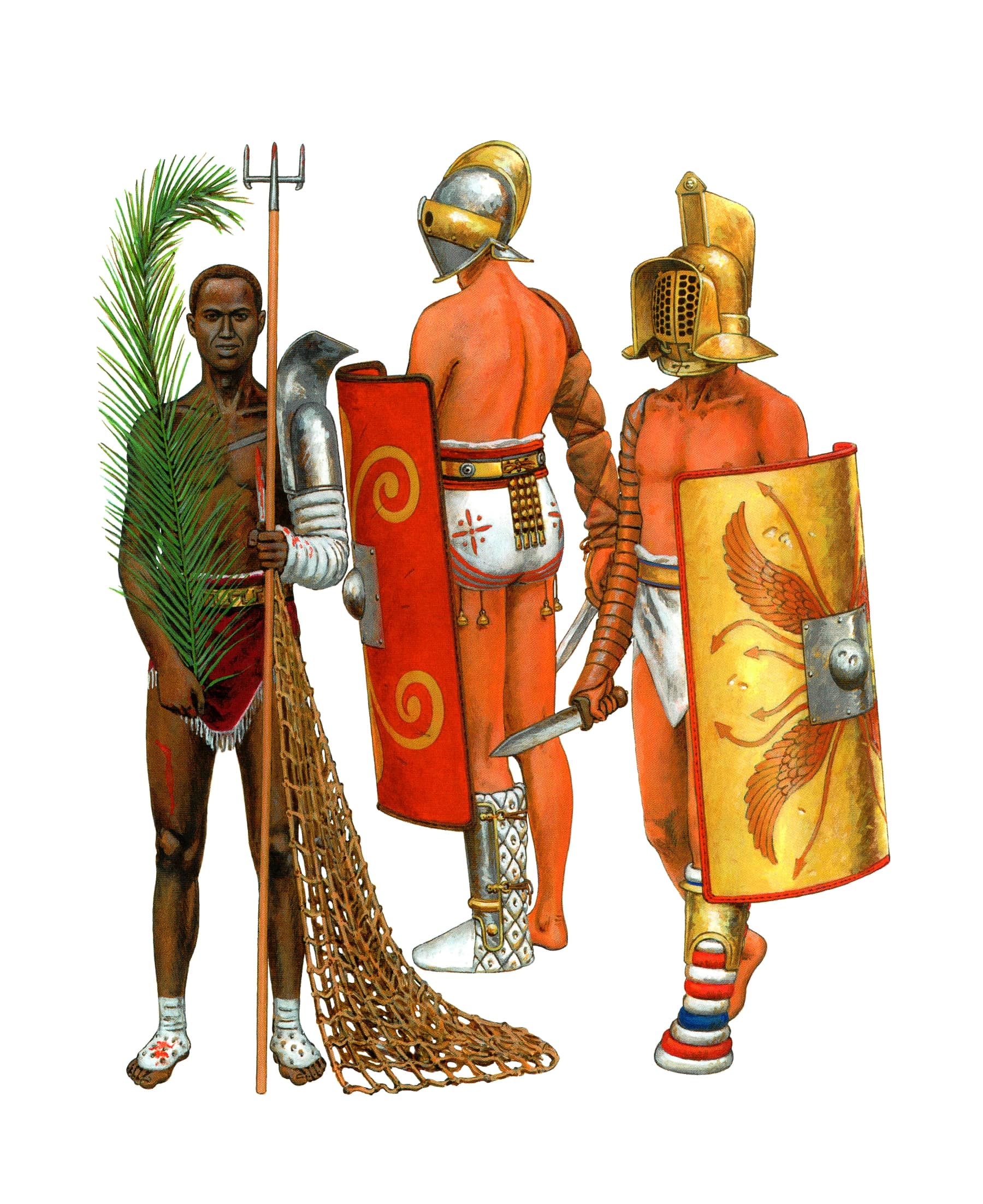
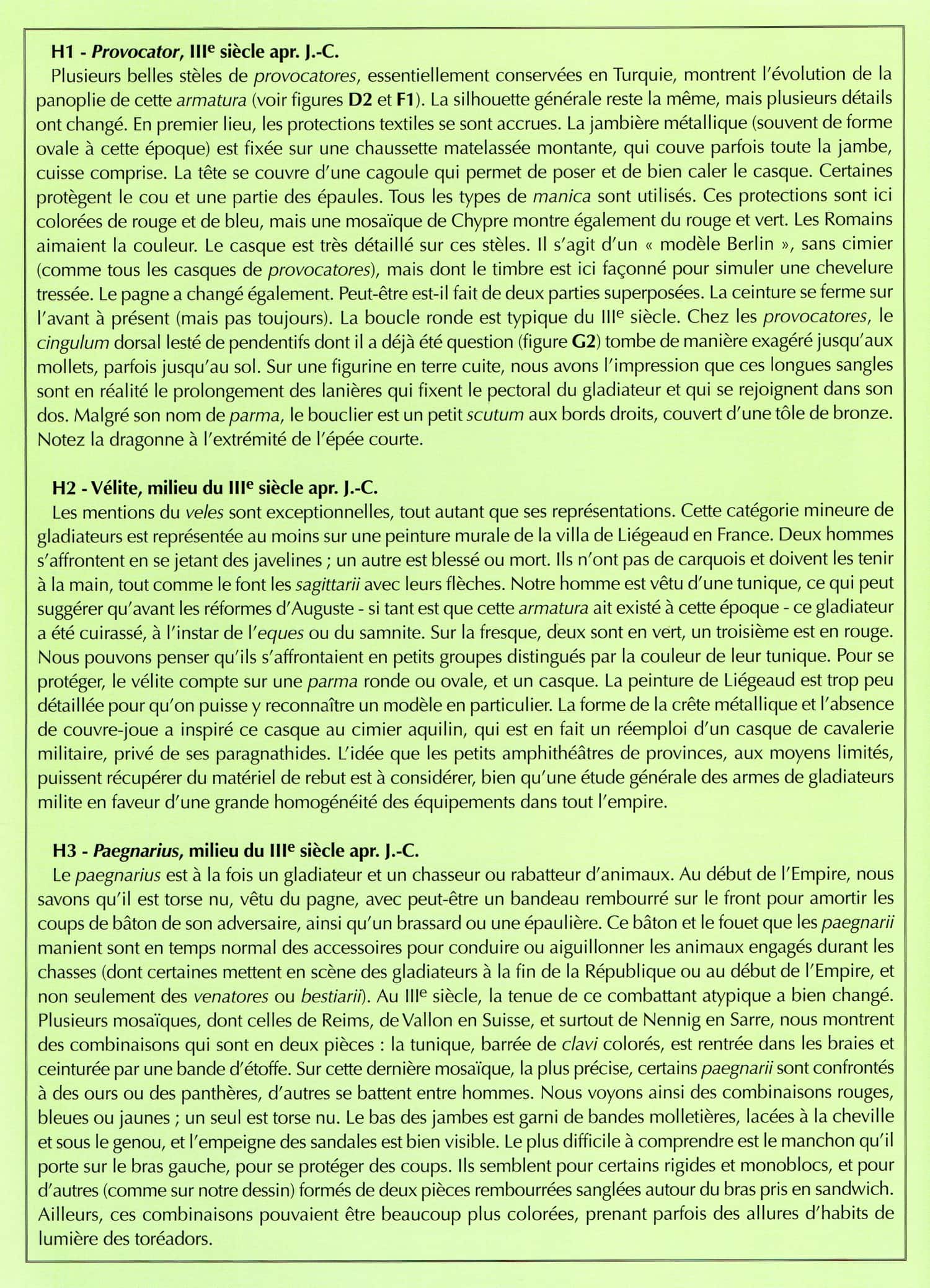
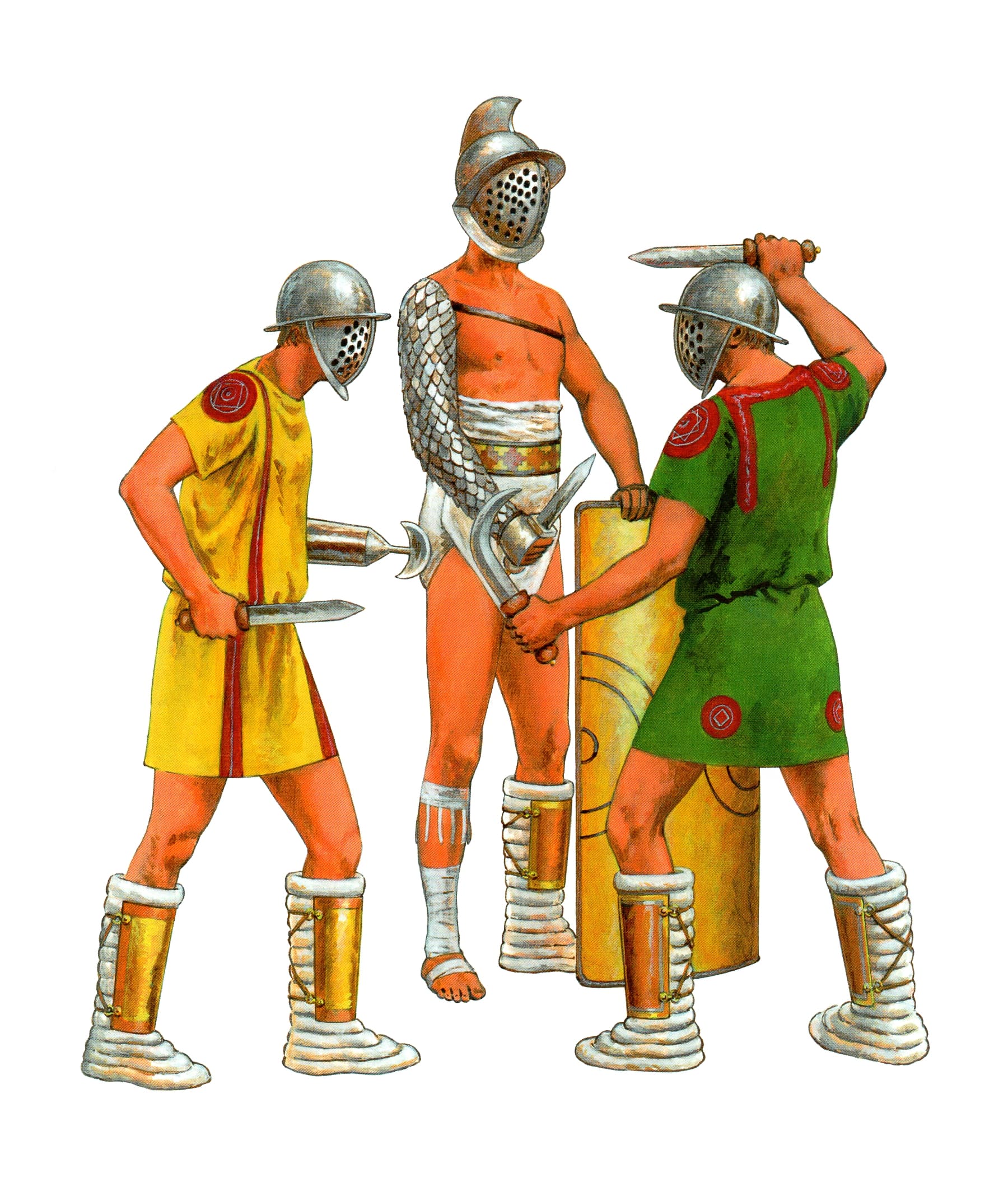
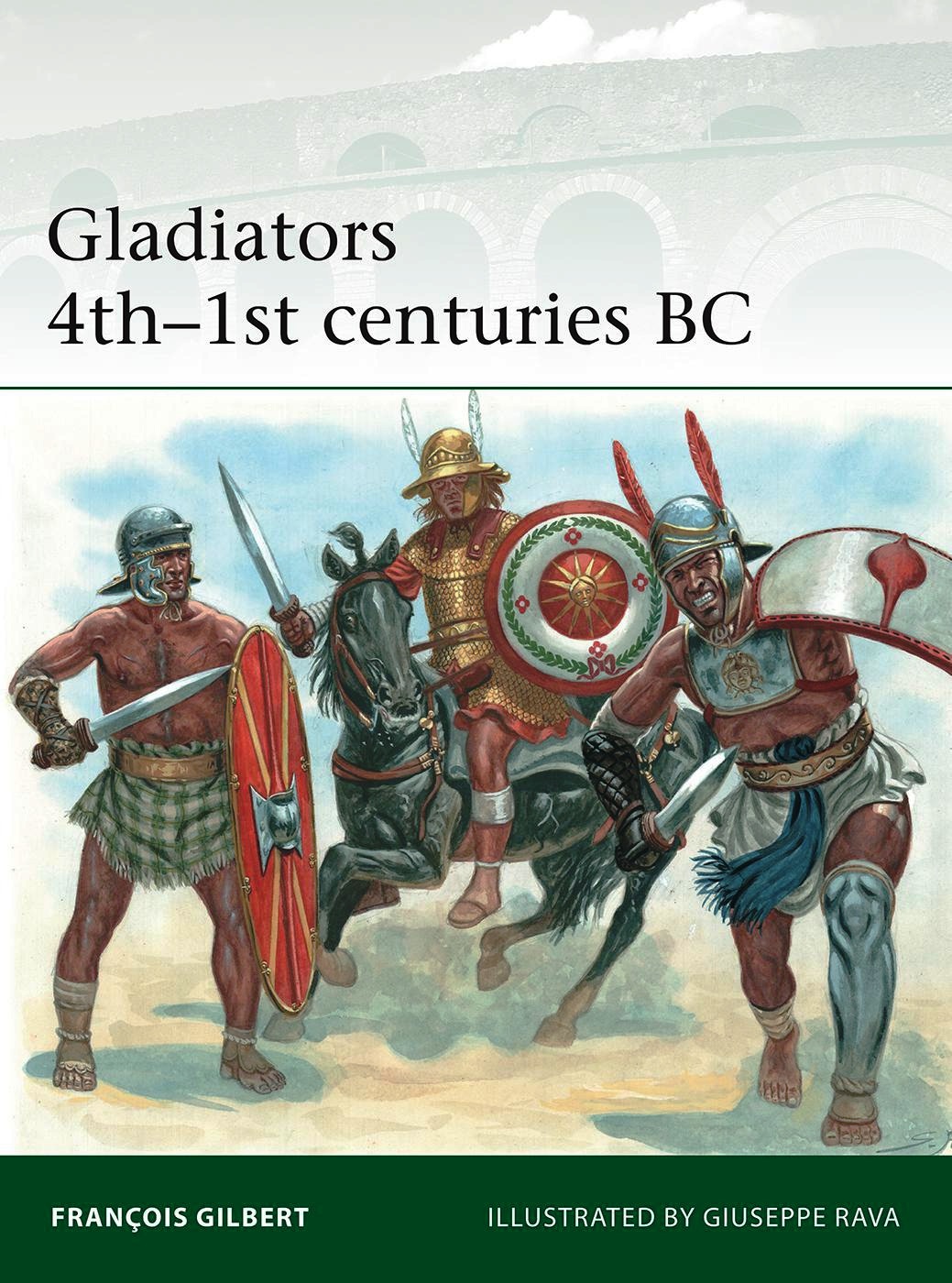
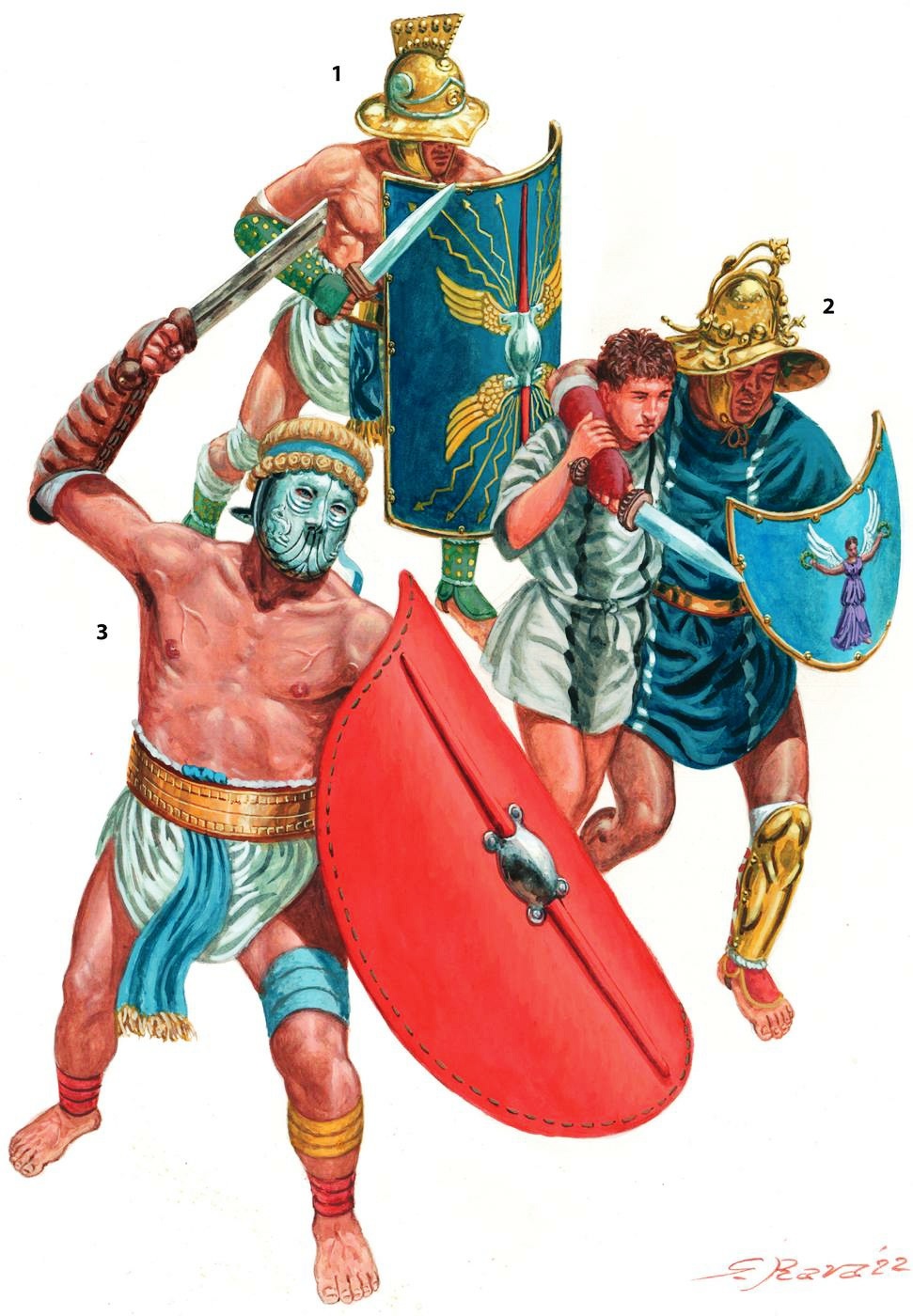
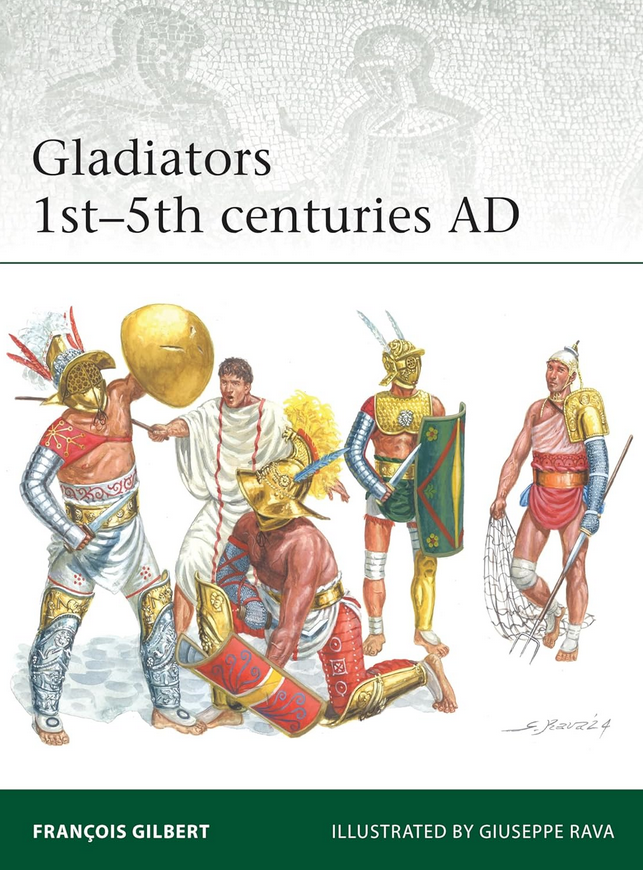
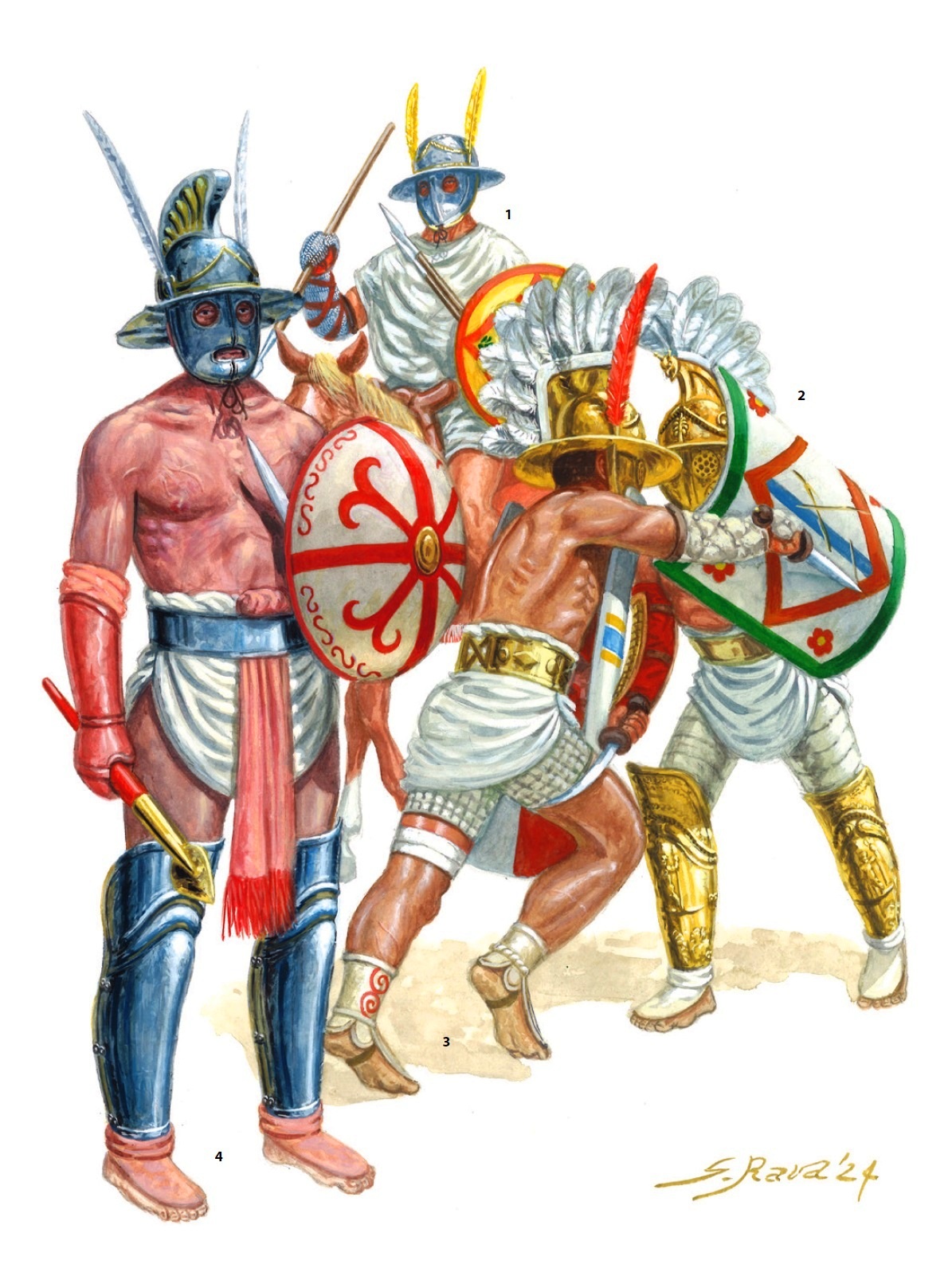
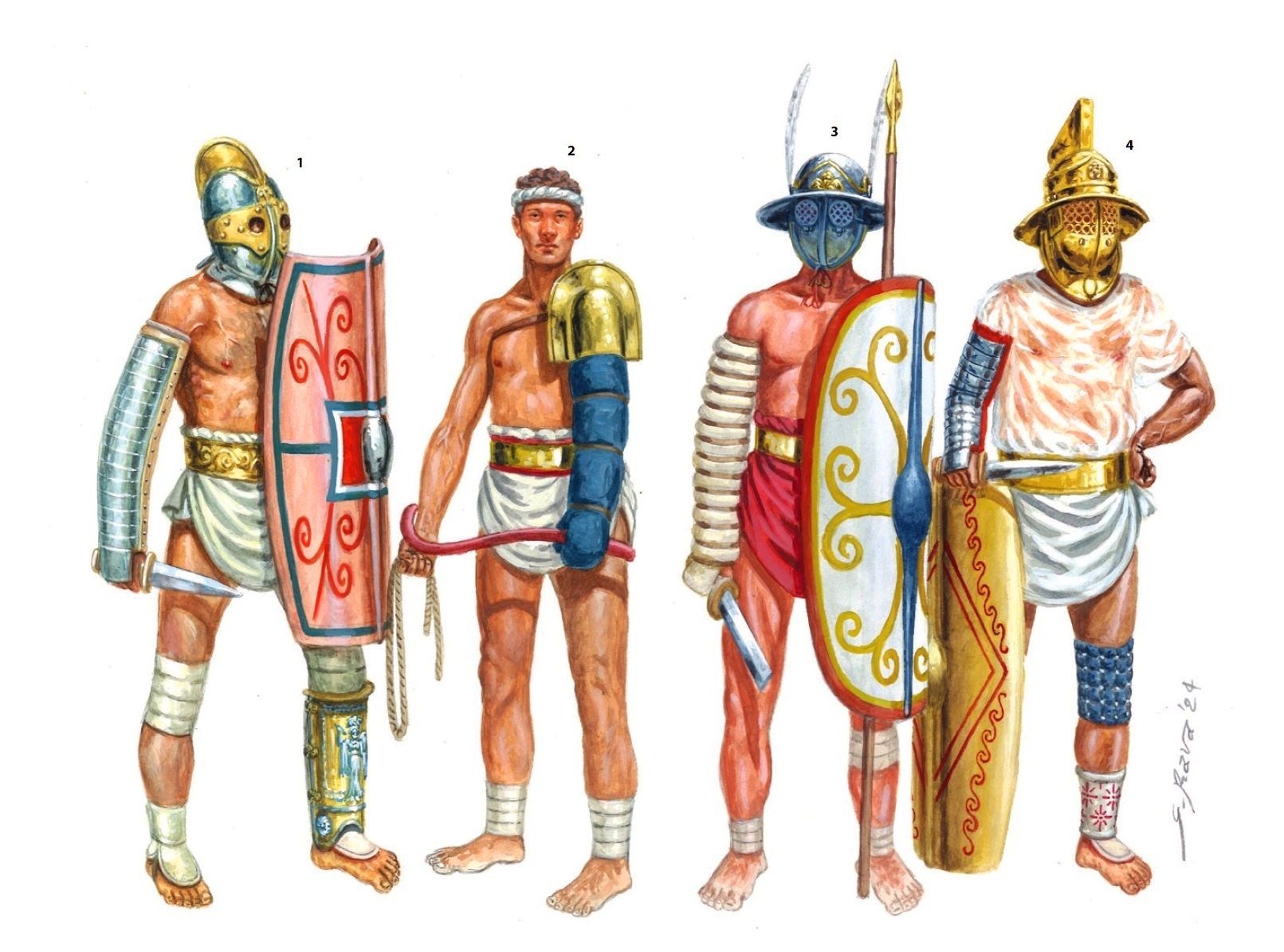
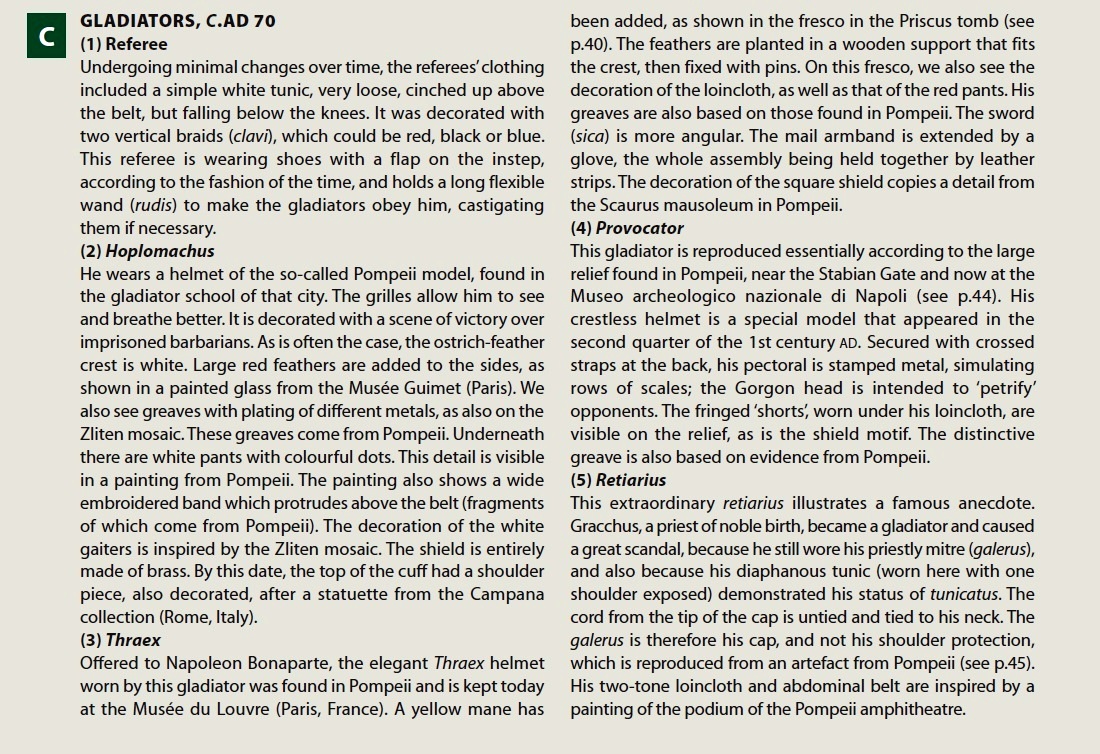
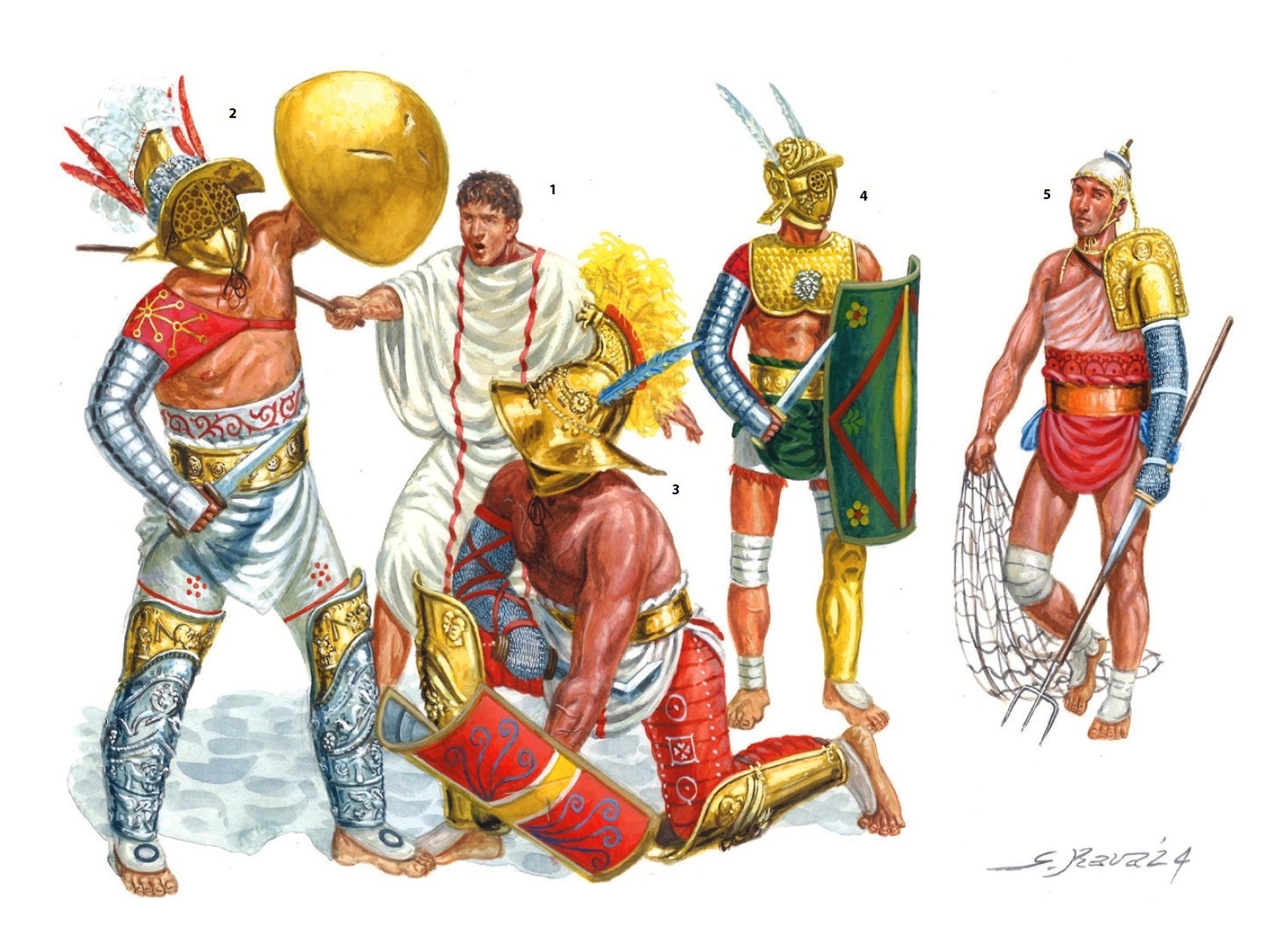
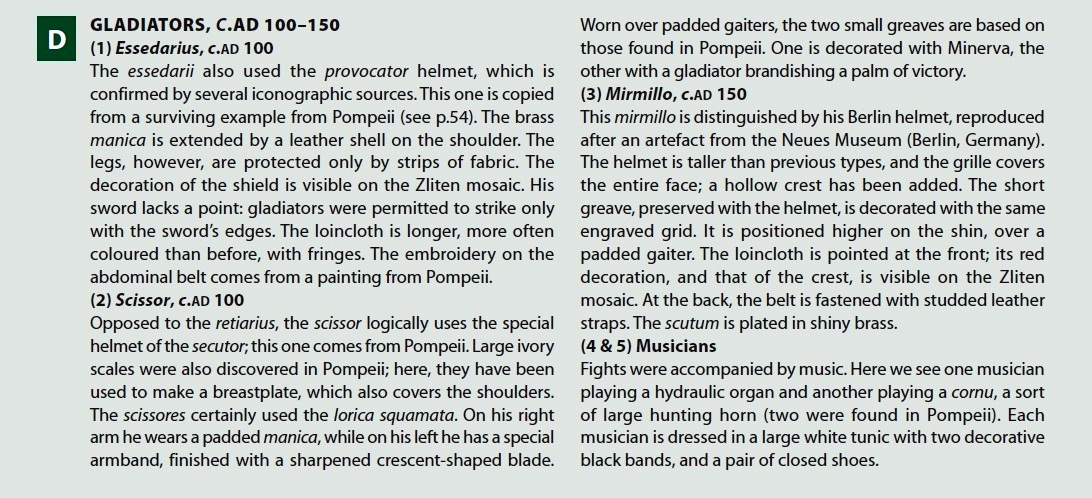
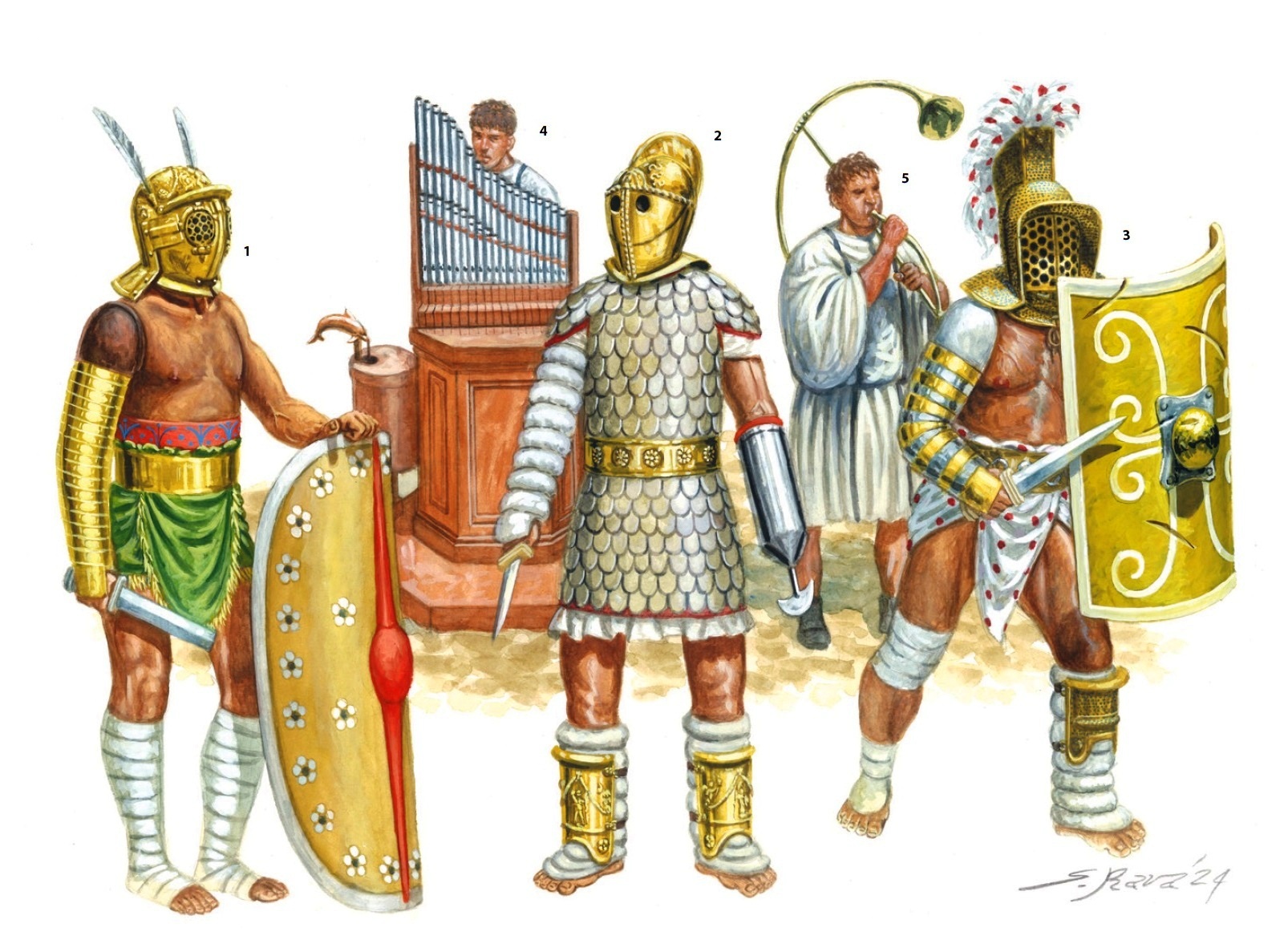
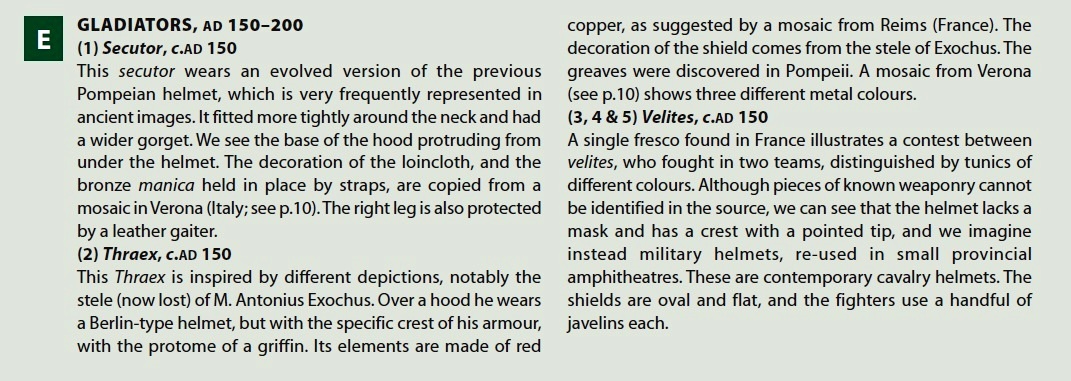
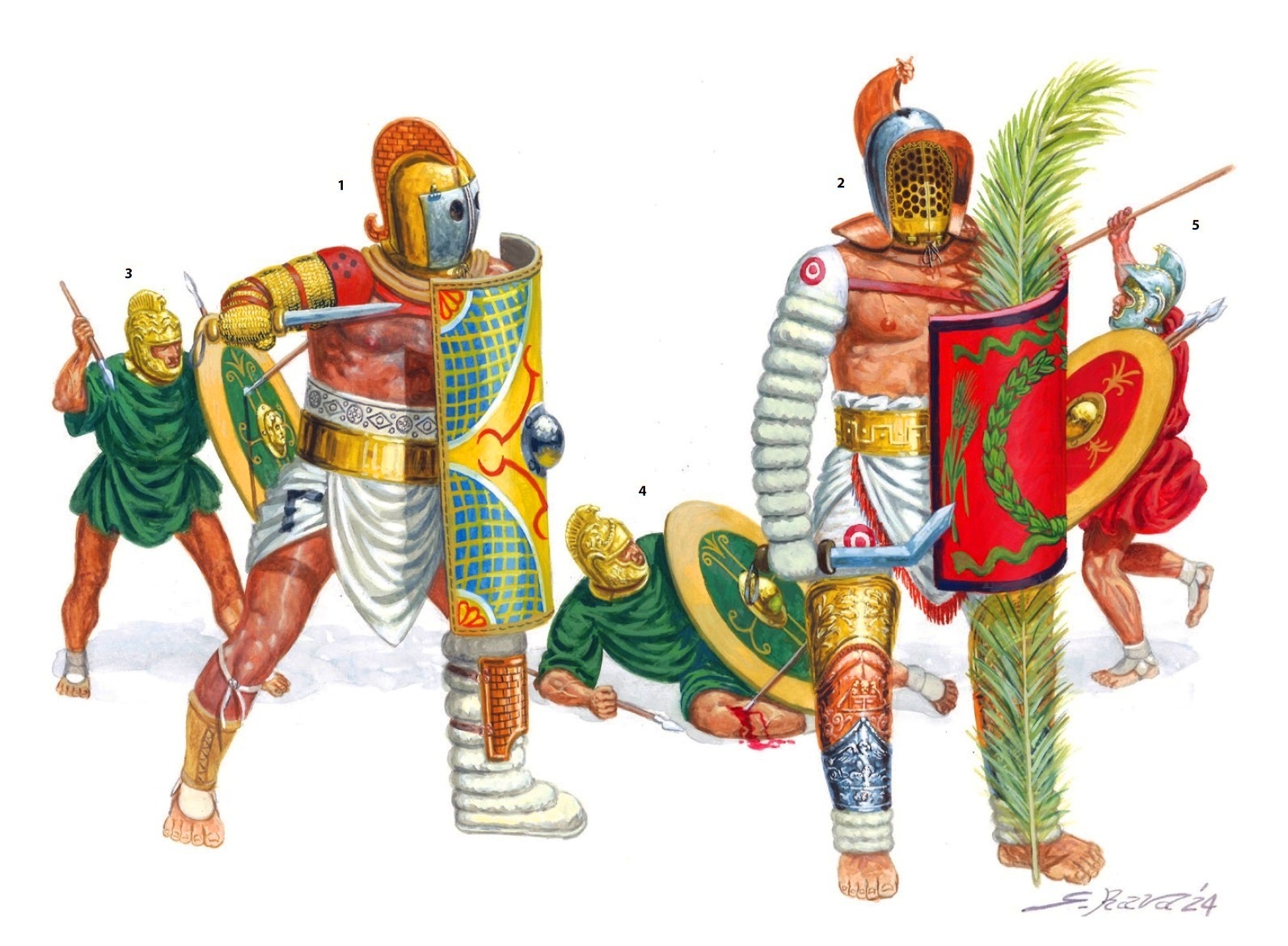
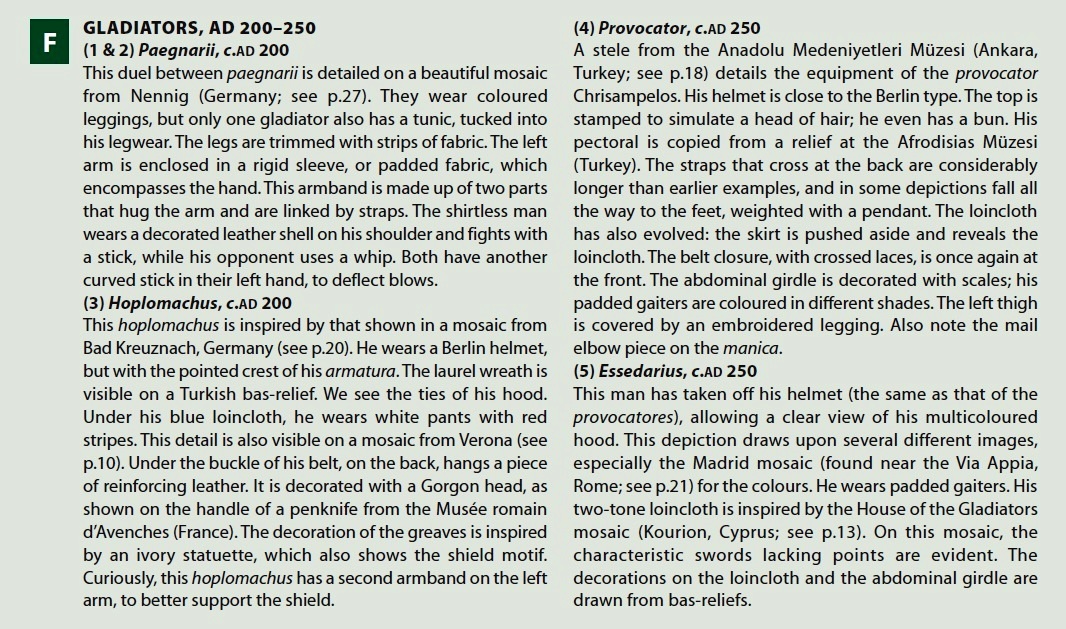
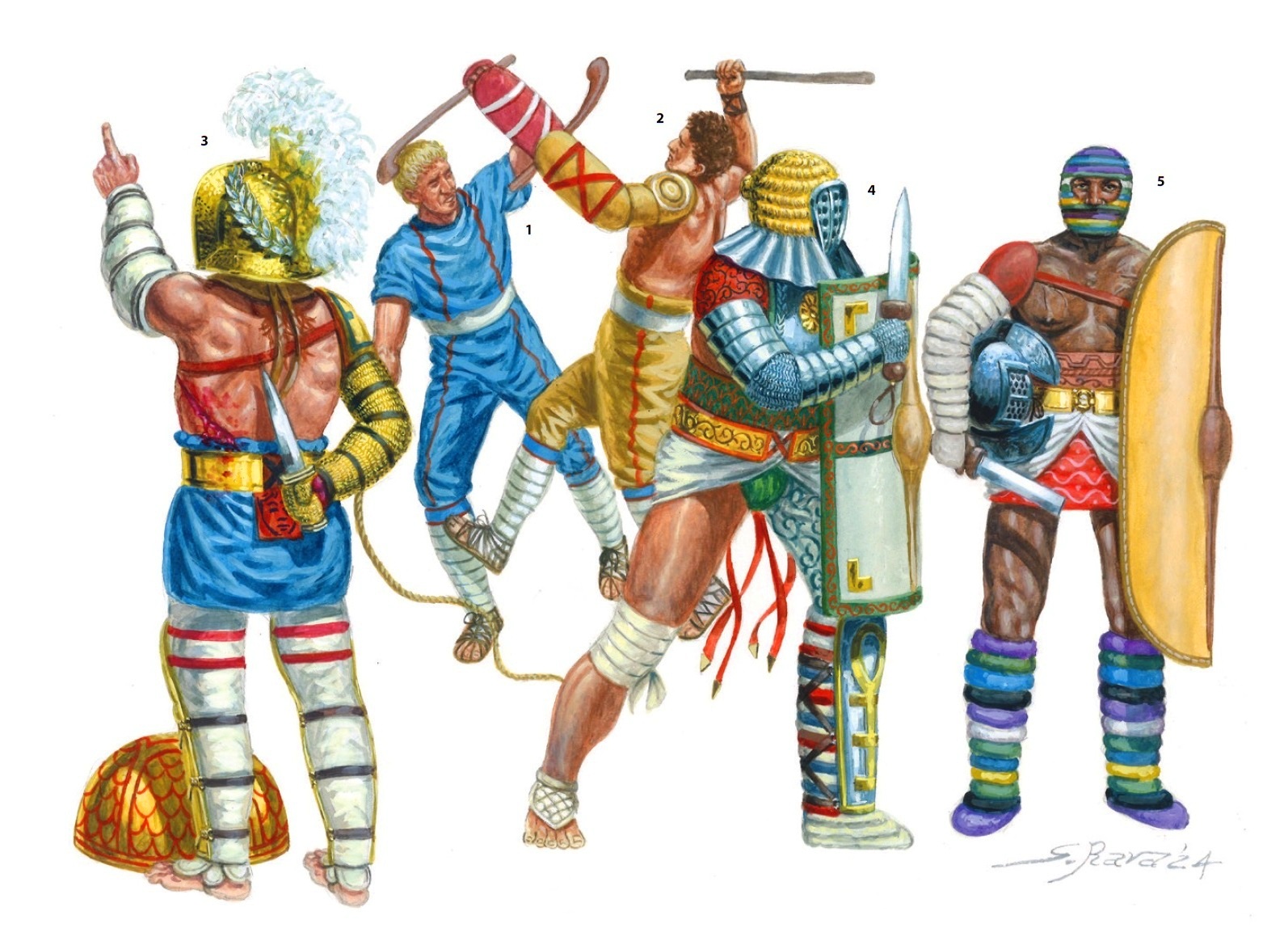
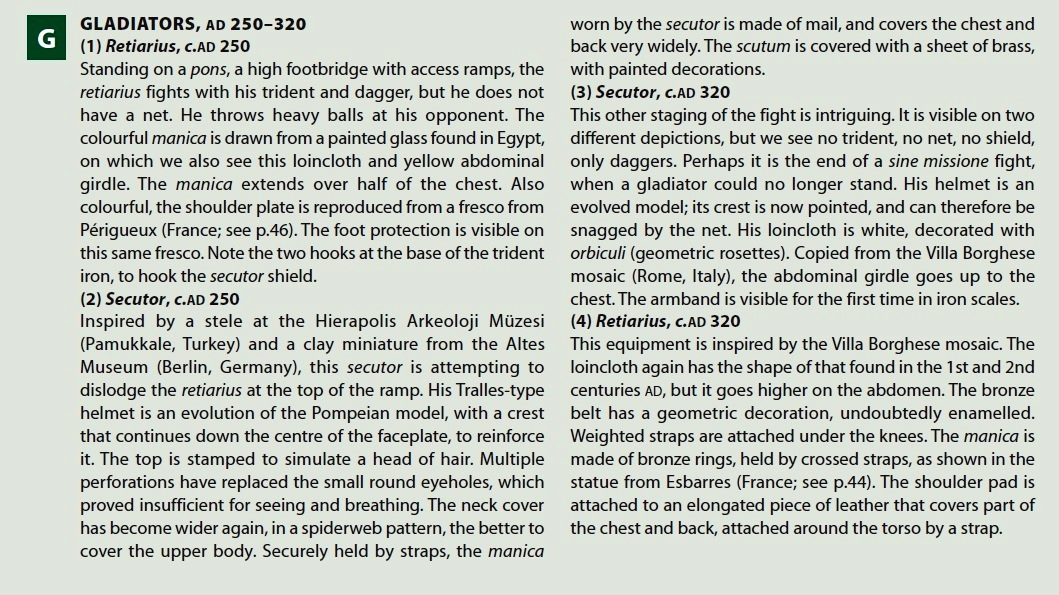
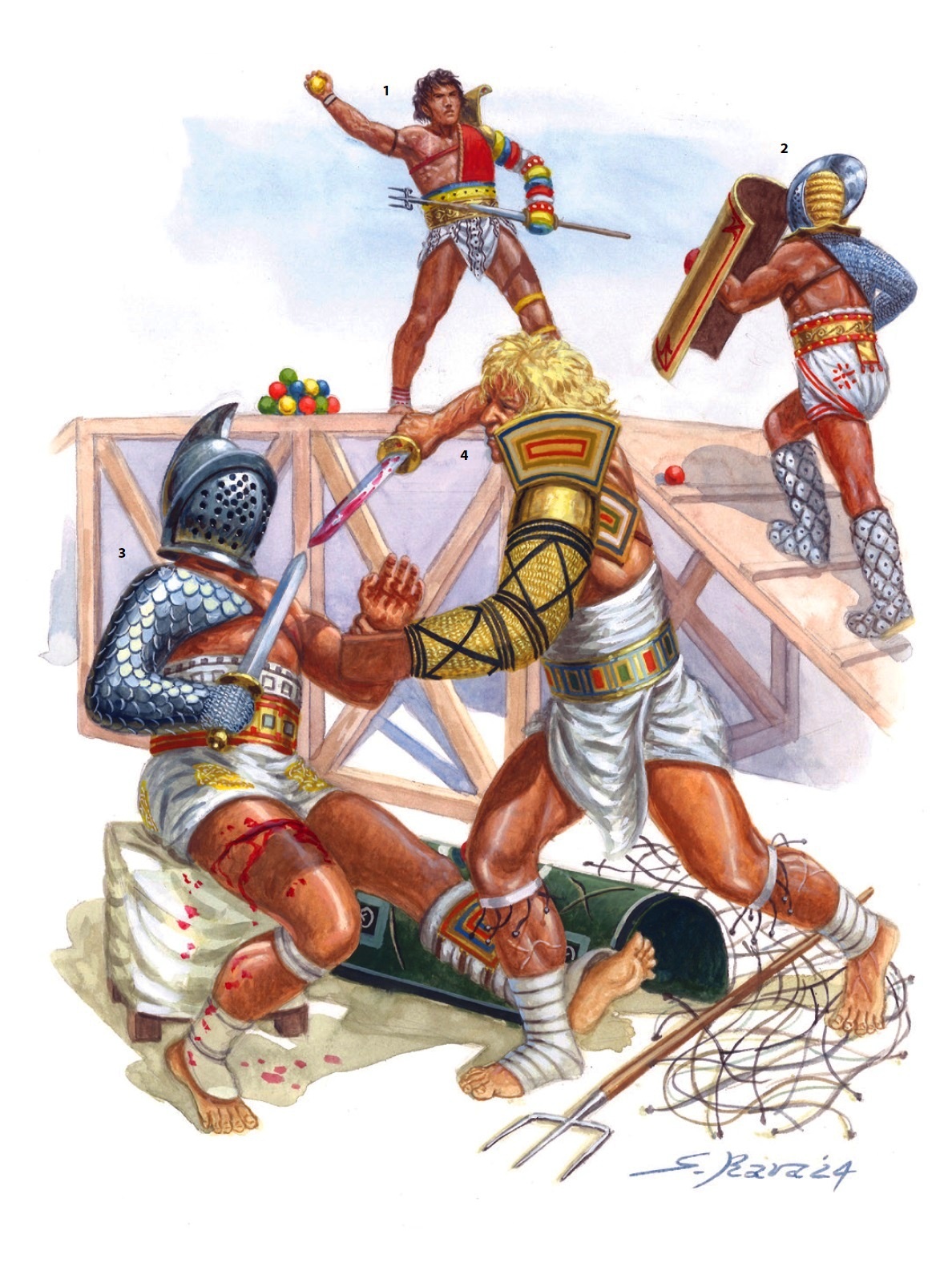
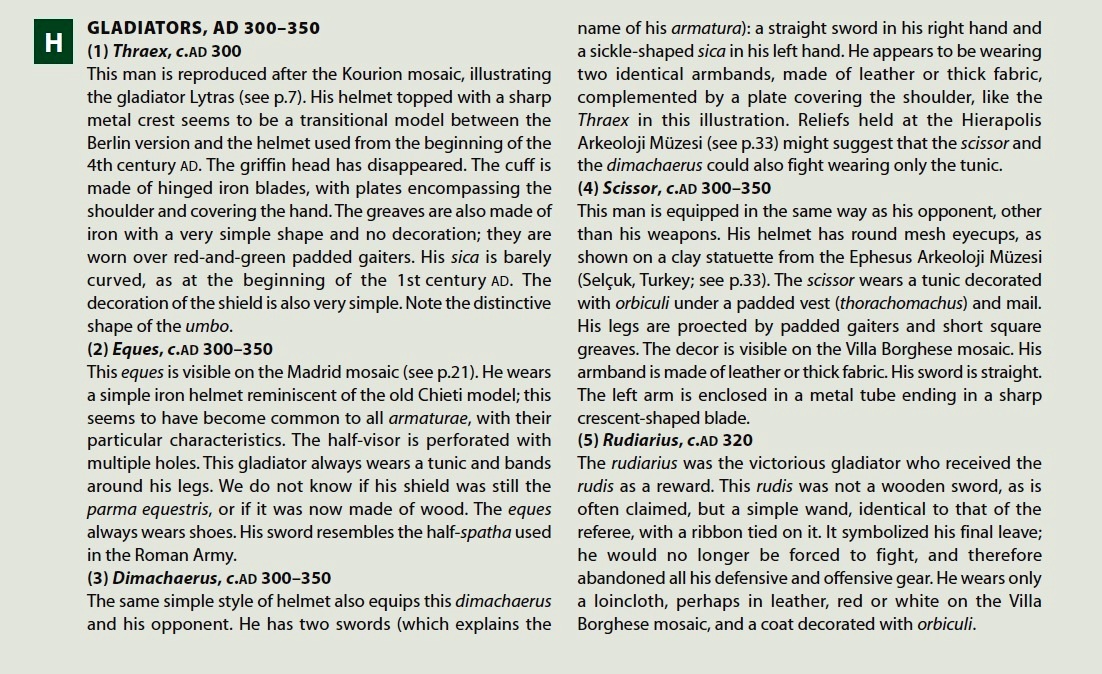
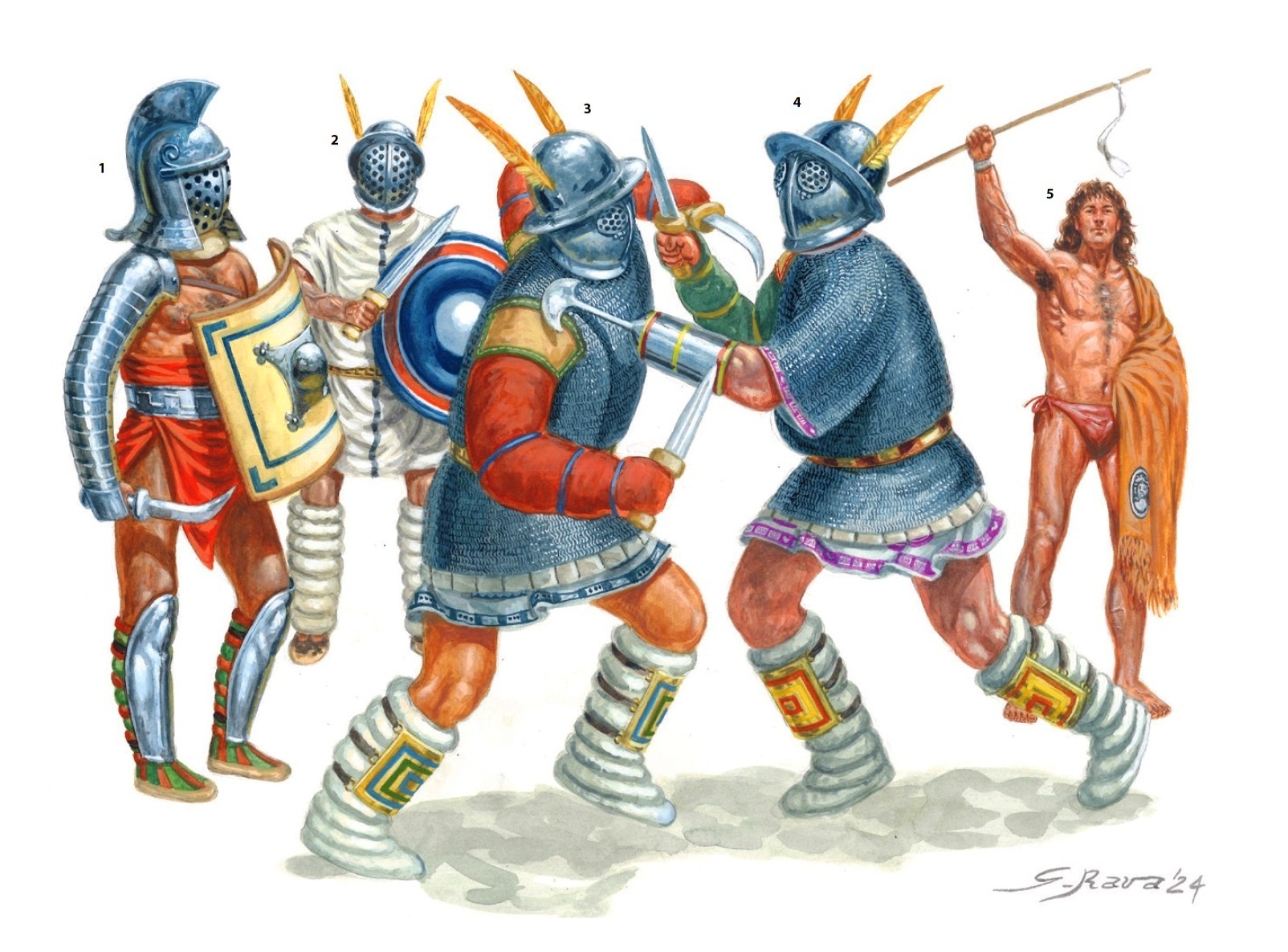
Gladiators have evolved considerably, and the ones we know best are from the imperial period.
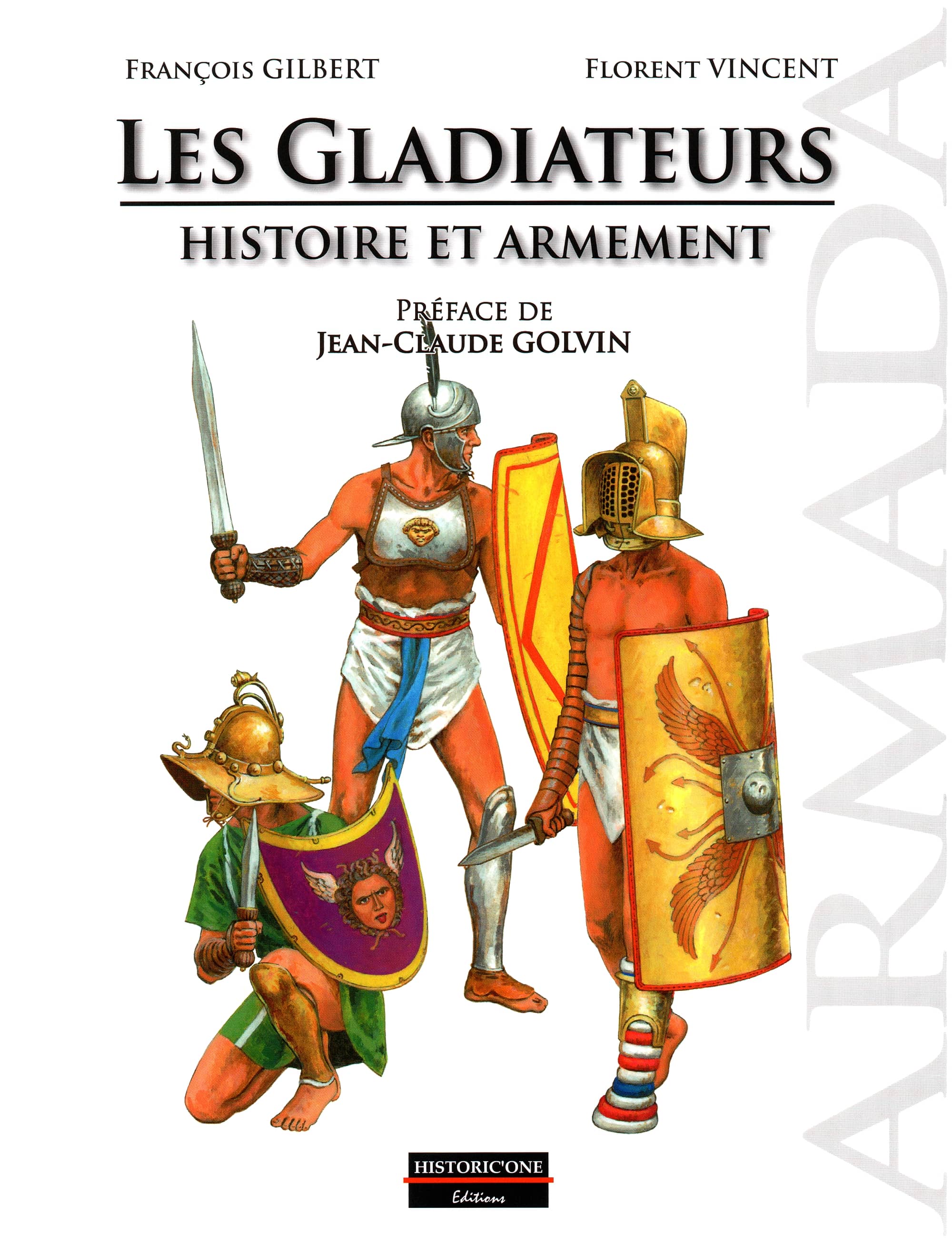
There are a few books on the subject:
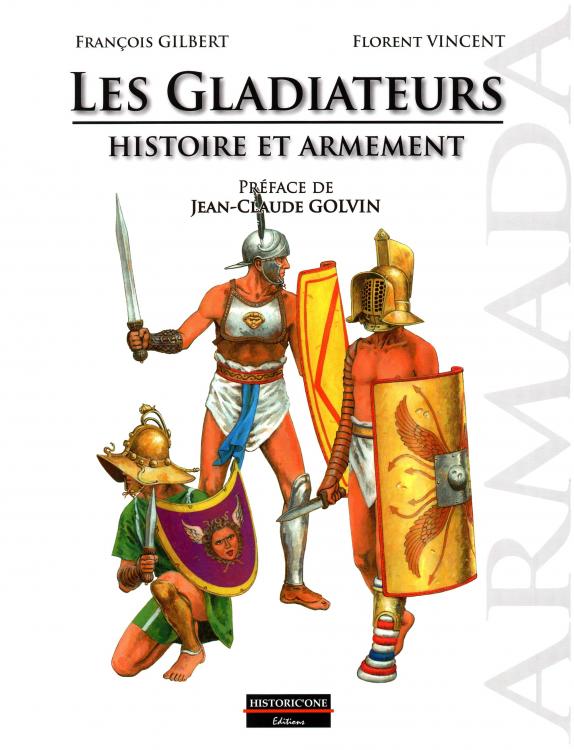
Plates and descriptions:
Spoiler1
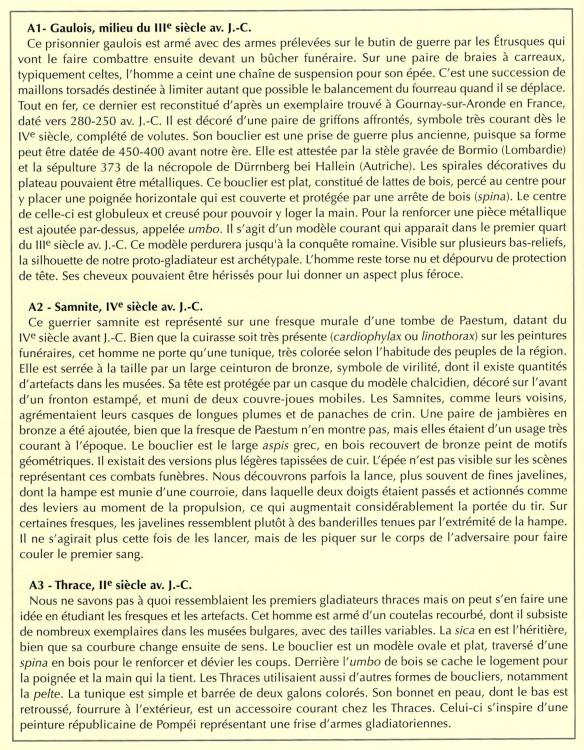
2

3
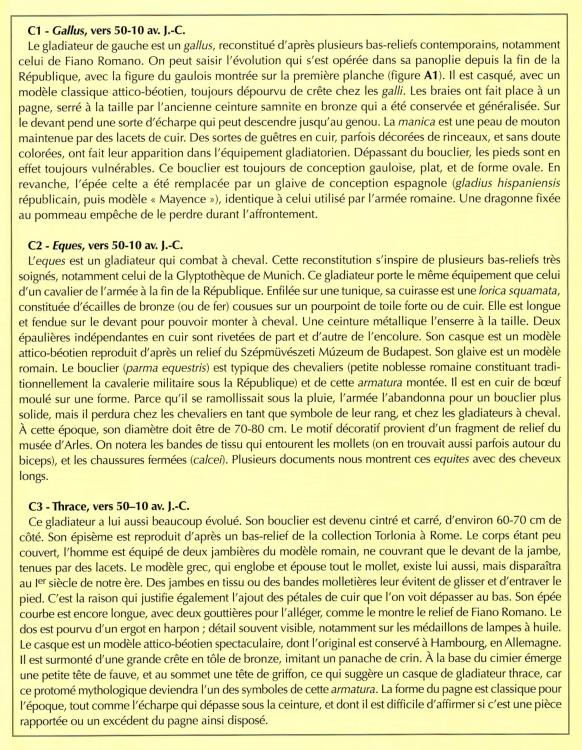
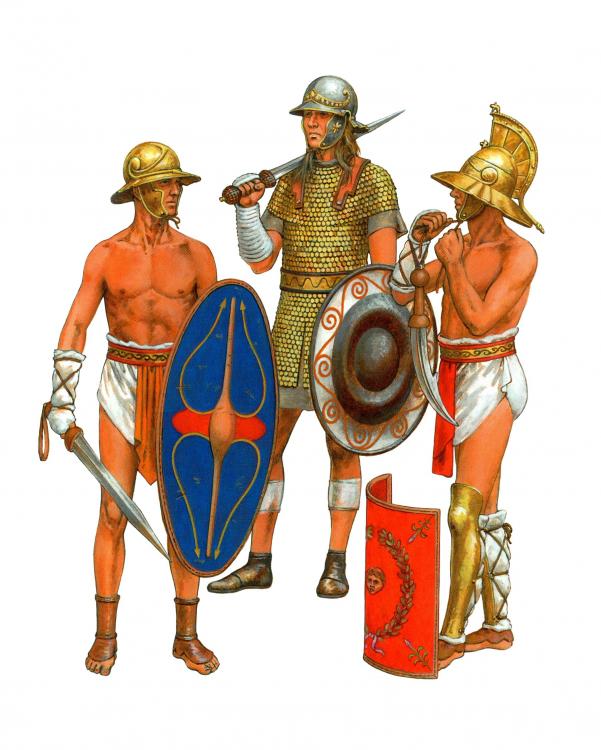
4
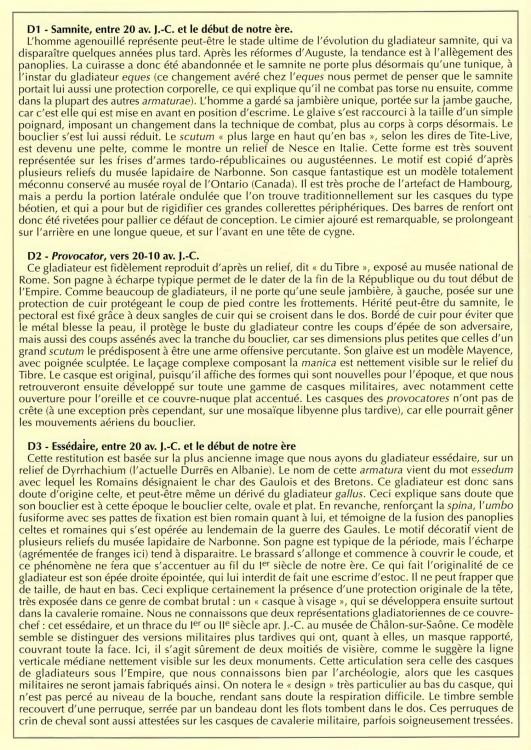
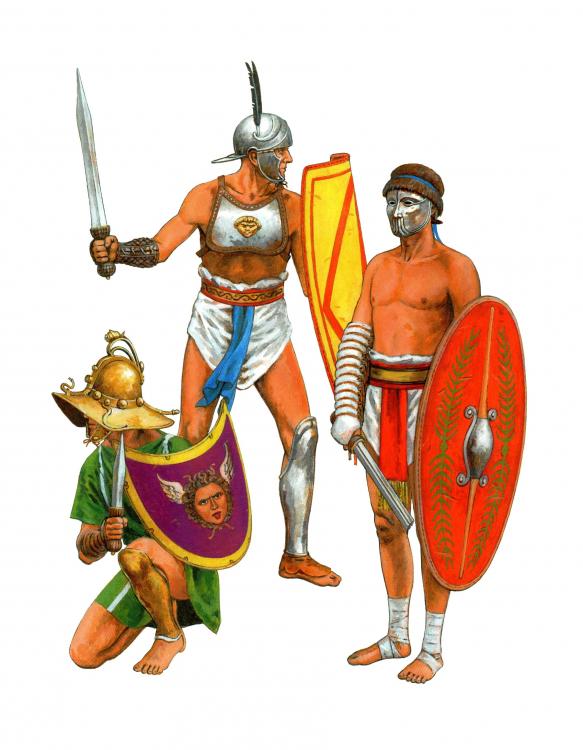
5
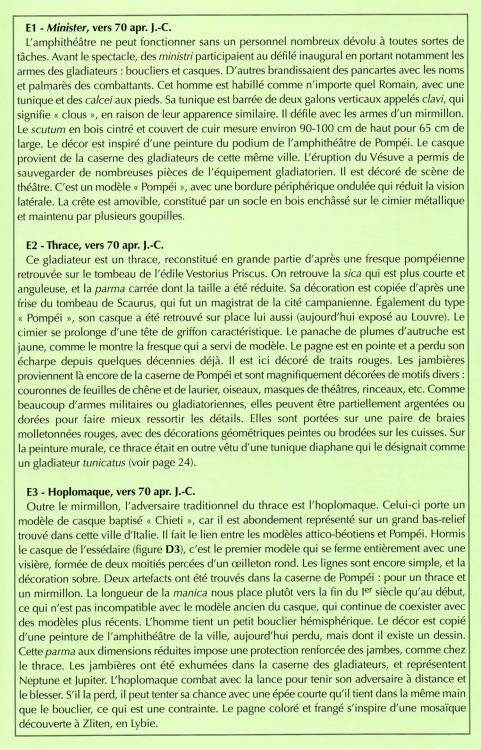
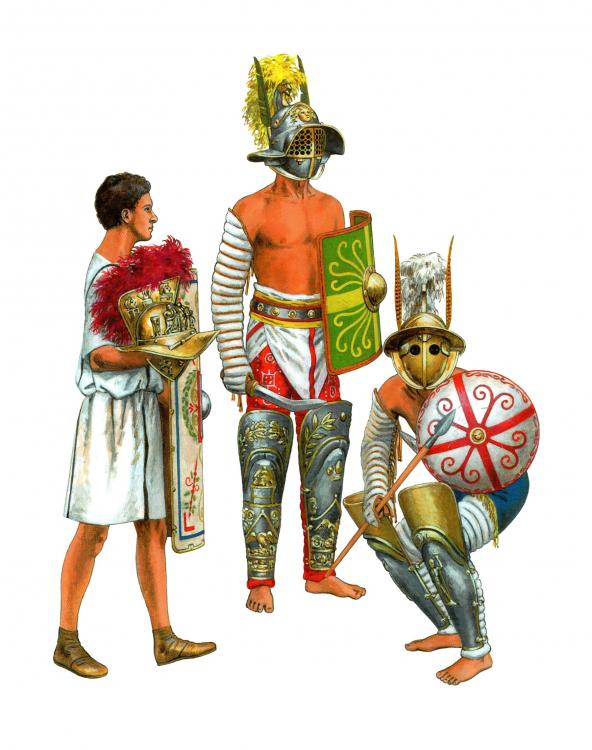
6
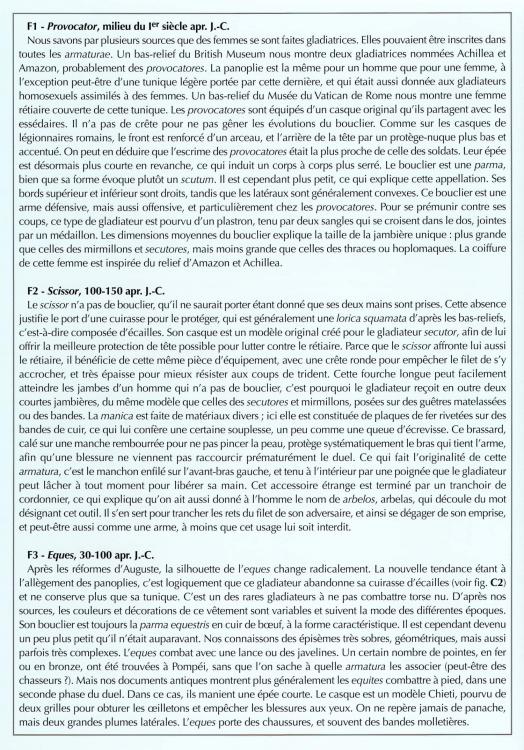
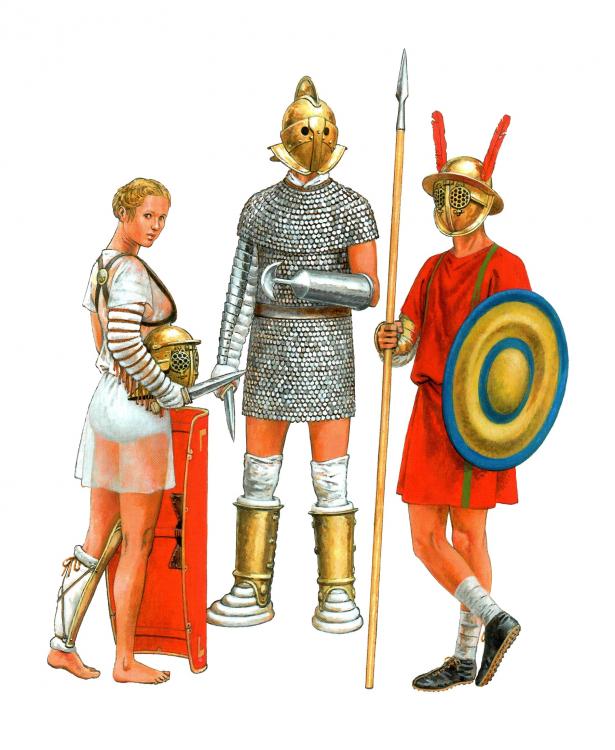
7
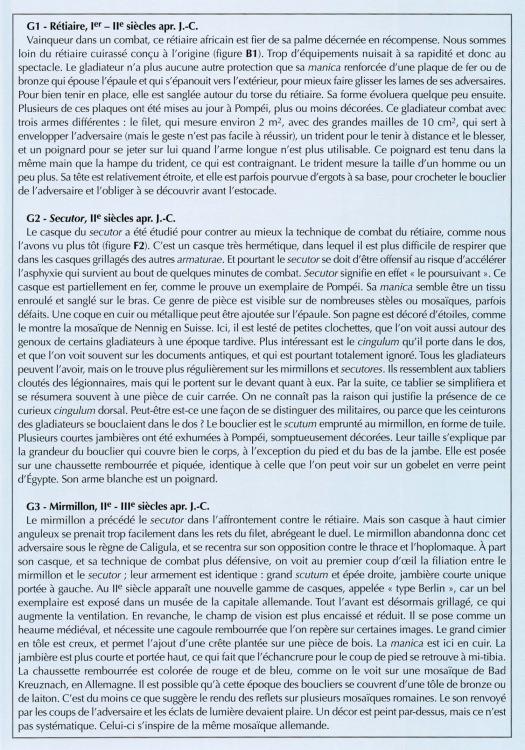
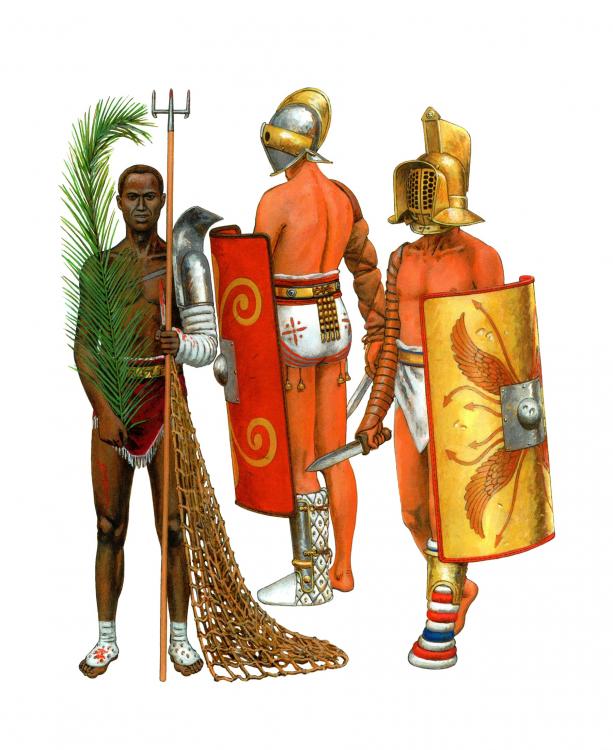
8
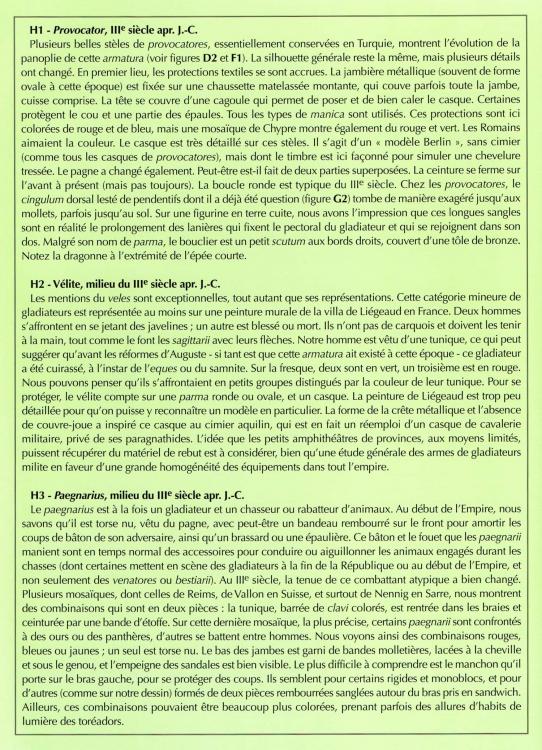
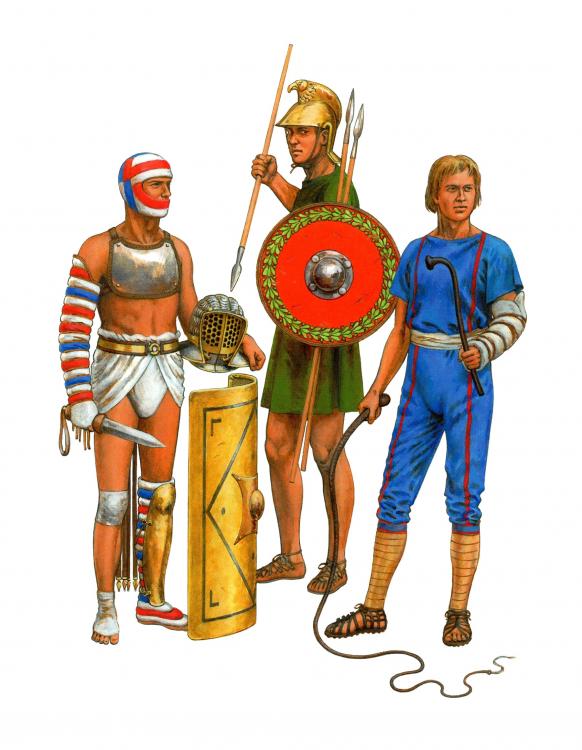
9
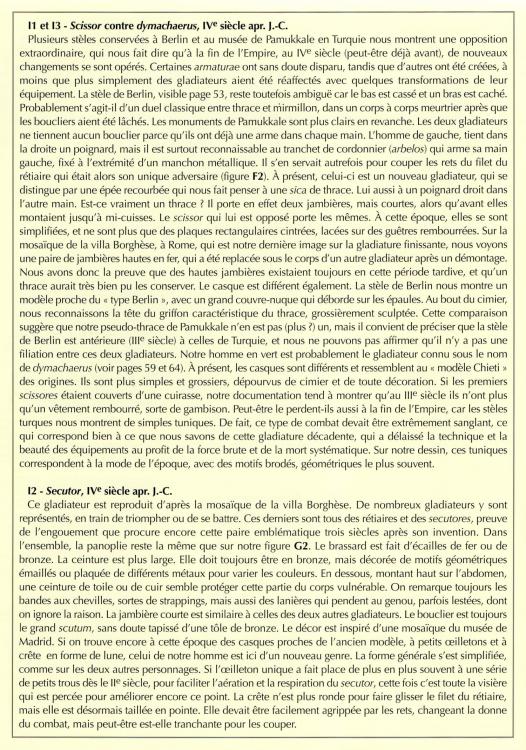
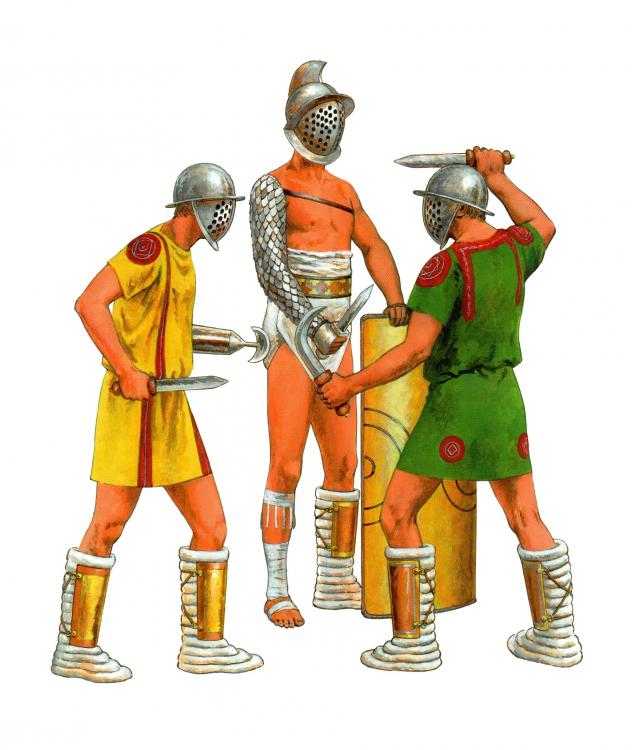
10
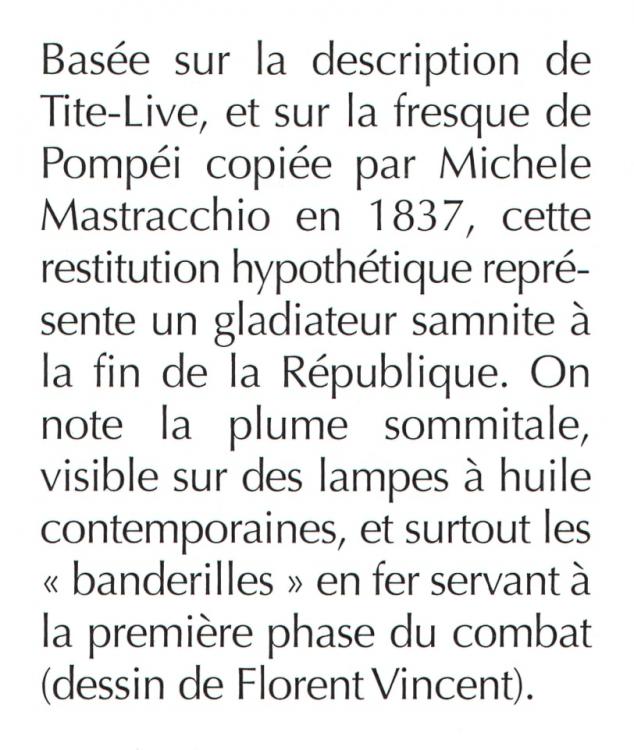
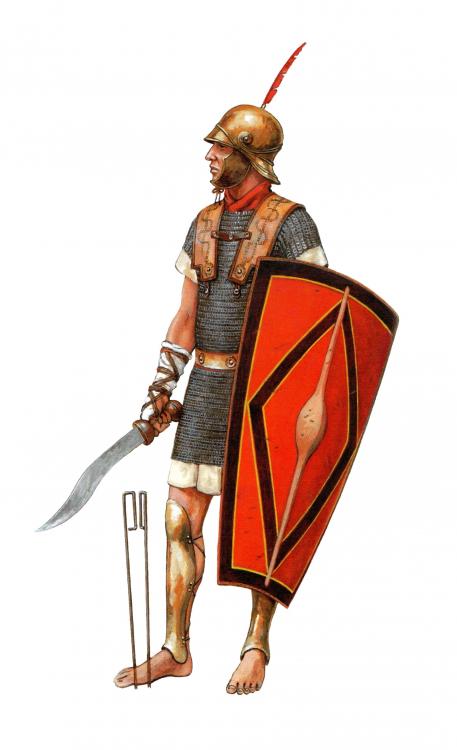
11
Plates and descriptions:
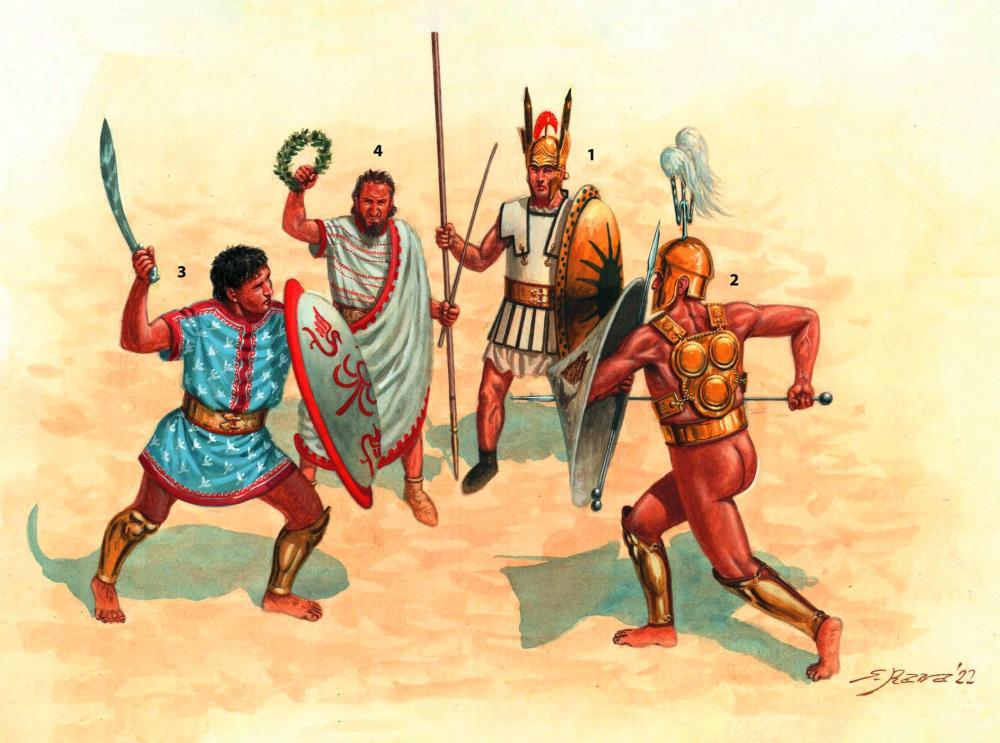
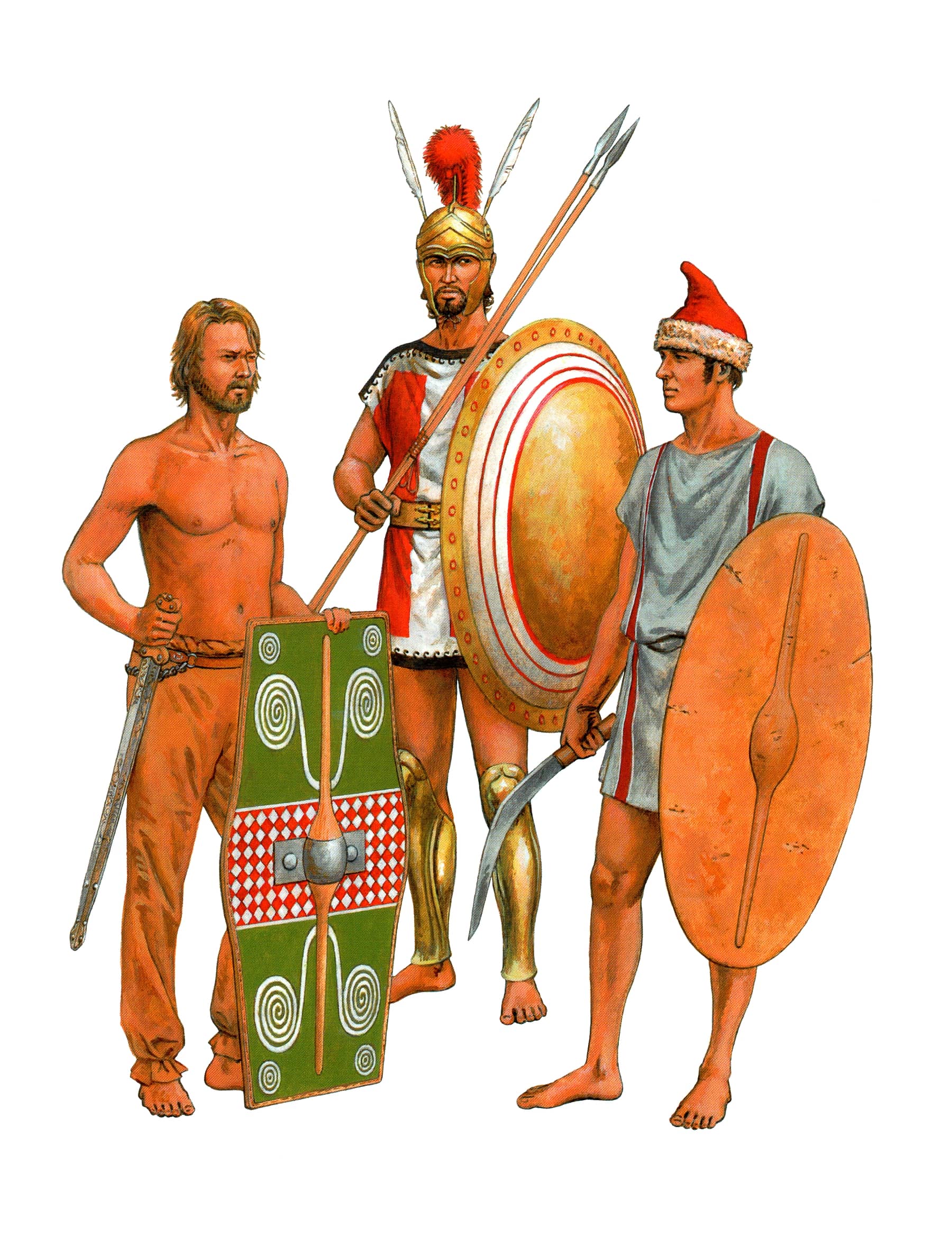
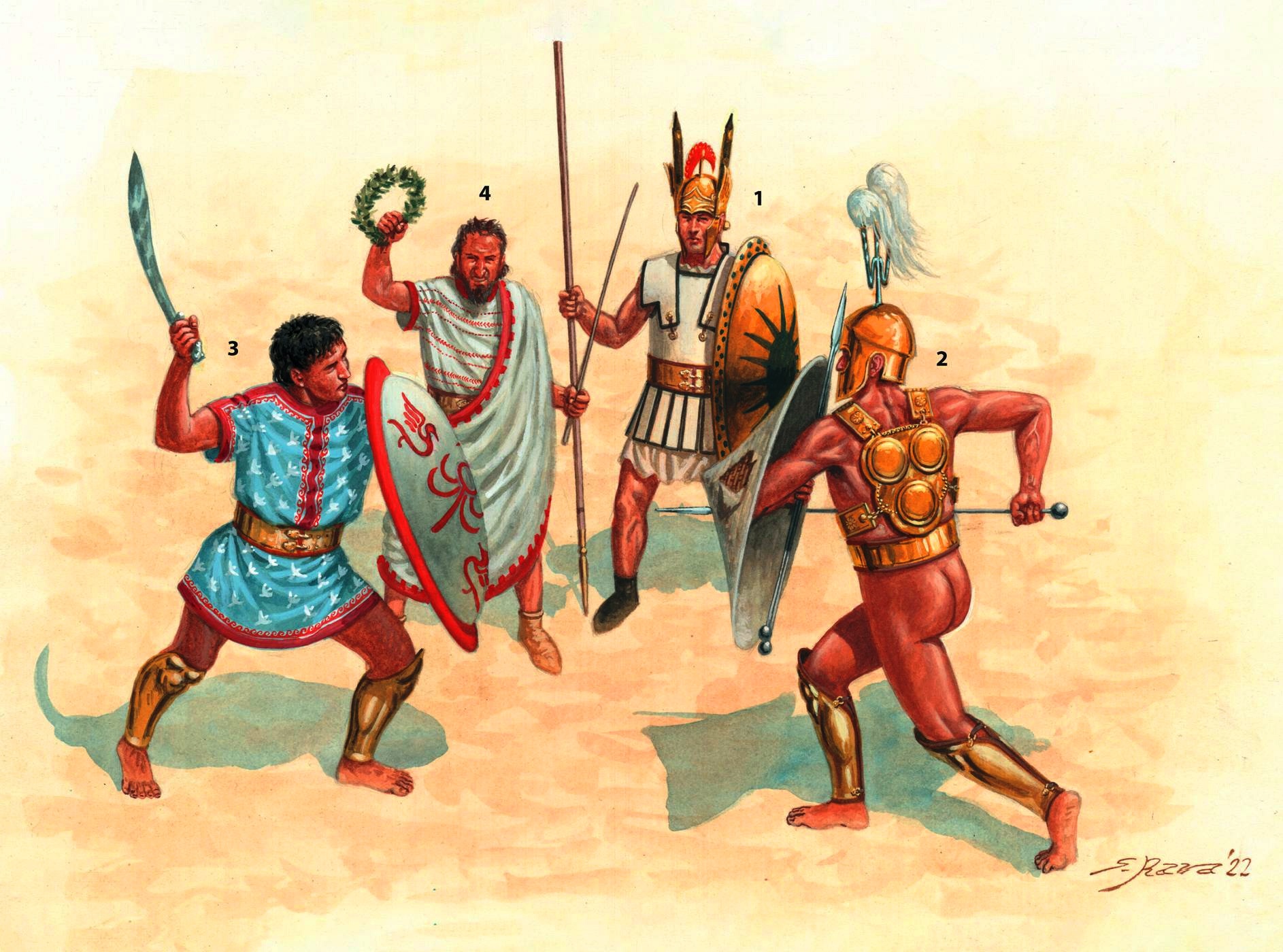
Spoiler1. FUNERAL DUELS, CAMPANIA, 4TH CENTURY BC
These three Lucanian warriors of the 4th century BC are
representative of the men who clashed during the funeral games. They are the ancestors of the first gladiators of the Samnites armatura. They are inspired by frescoes discovered in several necropolises around the ancient city of Paestum in Campania.
(1) Lucanian warrior, c.320–315 BC
This figure, based upon a tomb painting in the necropolis of Andriuolo, is a wealthy man, capable of owning a horse and full equipment. His Italo-Chalcidian helmet is spectacular, with a bronze crest, wings and feathers. The artefact is in the Museo archeologico nazionale del Melfese “Massimo Pallottino” (Italy). His breastplate is a white linothorax, worn over a beige tunic. Typical of this region, he wears a large bronze belt, which is a symbol of virility; it remained an accessory for gladiators for centuries. The decorated shield comes from a fresco in the necropolis of Vannulo.
(2) Lucanian warrior, c.350 BC
This warrior is completely naked under his panoply, perhaps for a religious reason. Based on armour held at the Museo archeologico nazionale di Paestum (Capaccio Paestum, Italy), his trilobed armour, typical of the peoples of Samnium, is made up of two similar plates (ventral and dorsal), held by wide bronze straps. With an original crest mount, the helmet also comes from Paestum. His conical shield is made of woven wicker, covered with leather. His weapons are javelins that are intended to be used like banderillas.
(3) Lucanian warrior, 375–350 BC
This man wears neither breastplate nor helmet, and is protected only by a pair of greaves and his shield, the latter a wooden hoplon (or aspis) covered with leather or metal. A bronze belt encircles his highly decorated tunic; the Romans laughed at these colourful tunics. Few frescoes show funeral battles with swords.
(4) Referee, c.365 BC
Funeral duels were conducted under the control of referees, like all athletic competitions. This depiction is based upon a fresco at Paestum. He too wears a bronze belt, along with his loosely draped garment. He wields a long flexible wand to enforce his decisions; it is the symbol of his function. In his other hand, he holds the crown that will be presented to the winner.
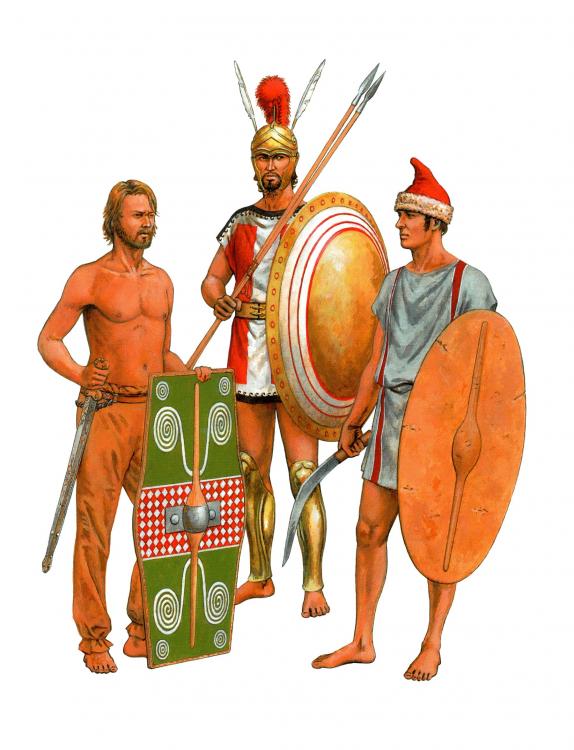
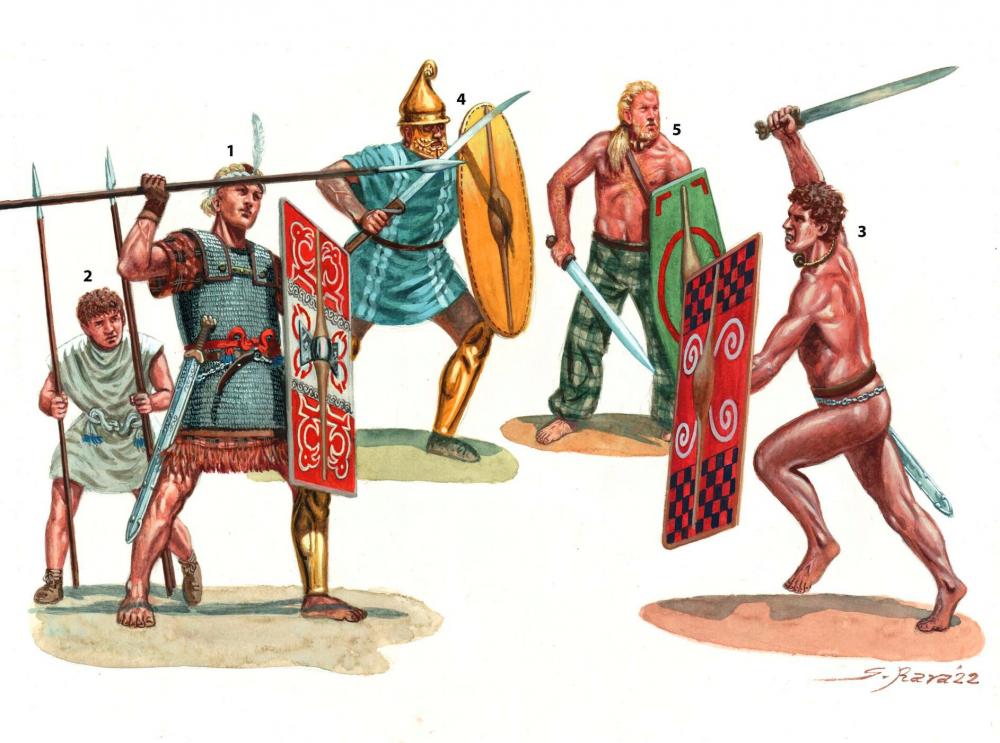
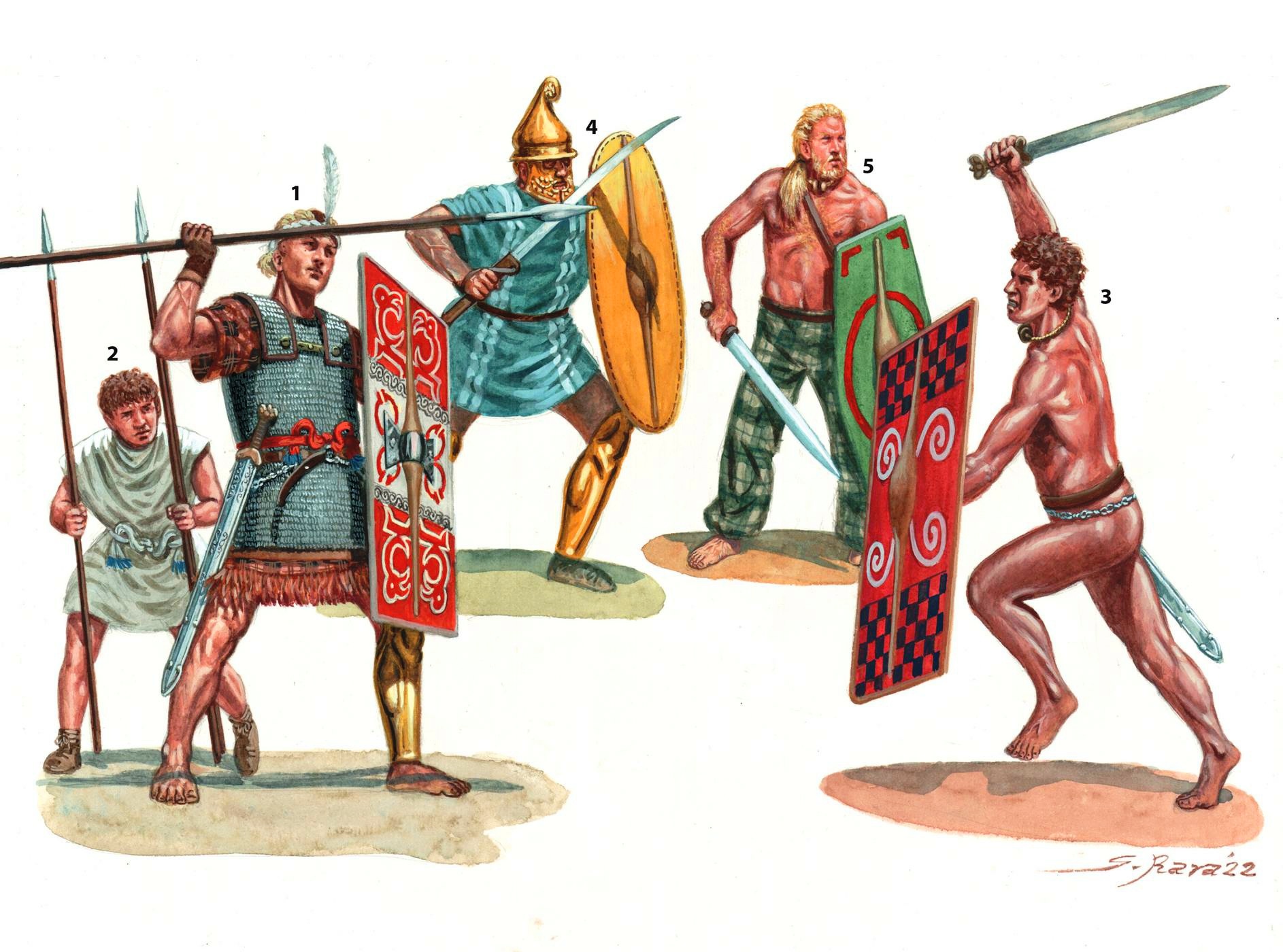
2. ‘ETHNIC’ GLADIATORS, 3RD–2ND CENTURIES BC
A relief from Amiternum (see here-here), held at the Museo
nazionale d’Abruzzo (L’Aquila, Italy), undoubtedly shows a ritual fight between two Galli, equipped with special outfits, as the historian Polybius testifies (Hist. III.62.5). The winner will take the feather of his opponent, like a trophy. The typology of certain weapons indicates a Celtic origin, and a dating between the 3rd and 2nd centuries BC.
(1) Gallus, 3rd–2nd centuries BC
The man’s head is bare, surrounded by a band in which a feather is stuck. He wears a short chain-mail shirt, an invention of the Celts, and a leather belt with an iron chain for hanging a Gallic sword, with a fabric belt placed over the top. A bronze greave – a borrowing from the Italic tradition – protects his left leg. His right hand is protected by a leather mitt.
(2) Gallus assistant
This young man is not Gallic. He only assists the Gallus in his duel, giving him spears and allowing him to continue the fight when the previous spear is broken or lost.
(3) Gallus, 2nd century BC
This Gallus is based upon a depiction on a stone urn (see here) kept at the Musée Calvet (Avignon, France). He is naked, to correspond to the stereotype of Greco-Roman literature. His flat shield is rectangular, but it could have another shape. The torque he wears was found in Fenouillet (France). His weapon is a sword, attached to the belt with a metal chain.
(4) Thraex, start of 2nd century BC
Captured in Thrace by the Romans, this prisoner of war is based on a depiction in the Sashova mogila tomb (Kazanluk, Bulgaria). His weapon is the long, almost straight scythe called a romphaia; it will shorten over time, to become the sica. His helmet is in the Phrygian style, characterized by the globular crest; the cheekpieces simulate a beard.
(5) ‘Celto-German’ gladiator, late 2nd–early 1st century BC
The Roman historian Sallust testifies to the existence of many Germans in the army of Spartacus. They are surely the descendants of the vanquished of the great migration of Cimbri and Teutons, augmented by other Celto-Germanic peoples. This figure is inspired by a bronze situla found in Pompeii. The torque is reproduced from an artefact from Tayac (France). The sword’s round pommel suggests the use of a Roman sword in place of an ‘ethnic’ sword. At this time, the outfits gradually became less ‘ethnic’, and more codified. The decoration of the hexagonal shield is visible on the situla. It also shows two spears. We understand that the duel began with the spear and ended with the sword.
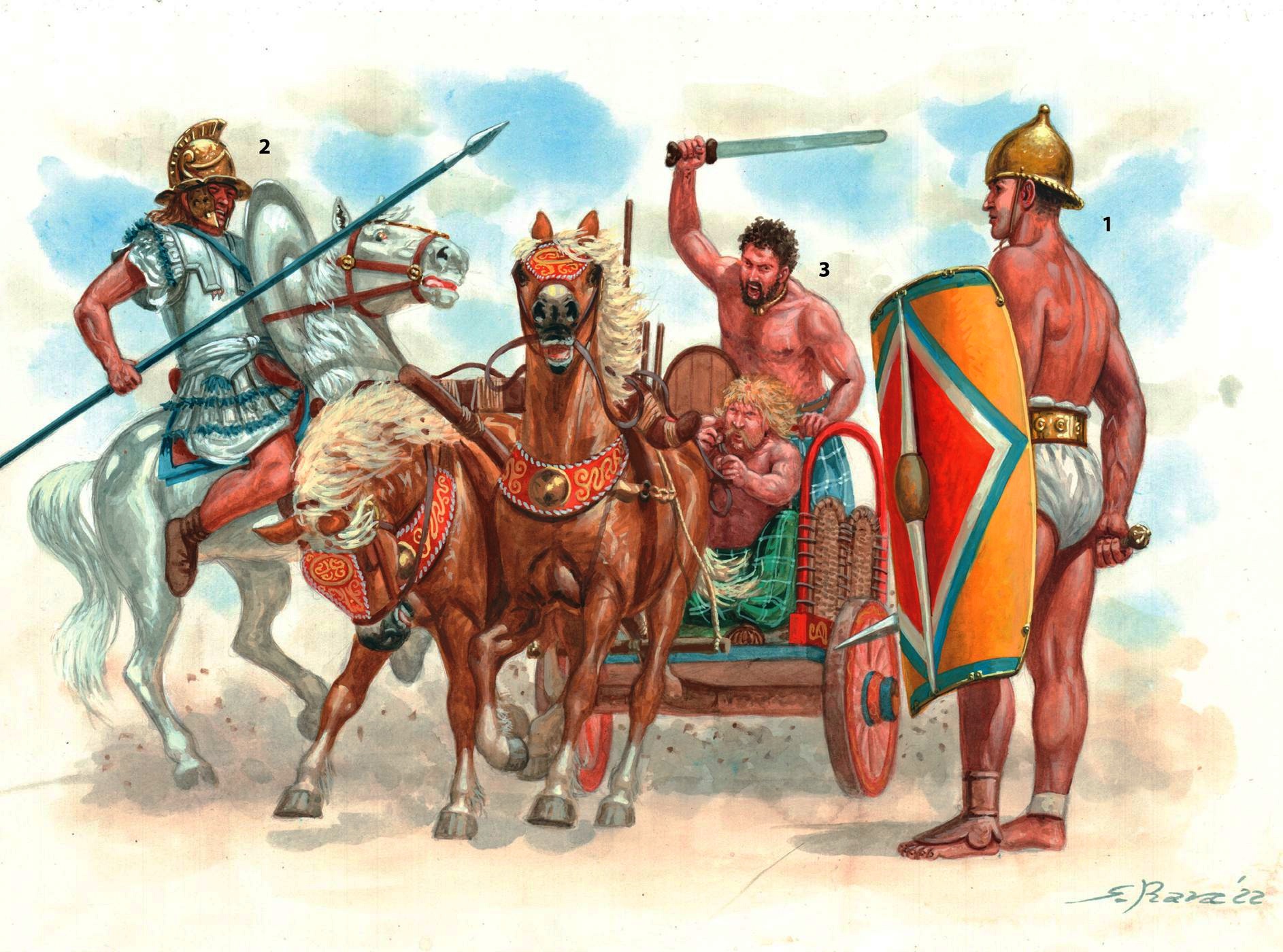
3. GLADIATORS, EARLY 1ST CENTURY BC
This representation is essentially based on a fresco in the House of the Priest Amandus in Pompeii. It illustrates a show in the amphitheatre, as evidenced by the presence of a musician. The fresco is damaged, however, and the armaturae are difficult to identify. The equipment became lighter and standardized in the 1st century BC.
(1) Mirmillo, c.80–70 BC
This man fights topless. His conical helmet looks like a Montefortino model; here it is devoid of metal cheekpieces, and it only has a simple leather chinstrap. His shield, known as the myrmillonicum scutum, is the great scutum of the legionary, but the ends have been truncated to make it lighter. His sword is the long gladius Hispaniensis used by the Roman Army.
(2) Eques, c.80–70 BC
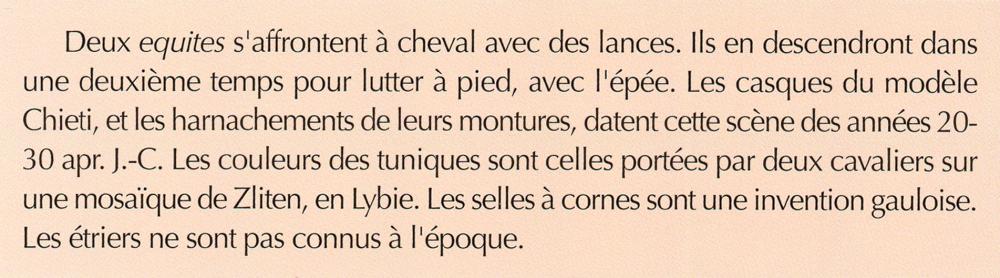
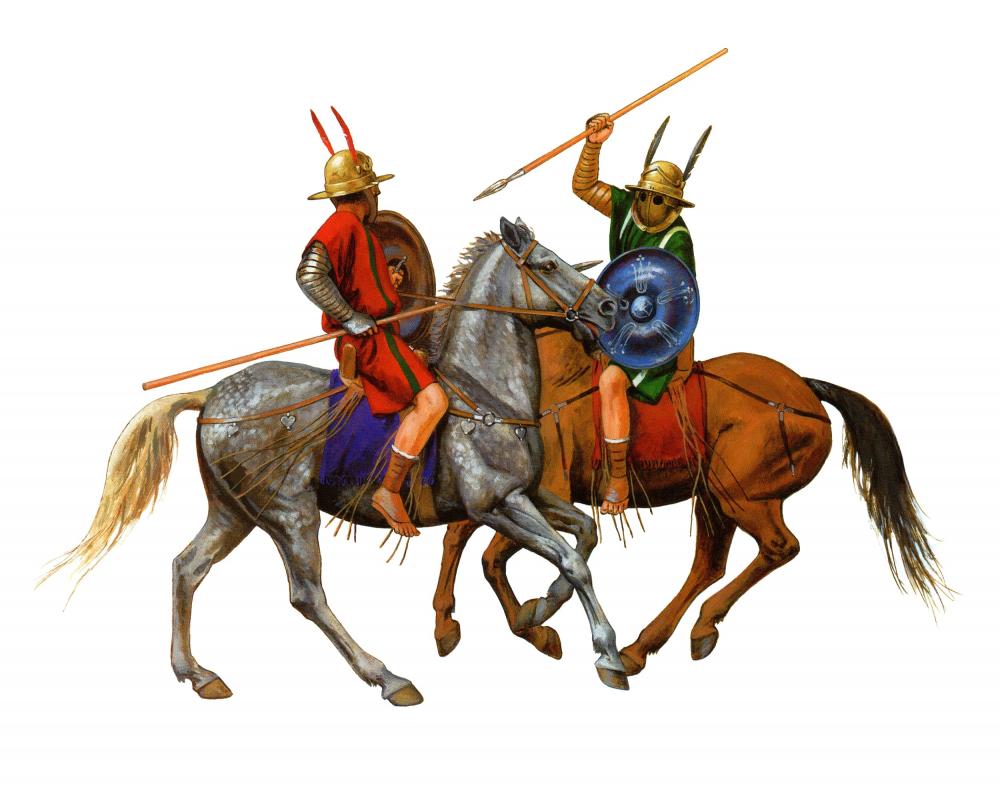
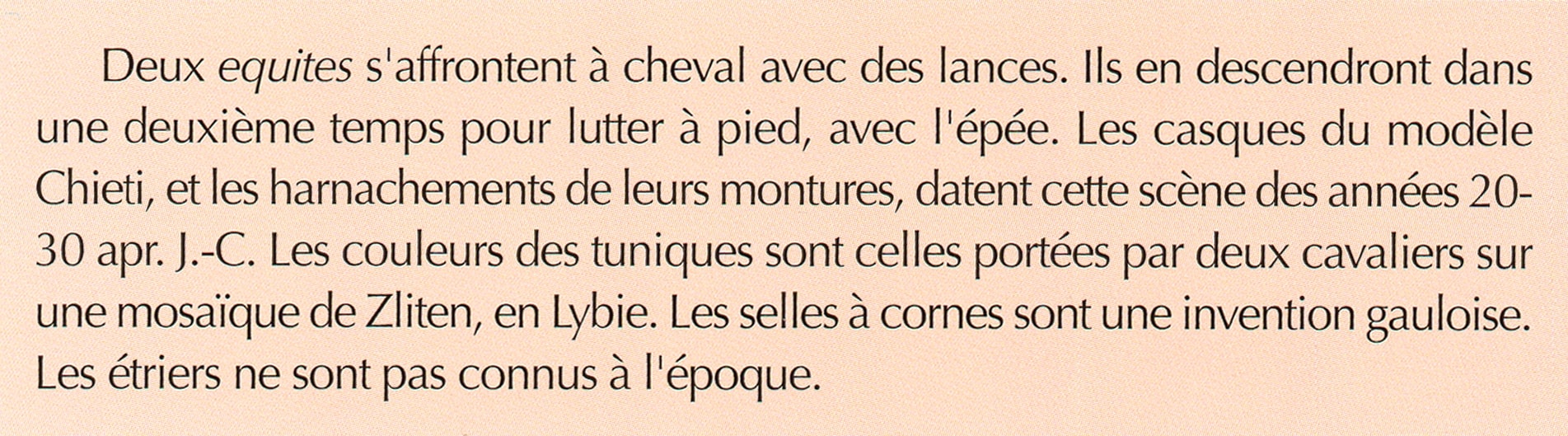
On the same fresco is visible a duel of equites, possibly commemorating the death of Spartacus, as the name ‘Spartaks’is written above the wounded rider. The horse has a Gallic saddle of the style recently adopted by the Roman Army. It is made of leather with four horns, to stabilize the rider without stirrups. The gladiator’s panoply is difficult to identify. He wears a linen breastplate, extended by pteryges, inspired by contemporary sculptures from the temple of Juno Sospita in Lanuvium (modernday Lanuvio, Italy). He carries a sword on his left hip, but first fights with a spear. His helmet is an Attico-Boeotian model, characterized by its large wavy brim; the sheet-metal crest simulates a horsehair crest. Like all equites of the 1st century BC, he wears long hair. His shield is a parma equestris formed from cowhide; its large diameter will be reduced under Augustus. Its white colour is visible on a frieze from Pompeii. The eques wears shoes, unlike other gladiators.
(3) Essedarius, c.100 BC
This reconstruction is hypothetical, as there is no image of an essedarius on a chariot; this depiction is based on the archaeological record. As the gladiator cannot both fight and drive the chariot, it is driven by a coachman. After a phase fighting with javelins or the spear, the essedarius continues the combat on foot. The sword used by this prisoner of war has a rounded end, as it is intended to strike with the edges only. This particular form of fencing will justify the survival of this armatura, but the chariot will be definitively abandoned.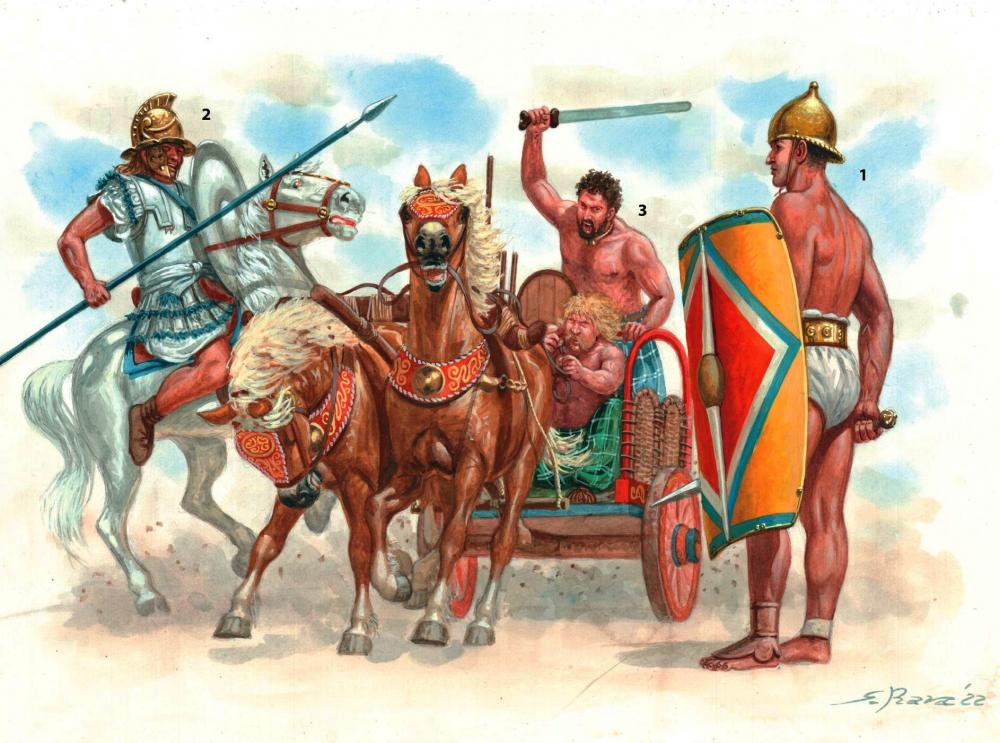
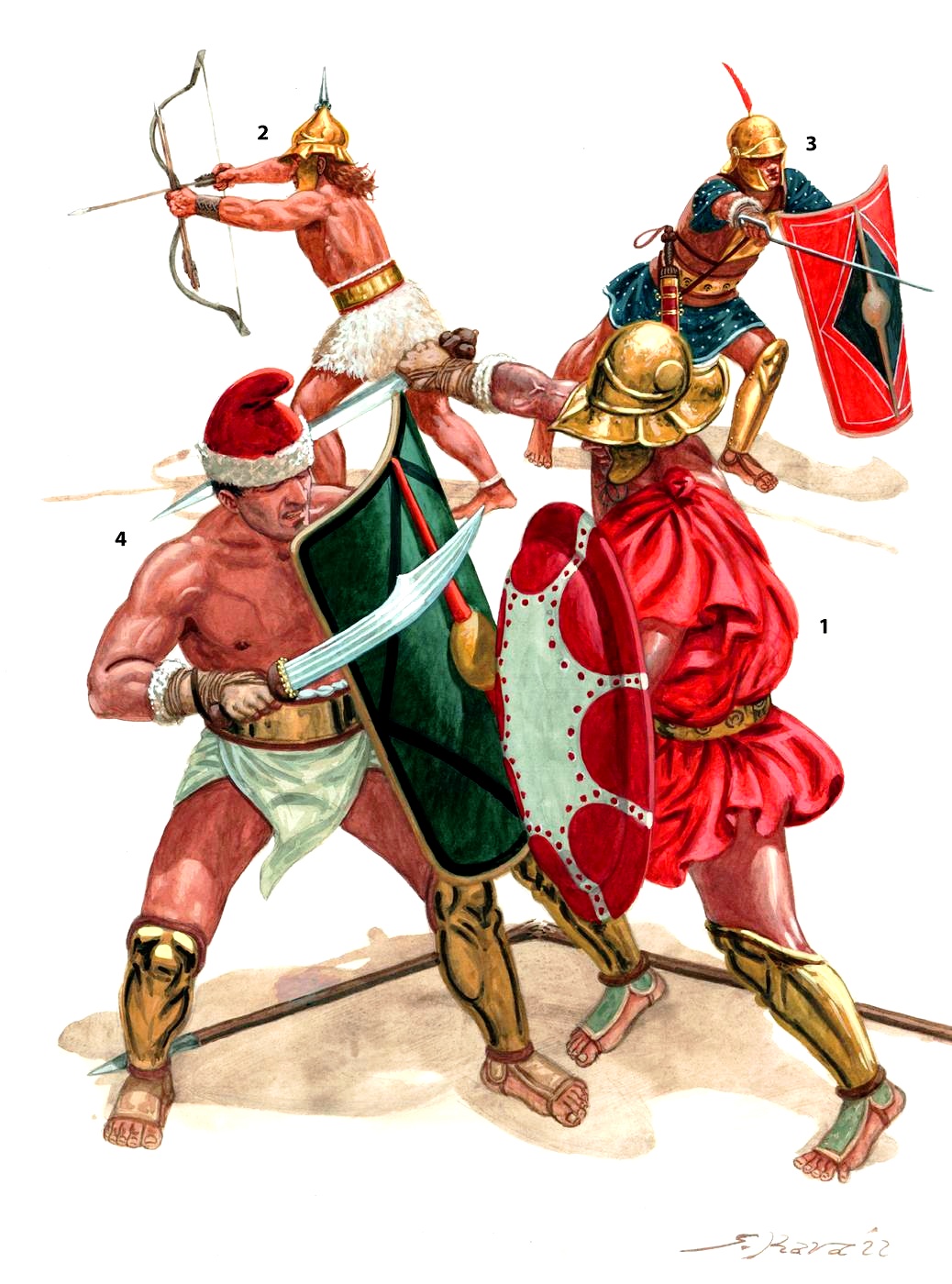
4. THE FIRST ‘TECHNICAL’ GLADIATORS, MID-1ST CENTURY BC
After the revolt of Spartacus, gladiatorialism was reformed to ensure its survival. The barracks were now also open to volunteers, and new armaturae appeared to increase the variety of combat.
(1) Hoplomachus, c.50 BC
This representation is based on a bas-relief in the Museo Stefano Bardini (Florence, Italy), which probably dates from the middle of the 1st century BC. The hoplomachus fights like a hoplite, with a lenticular shield and a spear. If he loses his long weapon, then he uses a sword. At that time, it was the gladius Hispaniensis used by the Roman Army. The three-lobed pommel is characteristic of this period. The diameter of the shield is still large. Its decoration is copied from a frieze of painted weapons from Pompeii. The gladiator wears a style of tunic known as the exomis, which reveals one shoulder. His Attico-Boeotian helmet is based upon an original held in the Museum für Kunst und Gewerbe Hamburg (Germany). His Greek-style greaves encompass the entire leg, and close behind the calf; leather gaiters prevent them from slipping down. On his right arm he wears an armband made of leather straps on a sheepskin sleeve.
(2) Sagittarius, c.50 BC
In the same bas-relief held at the Museo Stefano Bardini, two archers fight one another. Widely used in the Balkans, this man’s conical helmet is a Hellenistic model surmounted by a moulded point. His loincloth is made of fur; it is worn with a bronze belt. His left arm is protected by a leather armband. The bow is a small model, with a double curvature. The number of hand-held arrows appears to be limited to three. The archer uses a thumb ring to tighten the string.
(3) Samnis, c.50 BC
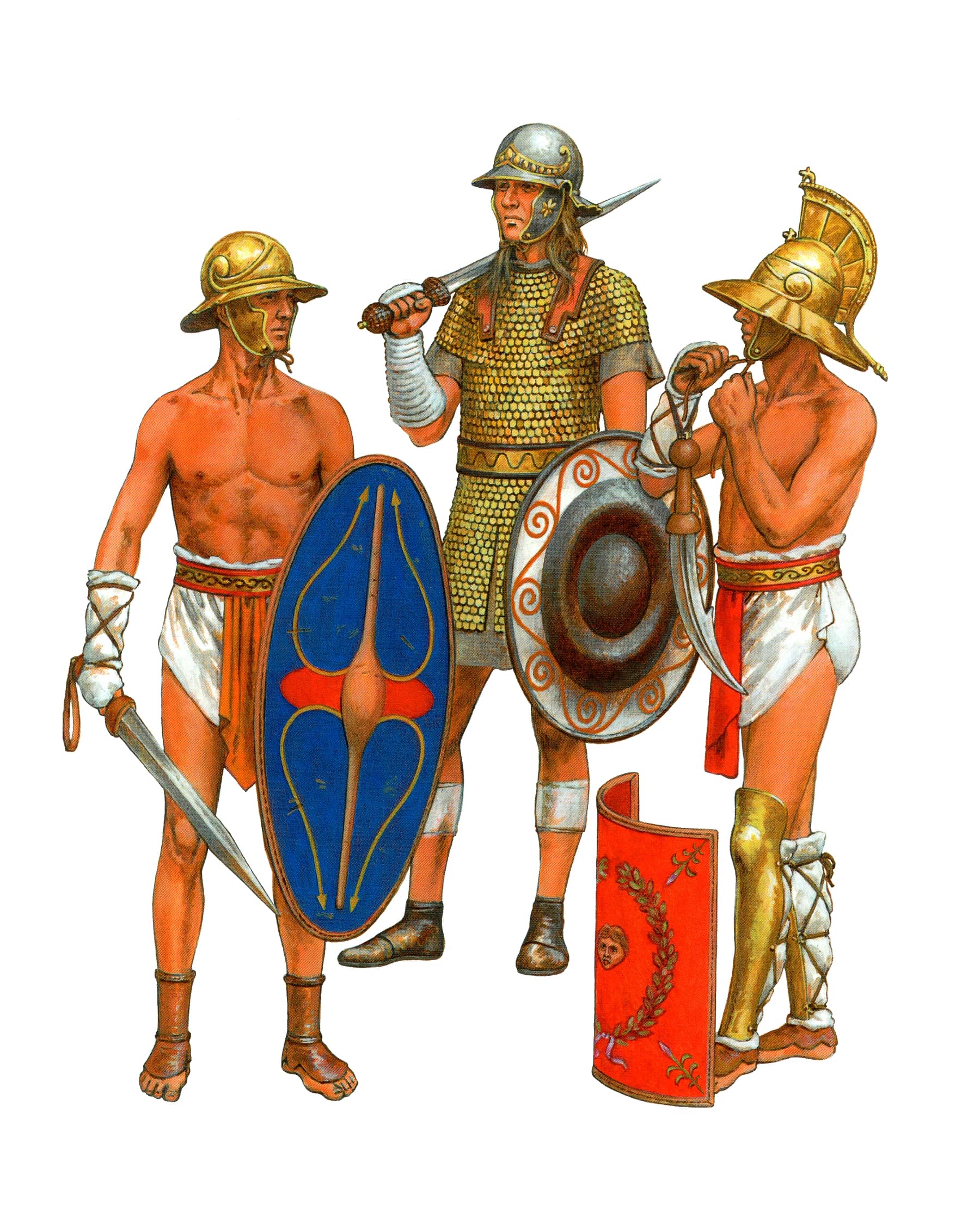
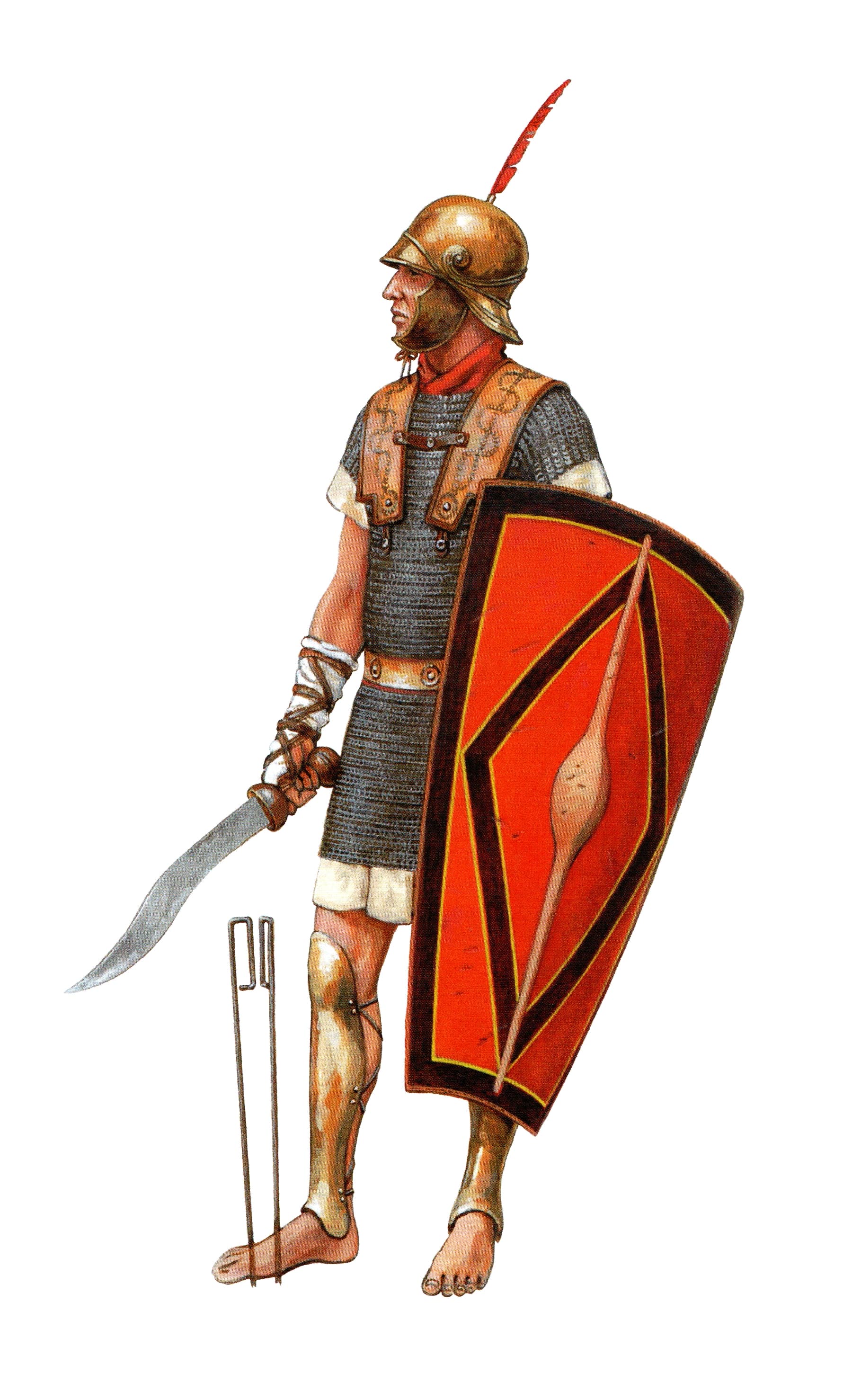
This Samnis is reproduced from a frieze of weapons from Pompeii (see here), and an anachronistic description by Livy. He wears a leather doublet, reinforced by a square bronze pectoral. Livy confirms its use; he calls it spongia pectori tegumentum – literally ‘the sponge that covers the chest’ – because it ‘absorbs’ the blows of the opponent. His helmet is a Hellenistic model, with a feather on top. His shield is wider at the top, to cover his upper body, and narrower at the bottom, so as not to interfere with his legs. Initially, he fights with metal banderillas, using his sword subsequently.
(4) Thraex, c.50 BC
This Thraex is inspired by the bas-relief held at the Museo Stefano Bardini, and the frieze of arms of Pompeii. On the latter, we see a red Phrygian cap in sheepskin, the bottom of which is rolled up. His shield is rectangular in shape, medium in size, with classic decoration. He also wears small leather gaiters to better support the metal greaves. His weapon is an evolution of the romphaia, but its size has shortened to the length of a sword, and its curvature has reversed. Its blade has a central groove, and a protruding lug on one side.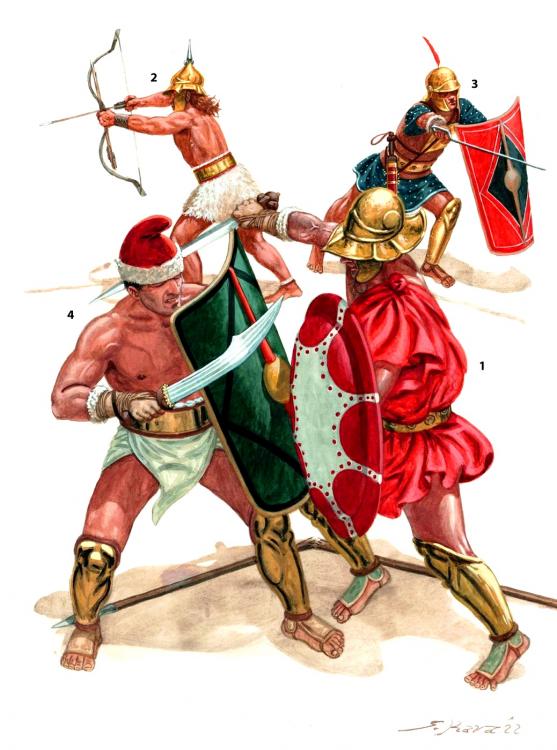
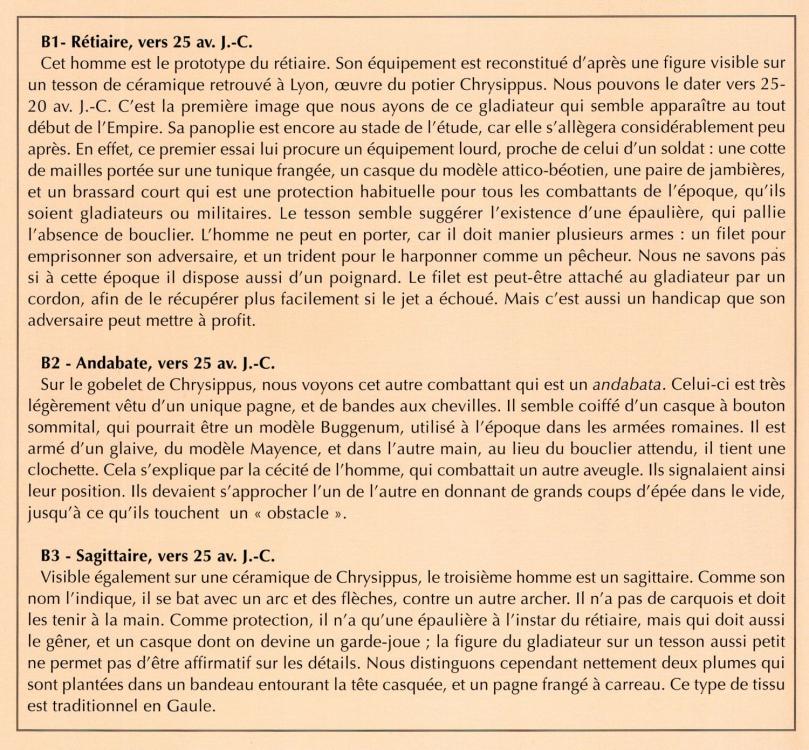
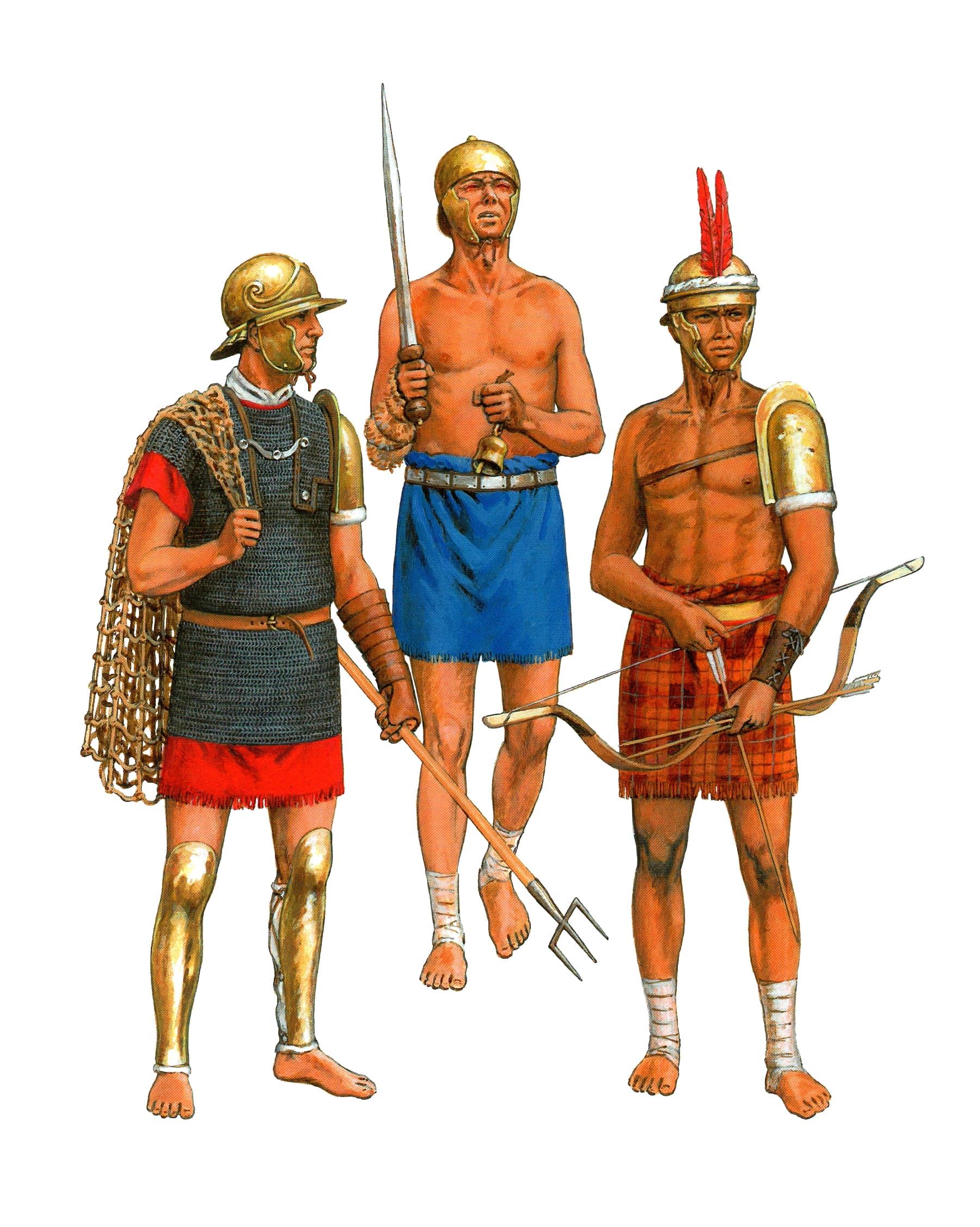
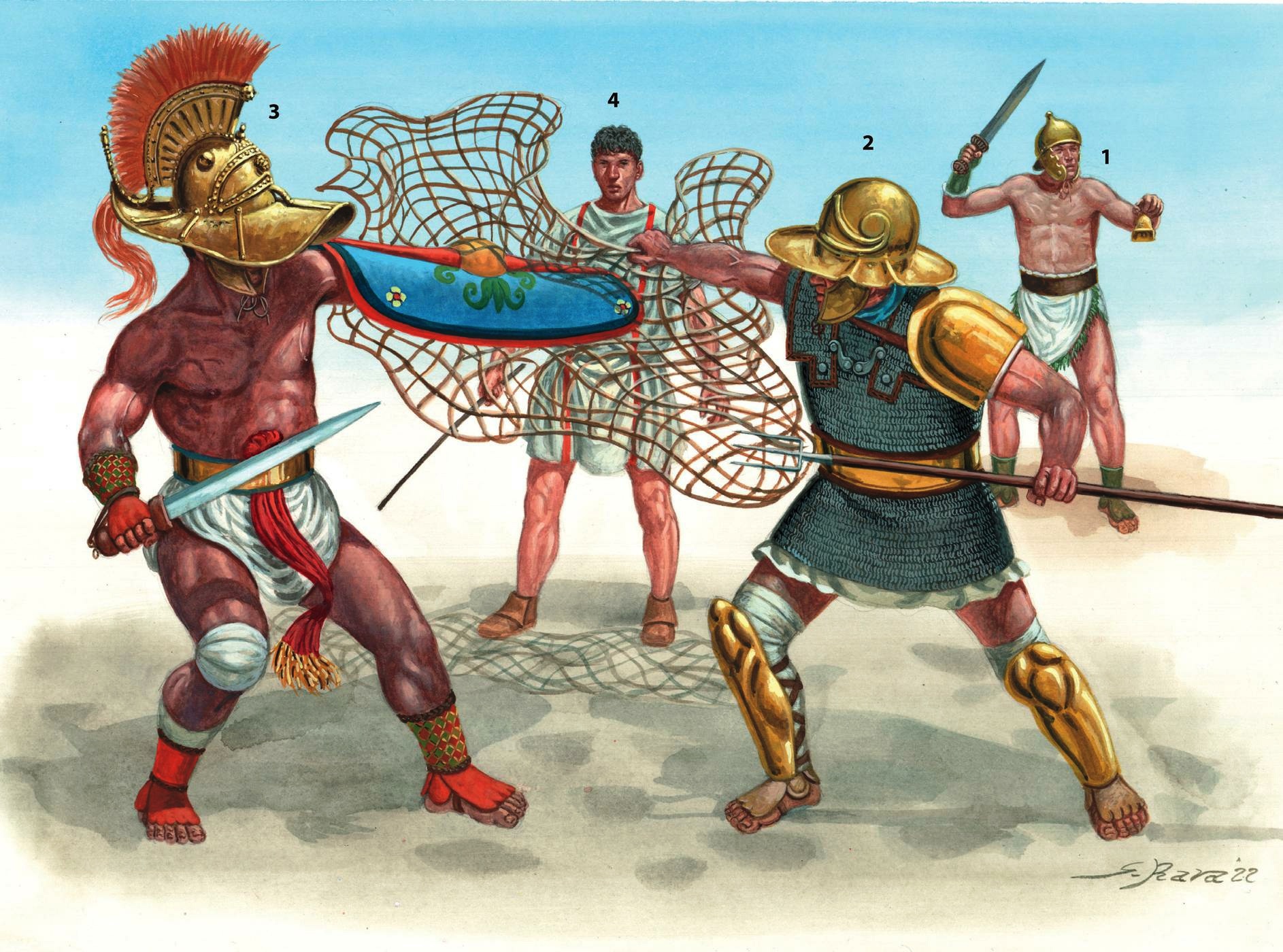
5. GLADIATORS AT LUGDUNUM, C.25 BC
The ceramics of a potter from Lugdunum (modern-day Lyon, France) are exceptional, because they show us provincial gladiatorial fights at an early date. Some armaturae, such as the retiarius and the andabata, are visible for the first time.
(1) Andabata, c.25 BC
This man is a blind convict who has agreed to fight against another andabata in order to have a chance to save his own life. He has no shield, only a sword to hit his opponent, and a bell to signal his position. This illustration is based on the only surviving depiction, on a goblet from Lyon. His helmet is a Buggenum model, which appeared around the middle of the 1st century BC. His sword is the Mainz model.
(2) Proto-retiarius, c.25 BC
The first surviving image of the retiarius is also provincial, taken from a shard from an artefact attributed to the potter Chrysippus (Lyon). This man’s panoply is complete and heavy. He wears greaves and an Attico-Boeotian helmet. He cannot wield a shield as his hands are occupied with the net and the trident, so he wears a shirt of chain mail, and a plate placed on the left shoulder. The heaviness of the equipment slows the movements of this proto-retiarius. This first test will not be satisfactory, but it will evolve.
(3) Mirmillo, c.25 BC
The mirmillo fights with a Mainz sword. The decoration of his shield follows a bas-relief from the Collezione Torlonia (Palazzo Orsini, Rome, Italy). Because this man has a large shield, he does not need greaves; instead, he wears a leather gaiter, decorated with criss-crossing thongs. This detail is visible on the Fiano Romano relief. At the end of the 1st century BC, a long scarf was worn under the bronze belt and over the loincloth (perhaps only in Italy). This bronze belt always buckled at the back. Over a protective hood, he wears a spectacular helmet based on an artefact held in the Higgins Armory Museum (Worcester, Massachusetts, USA). A crest of feathers is added in the hollow crest, extended by a ponytail.
(4) Referee, 1st century BC
Gladiatorial fights were watched by two referees; ancient images often show them. He wears a loose white tunic with two vertical stripes, and plebeian shoes. The referee’s ‘tool’, and the badge of his profession, was a long flexible rod, used to castigate the gladiators and ensure obedience.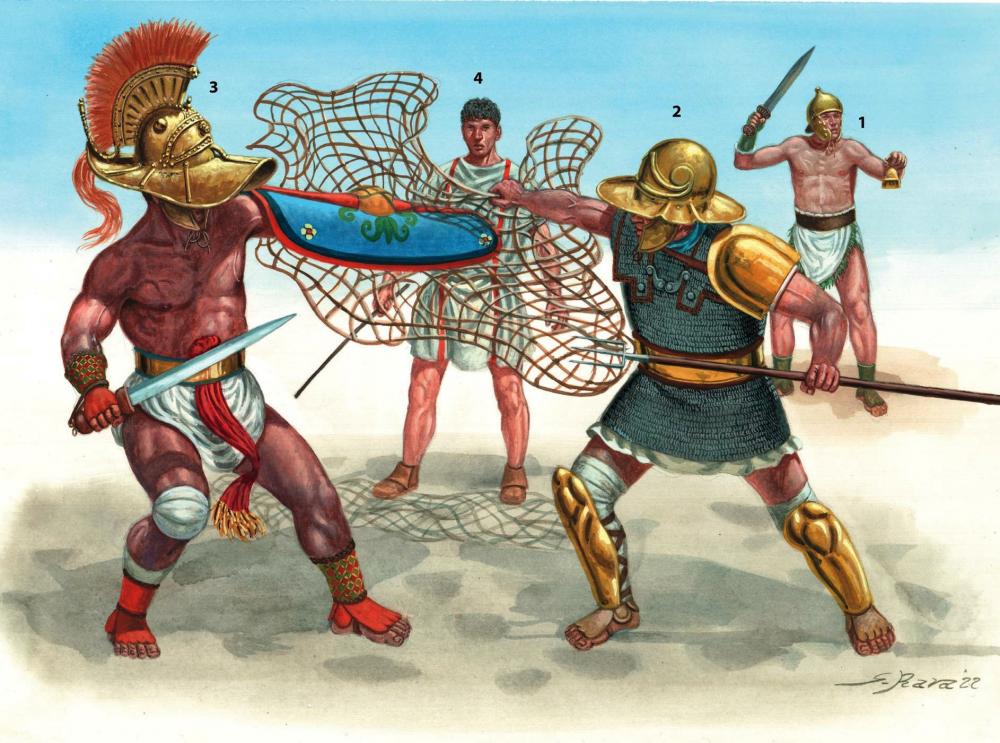
6. GLADIATORS AFTER THE REFORMS OF 22 BC (i)
In 22 BC, the emperor Augustus reformed gladiatorialism in order to limit the risks to Roman social order. Gladiator gear was undergoing changes at this time, and swords and shields were getting smaller.
(1) Thraex, c.20 BC
At the end of the 1st century BC, the thighs of the Thraeces and hoplomachi were more systematically clad in bands of fabric, or of leather. The bronze greaves now extended beyond the knees, to protect the lower thighs. Indeed, the shield was smaller and squarer; the shield decoration shown here is copied from a bas-relief at the Museo Nazionale Romano (Rome, Italy). On his right arm he wears an armband made with criss-crossing leather bands. His weapon is the long sica. The crest of his helmet, very arched, ends with a griffin’s head, which became a symbol of the armatura. The feathers are removable.
(2) Hoplomachus, c.20 BC
On the Fiano Romano relief, all hoplomachi (but also some Thraeces) have a large bead to weight the end of their ventral fabric band. Is this the mark of their ludus? In surviving depictions these strips of fabric usually have fringes at the end, or nothing at all. Here there is a bead about 4cm in diameter, possibly made of wood. His armband is made of leather bands, but they are assembled in parallel; the closure is done with a lace on the inside of the forearm. His Hellenistic helmet is copied from an artefact from the Detroit Institute of Arts (Michigan, USA); it is very similar to the helmet worn by a hoplomachus on the Fiano Romano relief. His heavy shield is hemispherical and bears a depiction of a gorgon’s head based on a relief in the Musée lapidaire de Narbonne (France). To make the shield easier to hold in a defensive position, it rests on his upper left shoulder, but this is rather awkward and uncomfortable. This is why the hoplomachi equipped their shoulder with padded protection, held in place by strong bandages that surround the torso.
(3) Sagittarius, Lugdunum, c.20 BC
Like other gladiators visible on the shards surviving from artefacts made by the potter Chrysippus, this archer wears a loincloth that appears to be made from a typically Gallic checked fabric. The edge is frayed, to make fringes. His round helmet is a Coolus- Mannheim model, kept at the Rheinisches Landesmuseum Bonn (Germany), in use by the Roman legions at the end of the Republic; it has cheekpieces but lacks a crest, and is surrounded by a band in which are stitched feathers.
(4) Tubicen, c.20 BC
The musicians improvised during the fights. This one is dressed like the referee, with shoes and a braided tunic. Over it, he wears a rust-coloured cape. His instrument is a long, straight trumpet (tuba), about 175cm long, composed of several nested segments made of bronze decorated with silver. A cord is attached to its end. It is kept taut, tied to a finger, so that the trumpet does not come apart. The large mouthpiece gives more power to the instrument.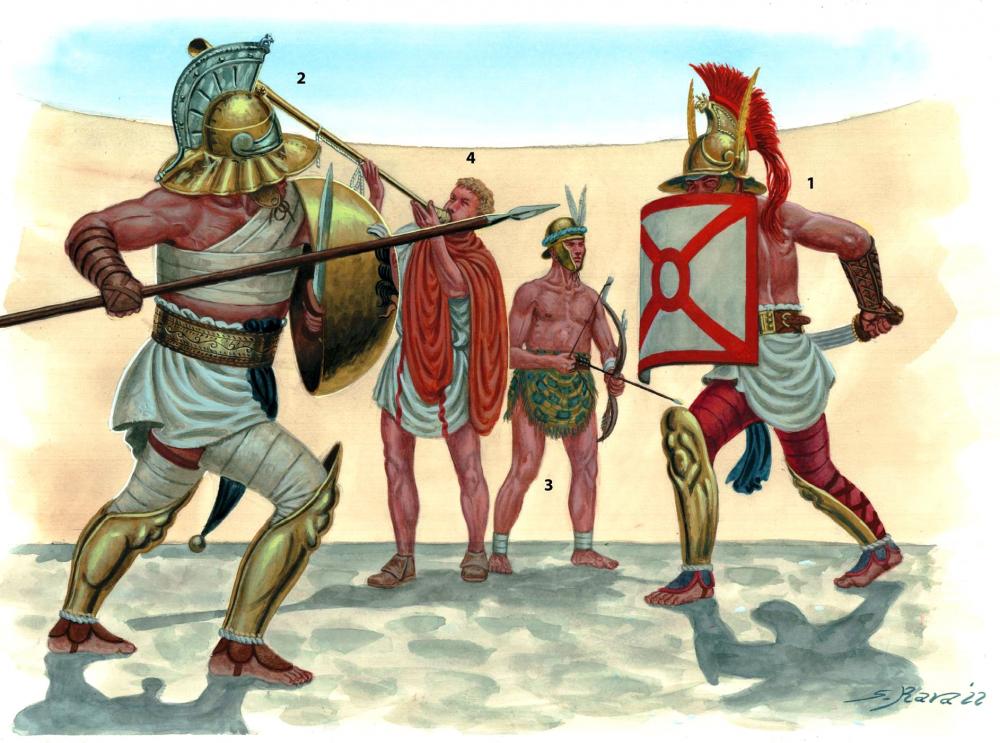
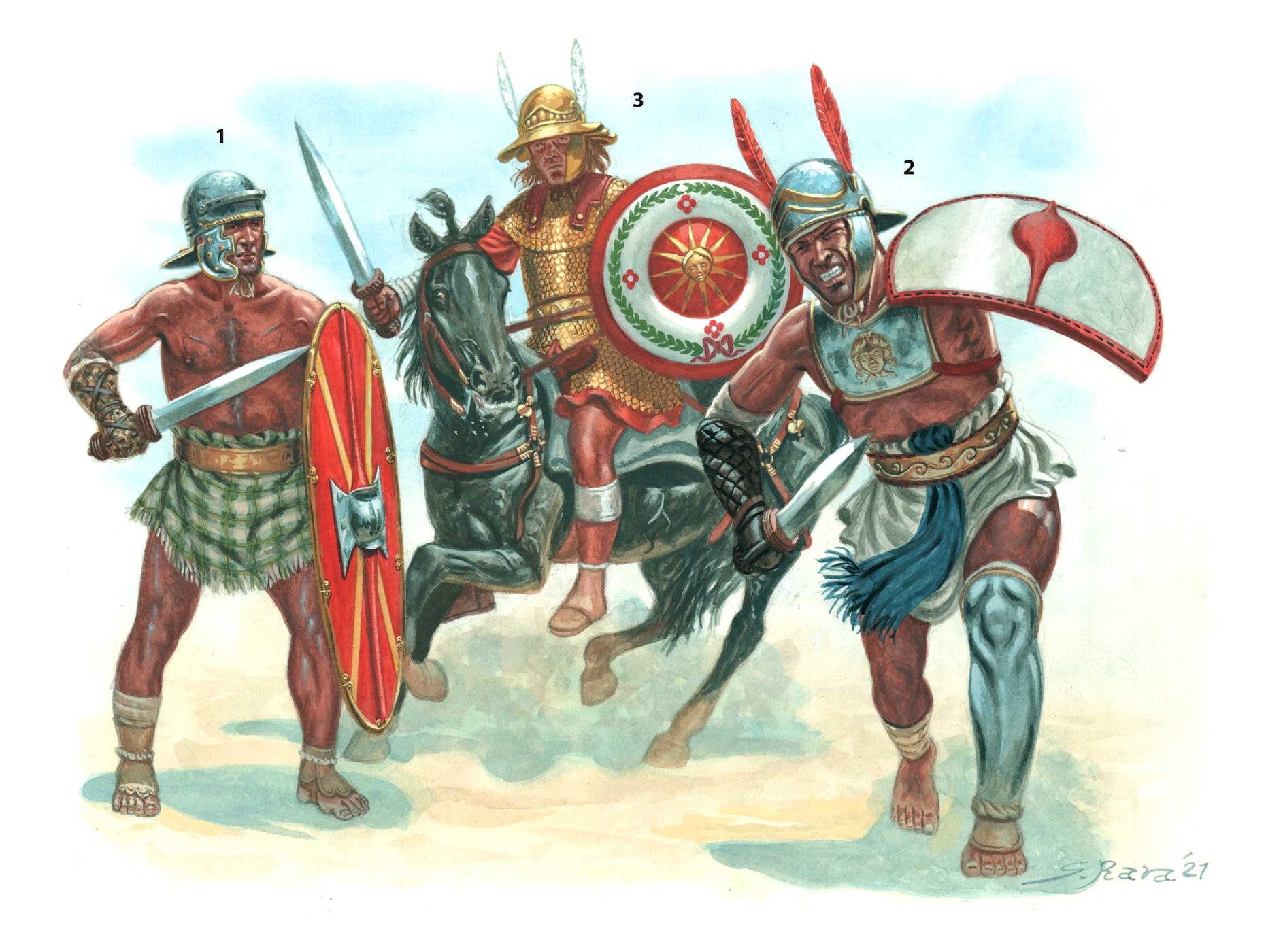
7. GLADIATORS AFTER THE REFORMS OF 22 BC (ii)
Towards the end of the 1st century BC, and especially after Augustus’ reforms, the images of gladiators become more numerous, because they were also used for imperial propaganda. The equipment of the gladiators is therefore better known to us from that time.
(1) Gallus, c.20 BC
This gladiator is reconstructed from a lead figurine (see here)from the British Museum (London, UK), shards of pottery from Lyon as well as the Fiano Romano relief. He is a provincial gladiator, wearing a checked loincloth. His helmet is a military model, with a lower neck cover; the original was discovered in a Gallic auxiliary tomb in Verdun (Slovenia), dated c.30 BC. His shield is oval and flat, with a Celtic ‘winged’ umbo. His sword is the Mainz model. He wears small leather gaiters. Clearly visible on the Fiano Romano relief, his manica is made from crocodile hide.
(2) Provocator, c.10 BC
This character is copied from the Tiber relief held at the Museo Nazionale Romano. His helmet mixes certain characteristics of
the new military helmets, in particular the cutout around the ears, and the undulations of the neck cover. He wears a pectoral for protection, especially against blows from his opponent’s shield, which is used in a very aggressive manner. It is held by straps that cross at the back; the gorgon’s head was a common decoration. The shield (parma) is smaller than that of the mirmillo. A single greave is worn on the left leg. The sword is the Mainz type.
(3) Eques, c.10 BC
At the start of Augustus’s reign (27 BC), the equipment of the eques became standardized; he now wore a metallic scale breastplate, with two narrow leather shoulder pads. It was a new model at that time, stemming from Rome’s Eastern wars. The
decoration of the belt is visible on a bas-relief (see here) in the Glyptothek (Munich, Germany). The red tunic is copied from a
frieze of weapons, from Pompeii. He is the only gladiator who wears shoes, identical to those of the referees. He fights with the spear or javelins, and then continues fighting on the ground with his sword. The diameter of his parma equestris has shrunk. Its decoration, like the two feathers of its helmets, is inspired by a bas-relief from the Collezione Torlonia. The harness of his horse is the pattern in use at this time.
8. THE LAST GLADIATORS OF THE 1ST CENTURY BC
These last gladiators of the 1st century BC inaugurate different duels, because military swords were abandoned and replaced by
daggers. The weapons were now very short (for most fighters), and the clashes were at close quarters.
(1) Mirmillo, c.10 BC–AD 10
Like all gladiators, this man wears bandages around certain limbs. The leather elements are patterned with perforations; this detail can be seen on the Fiano Romano relief kept at the Antiquarium di Lucus Feroniae (Capena, Italy). Preserved at the Museo archeologico di Terni (Italy), his helmet is an evolution from previous styles: the brim is no longer wavy and the large angular crest suggests that it belongs to a mirmillo. The length of swords decreased sharply at this time; they were now daggers, which necessitated a closer combat. The shield has also been reduced in size, its side edges having been cut to make it lighter. The spina is reinforced with a metallic umbo. The decoration, very military, is visible on a surviving relief.
(2) Samnis, c.10 BC–AD 10
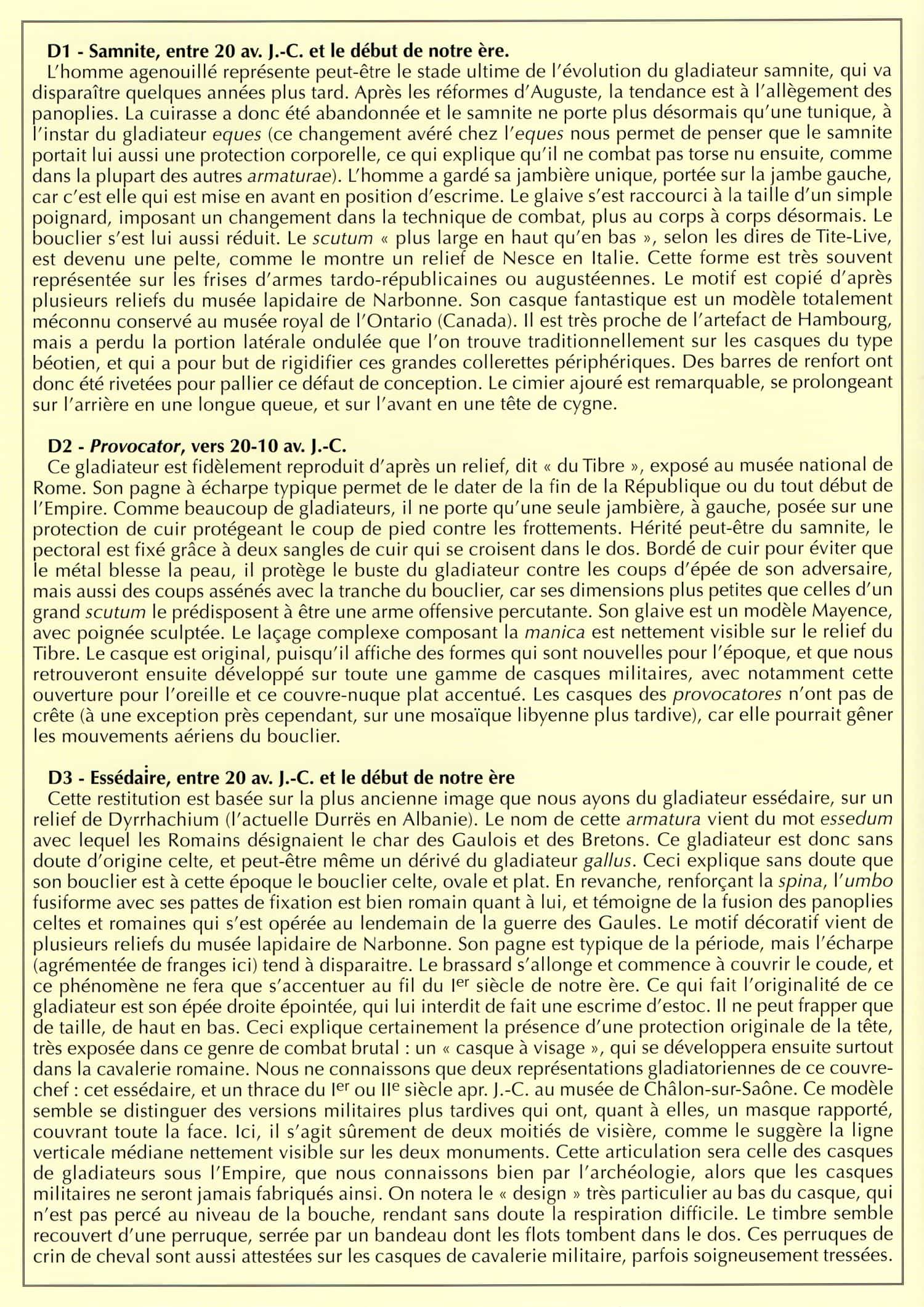
This is perhaps the last version of the Samnis, reconstructed from a bas-relief from Nesce (Italy). His panoply is different from otherknown armaturae. He is wearing a tunic, possibly because he does not have a breastplate; the eques soon made the same transition. His shield is in the form of a pelta and corresponds to Livy’s description, being wider at the top than at the bottom; this shape is often visible on the friezes of weapons. Its decoration comes from a bas-relief from the Musée lapidaire de Narbonne. His dagger precludes the possibility of identifying him as a Thraex. His spectacular helmet is based upon one kept at the Royal Ontario Museum (Toronto, Canada). The bas-relief is broken, however, and we do not know for certain whether this gladiator wore one or more greaves.
(3) Essedarius, c.10 BC–AD 10
This gladiator is reproduced from a bas-relief in the Narodni muzej Srbije (Belgrade, Serbia). The decoration of his bronze belt is inspired by a contemporary statue of a Thraex at the Musée Vivant-Denon (Chalon-sur-Saône, France). In these two ancient depictions, the two gladiators wear a helmet with a mask, in the style of the Roman Army’s cavalry; unlike the cavalry mask, the gladiator’s mask is in two parts. Our painting mixes the details of the two sculptures. This helmet has a wig, held in place by a headband. His armband protects his elbow. His sword lacks a point, which prohibits thrusting. His shield is a military-style curved scutum; its red colour is visible on a frieze from Pompeii.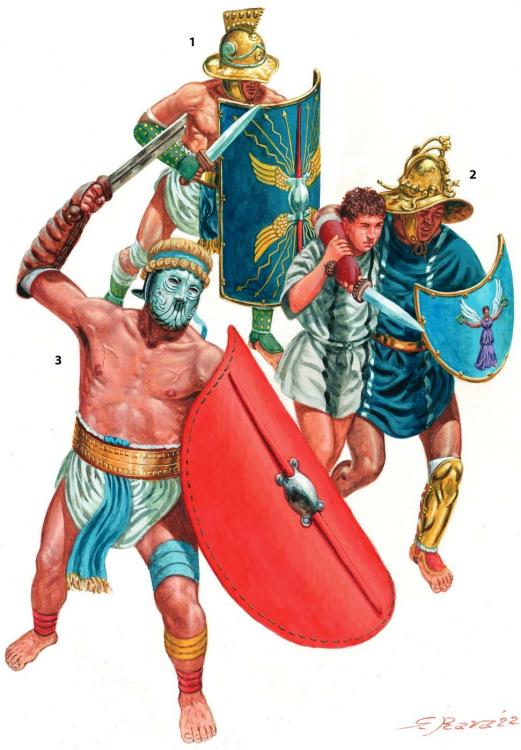
Plates and descriptions:
Spoiler1
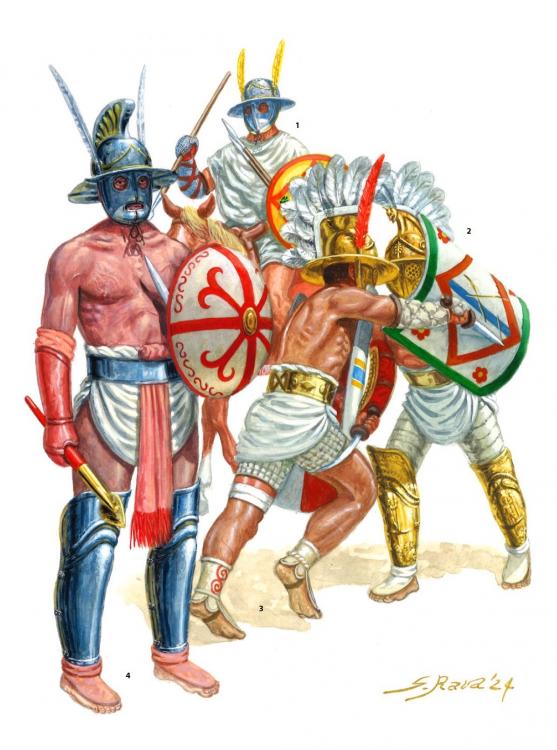
2
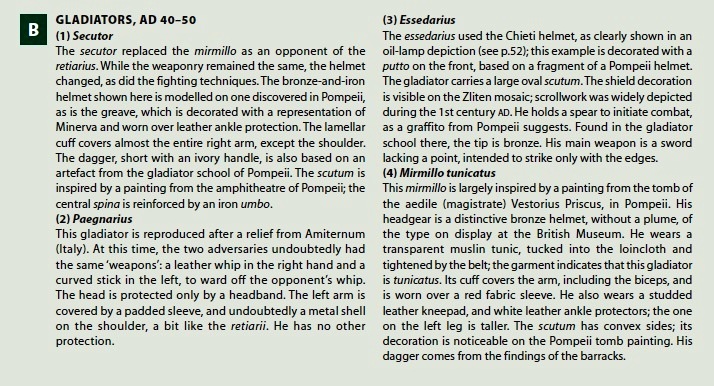
3
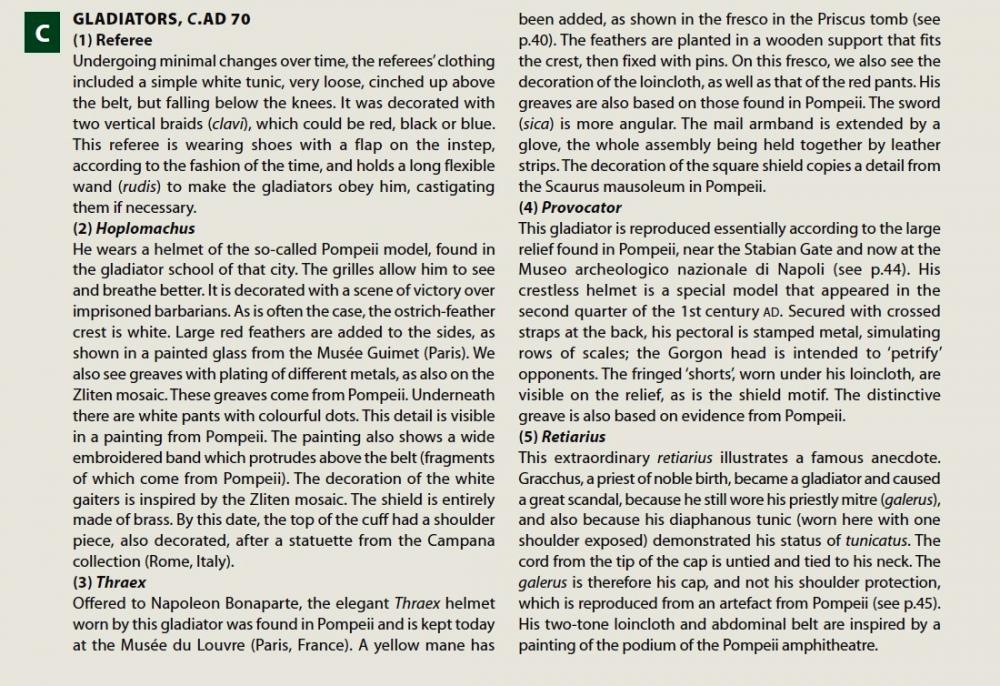
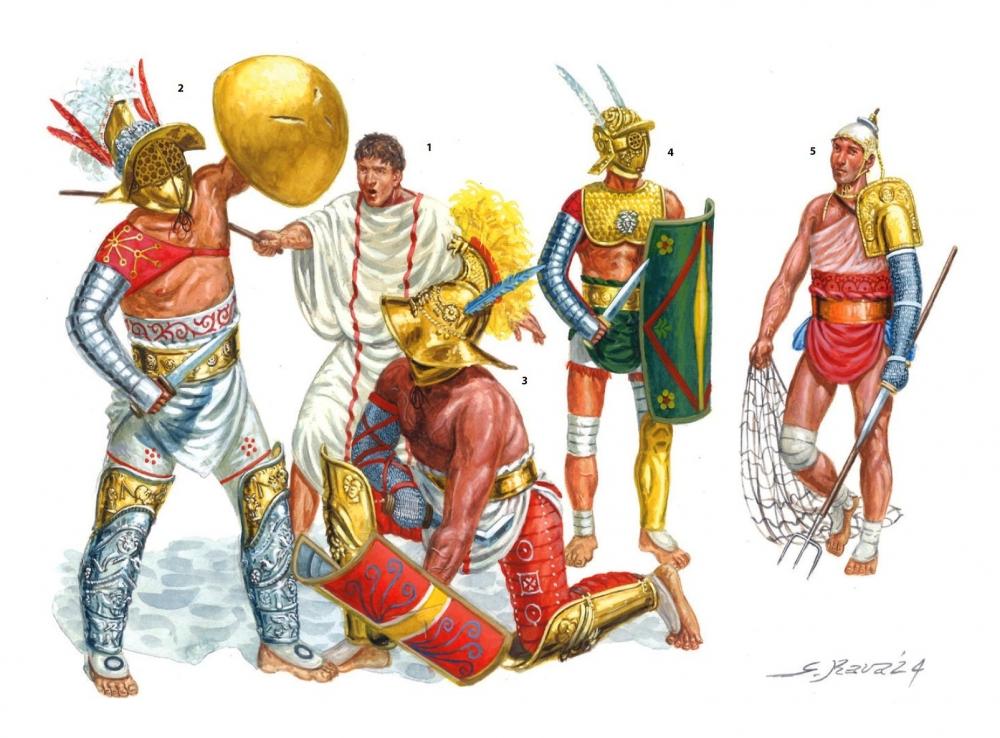
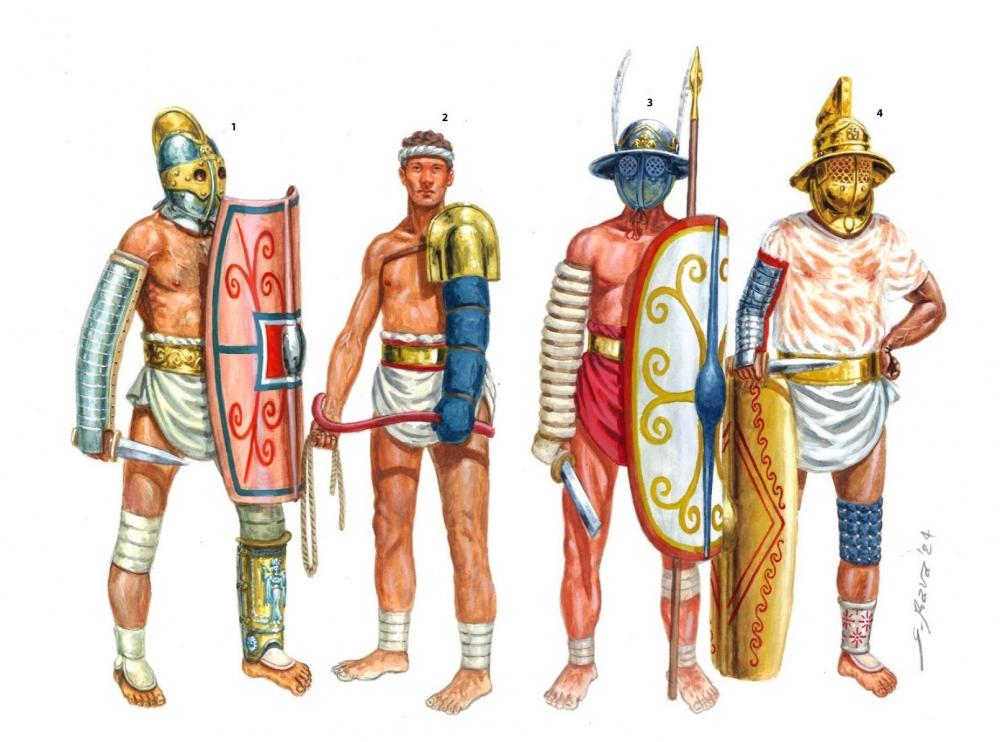
4
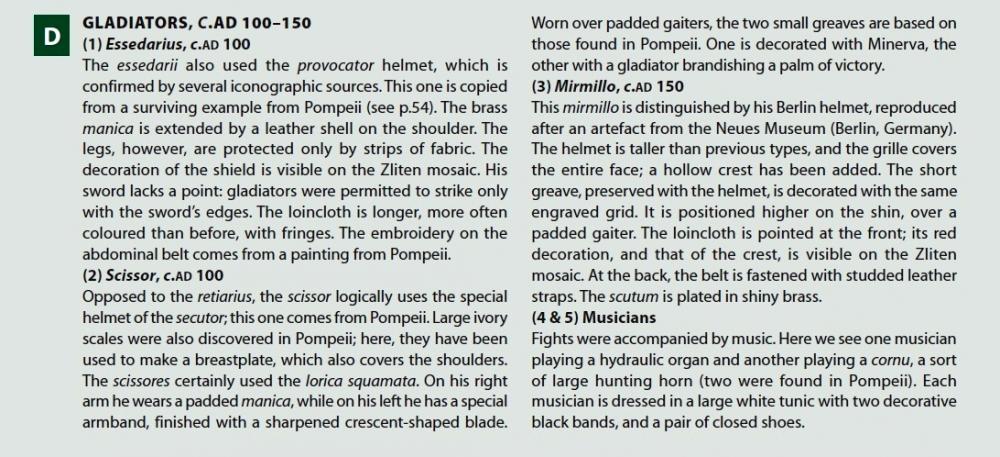
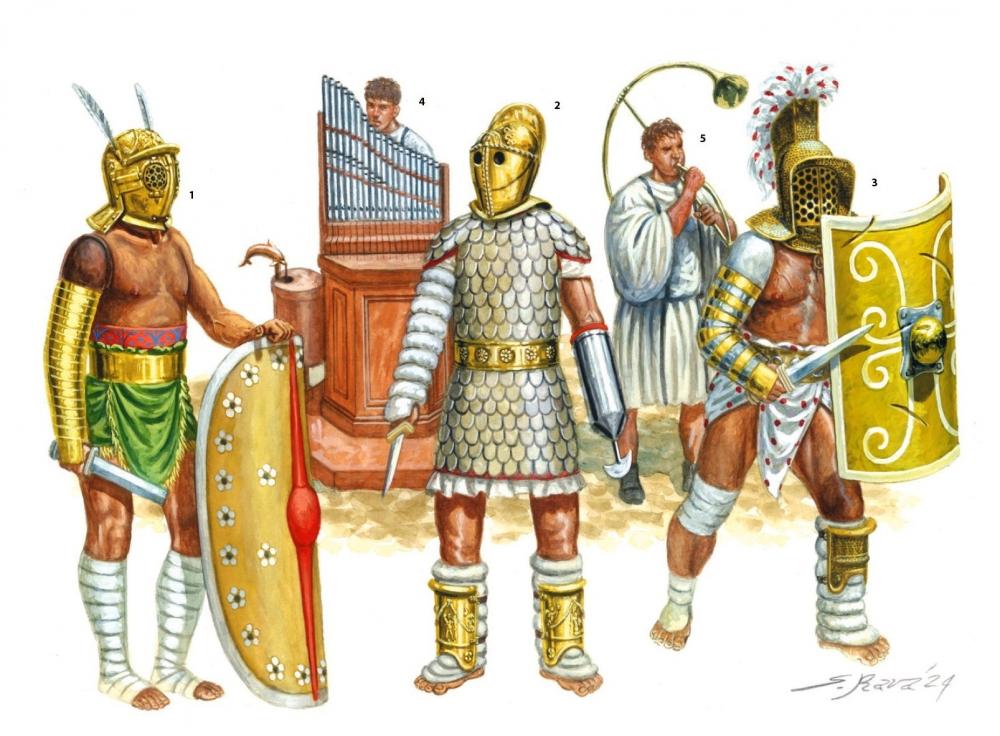
5
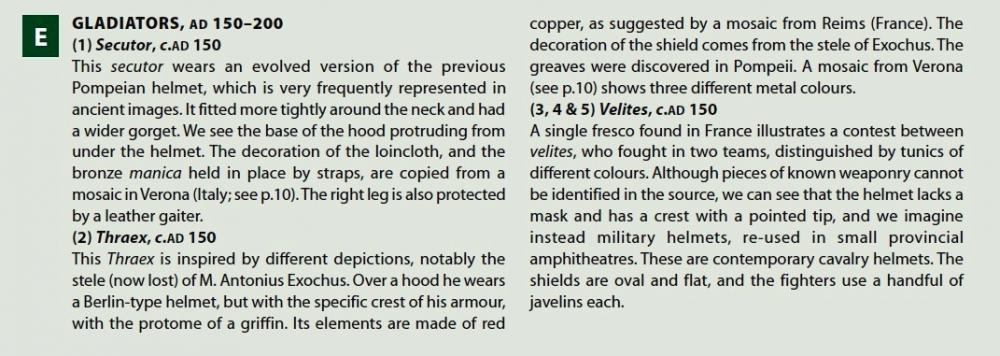
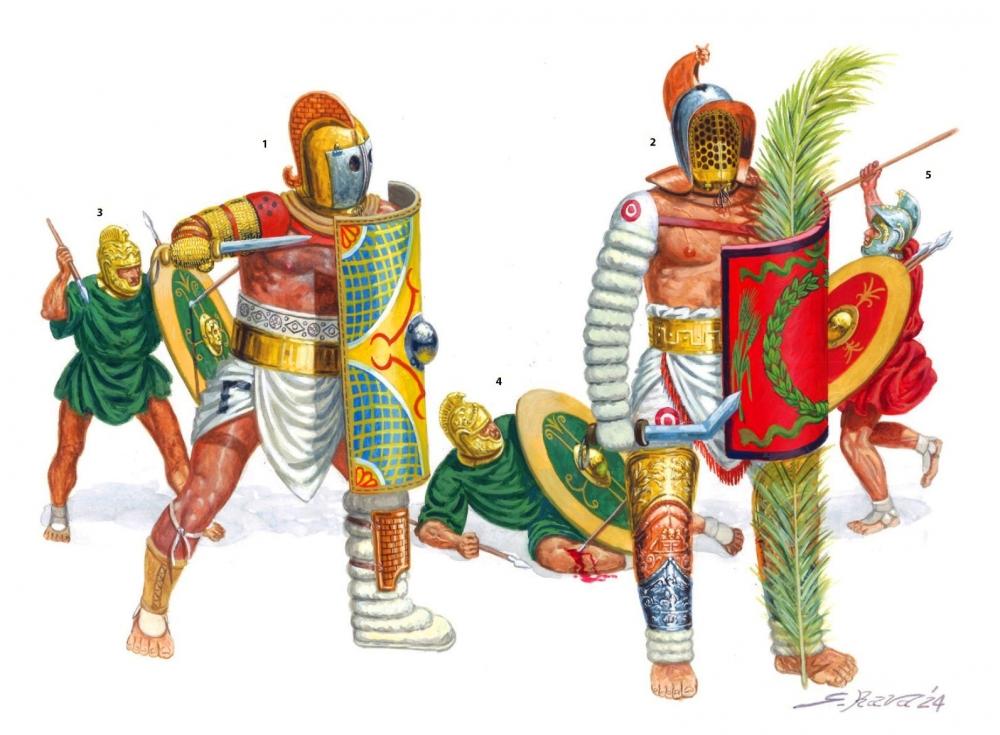
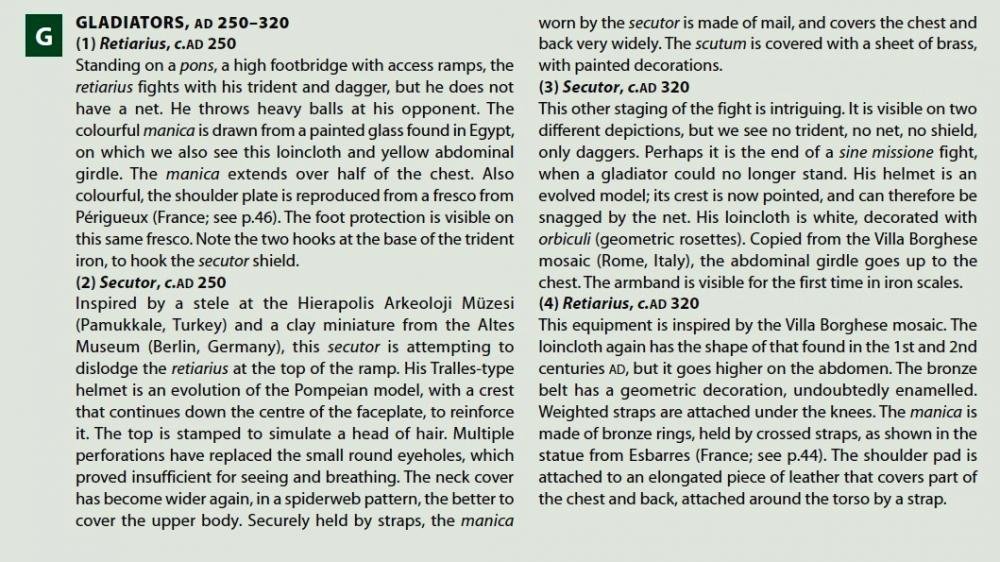
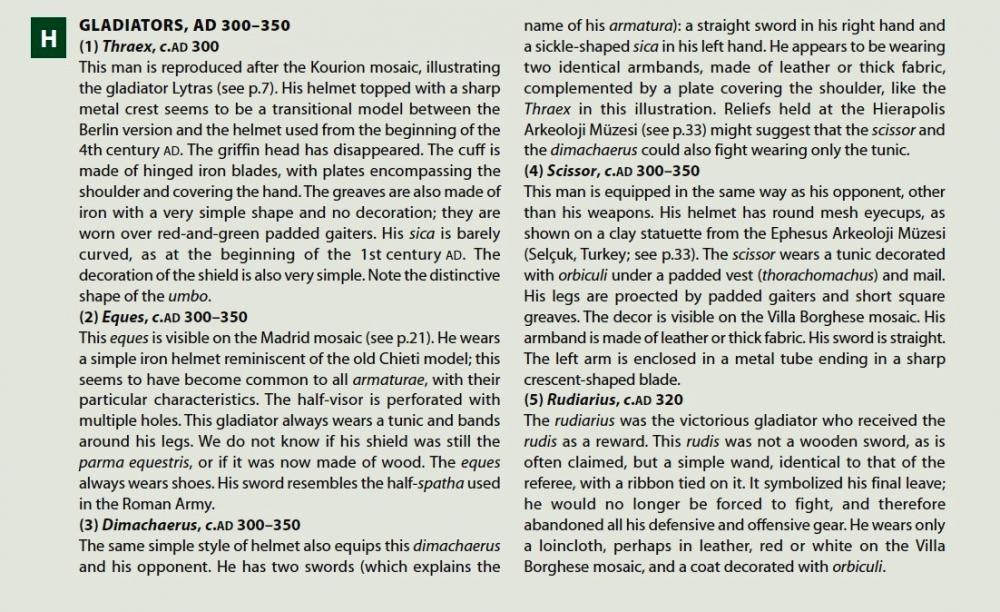
6

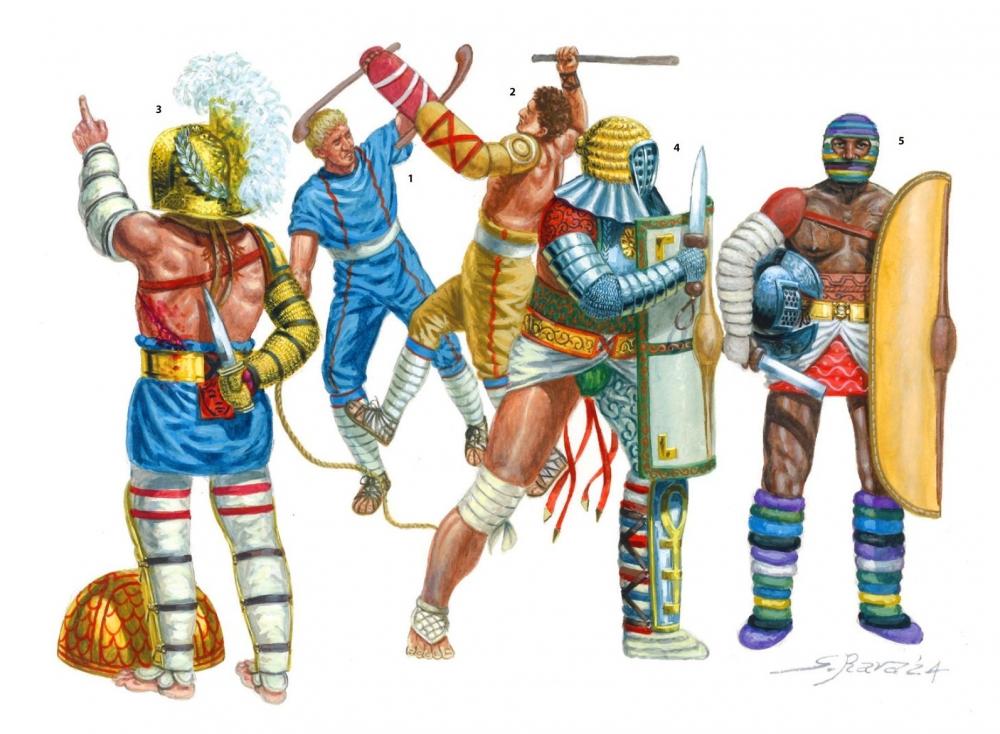
7

8
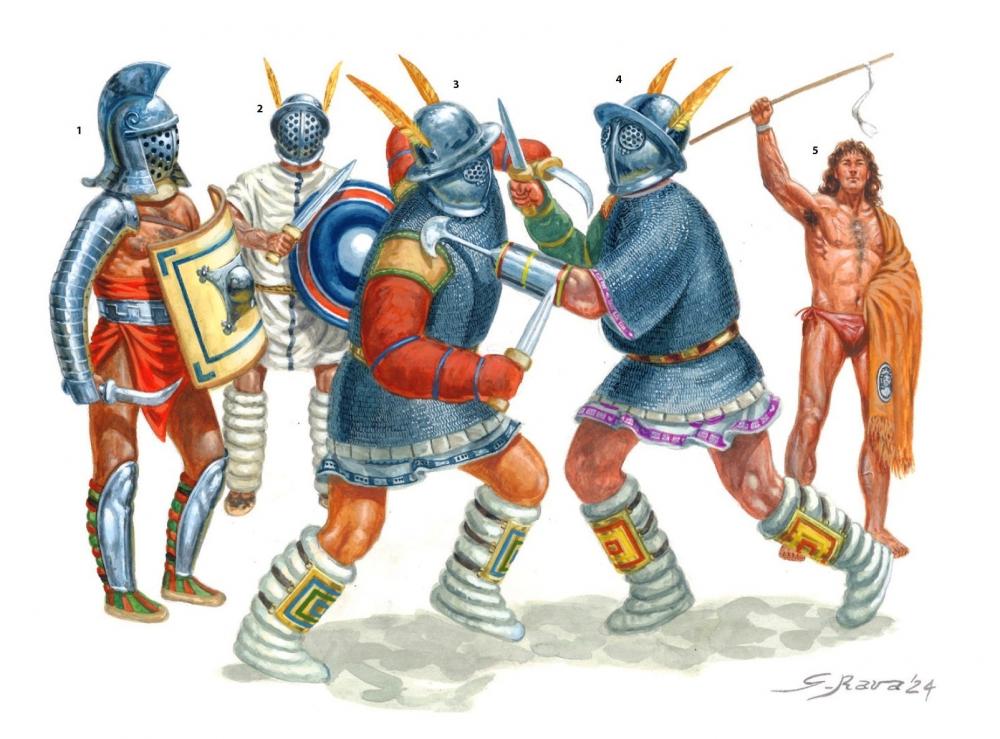
Bonus:
Spoiler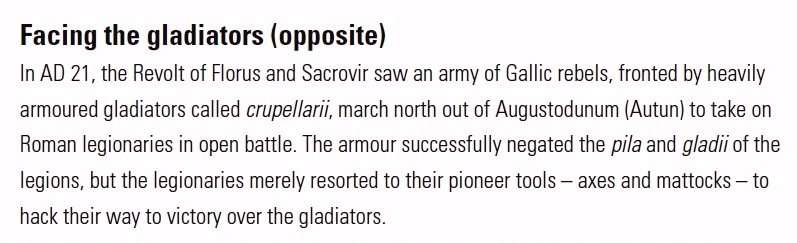
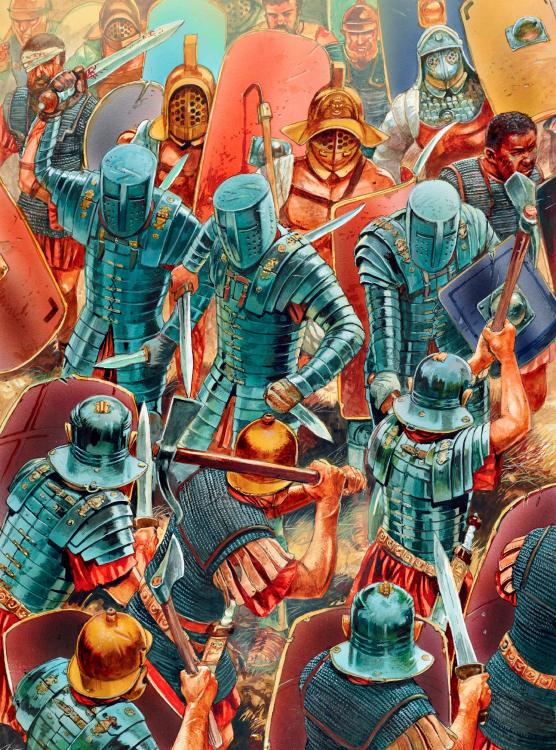
I hope you find it interesting
-
1
-
-
13 minutes ago, Seleucids said:
Train gladiator champions (which exist as templates but are hidden from the main game)
There is a dedicated thread for them:







Civ: Germans (Cimbri, Suebians, Goths)
in Delenda Est
Posted
This unit has been removed from the Britons due to a lack of historical accuracy. No zweihander.