


Lion.Kanzen
-
Posts
25684 -
Joined
-
Days Won
302
Everything posted by Lion.Kanzen
-

Faction idea: Koreans (Silla, Gojoseon,Goguryeo)
Lion.Kanzen replied to Lion.Kanzen's topic in Rise of the East
The Silla dynasty was one of three to rule Korea during the Three Kingdoms period (57 BC to 668 AD). Murals have been found showing cavalrymen with intricate armor on both horse and rider, but until now, that was all the evidence we had of Silla warriors. Archaeologists excavating the Silla tombs of the Jjoksaem District of Gyeongju (the onetime capital of the Silla Kingdom), have unconvered an astonishingly complete set of armor, scale for the human and barding for the horse, dating between the 4th and 6th centuries AD. Silla burial customs seem to have played a major part in the dispersal of their remains. After burial, a person’s belongings were left outside the tomb for people to take, so finding a buried set of armor is unprecedented. This burial had a coffin where the body was interred (no remains of the body were found) and a box containing the decedent’s belongings. The armor was found in the coffin, laid out flat underneath the body. The barding was on the bottom, neck and chest armor first, then the flank and hindquarters armor. On top of that was the scale armor. You can see how it looks flattened out in the picture on the left. The mural on the right shows it in action.
-
Faction idea: Koreans (Silla, Gojoseon,Goguryeo)
Lion.Kanzen replied to Lion.Kanzen's topic in Rise of the East
Koreans developed a unique and distinct fortress tradition.[1] There are numerous types of Korean fortresses, including sanseong (mountain fortress), eupseong (city fortress), pyeongjiseong, gwanseong, jangseong, chaekseong, and more.[2]Korean fortresses were based on a stone culture and built using stones, and often incorporated natural mountainous terrain, and therefore were conceptually completely different compared to Chinese fortresses, which were based on an earth culture and built using bricks from earth.[3][4] Korean fortresses were invented by Goguryeo and spread to Baekje and Silla,[5] and then inherited and further developed by Goryeo and then Joseon.[4] Korea, especially Goguryeo,[2][6][7] has often been called the "country of (mountain) fortresses";[1][4][8][9] almost 2,400 mountain fortress sites have been found in Korea.[1][4] Goguryeo fortress ruins have been found in about 170 sites to date, including in China;[6] one of the most notable among them is Anshi Fortress, which successfully defended against Tang Taizong during the Goguryeo–Tang War.[10][11] Goguryeo fortress ruins have also been found in present-day Mongolia.[12][13][14] Korean-style fortresses can be found in Japan, which were constructed and supervised by immigrants of Baekje origin.[4]

-
Faction idea: Koreans (Silla, Gojoseon,Goguryeo)
Lion.Kanzen replied to Lion.Kanzen's topic in Rise of the East
Proto–Three Kingdoms Period (c. 1st-2nd century BC to 3rd-4th century AD) According to Chinese text Sanguo Zhi, it recorded the existence of three types of prehistoric dwellings in Korea: pit houses, log houses and elevated houses. Only the remains of pit houses have been identified, however. Pit houses consisted of a 20–150 cm deep pit and a superstructure of grass and clay supported by a tripod-like frame made of timber to provide protection from the wind and rain. Pit houses of the Neolithic period had circular or oval pits about 5–6 meters in diameter with a hearth at the center. Most of the early ones were located on hills. As these dwellings moved down nearer to rivers, the pits became rectangular in shape as well as larger, with two separated hearths.[2] In 108 BC, the Chinese commanderies was established after the destruction of Gojoseon. Official buildings of this period were built of wood and brick and roofed with tiles having the features of Chinese construction. Fortress architecture Goguryeo, the largest kingdom among the Three Kingdoms of Korea, is renowned for its mountain fortresses built horizontally and vertically along the incline of slopes. One of the well-preserved Goguryeo fortresses is Baekam fortress (白巖城) constructed before 6th century in present-day South-West Manchuria. A Chinese historian noted, "The Goguryeo people like to build their palaces well." Patterned tiles and ornate bracket systems were already in use in many palaces in Pyongyang, the capital, and other town-fortresses in what now is Manchuria.
-
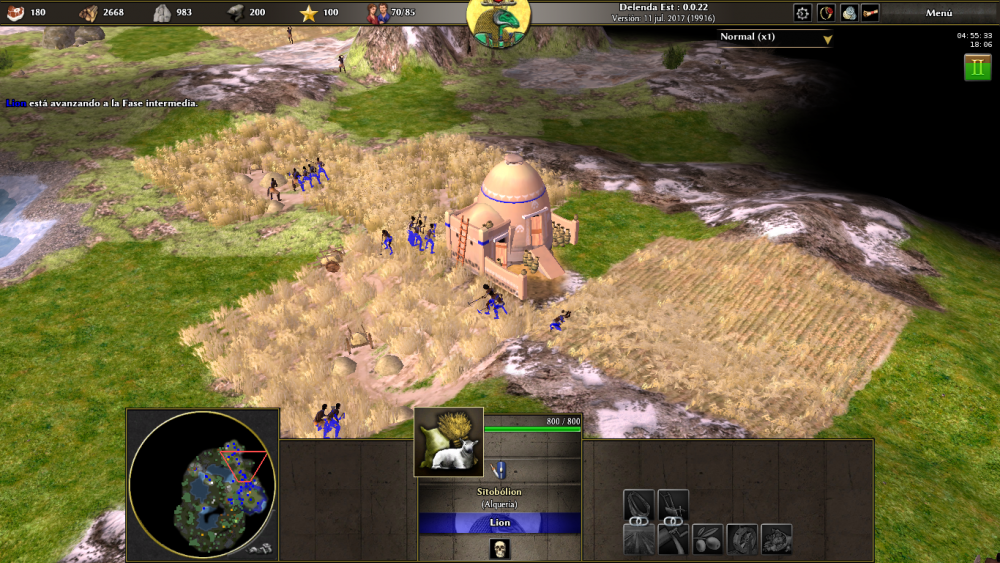
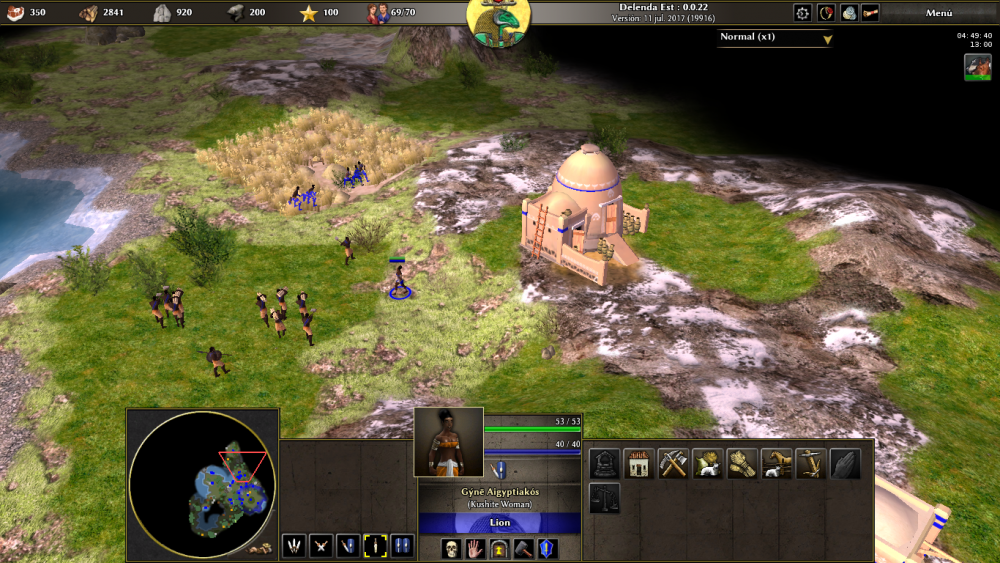
my first gameplay.
-
Batter upload it here.
-
Need Stanislas hard work.... but we can starting with Han template.
-
Cavalry units can't gathering glory. Justus don't include Zapotecs. We can add Koreans in a month.
-
Here is..

-
Done. Now wait for the guys are 4:00 am here in Argentina must be 7:00 am, they must be the first to see the announcement. im not sure how many Iberian Spanish/ Castilian , in Spain must be 11am. But I'm not sure.
-
Ok I'll advise to my men. you can get me promotional images?
-
I agree with that, must be Tab feature, mostly of new comers even don't touch options. and option panel is a mess, can be nice separate each set of options.
-
Unless you are looking for this.
-
AoEO can't be most realistic example but have lovely color palette. Don't abuse of blue bricks. mix very well the yellow and polish stone, excessive use of plants but isn't bad idea. the other is a very realistic render but with poor texture color. and finally the perfect balance,but don't use plants or props.


-


-
I will return as dev for A while I need moderator rights to pin some post. @niektb i will working in the textures.(and some functionalities as designer co-working with @Zophim i can work for Millenium , made shields, banners. and for Terra Magna.
-
babylon style1 babyloniansmall_normal.psd babyloniansmall.psd publicdomainlionmod.psd babilonian_classic.psd
-
===[COMMITTED]=== Order move indicator[Visual]
Lion.Kanzen replied to Lion.Kanzen's topic in Completed Art Tasks
What's happen with this? -
Terra Magna Infrastructure / Kushites Mod Integration
Lion.Kanzen replied to balduin's topic in Rise of the East
Yes indeed.
-
Merle cavalry must deal with them and Bolst shooter must insta kill but cavalry can take down is a double K.O.
-
Lancer tier ( Cataphract and shock cavalry with powerful armor and resistency vs heavy swordman infantry. But more slower than Carthage lancers. Are missing cavalry bonus vs siege units except bolt shooter. add to the mix defensive buildings.
-
Creating Selector screen and adding buttons/ features.
Lion.Kanzen replied to Lion.Kanzen's topic in Game dev
@s0600204 you see me second reply in A22 issues. -
Creating Selector screen and adding buttons/ features.
Lion.Kanzen replied to Lion.Kanzen's topic in Game dev
but that's dev / gameplay decision. is minimal thing. -
i think this dont be needed(?)
-
size="50%-280 50%-200 50%+280 50%+150" this the size . how i can Interprete this? Specially I want a bigger windows size.