All Activity
- Past hour
-

Implementing forces in Unit Motion (HELP WANTED)
Atrik replied to Atrik's topic in Game Development & Technical Discussion
You can see how "solid effect" of "stiffness" impact the boats in the video. You get super cool effects when there are a few ones, but a lot of them result in them taking a lot of time to settle. It's fine for boats as you rarely think of crowds of boats, and I just made a scene for this in the video to show that it works, and still look good for them. But if you have a crowd of infantry constantly wiggling and taking forever to settle, this would look very bad. Inertia and pushing aren't the same thing. But for navigating on open terrain, this wouldn't change much. However if you try to funnel "solid" physical bodies into a choke-point, they obviously take a while more to achieve the same movement. So if ever we wanted to make cavalry "solid bodies", with this PR it's only just one tweak in their template. But because big crowds of them cost more to simulate and that moving them around take longer if they are in high number, it should be accompanied by an increase of cost/population for example. The pros are that they will have much more realistic charge effects, like you see with elephants, but cavalry have less contact area and are moving much faster, the physic outcome would be different too (like a cavalry can trow fewer infantry units away but at higher velocity). So this is just a balancing change, out of scope. Even without proper "charge", -so just using the old pushing pretty much as it was, the inertia improves physics for cavalry fighting at no additional cost. The cavalry can push away other spread units thanks to it's superior weight, and also push it's target by a little - even if ideally it would be more, and the cavalry would be smart enough to take more advantage of it instead of stopping once in front of it's target. Screencast from 2026-09-22 18-44-41.webm -
0 A.D. 2026-09-22 22-30-22 - Trim.mp4
- Today
-
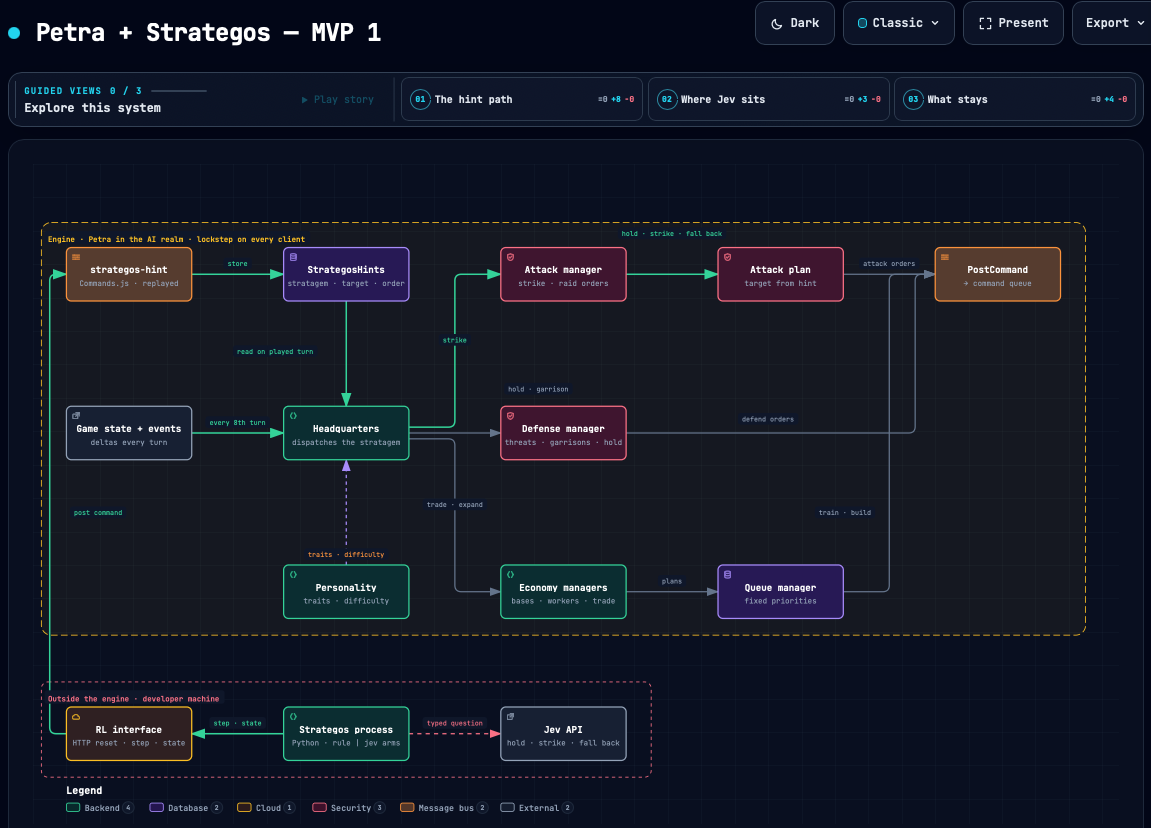
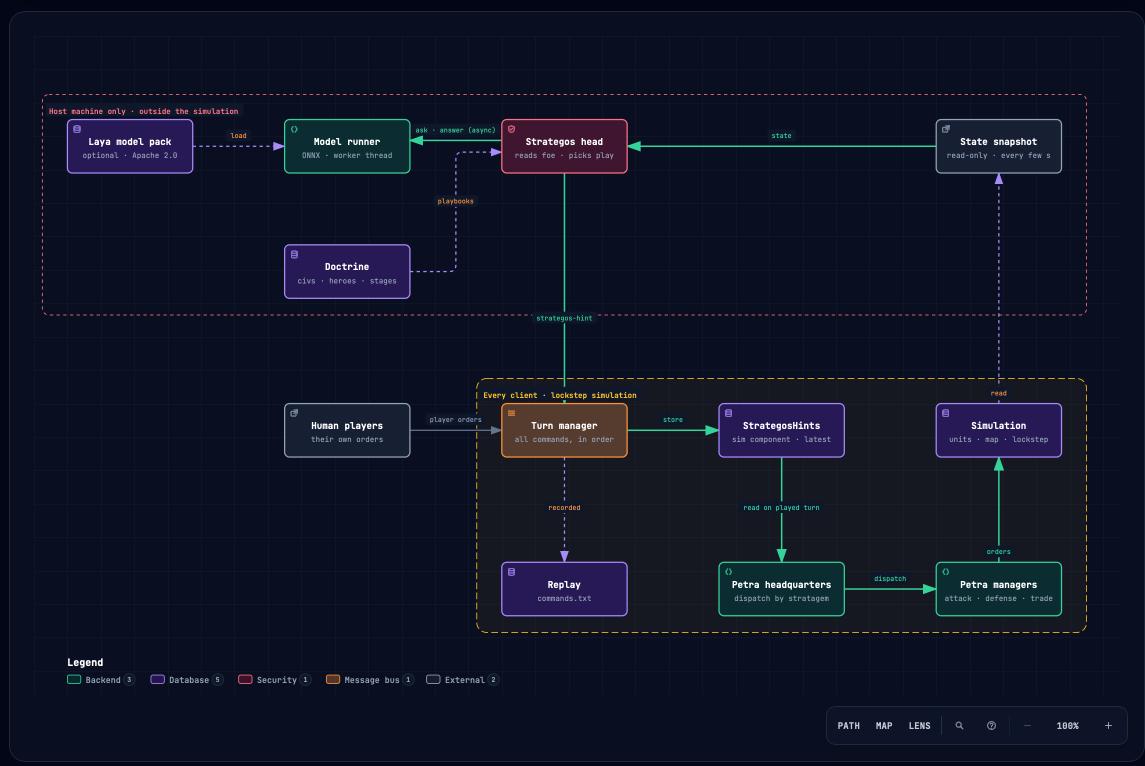
 Thanks for being upfront, that's useful context. I think the difference between us is one line: you make the civs differ in the data (units, techs) and the AI exploits it; I'm trying to make Petra play the vanilla civs differently, on the data everyone has. Both are valid, and if things like "charge" land in the base game they'll help my side too. The whole idea rests on a table like this:
-
 Appreciate you response @josue valencia. Juist so we are clear, I know very little about what I'm doing, AI is doing most of it for me I basically send replays/interesting log and send to chatGPT and then tell it what i see think should be improved and it writes the changes. Yes the AI is tied to Classical Warfare, so you would have to download the AI only and probably recode some of it. However, I think we are trying to be similar in ways that you might not be aware of. In general we changed CWA so that the Civs were a little more different and represented their heroes/styles better. For example greek hoplites are a little stronger than most spearman and the first melee attack tech is aviabile in p1 for greek city states. So in the p1 rush for Greeks the AI is supposed to try and get that attack to give it an advantage. There are still llots of little things that need cleaning up. ANd I continue to work on it daily. Would be great to bounce ideas off someone else, but yes I realize it is mainly tied into the changes we made to CWA and some, if not a lot of people may not want that. Although some of those changes will probably be coming to newer versions of the base game, like "charge" type behavior and other things I think.
 -

Implementing forces in Unit Motion (HELP WANTED)
Thalatta replied to Atrik's topic in Game Development & Technical Discussion
Hardly , just pointing out history, realism, and possible improvements, more so considering many have stated a preference for tactics and formations becoming more relevant, which units not going through each other would automatically provide, in good part Sure, but it's a theory/practise issue. Shouldn't increasing the radial repulsion force at a given distance (in physical terms, the elastic constant k, or stiffness) of land units achieve a more "solid" effect? Would this be costlier to simulate? I wonder how your cavalry turning would look in that case, for example. -
thanks, @Emacz That's great to hear, and close to what phosit suggested above: named openings instead of Petra's threshold flags. I had a look at your repo (Emacz2/classical-warefare-aea); the expertDecision/ stage machine and build-order planner are very much the "hands" side done well. A few questions: 1. The AI looks tied to Classical Warfare units (Athenian Marine etc.). Is there a version that runs on vanilla, or an older build with the 4 random strategies? I'd like to use it as a second, stronger baseline in my headless harness (fixed seeds, Petra vs Petra). - will be funny, to have different AI battling each other 2. "Breaks Very Hard by 10 min, then 15 more to finish": the finishing problem (when to commit and end the game) is one of the questions I want to measure. Any intuition what it's missing there? Happy to compare notes; your work is a good deterministic baseline against which anything model-driven has to prove itself. Where I think we differ, and why I'm not just doing the same: your expert AI makes Petra stronger, with a well-tuned build order and a stage machine, and it works. What I'm after is variety: a Petra that plays differently as Sparta under Leonidas than as Carthage under Hannibal, that holds a pass on one map and builds a trade network on another, and that reacts to what the opponent is doing. Strength is a side effect there, not the goal; the "expert" doctrine could well be one of the openings a civ picks. So the two are complementary: your work is the hands, mine tries to be the head.
-
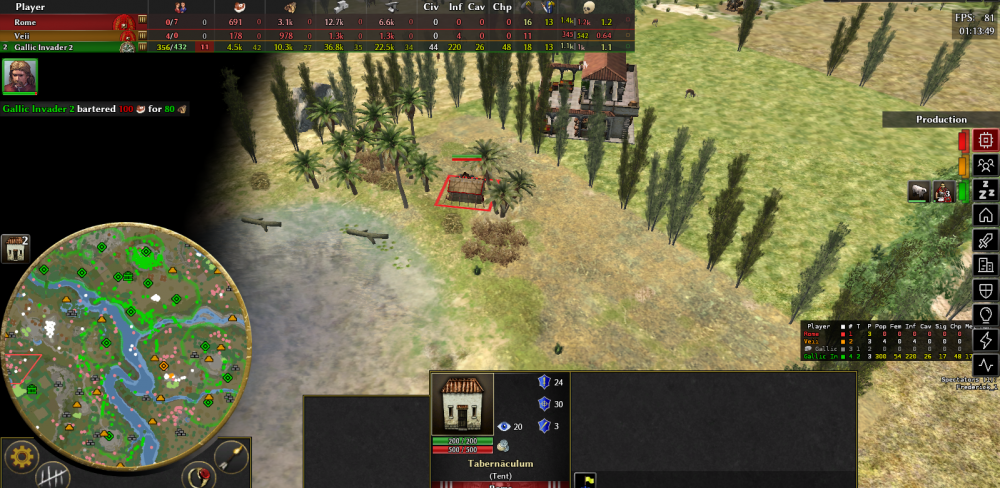
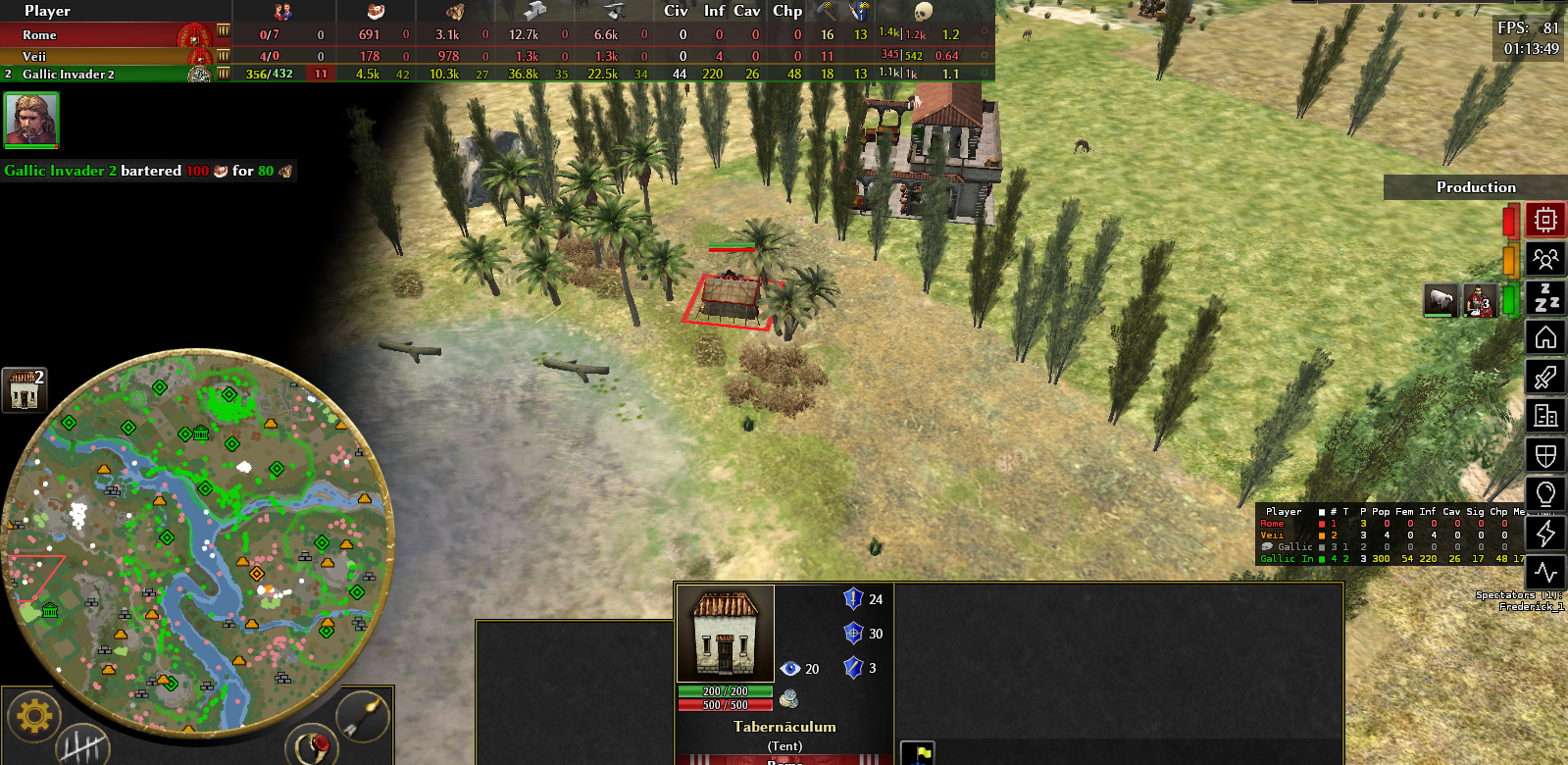
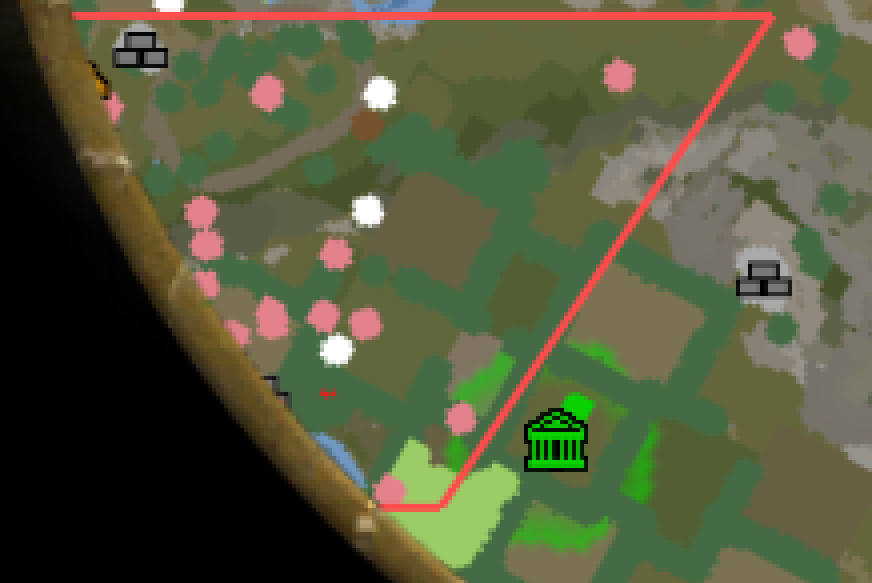
Okey, altough there does not seem to be much interest, I promised it... there is a little tent left, that rome captured and does not decay after destruction of all the rest, and this keeps rome for the engine in a state "Not lost all critical resources". Altough a tent despite a house can not train woman, so it is over for rome. What is special, due to the palms next to the tent it is almost invisible in the mini map.
-
Thanks @phosit, this is exactly the feedback I wanted. PRs. Fair. Those were low-priority fixes I made while setting up my local environment on macOS (not easy) and to test the AI-assisted workflow I'm using now. I'll reopen the ones that still make sense (#8976 fixes the still-open #8975; #8977 I owe you the commit split) and answer the pending reviews. No hard feelings. I agree, and I'd put the line here: the model never writes behaviour. Every stratagem, every question and every fallback rule is plain JS/Python you can read. The model only picks between options we wrote, and the rule arm (a hand-written distance rule) exists precisely so the model can be swapped out and compared. - i am building it now with laya, but it should allow easily swap to use other like Jev - At the end of the day the model will pick up which "function" in the system to use. Two tasks in one system. Partly a misunderstanding on my side of the post: hero "playbooks" are strategy (Fabius = delay, Leonidas = hold the pass), not unit micro, and the actual fight stays Petra's. But you're right that "hold / strike / fall back" every few seconds sits between strategy and tactics. I'll keep the questions at the strategic level (which stratagem, where, when to commit) and leave "when to end an attack" to Petra's existing attack-plan logic unless the data says otherwise. Starting strategies. Looked at startingStrategy.js (configFirstBase): flags from land/food/wood plus the personality axis, chosen once, no civ or enemy input. That's a natural home for the civ-doctrine part (a named opening per civ instead of threshold flags), and a smaller, more upstreamable change than what I described. I'll start there for the early game. State as language. I won't feed raw commands. The state is a short readable summary ("enemy army of ~30 units, 80 m from the pass, moving toward our tower; our 25 units garrisoned"), which is what these classifiers are trained on. I measured Laya locally today: ~40 ms per question on a laptop CPU after a one-time 55 s load. I'll publish the exact input format with the dataset. Host-only model. You mean #8786, I think. That one moves all of Petra to the host and clients stop simulating it, so a modified AI would be undetectable; I understand why it stalled. This proposal is narrower: Petra keeps running on every client (so the OOS hash still covers it) and only the hint is a host command, the same class as any command a human host sends. The residual risk is a host sending sabotaging hints to an AI slot, which is a "bad ally" problem, not a desync one. It's not doable as a pure mod, agreed: the server must accept that one command type for AI slots. That's a small engine change, and single-player needs none of it. please take a look at, Script and the Output. Reproducible in 5 min: pip install laya, run this script; And yes, using a model to find where Petra is weak is a good use too; the labeled game states from this work could feed that. To be clear about the goal. Performance (Petra's or AI lag in general) is not what I'm trying to improve. The goal is a smarter Petra: strategies that fit the civilization and the hero it's playing, the way those armies actually fought. Whether that needs a model at all is an open question. Right now this is a prototype, there's plenty of room for improvement, and I'm fully open to dropping the model if a deterministic, hand-written way gets the same result.
-
Ive been using AI to help improve Petra. I have an "expert" version that comes with Classical Warfare AEA. But I'm you could easily just download the AI files. ALthough it does specifically work with some of our overall changes. It can randomly roll 4 strategies, p1 rush, p2 military tech push, p3 max pop max techs and I forget the 4th one It beats very hard 95% of the time (and only has a 20% gather resource bonus instead of the 56% that VH has) but I'm still trying to get it to be more efficient. A lot of times it will basically break very hard by 10 min, but then it takes another 10-15m to actually finish the gam
-
Implementing forces in Unit Motion (HELP WANTED)
Atrik replied to Atrik's topic in Game Development & Technical Discussion
You are such a gigantic troll But I'll bump on it still, and give some nerdy details. The collisions between units are not indeed like solid bodies that are impossible to overlap, even with this PR, this will remain true for most units. It's more a spring-like push that tries to make units keep distance to each others. This pushing just use a distance-to-center repulsion force. What's introduced here for boats and elephants is a different stronger pushing and that actually take the unit's shape into account. This is why on the video you see that the hulls act like actual solid bodies. However simulating this, is ~x1.5 time costlier then the simple radial spring pushing. So because that, for small units, the difference in visible behavior would be minor, better go with the simple pushing, and use the better one only for big units that get the most benefits from it. A fun fact is that before this PR, all units were treated the same, so you did had still this radial-pushing for boats (the collisions were spring-like and only a small circle at the center of the boat was even acting as the hitbox) but it was still much bigger then for, say infantry. To detect if units were colliding, the map had a grid that allowed each unit to search a limited area where it might be actually colliding with other units. This grid size had to be proportional to the largest pushing unit of the game : boats - who's pushing effects where questionable anyway. Even if you played on mainland map with no ships whatsoever, the grid was sized to work for boats too. And your unit had to check their distance with much more other units they needed to. So you can say that the lag you experience on mainland, was partially due to ships. This along a few other optimizations with the pushing and more resilient obstruction handling, make the PR a performance improvement for common scenarios (yey!). -
 Hi, i closed your PRs as you didn't reply for some months. Feel free to reopen them. Nice that you work on this. I also had plans to use AI to improve the Petra. (Not to integrate it but to use it to see where Petra is bad at.) Integrating it that much goes (for me) against the free software philosophy. Every code should be possible to understand. You want the AI to choose a strategy. But you also want the AI to say when to end an attack (fall back) and how a hero should fight. Thous seem pretty different tasks. I think it's bad to solve both with the same system. Currently there are starting-strategies witch are chosen from. It would be good when you take a look there. Maybe you can extend that. The model you choose takes language as "state". Yes it can be json formated and yes it's multilingual but i'm not sure it understands something like {"type":"repair","entities":[177],"target":4030,"autocontinue":true,"queued":false,"pushFront":false,"formation":"special/formations/null"} Why? There has recently been a PR wanting to do a similar thing for Petra. As i remember it the conclusion was to not continue the plan for now. I don't think that it is possible to do it in a mod.
 -

Specific Name Review: Units
Ultimate Aurelian replied to Doktoreus's topic in Game Development & Technical Discussion
This seems to now be used for the Gaul and Briton villagers. Not sure how accurate it is in that more lower status role (in any case, the villagers might work better as freemen/commoners. With the servants/slaves being portrayed by another type of villager once implemented). -

Report @Bakki player for quitting game when loosing
Gurken Khan replied to thegreatandfurious's topic in General Discussion
-> -
 happened on 22/09/2026 at 12:01 Paris Time
 -
thegreatandfurious joined the community
-
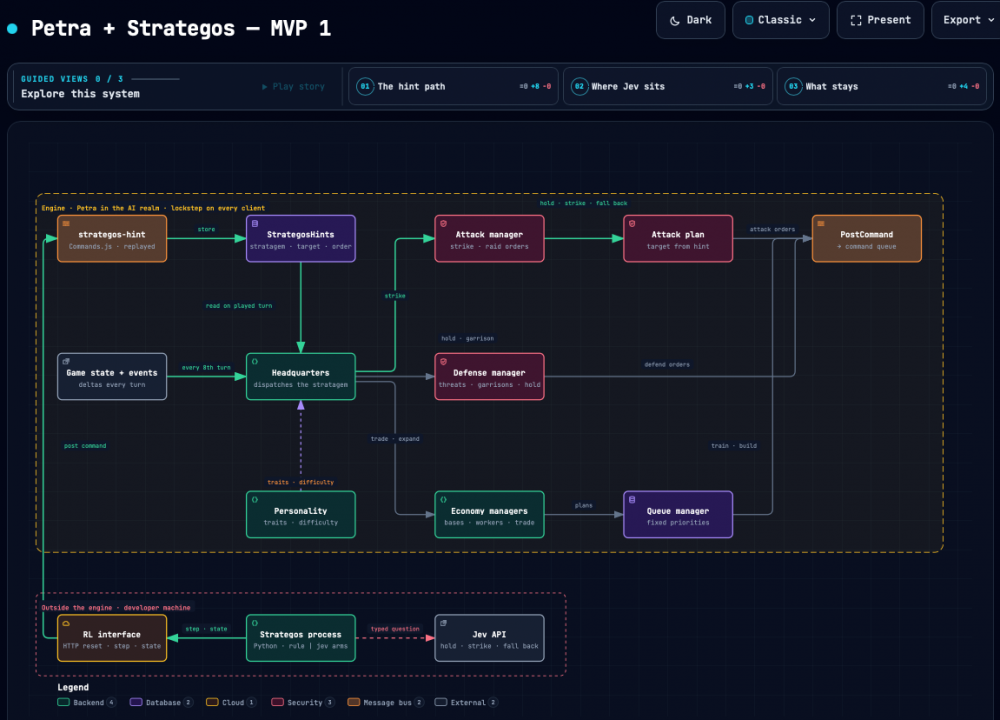
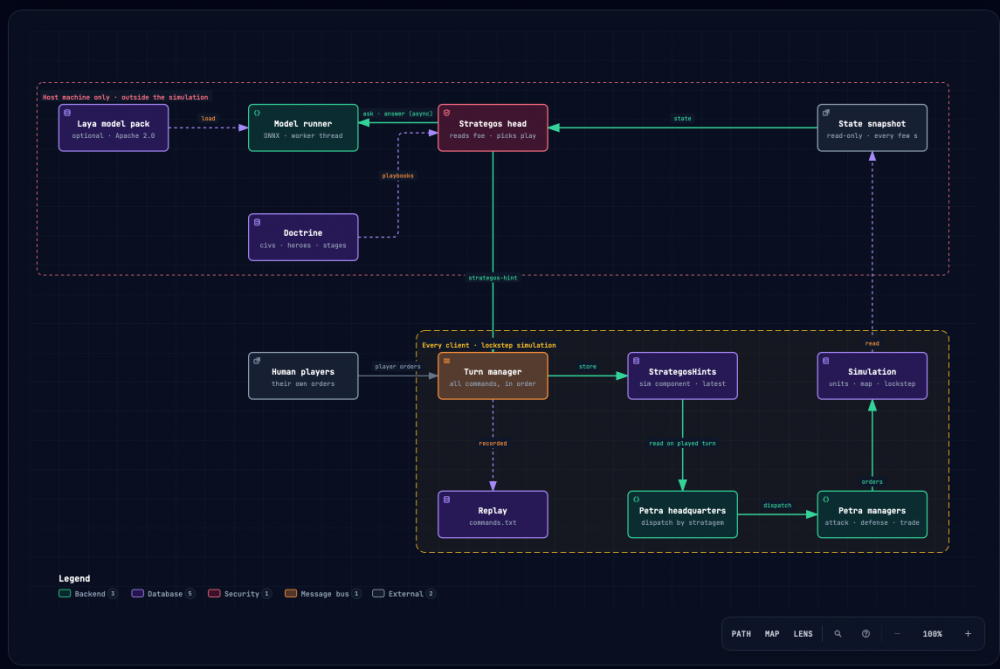
Hi all, I'm Josue (josue on Gitea), a fairly new contributor. I want to share a project I'm about to start, get your feedback before I write code, and later hand you a fork to test and pick apart. The itch Petra is a solid executor. It gathers, builds, places, trains and fights well. But it plays the same linear game on every map, against every opponent: gather, age up, train, attack the nearest Civic Center, repeat. It doesn't use terrain, it doesn't read you, and difficulty is mostly a handicap (gather rate ×0.42 on Sandbox up to ×1.56 on Very Hard, plus some caps). Meanwhile the game ships 51 historical heroes across 15 civilizations: Hannibal, Alexander, Vercingetorix, Leonidas, Fabius Cunctator, Viriathus, Themistocles... and the AI never fights like any of them. Petra's Leonidas doesn't hold a pass. Petra's Fabius doesn't delay. Nobody builds Alesia. The idea https://gitea.wildfiregames.com/josue/0ad/src/branch/strategos/mvp1/docs/strategos Split the bot into hands and head. Hands stay Petra: economy, building placement, gathering, queues, trade and garrison mechanics, the actual battle. The head is new: a small strategy layer that picks a stratagem: wall the choke by the river and wait; build a trade network; garrison the towers along the enemy's approach; strike their army while it's strung out in a pass; fall back. A stratagem enters Petra through one door (Headquarters), which hands it to the manager that already knows how to execute it. The ambush and the Persian trade network go through the same channel. Who picks the stratagem? We write the doctrine, a model judges. Civ doctrine: read from the civ bonuses that already exist as data. Romans fortify, Carthage goes to the sea and to elephants, Persians trade, Spartans hold ground. Hero archetypes: 5–6 playbooks mapped to the heroes: siege builder, ambusher, hammer and anvil, hold the pass, delayer, naval raider. Stages triggered by the game, not the clock: early game follows the civ doctrine; mid game picks a hero and runs their playbook (hero dies → next hero); when heroes run out the AI goes defensive: commerce and fortification. Opponent model: is the other player rushing, booming or turtling? Where is their army heading? Are they weak at sea? This is what changes every game, and it's what Petra has never had. The model doesn't invent strategy. It answers typed questions ("hold, strike or fall back?", "rush, boom or turtle?") with probabilities. That's a classification job, which is why a small model can do it. Free and open, by design The target model is Laya (convaiinnovations/laya on Hugging Face): Apache 2.0, 421M parameters, a classifier that answers typed questions and runs on a CPU (the model card says roughly 200–450 ms per question on CPU; I haven't measured it yet). Optional download (~650 MB). Without it you get plain Petra; nothing changes. No account, no API key, no network, no cost. Multiplayer-safe: only the host runs the model, and its decisions go out as ordinary network commands. Clients don't need the model, lockstep holds, replays replay. This also sidesteps floating-point differences between platforms. One engine change is needed for it: today the server drops commands sent on behalf of another player unless cheats are on (NetServer.cpp), so the host must be allowed to send this one command type for AI-controlled slots. Single-player is unaffected. Mod first: a strategos mod that overlays only the Petra files it touches. Default Petra stays untouched. An honest note on prototyping: to learn quickly which questions matter, the very first prototype uses a hosted typed-question API (TypeSafe's Jev), called from an external Python script through the existing RL interface. That is developer scaffolding only. It will never ship and players will never need it. Both models take the same question format, so swapping to the local model doesn't change the questions. Performance: what it costs Lag is already the most common complaint, and AI plus pathfinding are big parts of it. Today every AI runs on the simulation thread, on every client, every turn. So this has to be designed not to make it worse: The in-engine part is tiny. Petra reads at most one hint per played turn and hands it to a manager it already runs. I'll measure Petra's turn time (the existing PetraBot bot (player N) profiler section) with and without the mod, and publish the numbers. The target is ≤5% overhead. The model never runs on the simulation thread. At 200–450 ms per question on a CPU, running it inline would freeze the host, and in lockstep that means everyone. So questions are asked every few seconds (not every turn), inference runs on a worker thread, and the answer comes back as a command a few turns later. The engine already has a TODO for exactly this pattern (async AI tasks that return after a fixed number of turns, in CCmpAIManager.cpp), and it lines up with the ongoing threading work (#5874). If that helper gets built, Petra's own heavy analysis could use it too. Only the host pays. Clients run nothing extra. The host pays CPU on a spare core, plus the model's memory (roughly 0.5–1.7 GB depending on quantization; I'll measure and publish it). It won't fix lag. I'm not promising a speedup. At best, stratagems replace some of Petra's per-turn strategic scans with a cached decision; that's a side effect, not the goal. How it relates to existing plans From the Gameplay Feature Status and Game Performance wiki pages: Advanced AI is listed as "partially complete" (#973, #3003). The terrain and threat reading here (choke points, the enemy's approach) overlaps #3003 ("Petra should be aware of dangerous areas"). Anything reusable goes upstream on its own. The naval raider archetype depends on #3002 (Petra using ships for warfare), so it comes later. Directional attack bonuses (flanking) aren't implemented, so "hammer and anvil" can only win through positioning and surrounding, not a flank bonus. I'll keep the playbooks honest about what the game actually rewards. "Ambush" here is AI behavior (hold a choke, strike at the right moment). It's unrelated to the concealment mechanic in #3177. Narrative and strategic campaigns were cut from Part 1. A historically flavored opponent in skirmish is a cheap way to get some of that feeling back. How I'll prove it (before anyone gets excited) MVP of the MVP: one map with clear choke points, one stratagem (ambush at the pass), one question (hold, strike or fall back). Three arms on the same seeds: vanilla Petra ambush + a dumb distance rule ("strike when their army is within N metres") ambush + the model Arm 2 vs 1 measures the stratagem; arm 3 vs 2 measures the model. Before any game, the model has to beat the rule on 50–100 hand-labeled game states. If it can't, I'll post that result here too. Roadmap Phase 0: headless Petra vs Petra harness through the RL interface; determinism checked through replays. Phase 1: the hint channel (a new strategos-hint command → Headquarters dispatch). JS only, no engine changes. Phase 2: choke points extracted from the passability grid. Phase 3: the ambush stratagem in Petra. Phases 4–5: rule arm, labeled dataset, model arm; results posted here. After that: the local model on the host, outside the simulation (optional ONNX Runtime dependency, off by default), the small network change above, then more stratagems, civ doctrines, hero playbooks, the opponent model. What I'll share, and what I'm asking I'll share: Everything in my fork, https://gitea.wildfiregames.com/josue/0ad (branch strategos/mvp1): code, match results, replays and the labeled dataset, for anyone to test, reproduce or tear apart. Fixes, as normal PRs, for the RL-interface bugs I run into along the way. #7854 and #7628 look like the first ones I'll hit. I'm asking for feedback from: Petra maintainers: is a single "stratagem hint" entry point in Headquarters acceptable, or would you prefer a different hook? Engine folks: what do you think of an optional ONNX Runtime dependency behind a build flag, off by default? Players and history nerds: which hero should fight how? Which maps have good passes? Everyone: is this a direction the project would consider upstream one day, or should it live as a mod? Either is fine with me. Disclosure: I drafted this post with help from an AI assistant (Claude). The plan and the decisions are mine, and any code will go through the normal review process.
-
josue valencia joined the community
-
Implementing forces in Unit Motion (HELP WANTED)
Thalatta replied to Atrik's topic in Game Development & Technical Discussion
Already ships not going through each other is an astronomical improvement (although realistically, for the more direct impacts the ram would perforate the other ship and reversing would be needed to separate them). I hope the same could be implemented for land units, making their movements more natural and their tactics more relevant. -
-
 parizaad joined the community
 -
 Subzero57 2nd joined the community
 -
Implementing forces in Unit Motion (HELP WANTED)
Atrik replied to Atrik's topic in Game Development & Technical Discussion
Screencast+from+2026-09-22+02-47-35.webm Screencast+from+2026-09-22+02-49-43(1).webm Better? Also another demo about cavalry movement now : Screencast+from+2026-09-22+02-53-38.webm - Yesterday
-
 Having people who can compile is important for testing many things. I can help you with that if you want to do it some day
 -
Implementing forces in Unit Motion (HELP WANTED)
Atrik replied to Atrik's topic in Game Development & Technical Discussion
My favorite too Hopefully it can be a good starting point to make naval battles very different then land battles. Right. -
Implementing forces in Unit Motion (HELP WANTED)
nifa replied to Atrik's topic in Game Development & Technical Discussion
Too bad it's not possible to make a mod, unfortunately I don't have it compiled. I like what I see in the videos. The ship's movement looks really natural. The timing in the other two videos might be not 100 percent on point (on the elephant attack too late, on the catapult impact too early?). I think it's nice and I wanna encourage anyone who is able to test it -
I haven't even looked at the Romans in vanilla yet
-

Map making support and conversion tool: post-Atlas
Grautvornix replied to Grautvornix's topic in Scenario Design/Map making
Thanks @Asher! This is great to hear! (read ) Just tried to convert some older maps from the forum (the LegendofMali worked mostly!) but some are just too old and I need to investigate how to still use them. -
Map making support and conversion tool: post-Atlas
Asher replied to Grautvornix's topic in Scenario Design/Map making
Seems to work , @Grautvornix -
Implementing forces in Unit Motion (HELP WANTED)
Atrik replied to Atrik's topic in Game Development & Technical Discussion
Unfortunately it's mainly modifications to the game engine itself, meaning it's not possible to wrap into a mod. But I can help out by providing a couple of demo videos for you : (I had to compress the videos) Screencast+from+2026-09-21+22-14-52.webm Screencast+from+2026-09-21+22-13-08.webm Screencast+from+2026-09-21+22-11-19.webm For testing you will need to know how to compile the game. Which makes things difficult I'm aware.



-
Latest Topics
-