

Thalatta
-
Posts
604 -
Joined
-
Last visited
-
Days Won
15
Everything posted by Thalatta
-
Game Balance: Battering Rams, the 0 A.D. tanks?...
Thalatta replied to krt0143's topic in Gameplay Discussion
Completely wrong about what? Are you leaving open the possibility that they would work the fields while wearing armour? In any case, in theory you could make them return to their houses/barracks/whatever to rearm themselves, but the problem is, as usual, if you are super realistic in some things, and not in others, then you’d end with even more unrealistic situations! If you were to make them rearm, then you’d need to rework things like FOV, etc, to give you ample warning about approaching troops, besides on how to deal with the actual proportion of time being taken by all that, which is not trivial. Right now the game is more realistic than only taking half of those things into account because of reduced FOV and fast pacing. At the end no approach among these two is baffling (unless you only think about half of the issues and just mess up things), they are just different ways of doing it. -
Game Balance: Battering Rams, the 0 A.D. tanks?...
Thalatta replied to krt0143's topic in Gameplay Discussion
The only baffling thing is what you say. It's obvious that units are not holding everything at the same time, they hold tools when working, and weapons when fighting. You don't show them making those changes for the same reasons you don't show them eating or taking a dump. -
Game Balance: Battering Rams, the 0 A.D. tanks?...
Thalatta replied to krt0143's topic in Gameplay Discussion
Not really. I mean, sure if you are thinking about a light ram, but the larger rams in the game are what is called tortoise rams, named like that because of their slowness. Kind of pointing to the (uncontrollable, but renewable and killable) base garrison idea I’ve mentioned many times, which would also take the place of the abstract capture points and not really increase micro, if properly implemented. Which, also as discussed, is nonsense, and boring. Everything should be needed depending on the situation. Yes, but that doesn't mean they'd all be levied at the same time. For most Greek city-states, that fraction would have been around one third, for example. I agree with your proposal that siege should be fixed, but, as I’ve said a couple of months ago, "when people bring it up, then some jump to say that they "don’t understand the game" and "things are balanced", which completely misses the point of being inaccurate, thus counterintuitive. I could make melee infantry fly and make a perfectly balanced game". -
@wowgetoffyourcellphone DE goes up to 500 AD, if I remember correctly? I can see all factions in https://mod.io/g/0ad/m/delenda-est#description, but is there a place where their heroes and bonuses are stated, for fast reference?
-
Artemisia I is well known and was held in high regard even by those sympathetic to the opposite side. That you need to Google her and instead get a plant, thus incorrectly concluding she was not "emblematic", only exposes your own ignorance. Try reading Herodotus, or something actually substantial. Artemisia II's marriage could have been a non-physical arrangement for all we know, but your comment is utterly irrelevant, not only by itself but also given the period, culture, and considering we have plenty of Ptolemaic royal heroes anyway. What I count is allegiance, not ethnicity, which is what matters in combat. Regarding Lǚ Mǔ, I really wonder who are you to say that the first female rebel leader in Chinese history has a "low history", do you conclude this by the length of the quoted French Wikipedia article your extensive research is based on? Or can you share with us which Chinese history books on the matter you have read?
-
Just for your consideration, one of my early suggestions was to remove this redundancy:
-
This could have a late Screw Press tech if you want that to improve its efficiency: J.P. Oleson in The Oxford Handbook of Engineering and Technology in the Classical World states that “the lever and screw press was in many respects an improvement using the mechanical advantage of the screw to apply greater pressure. Pliny the Elder (HN 18.317), writing in the A.D. 70s, mentions this as a Greek invention of the last 100 years (i.e., late first century B.C.)”. Of course technically the animation would have to change, but I think presently techs don’t do this (maybe eventually?).
-
Fair enough. Also, javelins at that time were not just some long pointy stick, a very important part of them was the ankyle, a leather loop used to throw them, increasing their range by at least 50% (I haven't proposed it as tech because it precedes the timeframe of the game). This would require some throws to get a proper hang of it, which one could assume someone owning one would have, unlike helots. Then, besides range you could also penalise accuracy. A channel that could be of interest for some around:
-
=[TASK]= Temple of Athena Nike
Thalatta replied to wowgetoffyourcellphone's topic in Completed Art Tasks
When I said the Attic dialect is more "authentic", of course I meant in reference to Athens. The problem is, Spartans would use the Doric dialect, which would mean all their Ancient Greek names in the game should ideally be revised, but I didn’t manage to find an Attic to Doric translator. One could follow some transformation rules, but would be a bit time consuming and error prone for a non-expert. -
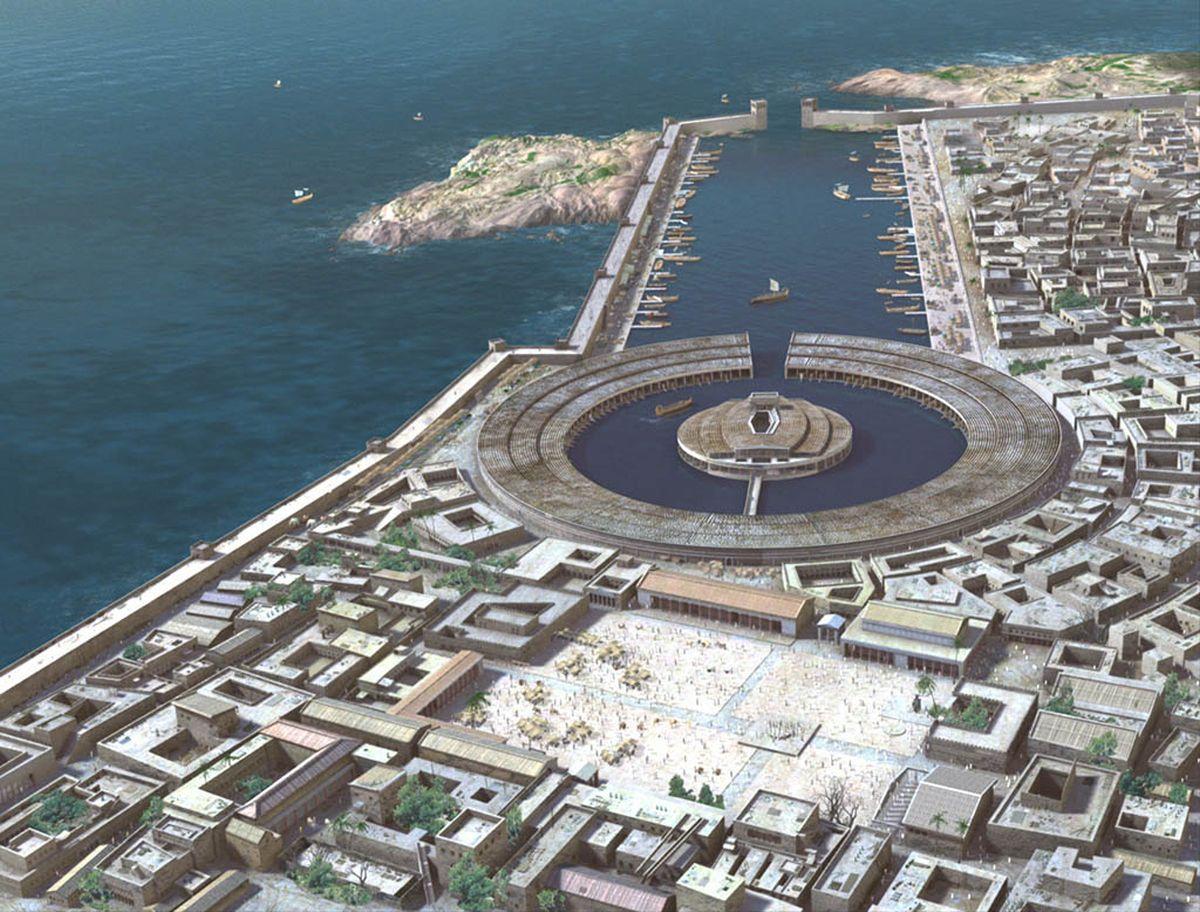
Players: "Carthage Is Weak." Meanwhile Historical Carthage:
Thalatta replied to AlexHerbert's topic in General Discussion
Still not what it "ACTUALLY Looked Like" :P. That fits around 50 warships in the outer ring, and the inner ring is not being used. In reality, it would have been around 200* total (military port only, the circular one). Something closer to this: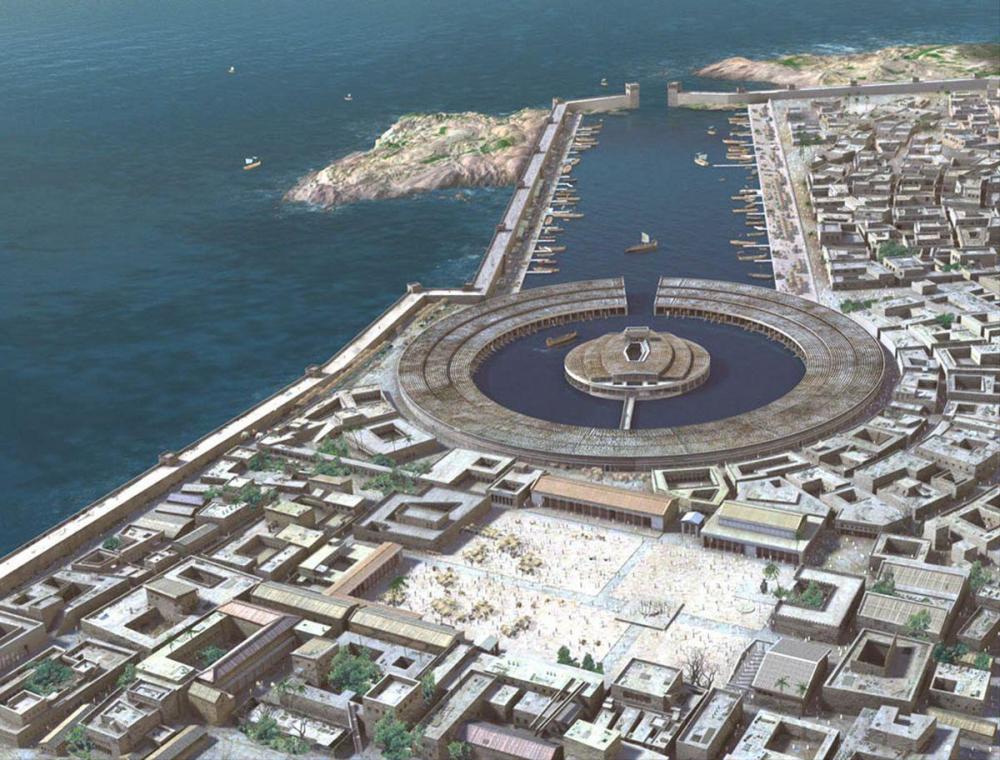
-
Opinion on when it is OK to resign in a game or why I left 0ad
Thalatta replied to diagonalo's topic in Gameplay Discussion
Excuse my ignorance regarding MP, but what happens with the units of those who resign? If they are basically removed from the game, couldn’t the AI take over them, not to make the change too drastic? At least as an intermediate solution, since I’ve seen this happening in some online boardgames. -
Yet I can’t imagine how speed could be affected negatively. What about range? The whole point is, what is a normal peltast? It’s not like there was peltast training. Roles were more or less determined by status, that is, wealth. Roughly, either you had money for a horse, if not, maybe for the panoply, if not, maybe for a bow, or javelins, and if not, then sling or even throw stones by hand, or be an oarsman. Much of our impression that cavalry and heavy infantry were the really relevant troops while the rest almost cannon (arrow?) fodder comes from the fact that those who wrote down the stories were in that position, from having some wealth (thus, the time and education to write). Yet unprotected hoplites could be obliterated by peltasts (as Iphicrates knew), the idea that they were impervious to that is just a myth. But I digress. My point is that I don’t see a speed handicap between a helot farmer and a free potter (if anything, the opposite). Then, helots would be given weapons that one might imagine were not ideal, giving a penalty on attack or defense, but you don’t want that. One could instead generously think that, because the potter owns a javelin, he should have thrown it a few times (even when peltast training was not really a thing, although what I said about a lack of hoplomachia applies mostly to hoplites), putting him at some advantage when comparing with a helot (although ignoring that a farmer might tend to be in better physical shape than a potter). Because of this, a penalty on range would make a bit more sense.
-
All well known, my point (one of) being that, even when others did have weapons, they didn’t really train with them (save those who hunted, or participated in games, for example). I’m mentioning all this just because it’s just such a counterintuitive thing, yet that’s how their culture was.
-
Players: "Carthage Is Weak." Meanwhile Historical Carthage:
Thalatta replied to AlexHerbert's topic in General Discussion
Haven't watched the whole thing, but looks a bit better in some parts in the video. The rectangular merchant and circular military parts still would have the wrong orientation though. For those who don’t know, it left its mark to this day: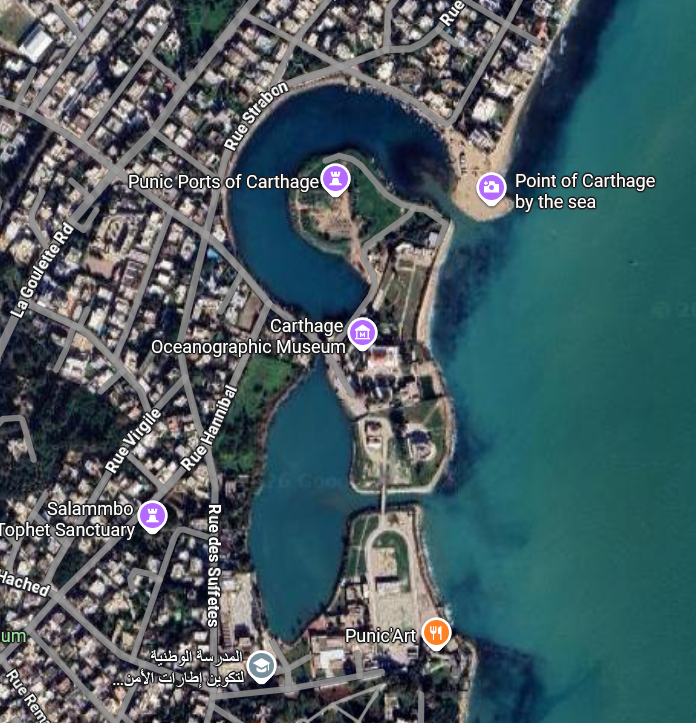
-
I think you are using the words "LITERALLY" and "historically" a bit too generously. What even is a fighting class at that time? Ancient Greeks, at least until the end of the Classical period, didn’t practise hoplomachia (weapons training)*, thinking courage alone would carry the day. No, not even the Spartans, their training consisted mostly in improving their fitness, and for the other city-states, people just didn’t have that much free time. They would go from working to fighting and back to working, and only at most one third of those who were able to fight (randomly chosen per campaign, only the generals had a more fixed position). That’s maybe why they insisted on the belief that courage was enough, otherwise their impossible to train militias would be demoralised. Helots were good enough, to the point that both Thucydides and Diodoros Siculus state that those who served under Brasidas were "freed" (implying that they distinguished themselves), while the Spartans that surrendered at Sphacteria were disenfranchised (at least for a time). What is more, a helot farmer could have been more combat ready than an Athenian trader or potter. Diodoros Siculus also states that "since Brasidas had been joined by a thousand Helots and troops had been levied among the allies, a satisfactory force was assembled". Now, if you want to nerf them for some not-so-historical reason, you could think of an "enslaved" characteristic (imagining that their fear would have been greater than their courage, or something), although I don’t understand why you propose a penalty on speed and not, as I think would make more sense, a penalty on attack or defense. But still, they would have fought satisfactorily enough, their fate being tied to that of their masters in the battlefield, and although they revolted and were liberated by Sparta’s enemies at other points in time, a battle is quite a convoluted scenario for any of that to happen, and I’m not aware of any records of it happening. *Certain ranged units like archers or slingers did have to practise, otherwise they’d be useless. Same with cavalry.
-
Increase Max Gatherers for 'Small' Ruins #8945
Thalatta replied to Baelish's topic in Gameplay Discussion
Using those values for the function I proposed (rounding): G(200)=2, G(300)=3, G(400)=4, G(500)=5, G(800)=8. Would seem the behaviour is obvious, but, as expected, G(1000)=10, G(2000)=16, G(3000)=20, G(4000)=22 and G(5000)=24, for example. -
A little shuffling: I really don't like this one as a ranged Aura, since centralisation is quite global and fixed (that’s the point of it), so I changed its name and made it a tech. I also thought Sanctuary as a ranged Aura, alongside an alternative bonus inspired on the Maritime Silk Route tech (if this one is not wanted): Sanctuary: increased resistance for non-military units under Hero's aura (taking a longer quote now: “many skilled Roman silk workers immigrated to the Sasanian empire to find work after Justinian I’s tariffs and price fixing practically killed the industry in the Roman empire, and took with them, no doubt, motifs and imagery as well as technical expertise. Similarly, after Justinian effectively closed the Athenian Academy in 529, prohibiting the teaching of law and philosophy there and pagans from teaching anywhere, six prominent philosophers led by Damascius traveled to Ctesiphon to seek refuge at the court of Kosrow I. This sort of intellectual movement also occurred as a matter of diplomacy. Procopius records that Justinian I lent the sickly Kosrow I the services of a physician over the course of a year. Persian Christians traveled to the Roman empire because it was a center of Christian learning or to escape persecution”). Coastal Control: reduced enemy port capture resistance, either as Hero aura or global bonus (not only "control of all coastal areas" was already quoted, but "Sasanian control of the Persian Gulf prevented the Romans from having direct access to the Indian Ocean trade (Daryaee 2003: 1-16). Under Justinian they sought to circumvent Sasanian middlemen by allying with Ethiopians who would buy silk directly from the Indians. Procopius reveals that it was “impossible for the Ethiopians to buy silk from the Indians, for the Persian merchants always locate themselves at the very harbors where the Indian ships first put in (since they inhabit the adjoining country) and are accustomed to buy the whole cargoes” (Procopius, I. xx.12)", from The Sasanian ‘Mare Nostrum’: The Persian Gulf, by T. Daryaee). Centralisation: renamed Autocrat bonus to tech that increases stats of a given CC, but penalises all others. I wonder if the chosen CC can be determined either by being under the Hero’s aura when researched, or it can be researched at CCs, and where it's researched in particular becoming the chosen CC.
-
Increase Max Gatherers for 'Small' Ruins #8945
Thalatta replied to Baelish's topic in Gameplay Discussion
Why not use a function for how many gatherers to have for any possible stone number? If I’m not wrong, the present behaviour seems to be: 5000 stone: 24 gatherers. 1000 stone: 12 gatherers. 500 stone: 1 gatherer. Which indeed seems too low for 500 stone. I managed to find something nice. As a very simplified model, since the amount of stone is proportional to its volume, and the number of gatherers G are proportional to (a fraction of, if sunk in the ground) its circumference, then naively one would have G=AS^(1/3), where A is some constant, but that’ll never work. Let's then include a "worthiness" factor 1-e^(-BS), meaning that the less stone there is, the less efficient would be to deal with its logistics proportionately (gatherers will soon need to be relocated anyway, for example, besides minimum upfront costs and infrastructure, etc), thus less gatherers than expected would be assigned to it (exponentially, going inversely, that is, the complement of exponential decay). The final formula is then G=AS^(1/3)(1-e^(-BS)), which for the initial conditions G(5000)=24 and G(1000)=12 returns A=1.4036 and B=0.001931. This means that G(500)=7, which might seem high but it’s because the initial conditions (24 and 12) are somewhat weird to begin with. One can check that for some extreme cases the function still behaves nicely: G(100)=1 and G(50000)=52. I’d propose to use a function like this but change one initial condition to G(1000)=10, as such one gets A=1.4064 and B=0.001242, resulting in G(500)=5. In conclusion: a very simple (non-linear) formula predicts 7 gatherers for 500 stone, but if for 1000 stone the number is tweaked from 12 to 10, one manages a more poll-friendly 5 gatherers, and can use that formula for any stone value to get the corresponding number of gatherers. -
Previously I proposed that since Khosraw I Reforms fixed harvest tax, it could make Fields trickle metal. Also they “further elevated the figure of the sovereign above the nobles and centralized power around him”, which could be a Hero bonus and champion penalty. For my take, I'm getting quotes from the book I mentioned: The Two Eyes of the Earth, by M.P. Canepa (I went through all of it). I write down first Aura, then Bonus, then Tech. I only declined Auras in the first person, but do whatever. As usual, it’s your decision what exactly they would entail, and I’m not sure about what’s possible. “Additional” ideas I leave mostly without hints, since maybe they are unnecessary. Ardashir I Overthrower: capture bonus ("After his successful usurpation Ardashir", referring to the Parthians). Inheritance: capture resistance bonus (“Believing these regions to be his by inheritance he declared that all the countries in that area including Ionia and Caria, had been ruled by Persian governors (...). He asserted that it was proper for him to recover for the Persians the kingdom which they formerly possessed”, this was really big for him, plenty of mentions regarding his “rightful inheritance”). Holy Fire: temple tech (“Ardashir I increased the cults of the temples and ordered the fire of Ohrmazd, which was on the altar at Bagawan to be kept perpetually burning”). Shapur I Shamer: attack bonus (the defeated Romans regarded the terms of a peace treaty “shameful”). Indemnisation: loot bonus (“Philip sued for peace and paid a large indemnity to Shapur I”, leading to “his official formulation of Rome as tributary and subject”). Humiliation: enemy Hero penalty tech (he captured Valerian in battle, a first for a Roman emperor, although “despite the assertions of certain extremely hostile Roman texts that speculated on his fate, in the reliefs Valerian is not humiliated, and he keeps his insignia of office”). Additional: Universality (“he expanded his father’s claims of dominion over Ērān, to ascendancy over Ērān ud Anērān (literally, “Iran and Non-Iran”)”). Shapur II Persuader: bribing bonus, or occasional automatic conversion? (“Ammianus devotes a chapter to the defection of Antoninus, bodyguard of the dux of Mesopotamia, to Shapur II”). Recognition: champion bonus (“the Armenian commander in chief Mushel so impressed Shapur II with his chivalrous treatment of his captured wife and attendants that the Persian king of kings honored him at the royal bazm as if he were in attendance”, and at another instance he “gave the Roman defector Antoninus honorific headgear along with a designated place at the royal banquet table and a seat in the council of the king to mark Antoninus’s integration into the Sasanian court hierarchy”). Glory of Iran: Hero bonus tech (“created a province called “Shapur, the Glory of Ērān””, they were big in personality cult). Khosrow I Autocrat: capture resistance bonus for CC under Hero aura, penalty if outside (“Both empires saw increasing centralization at the expense of local power bases, with sixth-century contemporaries Justinian I and Khosrow I responsible for intensifying this movement to autocracy in their respective realms”). Royal Gifts: discount on resource transfer (“Roman-Sasanian diplomatic exchange reached its apogee in the sixth century with the long coeval reigns of Justinian and Khosrow I”, and this “included objects that were given and received as gifts, throne room rituals, as well as the entertainments, culinary displays, and sundry other activities with which the two courts regaled each other’s envoys”). Maritime Silk Route: sea trade tech (“Peaking with Khosrow I’s control of all coastal areas from the Red Sea to the Indus, the Sasanians soon dominated the Indian Ocean sea trade. Under Kosrow I, the Sasanians began to expand into Sri Lanka and even markets in Southeast Asia”). Additional: Sanctuary (“after Justinian effectively closed the Athenian Academy in 529, prohibiting the teaching of law and philosophy there and pagans from teaching anywhere, six prominent philosophers led by Damascius traveled to Ctesiphon to seek refuge at the court of Khosrow I”). Additionally, he liked hippodromes. Khosrow II Pious: regeneration bonus (“after his victory over Bahram Chobin, Khosrow II spent a week at the site circumambulating the fire while reciting the Zand and Avesta”). Royal Hunt: hunting or ranged bonus (“The Sasanian motif of the “royal hunter” was an exceptionally powerful, not to mention popular, image”, “The side relief panels of Khosrow II’s (...) are the most extensive sculptural representations of the hunt, and the dynasty’s last. On the right panel, mostly unfinished, the king of kings hunts deer in an enclosure with a bow. The left panel depicts the king of kings hunting boars…”). Monumentality: whatever-statues/monuments-do tech (“Monumental rock relief sculpture fell out of vogue as a medium of triumphal expression for the Sasanian kings of kings, not to return until Khosrow II’s final brilliant reprise of the genre two centuries later”). I like that there's some thematic sense: Ardashir I captures and keeps, Shapur I is aggressive, Shapur II charismatic, Khosrow I a trader, and Khosrow II is more versatile.
-
I’ve already written on historical shield and armor changes in Thoughts on the Spartans. “your unit starts off with "no armor" just a shield and weapon... and then you decide which ones you want to give which units, at a loss of speed”: we’ve already talked extensively about armor evolution, so it should be beyond clear to you that, from an historical standpoint, this just makes no sense, at all, and what happened was closer to the opposite of this.
-
Although I've argued for the Mausoleum at Halicarnassus for the Achaemenid Wonder (being much taller), along the Hanging Gardens as a starting Wonder (both being among the seven Wonders of the Ancient World):
-
I think Sparta and Thebes populations were comparable, but full Spartan citizens were abysmally less. Maybe forget that extra population penalty, and deal with it by limiting more the number of Spartiates as one progresses. Neodamodes units should kind of become a necessity. All this has been proposed already by me and others before me, and aligns well with reality.
-
Tribes: mostly wooden cheap buildings. That doesn’t mean they don’t have their identity, like German mobility, Iberian defenses, etc. They should deal with their lack of manpower with Confederations. Although these categories serve to structure and simplify things, incorrect generalisations should be avoided: Gauls would be good at fighting in formations, for example. City-states: They should deal with their lack of manpower with Leagues (and Mercenaries). I’d avoid such unspecific names like “Civic Pride” (could apply to us!), I proposed @Emacz to change Hoplite Tradition to Hoplite Reform, since that’s how the literature calls that. I’d indeed remove the awfully named Will to Fight, and add some interestingly named necessary equivalent tech wherever needed. City-states indeed did not expand like empires (or republics and kingdoms), and I was a bit put off at the beginning when building more CCs with them. They should be colonies, and not do all what the original CC does. I think this is something that has to be reviewed for all civs, since some do have structures like this. I’m against “all proposed city-states already have the theater to expand original area”, Sparta didn’t have such a thing, I’ve already proposed to remove it. Regarding the Spartans in particular: they were eco driven regarding agriculture, their lands were among the most fertile of the Greek, and should have a population penalty on top of the lower population just for being a city-state. Spartan trade could be penalised for many reasons, as Sekunda states, “the age at which a Spartan adult was allowed to live at home with his wile is not entirely clear, but he was not permitted into the marketplace to converse with his fellow adults until the age of 30”, while Cartledge says “overseas trade in essentials was relatively unimportant” and “relatively restricted”, although “Sparta became much more accessible with the opening up of local economy in the Hellenistic period”. The use of iron ingots is not a myth, but “there is no evidence that the retention of iron spits as a store of wealth and standard of value prevented internal economic exchanges”, and “there were many good reasons why Sparta had not coined previously. The metal would have had to be imported, whereas the iron used in Sparta’s traditional spit-money was present locally in abundant supply”. In any case, regarding an encompassing name for a civ bonus (actually, penalty) to penalise trade, Cartledge goes into great extents to argue that it’s not because of austerity but self-sufficiency, for which I’d name it Autarkism, given the passage “Sparta through its control of the Eurotas and Pamisos valleys was extraordinarily autarkic in essential foodstuffs; and its possession of abundant deposits of iron ore within its own frontiers may have been a contributory factor in the decision not to import silver to coin”. Of course, I’ve already proposed many of these things on:
-
The categorisation cannot be clean cut, because it mixes forms of government with sizes, which is related to how heterogeneous they were. Taking what they were for the most time (Macedonia was an Empire for a very few years): Tribes: Britons, Gauls, Iberians, Germans. City-states: Athenians, Spartans, Thebans. Kingdoms: Macedonians, Ptolemies, Kushites. Republics: Romans, Carthaginians. Empires: Seleucids, Persians, Mauryans, Han.
-
I agree civs should be grouped somehow at some point, or things will become unwieldy, and it would be nice if they share some common important characteristics. That’s also why I supported the Confederacies idea for tribes, and proposed the Leagues one for the Greeks.