

Thalatta
-
Posts
604 -
Joined
-
Last visited
-
Days Won
15
Everything posted by Thalatta
-
Civ "Pers" -> "Achae"
Thalatta replied to wowgetoffyourcellphone's topic in Game Development & Technical Discussion
Given that Thebes would complete the list of hegemonic Hellenic factions at the time of the game (which starts with Athens and Sparta, and ends with Macedon, although there’s Epirus but it was not the same), I was wondering what’s the plan for the future of the Greeks. To take as much as possible into account without introducing more similar factions, what about having Leagues? They would be similar to @Genava55’s idea of Coalitions (for the Germans, which should be extended to Britons, Gauls and Iberians), but the difference is, while all tribes in a Coalition would be treated similarly (I proposed an initial tribe selection to start grounded on something, but that would make no difference on primary buildings, techs, etc), in a League one truly controls said faction (which already are quite fleshed out), and League choices would give (very limited) access to other “minor” Hellenic factions (there could be choices for the “major” ones as well, one could play Athens and have Thebes as part of the League for example). One has to be careful not to bloat a faction though, but the problem to solve is not to have more similar playable factions, while not leaving out certain factions from the game (and maybe the generic Greek template could still be used for stand alone minor factions when needed, which could also form their League). -
In case more is needed, another great monument they had is the Lion of Chaeronea (this time commemorating a defeat, against the Macedonians). It was rediscovered in 1818 and put back together in 1902. Not my picture (sadly it was hard for me to visit):

-
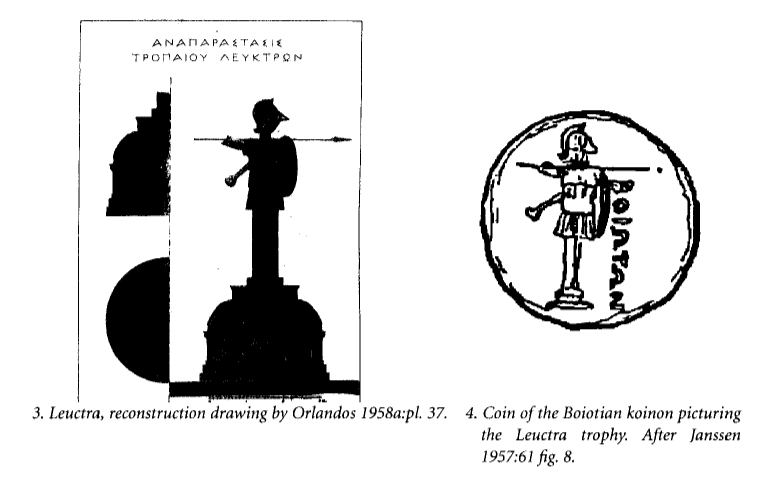
Good that you ask, because it seems it would have looked different. According to Greek Trophy Monuments, by Jutta Stroszeck: "The monument at Leuctra is a circular tower (3,38m in diameter) erected on three steps. The height of the tower could not be established, because there were not enough original stones. It was therefore restored in proportion. It is crowned by a Doric frieze, followed by a frieze of nine large round shields and a circular balustrade. Excavations carried out in the area brought to light some scattered conglomerate blocks, but no foundations in situ. So we have no information on whether or not it stood within a defining space. The interior of the monument is hollow, without any doubt for the reception of the [foundation for the] bronze trophy,' as Orlandos remarked. The bronze tropaion mentioned in the texts and shown on coins of the Boeotian Koinon must therefore have once stood on a pillar-like base in the center of the monument, rising high above the balustrade. The form of this monument is distinctive, the ground plan can be reconstructed as a round tower with a massive central base carrying the tropaion. Few analogies are known in architecture, and yet it does not seem likely that the monument at Leuctra was an invention for that occasion. It rather must have stood in line with an older tradition, the type and layout being developed much earlier. That ancient art was rather conservative with regard to the use of specific architectural types, especially in combination with cult buildings, can be deduced by comparing the main features of the two colossal Roman trophies that are preserved today: both the trophies from La Turbie and Adamklissi have a cylindrical central tower set on top of a quadrangular substructure. Each is crowned by a central pillar carrying the anthropomorphic stone trophy". Here drawings from the book:
-
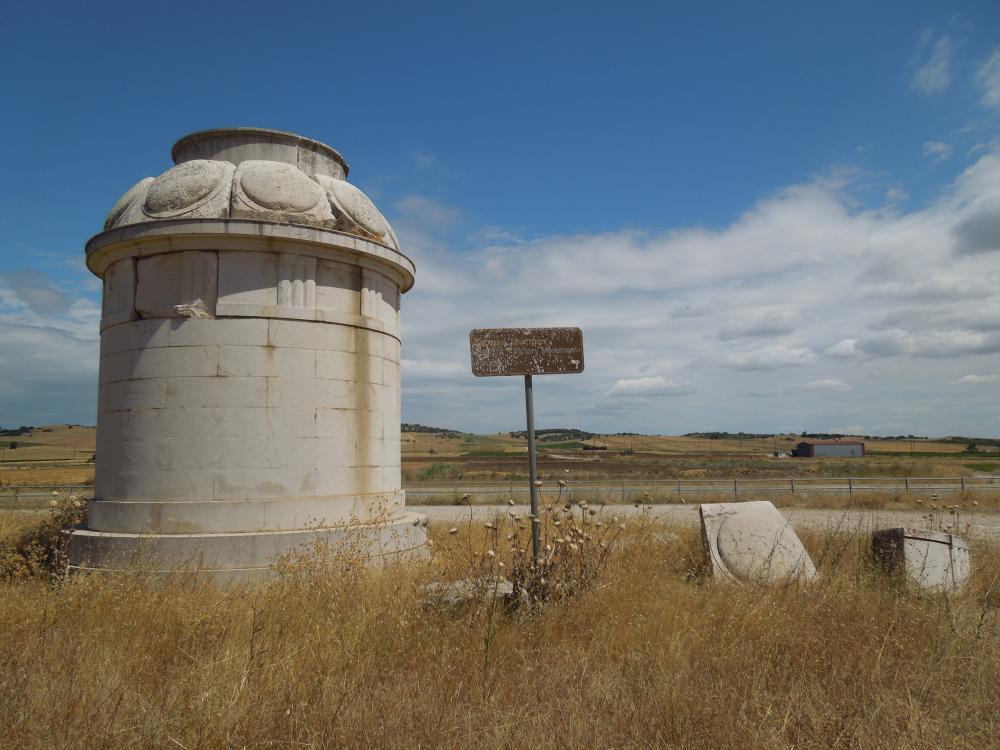
Besides the obvious Epaminondas and Sacred Band, I’m happy you have included their “fire-throwing engine”. From the top of my mind, I can suggest the Hamippoi ("those running with horses"), highly mobile light infantry (possibly javelinmen) that ran alongside cavalry and countered enemy cavalry (maybe could have mutual bonus). Xenophon says “Epaminondas on the other hand had made a strong column of his cavalry, also, and had mingled foot soldiers among them”, and says that “Another duty of a cavalry commander is to demonstrate to the city the weakness of cavalry destitute of infantry as compared with cavalry that has infantry attached to it. Further, having got his infantry, a cavalry commander should make use of it. A mounted man being much higher than a man on foot, infantry may be hidden away not only among the cavalry but in the rear as well“. Found this video about them (where at the end he mentions the Macedonians also using them), and since they are more a role for the fit and not a completely different unit, maybe it could relate to unit upgrade with experience: Regarding special structures, the Tropaion of Leuctra (trophy monument for their victory against the Spartans) still stands today a few km away from Thebes (where there's not a lot still standing), although only the top stone shields are original. Here the photo I took of it:
-
Speaking about asking R28 questions… what happened with the Ship Cladding tech? I can’t find it anymore, nor any discussion on its removal.
-
This just enhances the historical inaccuracy that siege engines shouldn't be used preferably for destruction, but for capture. Of course, the problem is OP siege, but when people bring it up, then some jump to say that they “don’t understand the game “ and “things are balanced”, which completely misses the point of being inaccurate, thus counterintuitive. I could make melee infantry fly and make a perfectly balanced game.
-
Something that could improve the AI is if ranged units keep their distance, I just mow them down with slow infantry with the Spartans, and should have a way harder time. Edit: I seem to remember this was the case in the first AoE...
-
Ah, I missed the script you posted before, and it wasn’t clear to me what you meant by “root degree”, you meant polynomial. Your formula is, for p>T, P=T+(p-T)^1/H, where P are the effective capture points, p the capture points to modify, T “threshold points” (what would be my C) and G is “diminish strength” (what would be my S). So, you have 2 independent parameters and a region condition, and I have 3 independent parameters, and no region condition. The issue is, your formula will still be visually non-linear, because you calculate effective capture points in two different regions, while I calculate only one effective rate, making the observed behavior linear. Another problem your formula has is that your T is not that intuitive as a normal/fast discriminator as my C (that’s why you have to use T=90 when P=3000, while I use C=300 when I want my threshold to be around there). Of course the advantage of your equation is that it’s easier to understand just by looking at it (and maybe easier to implement, depending on how rates can be directly handled).
-
How's this going? I'd be happy to help, I'm quite into mythology. I like the name. My (I hope small) criticism is that Leonidas and Alexander are too historical, seem out of place, I'd keep it mythological, after all Greek mythology has five ages: Gold, Silver, Bronze, Heroic and Iron, and it seems to me you'll be concentrating on the Heroic Age. There are plenty of heroes and demi-gods to take from. Also, Pan is a god, he's the only Greek god that, according to tradition (or misunderstanding), died, 2000 years ago. Very different from the monsters that actually died all the time. Atlas is not a friend of men, nor a god, but a titan being punished. In the Odyssey (https://www.perseus.tufts.edu/hopper/text?doc=Perseus%3Atext%3A1999.01.0136%3Abook%3D1%3Acard%3D44) it says “Atlas of baneful mind”, and of course there’s the Labours of Hercules story where (on some versions) when he arrives to the garden of the Hesperides, he finds Atlas holding up the sky, and asks him for help to get the golden apples in exchange of holding the sky for him for a bit, and when Atlas returns with the apples he betrays Hercules and tells him he doesn’t want to hold the sky anymore, but titans apparently are not so bright since Hercules tells him basically “ok, but hold it for me for a bit so I can adjust my cloak, if I’m going to stay here holding the sky after all”, to which Atlas agreed and Hercules just walked away. In any case, clearly a wicked being holding the sky not out of the goodness of his heart. Regarding his classification as a god, well, maybe that’s closer than anything, since titans would be deities, and “Deities, Men and Monsters” doesn’t have the same ring to it, I guess.
-
Ok, I see why you want exponential decay, it’s not that you want a fixed minimum capture time (hard cut-off), but a diminishing return, to softly adjust capture times for faster cases. That can also be done with no need to split the capture in linear and exponential parts, you just need a formula that modifies your capture rate to have this exponential behavior, but capture behaves linear all the way. Maybe this is what you meant by “not visible”, it’s just that in your original description that wouldn’t have been possible. This took me a bit because capacitor equations are not that appropriate for this, but what would work is R=r*(1-D/(1+e^((C-r)/S)), where R is your corrected rate, r is the rate as it is right now, D what percentage you want it to decrease for larger rates, C the rate that would indicate what is normal and what is fast, and S how sharp the correction is (more or less, the width around C where it mostly happens, for then to stabilise according to D). Then, for D=0.5, C=300, and S=100 (I’d fix it at C/3), you get these values (with C fixed, D and S can be tweaked to get different things): r=100 -> R=94 r=200 -> R=173 r=300 -> R=225 (the function scales nicely, if C=3000 and S=1000, then r=3000 -> R=2250) r=400 -> R=254 r=500 -> R=280 r=600 -> R=314 (stabilising at 50%, which can also be changed). I know that some people are scared of (simple) equations, but again, no one does the math, one gets an intuition, and what is good about this is that it does what you want, while keeping what one sees linear.
-
The rate cap I propose should be after accounting for regeneration, if that's possible. The only effect should be to stop captures faster than a certain minimum time (given, of course, by the total capture points divided by this effective rate cap). But in your video it is visible, and it should be, that's the point. It goes from 4000 to 2000 points between 0:13 and 0:25, average of 167 points per sec, and then from 2000 to 400 between that and 0:39, average of 114 points per sec, which is 32% slower, and could be frustrating when one had an early estimation on how much it would take.
-
Yes, I understood you the first time, I think. What you say is, given a Fortress, you would call normal capture the time an appropriate army would take to capture it, and fast capture the time a huge army would take to capture it... that is, after a certain army size (or quality of troops, or Fortress HP, whatever), you want to cap capture time. That's why in your example you trigger exponential decay after some point because the decay rate is too large. It would work, it’s somewhat equivalent to a capture slots cap, but I think it'd be confusing and frustrating for players to be confronted with a capture slowdown midway the process. That’s why I said, instead of doing that, just cap the rate, and enjoy a linear behavior all along. In your example, “if you are capturing a CC with a total of 500 pts per sec”, just cap that to, say, 300 pts per sec, or whatever that results in a capture time similar to the linear+exponential decay case. Setting a maximum capture rate is a less complicated technicality than combining linear and exponential decay, and it’s a nice and simple way of fixing a minimum capture time. That’s what I meant with a slower linear decay being able to do what you want: nerf fast capturing, leaving alone normal capturing. Good to know!
-
But what would be the effect of this? What's the difference of having a linear decay followed by an exponential decay, with a slower linear decay that results in the same capture time? There would be a difference only if actual (not total) capture points have an effect on some other stat. If the idea is that it would be noticeable on structures with a lot of capture points, then just give them more capture points (for the linear decay to catch up with the linear+exponential decay), unless I'm missing something. Something else I don’t know how it works is the effect of siege engines on capture points, which they should have to make their use make some sense besides destroying things. Since an army made only of soldiers or only or engines should have a very difficult time taking on a Fortress, I’d say that engines should increase the soldiers’ effect on capture points (not by proximity, but when actually taking part of capture), that way a mixed army would be more efficient.
-
We would need to evaluate only the best case (all techs, best units, etc) to work back from a minimum capture time. Other reference cases can be used for better calibration, like, if all are archers, how much time should it take, and so on, but just a very few cases should suffice to have some control on capture time, I just don't know the formulas. And can't the number of units capturing a building be just fixed? Same as the number of units working a field.
-
Exactly. "Isn’t 20 soldiers too few for a fortress?" is not the correct approach, but "which percentage of your max population is 20 soldiers"? Then it's not a small garrison. Just increasing it doesn’t seem right. What is worse, if one increases the pop cap, leaving the garrison caps fixed, all considerations of what is big or small are out the window… unless collisions are used. This always fixes the max amount of units trying to take a building. It also helps in fixing capture points, after a decision is taken on how little time capture should take (it cannot be that it’s not known if 5 seconds will become maybe 5.5 or 6 seconds, things should be calculated the other way around, first deciding an acceptable minimum capture time, and working backwards). And it applies for buildings that don’t have any of the mentioned Fortress or Tower defensive techs. If there’s a formation exploit, then I guess better if that’s solved, instead of collisions removed. If I understand correctly what’s happening from the videos, couldn't formations be temporarily disabled when units are taking on any of those tasks? Whatever needed since collisions does seem a step in the right direction. Collisions seem necessary, but maybe not sufficient, thus: I agree with 1. because of the regeneration problem pointed out, but disagree on how to exactly implement 2. because it doesn't seem very common that a given tech does more than one thing. On the other hand, someone said recently "the two techs for towers for greater range and more default arrows" "are also too expensive to be viable during the period of the game when towers matter", so I'd remove the Arrow Shooters tech and give that range increase to the Stone Tower for free, because, if I understand correctly, with no techs both it and the Sentry Tower have the same range (10 to 60 m, even when it’s taller). If Sentry and Professional Garrisons are not interesting enough, I’d make them do more of what they already do. Regarding increasing capture points +50% to Towers and +100% to Fortresses, I’d either give this for free, or have a mutual tech that gives +50% to both towers and forts, and from the start give forts for free whatever is needed to complete the +100% wanted.
-
Indeed, collisions solve that and other things. Cheaply massing troops becomes harder, as it should be, because the entry points to a fortification are limited. Still, capture points increasing with garrison could help. Another question to understand everything better: when saying tower range 10 to 60 (+8), what does the +8 mean? A change because of garrisons, or possible techs?
-
I agree with everything you say up to here, since, for making better use of fortifications (and historical accuracy), they should be inside and make capture more difficult. Can capture points increase with garrison, same as ram speed increases with it?
-
Maybe this would be useful for you, found it on some Maurya thread, but the link shared has Gupta units: Horse archers are notoriously absent, when they were a characteristic of the Guptas. Here some Gupta coins:
-
ships Naval Boarding - seizure of ships
Thalatta replied to CheckTester's topic in Gameplay Discussion
No, I'm not Kate, and this forum is the first I have taken part in like 20 years, if I remember correctly. Everything is math under the hood, but no one ever does it (not even me), one just gets a feeling of what will work when. One doesn't calculate exactly how many seconds a certain amount of units will take to capture some structure, but there's a formula behind it, and one just has some intuitive idea after some time. I was just trying to do that same thing with something a bit similar to what CheckTester said, with some realistic reconsiderations. And then arguing that virtual combat with base garrisons would be more realistic, simple, and help with intuitiveness. -
ships Naval Boarding - seizure of ships
Thalatta replied to CheckTester's topic in Gameplay Discussion
@CheckTester, I'm quite confused about your proposal. Let's imagine the case where a ship with a garrison of 30 boards an ungarrisoned ship. According to what I understand, successful boarding happens in 5 seconds, the captured ship suffers HP loss, and the attacker loses just 2-4 units? Always? What if the defender ship also had a garrison of 30? What does “almost over” mean? What does “soften” mean? That the garrison is vulnerable to ranged attacks? If the defender has more defenders, damage doubles where? On the attacker ship? Where is the fight even happening? It is unclear to me what happens with garrisons depending on which ship sinks. Seems like complicated ship combat where the parameters are the garrisons. I don’t think it’s realistic for ships to take this much damage from boarding, this is mixing a couple of different things: either you ram a ship to sink it, or you ram (shear) the oars, to slow it down for boarding (and hurt the rowers, decreasing the number of defenders). You don’t want to ram a ship, breach its hull, and then board it, because the boarders risk going down with the ship (although this is controversial, some claim they didn't completely sink, and the risk was being boarded themselves). In fact, after breaching, the ramming ship has to move backward, to avoid getting stuck. That’s why ships getting so much damage that sink during boarding would have been quite rare, many measures were taken to avoid such suicide. What did happen is that ramming ships could get damaged (something simple that could actually be added to the game, considering they do a lot of damage anyway), but not really during boarding. I would rework your mechanism like this: if attacker ship has N garrisoned units, defender ship has M garrisoned units, defender base HP is H and present HP X, then final surviving units that get split on both ships are F=N-(M+k)(X/H), where k is a parameter to set, and is how many attackers are killed if the defender ship has no garrison and full HP (just doing the trivial math, F=N-(0+k)(H/H)=N-k => k=N-F, attackers minus final survivors, that is, killed attackers). So k can be any coherent formula, from 2 to 4 as you said (the formula would give more survivors if the defending ship is damaged), or preferably something depending on the number of attackers and with how many the defending crew can handle, C, thus a simple formula could be C(C/N) (with this, crew resistance becomes inefficient when overwhelmed), that is, with C=5, 5 attackers get all killed (5(5/5)=5), and then goes down until from 17 attackers only one gets killed (5(5/17)=1.47), rounding up, and not taking yet into account defending garrison and ship HP, the final formula is of course F=N-(M+C^2/N)(X/H), which as a complete example, N=20 attackers against a ship with 100% HP that can handle C=10 attackers would mean F=15 survivors, that must be split in 2 ships, but if the defending ship is damaged first down to 50%, then there will be 18 survivors, and if the defending ship had a garrison of M=5, then these numbers would have been 10 and 15 survivors, respectively. If M=15 there are 0 survivors. If M=20, F=-5, which could mean 5 survived from the defender’s garrison (one has to be careful with extreme numbers, N=1 gives F=-24, when it should cap at -20, but I made the formula intuitively and fast). Furthermore, if it’s deemed that the defending garrison should have even more advantage, a defense factor D greater than 1 can be added, and if it’s deemed that ship damage should have a greater softening effect, a softening factor S greater than 1 can be added, resulting in F=N-(DM+C^2/N)(X/H)^S. In any case, both this and what you propose (or at least what you said) have a big problem anyway: blindness on how strong units actually are. That’s why I think “virtual combat” is necessary. Now, I think you misunderstand the “base garrison” idea. It does take into account boarding not being no-risk, high-reward. To do ship damage is recommended to reduce it (I’m mixing ramming and shearing because the game doesn’t differentiate them, but it’s not the same as truly mixing them during boarding, that’s why it’s more realistic). It precisely avoids being able to “capture an enemy trireme for free just by having 10 hoplites”, since the hoplites have to fight the base garrison first, and then both their survivors and the attackers base garrison has to be split, greatly preventing snowballing. Garrisons should be vulnerable to ranged fire. If the existing system doesn’t include some form of virtual combat, then nothing reasonable can be done, because having a garrison of 30 workers would be the same as 30 champions. If it’s included, then base garrison is a trivial thing to add, and the same mechanism could be used for capturing buildings. The only worry would be that the AI would need to be taught all this stuff, which is something that has come to my attention a couple of times lately, and it’s indeed not a minor issue. -
Yes, I was thinking, people build enough dropsites anyway to get fast access to resources, there's no point adding rules to solve a problem that doesn't really exist. But I think some simple addition to make new territory a bit more relevant is in order, after all, besides making other CCs more city-like, it has been mentioned in the past that there are not many reasons for expansion, that fields around CCs are unsightly and inaccurate, and even that CCs could be specialised. Maybe just adding a gap around the CC where no resources or structures can be located could tackle some things. I’m not sure how to easily make relevant building houses somewhere else though, and one has to be careful with snowballing.
-
Well, but the number of units will be arbitrary. I think it's ok for people to decide if they want to chase units, or to do it with last CC standing. I thought about an intermediate possibility: if all CCs are taken, units lose HP, unless they are close to a Hero or garrisoned (maybe just on certain buildings).
-
Well, a resource cap, with dropsites increasing it, is an interesting and not complicated idea, as long as it’s not too disruptive and only penalises under-building dropsites. Loot can be calculated as some fraction of total resources, divided by the amount of dropsites. Something I was thinking is that CCs are given too much importance as dropsites, and this just comes from other RTS, but it’s historically inaccurate (when compared to the other specialised dropsites), and causes fields to end surrounding it. Of course the idea is to have a dropsite at the beginning, but I wonder if, while one progresses, adding some penalty to them, or some bonus to the other dropsites, wouldn’t restructure things to look better, or maybe something else is better, with those consequences in mind. I have other ideas, but are more radical.
-
Yeah, then I understood, just that you proposed something that happens in basically no RTS (if any?) so casually that I was confused. I'm always happy to propose and discuss changes to the base game, but this, honestly, is not going to make it. It's just too radical. You'll have to try it in some mod.
-
Regarding your first line, not allowing fields next to CCs was discussed not long ago, I don’t know what was the conclusion. I think it’ll be implemented at least in one mod for now. Regarding your second line... I'm confused about “storage actually contains resources”, RTS don’t tend to work like that… not that that’s an invalid mechanic, just that you are stating it like it’s the obvious default, if I even understand correctly what's going on.