To gain an understanding of the Byzantine army and its constant changes in the Medieval Age, the Army will be split into Early, Thematic and Byzantine Armies. However there are similar overlaping themes. As with most medieval armies, the majority of Byzantine soldiers were seasonal fighters (with the exception of a few professional institutions such as the Athanatoi created by the Emperor John I Tzimiskes). However, unlike the armies of Western Europe, the Byzantine army was not dependant on feudal obligations to raise large amounts of manpower but was reliant on bureaucratic system and a stable system of pay by coin and land (which was known as the theme system). This, coinciding with adapting different methods of fighting, meant it could easily field a flexible and mobile army consisting of specialised elements.
Much of what we know of Byzantine warfare comes from the Byzantine military manuals- they provide us with a wealth of information on equipment, doctrines, tactics and deployment. However there is an inherit danger of readings these manuals as descriptive. Most of them, especially the Strategikon, were probably more prescriptive than descriptive in nature.
https://byzantineoplomachia.wordpress.com/2015/09/09/beyond-the-golden-gate-the-byzantine-army-at-war/
Infantry
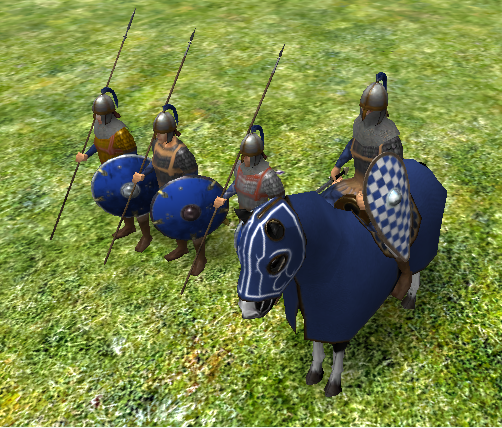
Although the Strategikon describes infantrymen equipped like Late Roman heavy infantry, it is highly unlikely that most Early Byzantine heavy infantry wore metal armour. The chapters on heavy infantry in the Strategikon were copied from an earlier Late Roman military manuscripts and there is little reason to believe that the best heavy infantryman had more than a shield, cloth armour and perhaps a helmet for protection. His main offensive weapon was a spear, around six feet in length that could be thrust or cast. In the Strategikon, infantrymen were instructed to throw their spears when facing infantry and thrust their spears when facing cavalry. Behind the first ranks of spearmen, archers or javalinmen were drawn up to provide missile support.
Infantry
Although the Strategikon describes infantrymen equipped like Late Roman heavy infantry, it is highly unlikely that most Early Byzantine heavy infantry wore metal armour. The chapters on heavy infantry in the Strategikon were copied from an earlier Late Roman military manuscripts and there is little reason to believe that the best heavy infantryman had more than a shield, cloth armour and perhaps a helmet for protection. His main offensive weapon was a spear, around six feet in length that could be thrust or cast. In the Strategikon, infantrymen were instructed to throw their spears when facing infantry and thrust their spears when facing cavalry. Behind the first ranks of spearmen, archers or javalinmen were drawn up to provide missile support.
Appearance
Uniforms were probably only used by the elite of the infantry. Most infantry units were therefore distinguishable by their shield patterns and standards. Cavalry units and the best infantry were issued uniforms and equipment from the Imperial Factories- elite cavalry units are described as wearing white uniforms on parade. Colours for other units included different shades of red, greyish white, light green and light blue.
Late Roman Infantry carried draco standards, while the cavalry units had either draco or vexillatio standards. By the time of Maurice, the swallow-tailed bandae flags replaced the draco and vexillatio. Like other pieces of equipment this was probably adopted from the Avars. The bandum was a simple square or a rectangular flag with two, three or four streamers, each measuring several meters in length. Units in the same division (mere) were to use the same or similar banner, and the cavalry unit’s pennons, the flammulae, were used to distinguish one unit from another (although they were probably stowed away before battle).
The general’s banner stood out in both shape and design and would have been of a different pattern than the other banners in the army
Protectores Domestici Pedites
Protectores Domestici Equites
. Lorica Plumata - is one of the less common types of Roman flake (lamellar) armor, which was used exclusively by officers of the Roman legion. Because of the low prevalence of this armor, information about it is very scarce, and gather them bit by bit. Despite the fact that the design of the armor is known, not known for certain whether Lorica Plyumata been used by someone else other than the officers. This armor was not only a good remedy, but the hallmark. There is speculation that Lorica Plyumata was forbidden to use ordinary soldiers, if that was the hallmark of the officers, it is logical that the use of ordinary soldiers Plyumaty brings some confusion in the ranks of its own troops.
3. Such oval shield found in Dura Europos.
Drawing on those shield and other Protectores Domestici, including different to the Western and Eastern Empires - correspond with those in Notitia Dignitatum.
4. Helmet Protectores Domestici Pedites refers to the infantry type "Kammhelm", that are found in Intercisa.
Helmet Protectores Domestici Equites is a type of cavalry "Kammhelm", which is found in Deurne.
5. Fighting horses could be scaly armor covering the horse as a whole, but probably full body armor can only be attributed to κατάφρακτος and Clibanarii and partial. At least three of these scaly armor was discovered in the Dura-Europos, one of which is iron, the second and the third bronze leather. Another armor found in Britain. horse mask could be scaly or presented from a metallic (bronze, copper) shamfron, who had not only protective but also other properties. There is mention of the fact that, shamfron greatly frightened enemy horses.
(Armies in the past) "were so indifferent in their practice of archery that they drew the bowstring only to the breast, so that the missile sent forth was naturally impotent and harmless to those whom it hit. Such, it is evident, was the archery of the past. But the bowmen of the present time go into battle wearing corselets and fitted out with greaves which extend up to the knee. From the right side hang their arrows, from the other the sword. And there are some who have a spear also attached to them and, at the shoulders, a sort of small shield without a grip, such as to cover the region of the face and neck." "They are expert horsemen, and are able without difficulty to direct their bows to either side while riding at full speed, and to shoot an opponent whether in pursuit or in flight. They draw the bowstring along by the forehead about opposite the right ear, thereby charging the arrow with such an impetus as to kill whoever stands in the way, shield and corselet alike having no power to check its force. Still there are those who take into consideration none of these things, who reverence and worship the ancient times, and give no credit to modern improvements."
Procopius
(500 to 560 AD)
History of the Wars
The Persian Influence
The more heavily armored Roman cavalry was a direct response to Rome's greatest enemy: The Persian Empire.
For 700 years the Persians and Romans were locked into a series of endless wars both major and minor. Although warfare lasted for seven centuries, the frontier remained largely stable. A game of tug of war ensued: towns, fortifications, and provinces were continually sacked, captured, destroyed, and traded. Neither side had the logistical strength or manpower to maintain such lengthy campaigns far from their borders, and thus neither could advance too far without risking stretching its frontiers too thin. Both sides did make conquests beyond the border, but in time the balance was almost always restored. Traditionally, Roman cavalry was neither heavily armored nor all that effective; the Roman Equites corps were composed mainly of lightly armored horsemen bearing spears and swords to chase down stragglers and to rout enemies. The adoption of cataphract-like cavalry formations took hold in the late Roman army during the late 3rd and 4th centuries. Cataphract armored horsemen were almost universally clad in some form of scale armor that was flexible enough to give the rider and horse a good degree of motion, but strong enough to resist the immense impact of a thunderous charge into infantry formations. The primary weapon of practically all cataphract forces throughout history was the lance. They were roughly four meters in length, with a capped point made of iron, bronze, or even animal bone and usually wielded with both hands. Cataphracts would often be equipped with an additional side-arm such as a sword or mace, for use in the melee that often followed a charge. Persian cataphracts, particularly those of the Sassanid Empire, carried bows as well as blunt-force weapons, to soften up enemy formations before an eventual attack, reflecting upon the longstanding Persian tradition of horse archery.
In an ironic twist, the elite of the East Roman army by the 6th century had become the cataphract, modelled after the very force that had famously defeated and slaughtered their forebears numerous times more than 500 years earlier. During the Iberian and Lazic wars initiated in the Caucasus by Justinian I, it was noted by Procopius that Persian cataphract archers were adept at firing their arrows in very quick succession and saturating enemy positions but with little hitting power, resulting in mostly non-incapacitating limb wounds for the enemy. The Roman cataphracts, on the other hand, released their shots with far more power, able to launch arrows with lethal kinetic energy behind them, albeit at a slower pace. Byzantine cavalry were ideally suited to combat on the plains of Anatolia and northern Syria, which, from the seventh century onwards, constituted the principal battleground in the struggle against the forces of Islam. They were heavily armed using lance, mace and sword as well as strong composite bows which allowed them to achieve success against lighter, faster enemies, being particularly effective against both the Arabs and Turks in the east, and the Hungarians and Pechenegs in the west. Bucellarii (Latin for "biscuit–eater") The term for a unit of soldiers in the late Roman and Byzantine Empire, that were not supported by the state but rather by some individual such as a general or governor, in essence being his "household troops". These units were generally quite small, but, especially during the many civil wars, they could grow to number several thousand men. In effect, the bucellarii were small private armies equipped and paid by wealthy influential people. As such they were quite often better trained and equipped, not to mention motivated, than the regular soldiers of the time. In the 6th century, Belisarius, during his wars on behalf of Justinian, employed as many as 7,000 bucellarii cavalry. By this time, the bucellarii were well integrated into the main Roman army, and soon the term came to be applied indiscriminately to well-equipped cavalry troops. Thus, in the 7th century, when the military recruitment areas formed the basis for the Theme system, one of the first themata was that of the Boukellariōn, in the area of Paphlagonia and Galatia, with its capital at Ankara. http://byzantinemilitary.blogspot.com/2016/01/roman-and-byzantine-cavalry.html
Koursores A category of cavalryman termed a koursōr (pl. koursores) is documented in Byzantine military literature from the sixth century onwards. The term is a transliteration of the Latincursor with the meaning 'raider'. The koursōr had a defined tactical role but may or may not have been an officially defined cavalry type. Koursores were mobile close-combat cavalry and may be considered as being drawn from the more lightly equipped kataphraktoi. The koursores were primarily intended to engage enemy cavalry and were usually placed on the flanks of the main battle line. Those on the left wing, termed defensores, were placed to defend that flank from enemy cavalry attack, whilst the cavalry placed on the right wing, termed prokoursatores, were intended to attack the enemy's flank. Being relatively lightly equipped they were more suited to the pursuit of fleeing enemies than the heavyweight kataphraktoi Cavalry
Legionis Balistarii
Balistarii - soldiers who were put to the servants of propelling vehicles, especially for Ballista, what they tell us about the two inscriptions from Chersonesos ballistarii.
Drawings on the shield - correspond with those in Notitia Dignitatum, and which relate to the Balistarii Dafnenses - Legio comitatenses.
The ballestarii, who mounted and fired the siege and heavy-throwing machines, such as ballistas, heliopoles, catapults, wolves, scorpions, manteletes and turtles.
Byzantine army in Egypt 550-600: 1 Buccelarius of the Duke of Thrbaidae; 2 primikerio of the legio V Macédonica (known as Quintani); 3 Flavius Macarius Isaccus military adiutor of Justinian. Autor Graham Sumter.
1 Spatharius; 2 Protector: 3 Excubitor


.png.a9ae33b5e5ddb0eb2b142b612b99c428.png)

.thumb.png.ce58cea22940c255f5b0a735d5abee36.png)