
All Activity
- Past hour
-
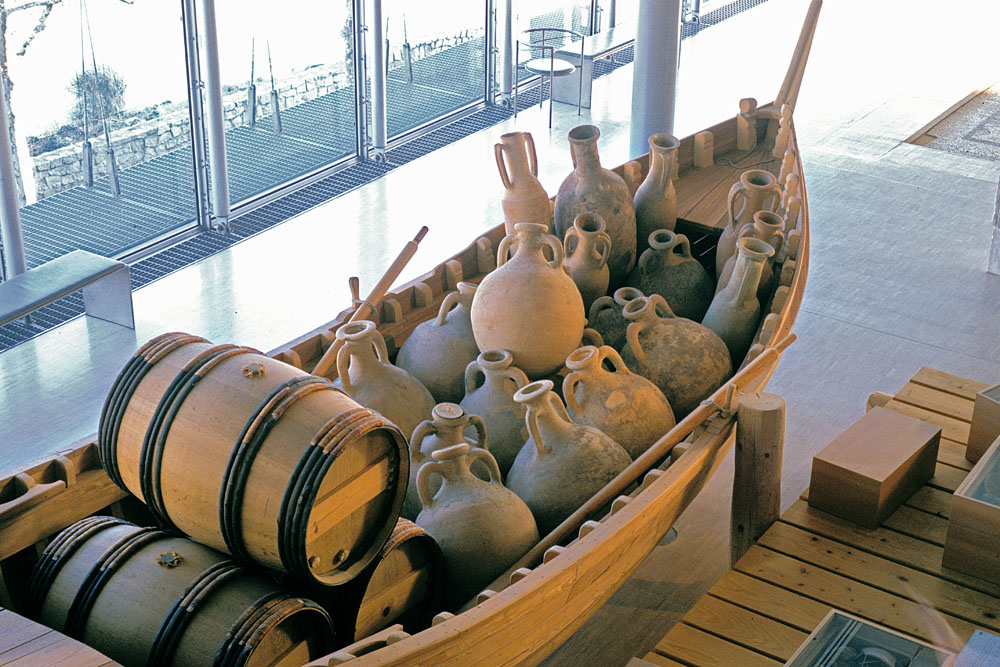
Reconstructed Gallo-Roman boat from Toulon, with some reconstructed wooden barrels.
-
I was think it could be the reverse of the coin (i like the combinaition of a celtic shield with greek writing)
-
What style will you use? Coin/relief style emblem. Shield style emblem ( like painted shield) In both cases, at least the shape of the head must be drawn.
- Today
-
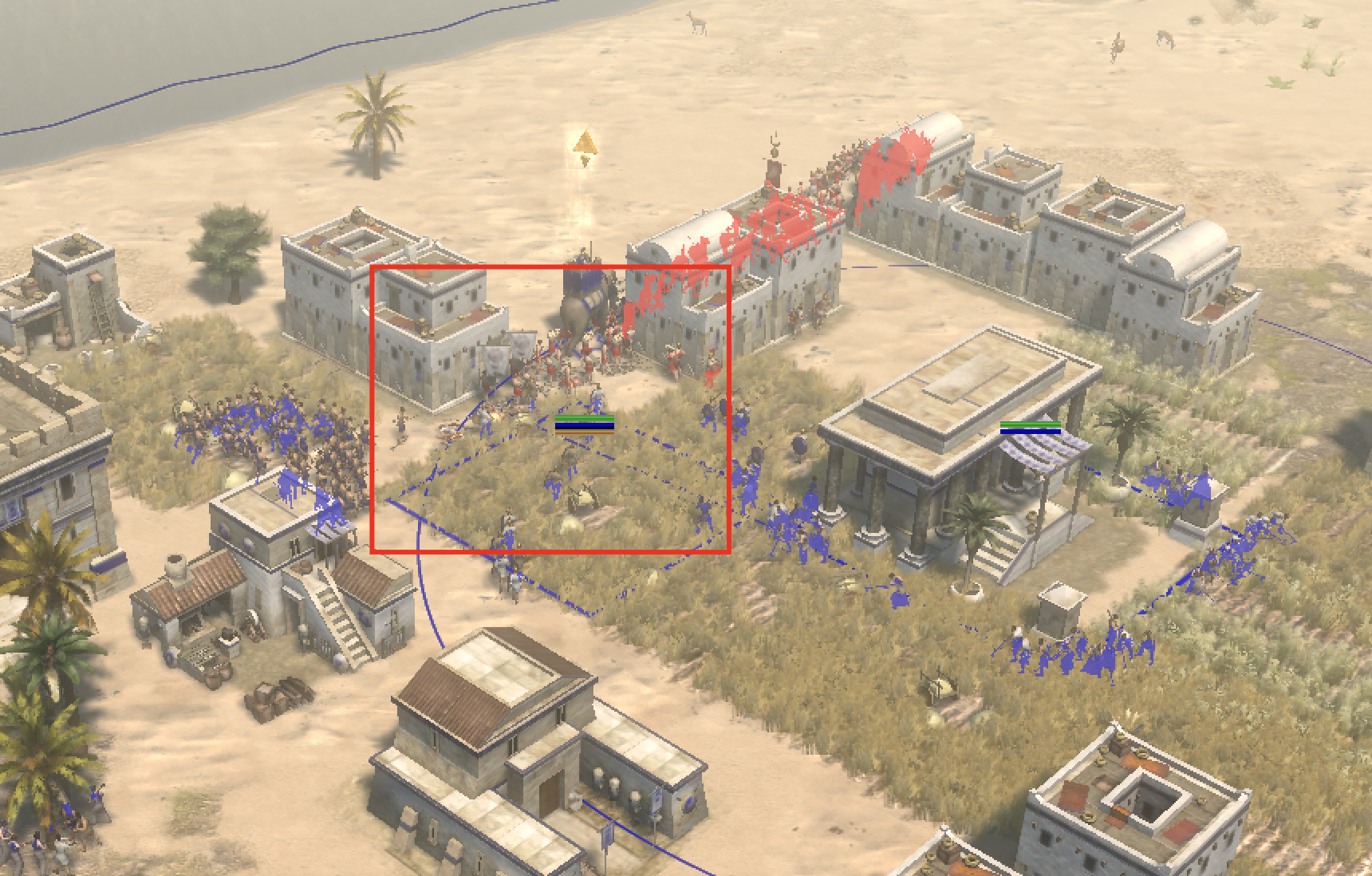
 I managed to block my 24 elephants again. The gaps they tried to pass through are quite small. I’ll clarify again here that I’m deliberately trying to push things a bit. In particular, I’d like you to look at what happens with the group at the bottom, which has a visibly wider path than the group at the top. The first elephant goes straight through, but the second one, which is coming slightly from the side, collides with the house and turns to its left to try to go around the house. However, there is no longer enough space for it to make the 90-degree turn, so it gets stuck at the corner of the structure's hitbox + some eles probably pushing it too, and ends up blocking all the eles. I replicated this with only a few elephants, and something similar happened. It seems that elephants need to make a 90-degree turn to go around a building, avoiding any contact between their hitbox and the corners of the structure. This can be seen in the following videos. There is clearly enough space for the elephant to pass through if it moved diagonally: The obvious conclusion is that the hitboxes are too large, both unit and building (I'm asuming hitbox are the green ones). They extend well beyond the 3D model that the user sees and create these visual inconsistencies: the elephant cannot pass through a gap that appears wide enough. Having the structure's hitbox larger than the model may be desirable to prevent units from clipping through it and perhaps also help with visual clarity. But for organic bodies, maybe we can cheat a little with this. And I think this is also why I mentioned several times trying to "give them more overlap". But perhaps that wasn’t the right term. Maybe it’s not a matter of giving them more overlap, but rather making their hitboxes smaller. This could help elephants move through gaps that appear wide enough to the user, and it would also prevent them from pushing each other without actually touching, as can also be seen in this same video (00:10). In this last example, we can see an elephant walking around the barracks while keeping an exaggerated distance from the structure's visible boundaries: One final clarification: It’s obvious that destroying the houses is the quickest way forward, and there’s no reason to expect the elephants to organize themselves perfectly and head straight for the fortress. After all, the purpose of this feature is to add more realism and make a huge creature like an elephant somewhat clumsy. However, I think there is still room to improve the visual inconsistencies I’ve shown, where there appears to be enough space for an elephant to pass through, but it nevertheless gets blocked. I think most users will consider these visual inconsistencies a bug, and they can make the experience somewhat frustrating. That’s why I keep pointing them out as something that I think needs to be addressed.
 -
 Omegle and the Unexpected Friendship: A Talk With Stranger Story The internet has changed the way people communicate. Today, meeting someone new no longer requires going to a crowded café, joining a local club, or traveling to another city. With random chat platforms inspired by Omegle, people can start conversations with strangers from different backgrounds and countries with just a few clicks. For many users, a random conversation may last only a few minutes. But sometimes, an unexpected connection can become something much more meaningful. This is the story of Alex, a young designer who discovered that one simple decision to talk with stranger could eventually change his life. A Lonely Evening Alex had recently moved to a new city because of his job. Although his new position was exciting, he struggled to make friends. Most evenings were spent alone in his apartment after work. One rainy Friday night, Alex was browsing the internet when he decided to try an Omegle-style random chat experience. He visited omeglechat.online, a browser-based platform where users can connect with strangers through random text or video conversations. The platform allows people to choose a chat mode and start a conversation without creating a complicated profile.
 -
He's really clueless, it happens a lot with veterans in RTS games who are newbies in 0 AD. Many things in 0AD are not intuitive. And they are very inconsistent.
-
[h1]Hybrid Total War + Rise and Fall Combat System[/h1] I have been thinking about a possible hybrid system combining some of the large-scale control of Rise and Fall: Civilizations at War with the individual soldier behavior seen in Total War. The main idea would be to separate strategic control, formation control, and individual combat. [h2]1. Hierarchy[/h2] A possible hierarchy could be: ARMY | +-- BATTALION | | | +-- UNIT | | | +-- SOLDIERS | +-- BATTALION | +-- UNITS The player would primarily control battalions or units, while the individual soldiers would remain autonomous enough to handle local movement and combat. [h2]2. Movement and Pathfinding[/h2] Instead of every soldier independently calculating a complete path, the formation could have a main path and each soldier would try to maintain a relative position inside the formation. For example: Formation path: A ---- B ---- C ---- D | +-- individual soldiers maintain formation positions This could potentially reduce the amount of expensive pathfinding required when moving large armies. [h2]3. Combat[/h2] When two formations engage, the game could first determine the front/contact area between them. For example: ROMANS ████████████ ████████████ ████████████ ⚔ ████████████ ████████████ ████████████ ENEMY The unit would have a general combat target, while soldiers in the contact area would look for appropriate nearby enemies. This would allow the battle to look like individual soldiers fighting individually without requiring every soldier to make high-level strategic decisions. [h2]4. Individual Combat[/h2] Each soldier could still have: []Individual position []Health []Target []Attack behavior []Animation []Local movement Collision avoidance However, the UnitAI would remain responsible for the higher-level behavior: []Attack []Advance []Hold position []Retreat []Pursue []Change target Change formation The soldiers would execute those orders locally. [h2]5. Casualties and Formation Deformation[/h2] When soldiers die, the formation should not instantly rebuild itself into a perfect rectangle. Instead, gaps could appear naturally: ████████████ ████X███████ ████████████ Nearby soldiers could gradually adjust their positions, while rear ranks could move forward when space becomes available. This would preserve the visual feeling of a large group of individual soldiers while keeping the formation as the main organizational structure. [h2]6. Possible 0 A.D. Architecture[/h2] Conceptually, this could fit into a hierarchy such as: Army / Battalion | v FormationController | v UnitAI | v Individual soldier behavior | v Pathfinding / local movement The important point would be to avoid making every soldier behave like a completely independent strategic agent. Instead: Army/Battalion: high-level orders Formation: positioning and collective movement UnitAI: unit-level behavior and combat state Soldier: local movement and individual combat [h2]7. Why this could be interesting[/h2] This could potentially provide the visual and tactical feeling of Total War while retaining the faster group-level control of Rise and Fall. It could also be interesting from a performance perspective. Instead of: 1000 soldiers x 1000 independent high-level decisions x 1000 independent pathfinding operations the system could operate more like: 1 army order | 10 formations | 100 unit-level decisions | 1000 individual combat/movement behaviors The individual soldiers would still be visible and fight individually, but the expensive high-level decisions would be concentrated at the formation and unit levels. I think the interesting question for 0 A.D. is not necessarily how to create a completely new "battalion entity", but whether the existing FormationController, UnitAI and pathfinding systems could eventually support this kind of hierarchical control. This could give large armies a much stronger sense of organization without removing individual soldiers from the battlefield. ##### This is an alternative idea. I have other ideas for the organization; this would only work in battle formation. ####
-
His Spanish commentary is pretty fun. He constantly calls the so-called champion units "elite units", as they should be more accurately renamed. He likes the graphics and historical accuracy, and encounters the issues of lack of hotkeys to build and, often and annoyingly, units walking in column formation when not ordered to. There are some not that intuitive things he doesn't realise, like Docks being dropsites, dropping resources before fighting, or how to capture. Comments showing yet again what people usually ask for: -"You know what I've always wanted from any RTS is the ability to build roads; that makes building cities more satisfying". -"There's a game that adds a lot of versatility to the game (even more) called Delenda Est. It introduces slave mechanics, new crops, money as an extra resource, prestige (which includes new sculptures and new recruitment systems)... I highly recommend it for greater replayability". -"One of the things that bothers me about this game is that soldiers start working when you're in the enemy base simply because you clicked the wrong tree. Also, that there are no default hotkeys or that they can be configured in the menu like in Age of Empires. And that some things are very simple or straightforward in terms of depth, but I think we already have that in Age". -"The only thing I find lacking about Age of Empires games is that they ignore logistics as a historically fundamental military concept. It would be awesome if they nerfed units when you move them away from urban centers, and allowed you to build roads or logistics nodes to compensate, or something like that. Penalties based on terrain type would be cool too". -"It's improved a lot. I played it about a year ago and it was still lacking, but now it's almost completely polished and super playable". -"The fact that the scale of the characters and buildings is in proportion, that alone convinced me". Indeed, same with ships
- Yesterday
-
Wintelf95 joined the community
-
For a DE style wonder one of the palaces of the Neapolis could sort of potray a transition to a different cultural stage (which is interesting if the wonder is supposed to unlock phase IV). I think those towns could at least be used for buildings like walls and towers if the Scythians have them (IMO nomad civs could still have access to defensive buildings if they used them, but perhaps later ingame and only through a technology)
-

Implementing forces in Unit Motion (HELP WANTED)
Atrik replied to Atrik's topic in Game Development & Technical Discussion
It is kind of the case depending on how you look at it : We could say that units aren't actually pushed, they just look at every neighbor that look too close to them, then they move away from them. Consuming all forces they calculated, tells them where they have to go for this turn. So it's them actually moving away.. Well since all that is a bit some abstraction of physical events probably there are as many way to phrase it as you want. Edit : I meant is that the pushing range is already some kind of way to communicate to units to move away. But maybe if you wanted to add one that apply only to allies but further then the normal push one, it could be a good idea for example for rams where you want them to push allies but enemy can still block the way. It's a good idea. Edit 2: Now I have regret dropping my initial approach about a forward area in front of units used for charging, that would be maybe a few lines of codes to just make it possible to apply to allies only... I'm glad for the involvement, it shows that this is an interesting topic and that many things will sprout out of it. In fact, a big highlight of this project is that it will be easy, even from a mod, to plug in forces into UnitMotion. Examples : weather, spells (attractions, repulsion)... -
Implementing forces in Unit Motion (HELP WANTED)
nifa replied to Atrik's topic in Game Development & Technical Discussion
ok, another random guess: Maybe we could use an additional force, where an idle unit clears the path for an allied moving unit, before they are colliding, when it's blocking the way? The blocking unit would just slighty move to the side, but only if there is space available -

Implementing forces in Unit Motion (HELP WANTED)
Thalatta replied to Atrik's topic in Game Development & Technical Discussion
I see, tangential forces would need friction to act. And I guess including that might cause a bunch of other problems, like units getting quite stuck. -
Implementing forces in Unit Motion (HELP WANTED)
Atrik replied to Atrik's topic in Game Development & Technical Discussion
Like a simplification that doesn't account for friction? -
.thumb.jpeg.67ef5b5dc6d918163efa04cd5336830d.jpeg)
Help Wanted. Export to sprite sheet.
Nicolaus_von_Kues replied to Boston's topic in Tutorials, references and art help
There was a guy named Enkeli who knew how to do that for AOE II. https://www.indiegogo.com/es/projects/enkelikuoleman/rise-of-kings-medieval-warfare He knows how to convert 3D models to Sprite models. -
Implementing forces in Unit Motion (HELP WANTED)
Thalatta replied to Atrik's topic in Game Development & Technical Discussion
I see. I wonder if increasing on-center repulsion range (to leave free self-alignment rotation) could have been a way out of that. Btw, I noticed that in your code you mention "a circular body is always struck through its centre", I guess this is some non-physical simplification since you might care more about just rotating elongated objects? -
Cimbri clubman raider decaying health
Nicolaus_von_Kues replied to Flavius Stilicho's topic in Delenda Est
If you've ever played with the militia in AoE III, you'll know that they're only there to raise a defense army very quickly and they die easily. It's the same here. https://ageofempires.fandom.com/wiki/Militiaman -
 not sure if it is finished or ready, but it might be a good idea to implement some way for animations to play depending on motion at the time of death.
 -
Implementing forces in Unit Motion (HELP WANTED)
Atrik replied to Atrik's topic in Game Development & Technical Discussion
But right now a collision is only detected once for a pair. I imagine this idea would require to do two. I did a quick attempt for ellipse. It wasn't going in the right direction so I dropped it. Thinking about it I think I can explain why it's a bad idea : ellipses are too good to tile up a given space regardless of if the shapes are aligned or not, creating interlocking patterns. A drawing not at all accurate but to give the idea : For the same area, the ellipses can compress easier regardless of orientation. Whereas the rectangles force a spacing. And there corner impacts actually helps keep it that way. Really? Where can I get it?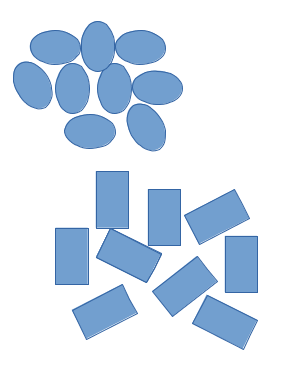
-
if you have a handle on if a unit dies while experiencing force (ie elephant strike or siege weapon), I wonder if one of @Alexandermb's new infantry death animations could be used. There is one where the unit gets knocked backwards off its feet, could be very cinematic.
-
I don't know if it's already been posted, but you can listen to the audio in English. The platform here doesn't offer that option. https://vt.tiktok.com/ZSbfNLmvn/ I uploaded a small part of the video to TikTok.
-
By the way, I think this one is in the mod but only with green feathers from the wings to the wings; there is another version of this bird with yellow plumage. https://en.wikipedia.org/wiki/Scarlet_macaw I don't know if @Lopess can confirm.


-
Hi 0AD community, I'm making a game engine under Creative Commons. With permission, I'd like to use graphics from 0AD. My game uses 2D sprite sheets. I'm no artist, but I'm willing to pay for a detailed tutorial on how to convert from 3D assets to 2D sprite sheets. I'd also like to be able to export the shadows cast by the the objects onto the ground plane. Any takers? Boston https://bbrooks193.blogspot.com/2021/12/maths-game.html
-
Implementing forces in Unit Motion (HELP WANTED)
nifa replied to Atrik's topic in Game Development & Technical Discussion
I thought the defender is that one who's movement gets influenced by the attacker. So when two units collide they are both on the same time attacker and defender, depending on which movement is calculated. -
I don't know if they'll be in any mod.





-
Latest Topics
-
