
All Activity
- Past hour
-
Yes, I think this behavior is quite appropriate. And I don’t think it’s worth over-optimizing this behavior. If there are no nearby buildings to garrison in, having units stay idle where they are seems like the most appropriate outcome. Players should be responsible for ensuring there are enough nearby buildings for units to take shelter. Otherwise, keeping them idle is actually helpful, since it makes it easier to quickly select them using the idle hotkey. Short video of this. I don’t see any civilians switching resources after the bell. Not even those who garrison in buildings with rally points set to other resources. ringbell.mp4
-
Possible. You haven't provided a replay so we're only working with hypothesis. What I described could have mislead you into thinking the units chopping wood were initially farmers. The maximum distance units travel to garrison seems a bit normal. You don't want units to travel half the map if they don't find any hides close enough. Maybe there is way to optimize the behavior however, with better sorting by distance for example. Also the input to ring the alarm is rather limiting...
-
I’ve noticed that when there are no buildings available for garrison, civilians just stay idle where they are. However, I haven’t verified whether this happens because there are no buildings close enough for them to detect, or because there are no available buildings at all. What I’m fairly sure about is that units do not switch to gathering a different resource. In other words, if they were farming, they will try to resume farming rather than moving to gather wood.
-
But, if I understand correctly, that doesn't seem to be the issue @Atrik, the issue is having less people in farms at the end of the alarm because they go to the trees instead.
- Today
-
They can be though, since there is that flood map where the water rises, so maybe it’s possible to change the sky colors in the future?
-
Didn't recheck but my experience debugging UnitAI tells me that what probably happened was: Your units were actually chopping wood on a woodline further from garrisonable buildings You call alarm so they move all the way into the buildings The exacts trees they were chopping disappeared (chopped by other units : your soldiers) You ring end of alarm so they try to go back to chopping wood, but since the trees they initially were chopping are no longer there, they search new trees, but relative to their own position. Making your civilians start chopping trees at a different place as they were supposed to. Just a likely hypothesis and note for myself (or anyone) when I'll work UnitAI, since that would be fixable.
-
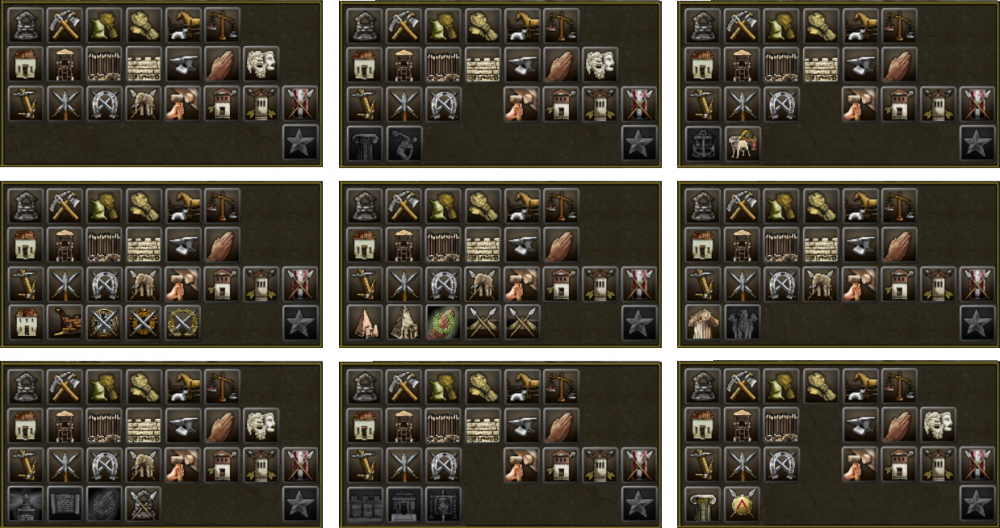
Is there any reason for the construction panel to be basically 2 long lines of 10 icons, a 3rd line with a few icons, and a last empty line, all with no apparent organisation? It doesn’t look good for someone new to the game (that was my first impression). Maybe the first 3 rows could be used for “normal” structures (those that civs tend to have in common), where icons would have a fixed place, and the last row for “special” ones (unique, or almost, and the wonder). The 1st row could be (mostly!) economic structures (resource oriented), the 2nd civil (what's left at the end, even when techs can influence military things, etc), and the 3rd military (that produce units that do damage, or do damage themselves). The 4th row would be ordered first with economic, then civil and then military structures. This looks better and also the fixed places on the first 3 rows help noticing fast what a civilisation has or lacks, in combination with checking the last row. Here I’m showing an image with the “template” on the upper left, and 8 civilisations as examples (did it weeks ago, so for R27).
-
 Strategie per le scommesse sul calcio italiano
 -
Scommettitore joined the community
-
@Emacz was asking me about slinger's shields, this is my answer, which could be interesting for some: Most people who could carry some sort of shield did, even animal hides, but it's a matter of how much stats would change. Besides, units were never as uniform as in a game, one just simplifies the most common ideas on them. Strabo (writing at the time of the game) says: "Although naturally disposed to peace, they bear the reputation of being most excellent slingers, which art they have been proficient in since the time that the Phoenicians possessed the islands. It is said that these were the first who introduced amongst the men [of the Baleares] the custom of wearing tunics with wide borders. They were accustomed to go into battle naked, having a shield covered with goat-skin in their hand, and a javelin hardened by fire at the point, very rarely with an iron tip, and wearing round the head three slings of black rush, hair, or sinew. The long sling they use for hitting at far distances, the short one for near marks, and the middle one for those between. From childhood they were so thoroughly practised in the use of slings, that bread was never distributed to the children till they had won it by the sling." Slingers could use a shield, having one hand mostly free, but that's useful when skirmishing close to the enemy, which is a role already taken by the javelineers (although one does more crush damage, the other pierce). In a simplified game, you want the slingers to do something else: slinging from the longest range. You can always just move the slinger closer for shorter range, but because of that would you want to add some shields in the animations to be that historically accurate? And also the javelin as a secondary weapon? Maybe, but stats shouln't change that much, and you also want to make units as differentiated as possible, not to confuse the player. It's also a matter of looking at the whole equipment: -Slingers: could have carried small shields, but couldn't use much armor (because of how the weapon is operated), slings are the easiest to carry, and munitions you can get easily (less so for lead). -Javelineers: most probably carried small shields, given their shorter range, but they also needed to be mobile because of that, so didn't carry much armor. -Archers: some apparently carried small shields, but coud use more armor, so makes sense to make them a bit slower. Not all javelineers were the same, not all archers were the same, each had what they could afford. -Crossbowmen: not necessarily all used large shields in all situations, but you either simplify and choose some representative units, or will have a plethora of options, most of which won't be convenient to even train.
-
I could be wrong, but it could be that they garrisoned on buildings that were closer to trees than to farms.
-
No inconsistencies there, since κώμη doesn't translate preferentially as home and house. Not my point, but that þurpą not meaning village could have been, although I don’t think much can be said about that, since it only appears once. Then you say (or repeat) that, because Lehmann point rests entierly on his incorrect ordering of ON and OE, and, again, from the ON incorrect meaning he states. Not true (if you keep referring to it as a single farm), þurpą appears only once in Gothic, and, yet again, ON states the opposite, why dismiss my ON dictionary quote?: So, your whole argument seems to rest on two quite weak points: 1. For Gothic, þaurp appears only once, thus not much can be really concluded. Haimaz appears multiple times as village and at least once as country, and wīhsą at least 6 times as village and at least 4 times as country. The country/countryside/farmlands discussion is totally irrelevant and not even the point (for a change). It’s not about farmland/country, but about how rural they are with respect to villages. I don’t care about wīhsą, the point is that you can’t rely just on Gothic, otherwise wīhsą would seem even more rural than haimaz, according to your own criteria and opposite of your own proposal. 2. The next attested instance of a þurpą cognate is in 725 OE, meaning village. Later on in OE and OHG it kept being used for “hamlet, village, farm, or estate”. For OHG, any spurious dictionary shift right in the 8th century cannot be just extrapolated back a thousand years supposedly unchanged. Heim being an older ending doesn’t mean it didn’t also mean all the other things every source states it meant, nor does it imply that the ancestor of dorf was an individual farm because it wasn’t used earlier as a place ending, as the multiple sources I’ve mentioned previously clearly state (just quoted one yet again explicitly stating how it was originally applied, and its etymological sense). Thus, sources show that haimaz was used in many different ways, while þurpą and wīhsą were more similar between them. And it’s clear already that Germanic hamlets were a bunch of cottages, farmsteads, estates, whatever one wants to call them, nitpicking on this point is a useless byzantine discussion. Those who put together the Proto-Germanic dictionary knew their sources, including (especially) the Gothic Bible, and heim/dorf/whatever endings. You have to explain why you think they didn’t.
-
I never seen this before. It might be worth to test it
-
That's what I do, and some of my farmers ended chopping wood. @wowgetoffyourcellphone, I don't think it's because of the rally point, because most of my farmers continued farming, while just some ended chopping wood, and had to put them on farms again. Seems something weird is going on.
-
You could do that although from a practical point of view I think it makes a littler less sense. If you research a technology, wont every unit that does that particular chore want to use the newest technology? Or you could do each phase (as game progress) soldiers gather rate reduces. I think this might be a little more practical, as they become more accustomed to fighting their will to work as laborers decreases?
-
-
Use the "End Alarm" button / hotkey (if it exists). It will make garrisoned Civilians go back to the work they did previously. Dunno if it works on Citizen Soldiers. In any case, killed cattle should count toward your maximum cattle until they are fully eaten up. Tbh I find it rather annoying as it mostly just adds a tiny detail you need to consider to optimize your BO, while adding little depth otherwise.
-
Forbidden thread!! I’d love to see what’s inside Wasn’t there rot in A23? I think I remember seeing it in some earlier version. I imagine the balance team must have some explanation. Same for the capturing siege feature From my POV, it would make sense to reintroduce rotting
-
Tell that to all people who answered that thread
-
I don't see how this is such a "huge" concern unless we try it.
-
IIRC we didn't not add rotting and fattening because the balance was a huge concern. Initially I had both, and you add to keep your sheep next to the corral aura so they would produce more food.
-
Well, I don't know exactly how the code works, but when workers are done building, they keep building other stuff, when the are done cutting a tree, they keep cutting other trees... can't tasks also be kept when garrisoned? After all, their HP is kept, so there's some sort of memory going on... EDIT: what I mean is, tasks at the time of sounding an alarm should override rally points. Or at least for that to be an option.
-
How is the game supposed to know that you don't want those units to go to your chosen rally point?
-
Agreed. I may introduce a Pull Request for it and get rotting into r29. It adds another interesting dimension to raiding and honestly, it's a pretty much expected feature for those familiar with RTS.
-
That animals currently do not rot has some strange implications, especially regarding Corrals. You can simply kill a couple of your own animals to bypass the maximum number of cattle, and enemy raids killing your cattle does not actually hurt your economy much because they do not rot.
-
Creo que é o mesmo vínculo; Estou aprovando a Semana Santa para atualizar e corrigir vários erros e coisas que caíram no final das primeiras Cívs. --- vers 0 a.d. 0.28 https://github.com/wltonlopes/Endovelico








-
Latest Topics
-


