

Thalatta
-
Posts
604 -
Joined
-
Last visited
-
Days Won
15
Everything posted by Thalatta
-
"No surrender" is an obviously false statement, that's exactly what they did. I'd advise not to use AI too much, there's plenty of things it doesn't consider. But I prefer to discuss these kind of details by PM and not here. Thomson's gazelle is certainly from East Africa, so that's quite wrong. I'm not familiar with all maps, plants and animals from the game, I don't know if it has lynx or ibex, but goats, rabbits, wolves and bears could be used, for example. There should be hard-leaved bushes, semi-evergreen forests, and depending on the exact region, the landscape can be dry-looking. But all these things can be easily found out first (and then check what the game has, and even propose to add what it lacks).
-
Indeed. Some optional flexibility could be implemented in addition to an absolute score being reached by player A: -Add a timer condition: a timer would start. Player A wins if no one surpasses its score in that time. Otherwise, if player B surpasses A score, the timer resets and same winning condition applies now to player B. -Add a relative score condition: a score difference has to also be achieved between the two highest absolute scores. One can try many combinations from this. Setting these two new conditions to 0 would just be the original case proposed. On the other hand, the absolute score condition could be set to 0, and with the other conditions one can achieve different game modes.
-
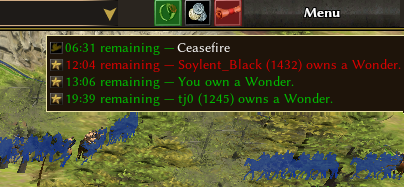
The problem I see is that that's only taking Ceasefire into account. What about other events, like the ones you mentioned at the beginning? To solve that (and other issues mentioned), here my take on combining what I liked most of your ideas ("Ceasefire" should be also in green): And objectives without a time limit could follow below.
-
No problem. I'm always happy to contribute towards historical accuracy, which I think, and read was others' motive to check the game, should be a characteristic of it. It's not that easy to achieve unique things in RTS nowadays, and one has to try to make a difference with whatever possible. Another observation: if you are going to name the campaign "The Fire of Freedom", then Scenario 2 has to have a different name, maybe "The Flames of Carpetania", since "The Raid of Carpetania" would be too literal when compared to the other scenario titles.
-
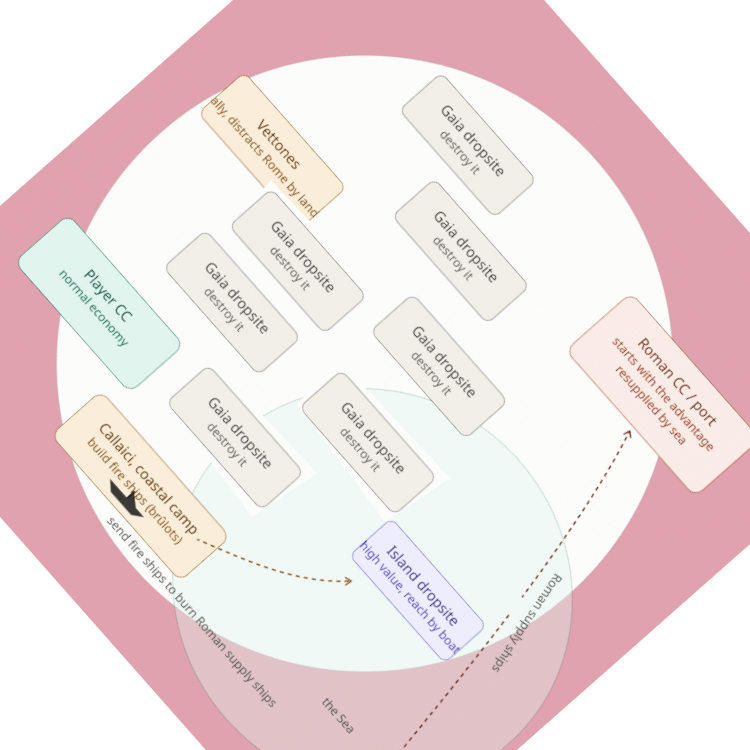
@lilypoppy, Scenario 4 seems fine to me, just rotated to align a bit more with geography, and more dropsites: The premise of Scenario 5 seems ok (just rotate it, leaving Saguntum on the right, and that should be on the coast), but my "Ending" was just the outro of the whole campaign, and since you said you wanted Viriathus story in three scenarios, I made it as short as possible, with four. But if you want to add it, it's title could be "The Lands of Sunset", because it's the end of the campaign and their independence proper, and for the lands given and their western location in the Empire.
-
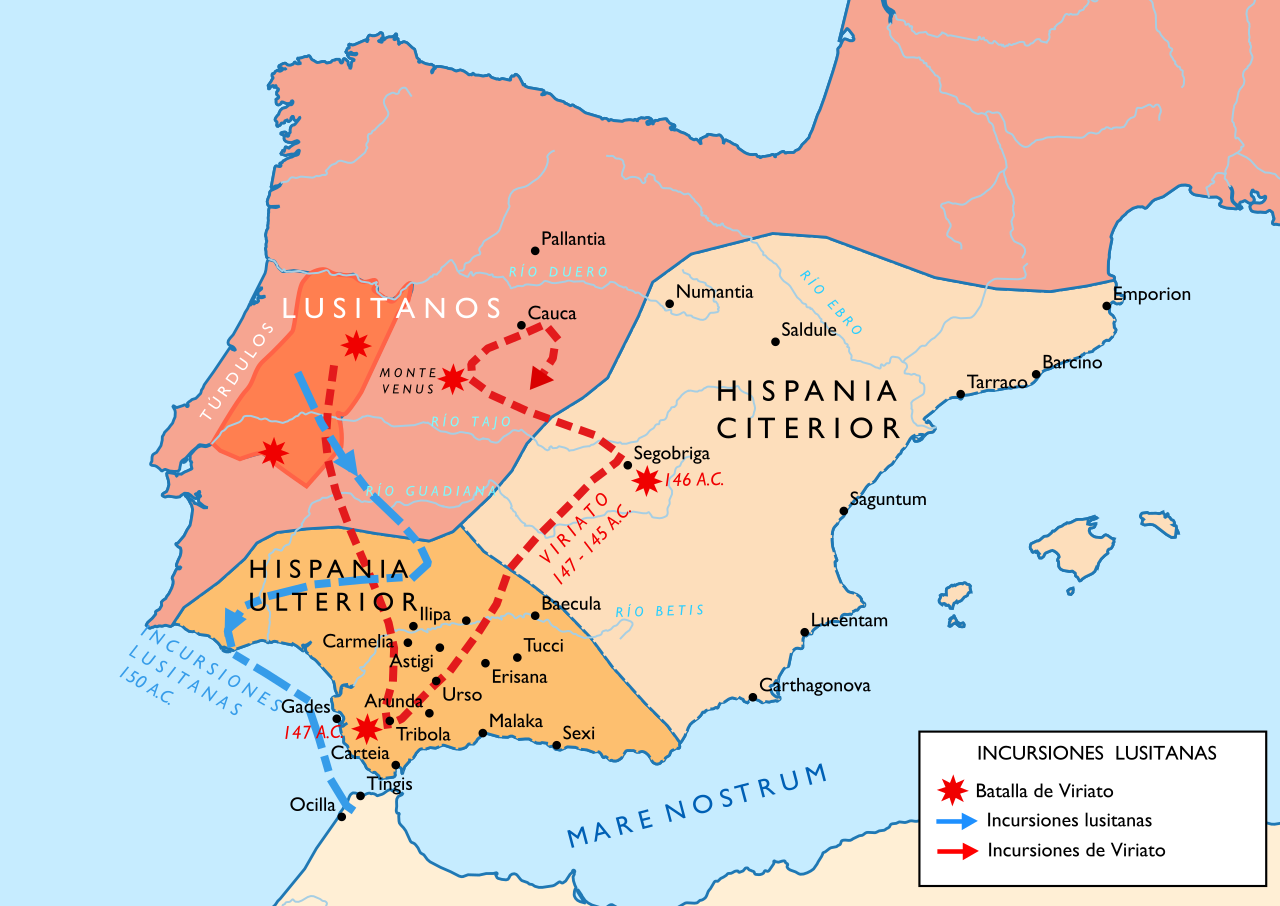
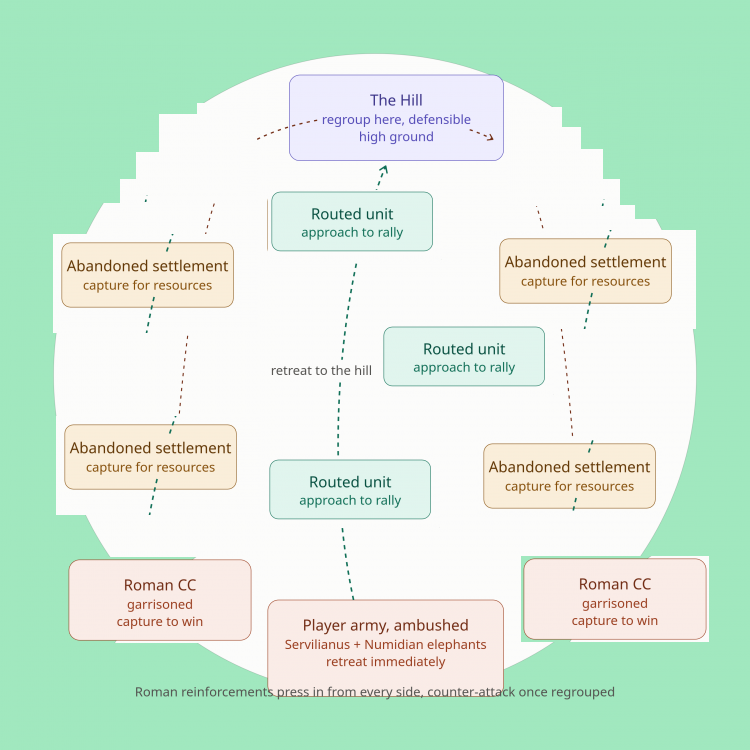
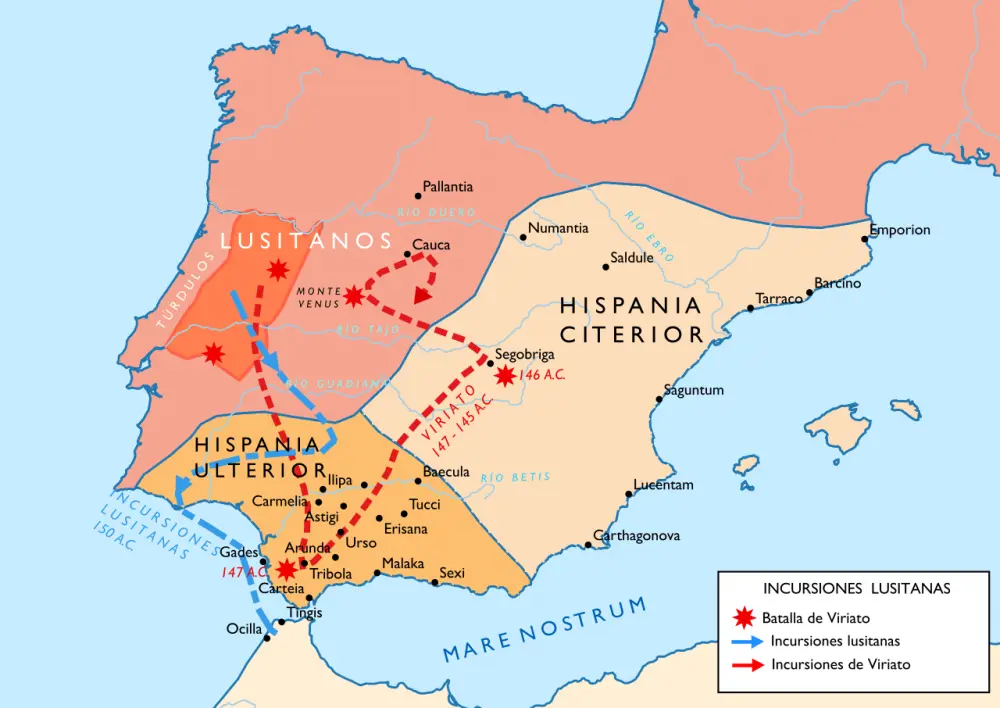
@lilypoppy, remember: §67) Servilianus marchs to Itucca (Tucci in a previous map), the big battle follows, Servilianus retreats to Itucca; §68) Viriathus returns to Lusitania (which we won't place so far), Servilianus attacks Baeturia, the Cunaei, and then Lusitania (so, took a northwestern direction); §69) stops at Erisana (shown west of Tucci, so he went back southeast, but the exact location of these towns is not really known), which Viriathus then attacks, but instead of killing them, Viriathus obtains peace. This is good because, like it was in part in Scenario 2, you are putting the final targets too close to the base, which in this case would render the southern part of the map almost useless. Thus, to make more chronological and geographical sense, and encourage the use of the whole map, for Scenario 3 the Roman CCs would be Erisana (left) and Tucci (right), the routed units placed on the path of retreat (turning the tide of the battle should be the first thing), and the other settlements should be in control of the natives, but weak and about to be taken by the Romans. So one starts in the lower part, retreats to the upper part, and has to come back to the lower part, with lots of the action taking place on both right and left of the map. To make it more historical, the capture (not destruction) of Erisana would be the objective, but whatever similar could work. It might actually be better to rotate this since the "up" direction would be a bit northwest: Edit: I'm thinking that maybe routed units should be located only below the centre of the map (another settlement could be placed about it), they are there just to defeat the Roman army (which, historically, would have retreated to Itucca, the CC on the right) before a long retreat. They should not be enough to challenge the Roman CCs.
-
Just in case, when I say "towns in Carpetania would be aligned with Rome", I mean historically. They would still be populated mostly by natives. When I say "particularly around Segobriga", I mean that, even when the arrows point to it, it should not be taken by the player (same with Toletum), not to have so easily an early CC (or, at least, it should be far from optimal, considering the Roman army presence there also).
-
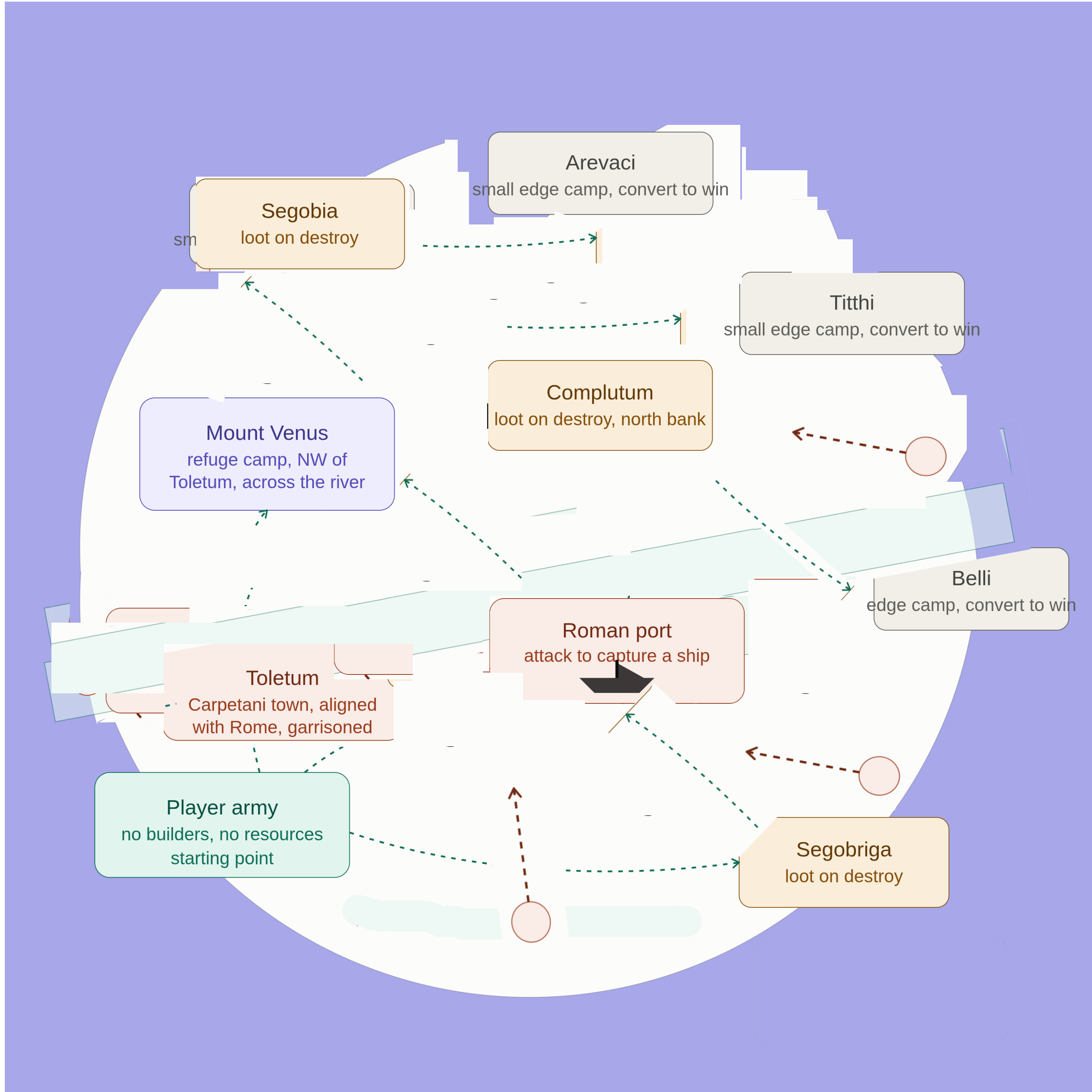
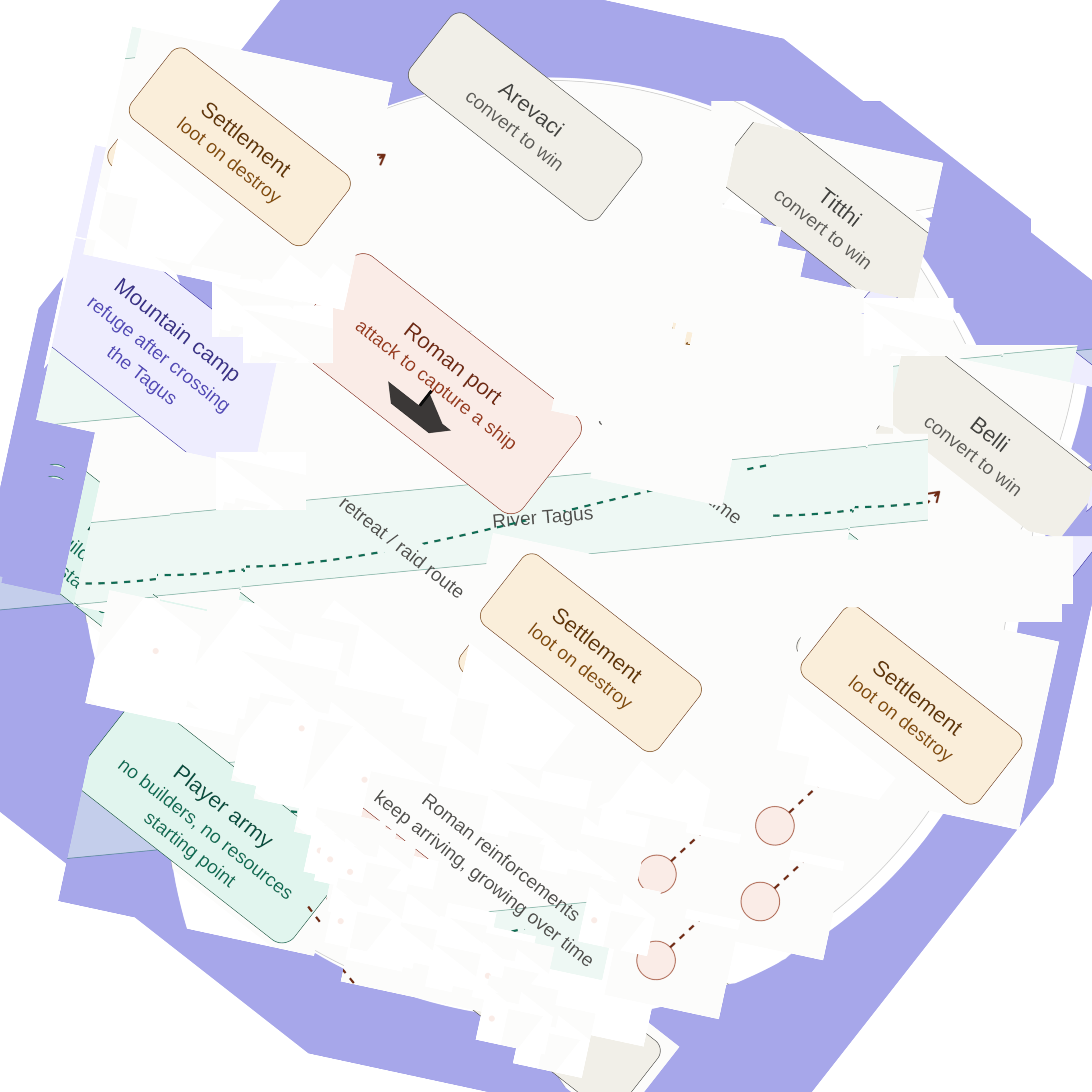
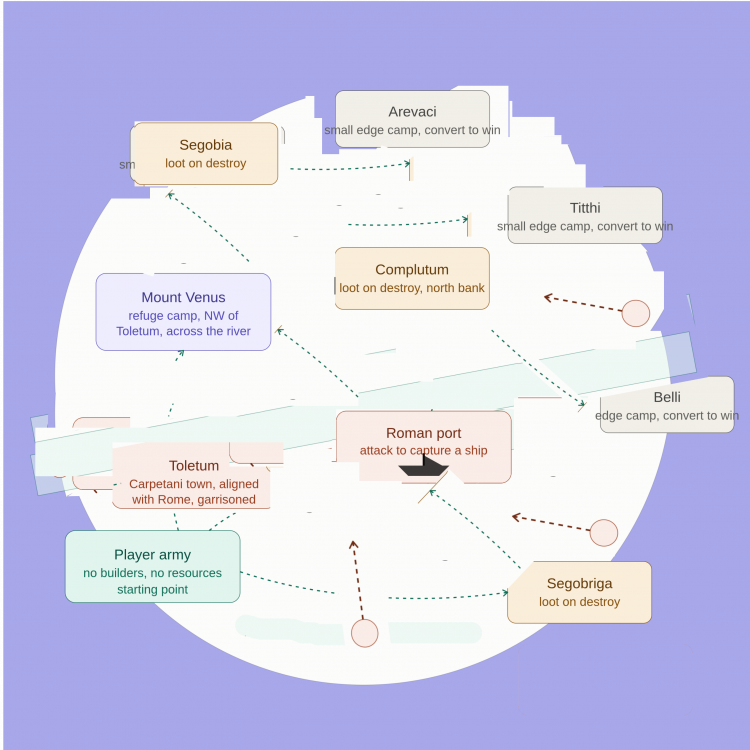
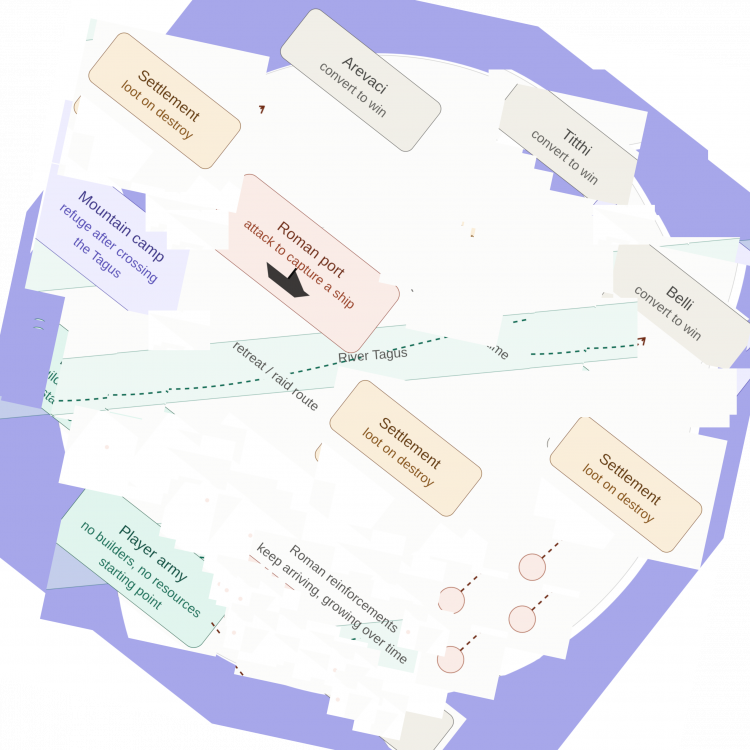
@lilypoppy, a few things: towns in Carpetania would be aligned with Rome (that's why Viriathus is raiding in the first place), not just Toletum, which should be on the southern shore of the river Tagus. Complutum should be between Segobia (both north of the river) and Segobriga, look at the previous map I sent. I lowered the river a bit (doesn't have to cross the map right through the middle, you can lower it more), and switched the lone port with Toletum (which could also have a more protected port). All has been placed now to encourage exploration, the optimal path shown in arrows. My red dots are from where Roman armies would mostly spawn, you can put their camps wherever you want. 1) Raid south of the Tagus to gather resources (particularly around Segobriga), while avoiding and distracting the Romans. One has no builders and still doesn't control the CC at Mount Venus. 2) Capture the port and build ships to cross (historically I guess they just swam, but their actual path seems similar to how I set it up now, check a previous map). 3) Capture the Gaia CC at Mount Venus (one was previously hinted that's an easy picking surrounded by resources). Romans keep coming, and they should have no problem crossing the river. 4) Continue raiding to accumulate a certain amount of loot, which is the first real objective. When this is achieved, one is told to reach the Arevaci, Titthi and Belli camps to know what one has to do to turn them neutral (not allies, since in theory this scenario ends with Roman victory, and the convincing of the tribes comes after that, all explained in the intro of the next scenario). 5) The requirements for each tribe could be something random among a list of possibilities, otherwise one would be too prepared beforehand. For example, a list of possible conditions could contain the things you say, and also: give them certain resources, research certain techs, bring them a certain number of certain units to a certain point, and so on. Hopefully a script can be made where each of the tribes (Arevaci, Titthi and Belli) gets assigned a task that they'll ask of you for their neutrality. 6) The scenario is won if two (or all three even, depending on what's decided) of those tasks are completed, and the corresponding tribes become neutral. All while the Romans by this point are almost impossible to stop and are overrunning everything, so all is a race against that. Hopefully you are happy with that!
-
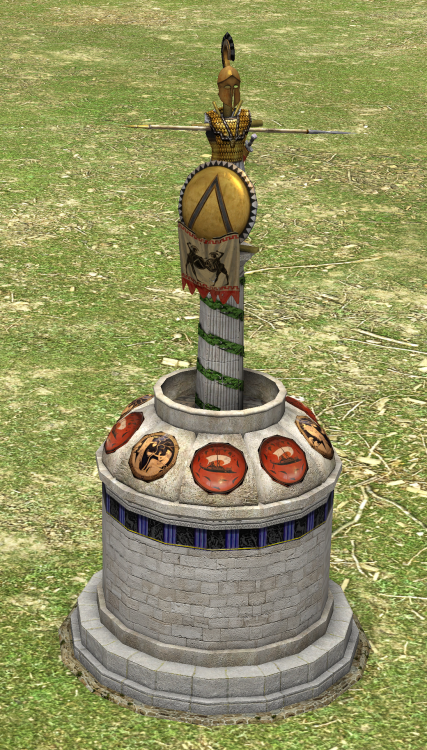
I was thinking that it might be better to just mirror the present aesthetics: since the sword is "equipped" but the shield is not (unlike on the coins, but I guess to show the armour better), the sword position would be more important that the shield's, so maybe you could put the sword on the left (instead of the right), and the shield on the right (instead of the left), keeping the aesthetic reasons and making the equipping of gear more accurate (one could think that some time after the coins were made, the shield fell and was put in this new position ). Edit: an horizontal flip of the model (I think nothing else gets messed up):
-
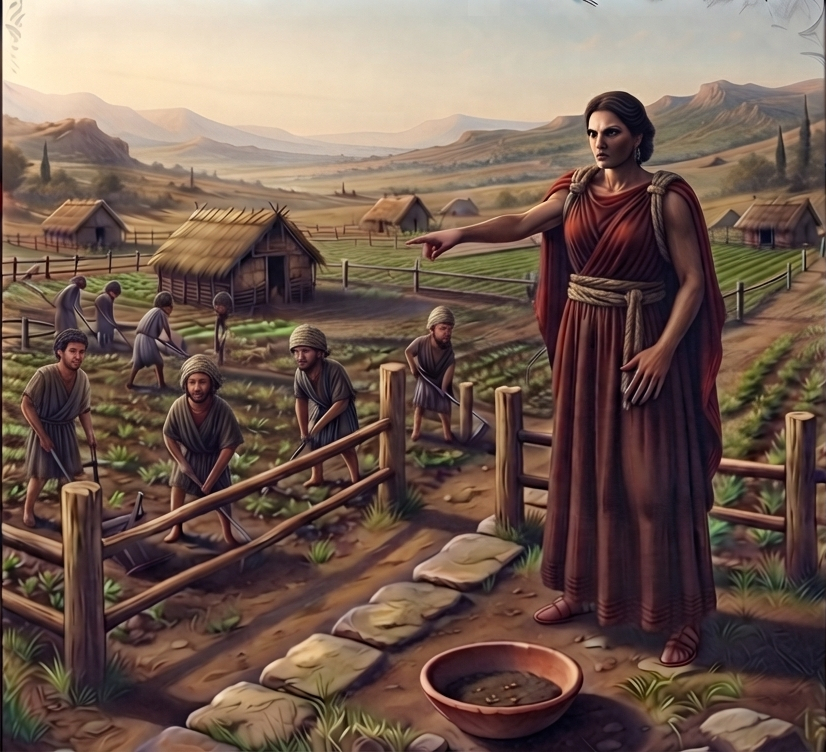
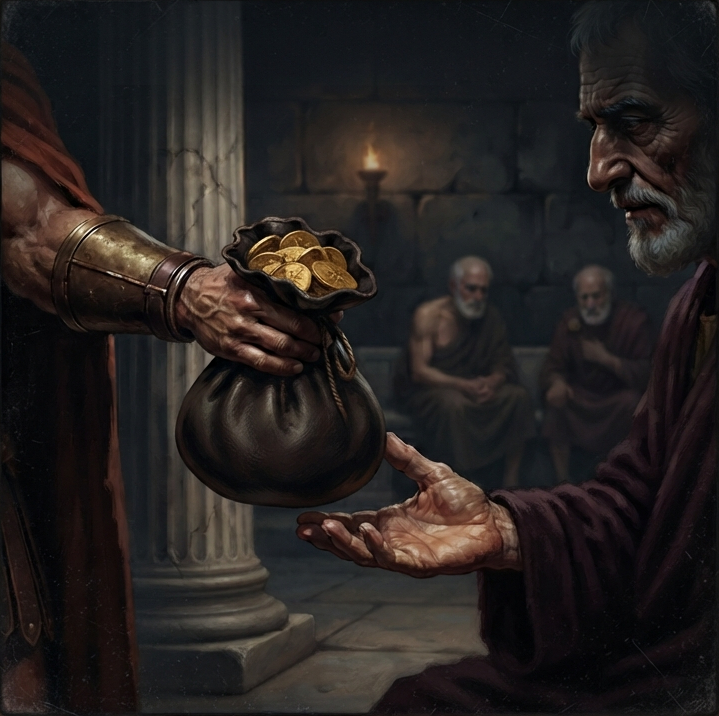
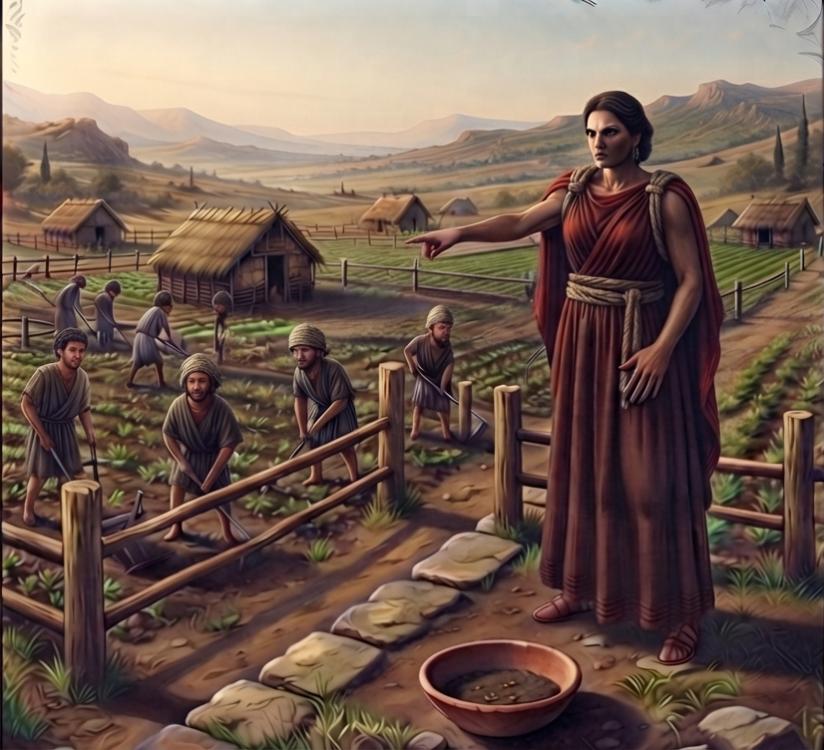
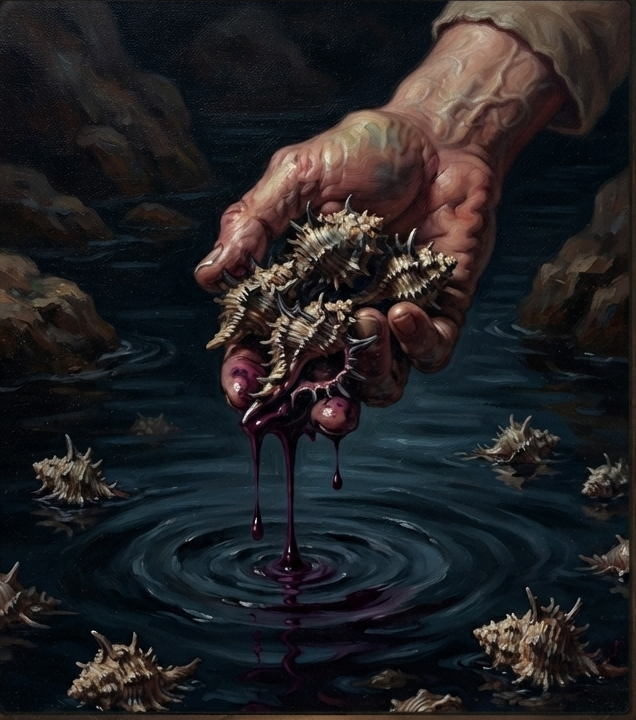
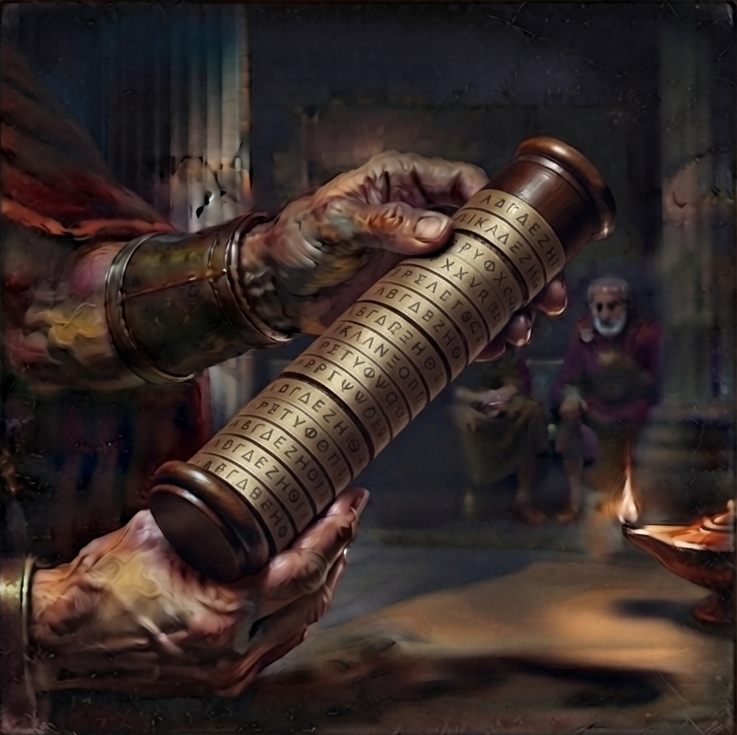
I thought, as with Bibasis, to present better a few of the most straightforward propositions I made long ago for the Spartans with some icons (some of which clearly need to be improved). Kleroi civ. bonus: Spartiate land allotments where helots lived and farmed. Also, their farmlands were among the most fertile. This would give more efficient fields (and could compensate for my proposal of removing their advanced agricultural tech). Scytale civ. bonus: transposition cipher for communications, since 7th c. BC, often associated with the Spartans, although it's somewhat controversial. This would increase FOV, to compensate for a civ that shouldn't be fast (lack of cavalry). Murex Fishing tech: instead of Fishing Nets (which have existed for thousands of years!). The Greeks were not that big in fishing, much less the Spartans, while "the murex mollusc" was used to obtain "royal purple", and "among the Greeks the Lakonians and Tarentines were leading producers". This would make fishing boats give some additional metal coin. Bribe Gerontes tech: something that Spartan kings did. If there are structure abilities with a cooldown, it would work better as such. This would make Heroes a bit more powerful, for a metal coin price. I ran out of free AI images when trying to make a Cleomenes III Reforms tech icon, but I wasn't having good ideas on how to represent that in a simple way anyway.
- 68 replies
-
- 1
-

-
- delenda est
- spartans
- (and 2 more)
-
Indeed. I was mentioning something similar with the Theban shipyards. And I've discussed with @Emacz how much less monumental the Spartans were compared to the Athenians. Having different models could also be useful for any mod that wants to include building upgrades (civ allowing), which I've also proposed for Towers. These things would make civs more unique, and make gameplay more interesting.
-
Couldn't both appear at the same time? Left as an option which ones to show? Maybe for some having a colour is easier to notice than constantly reading a number.
-
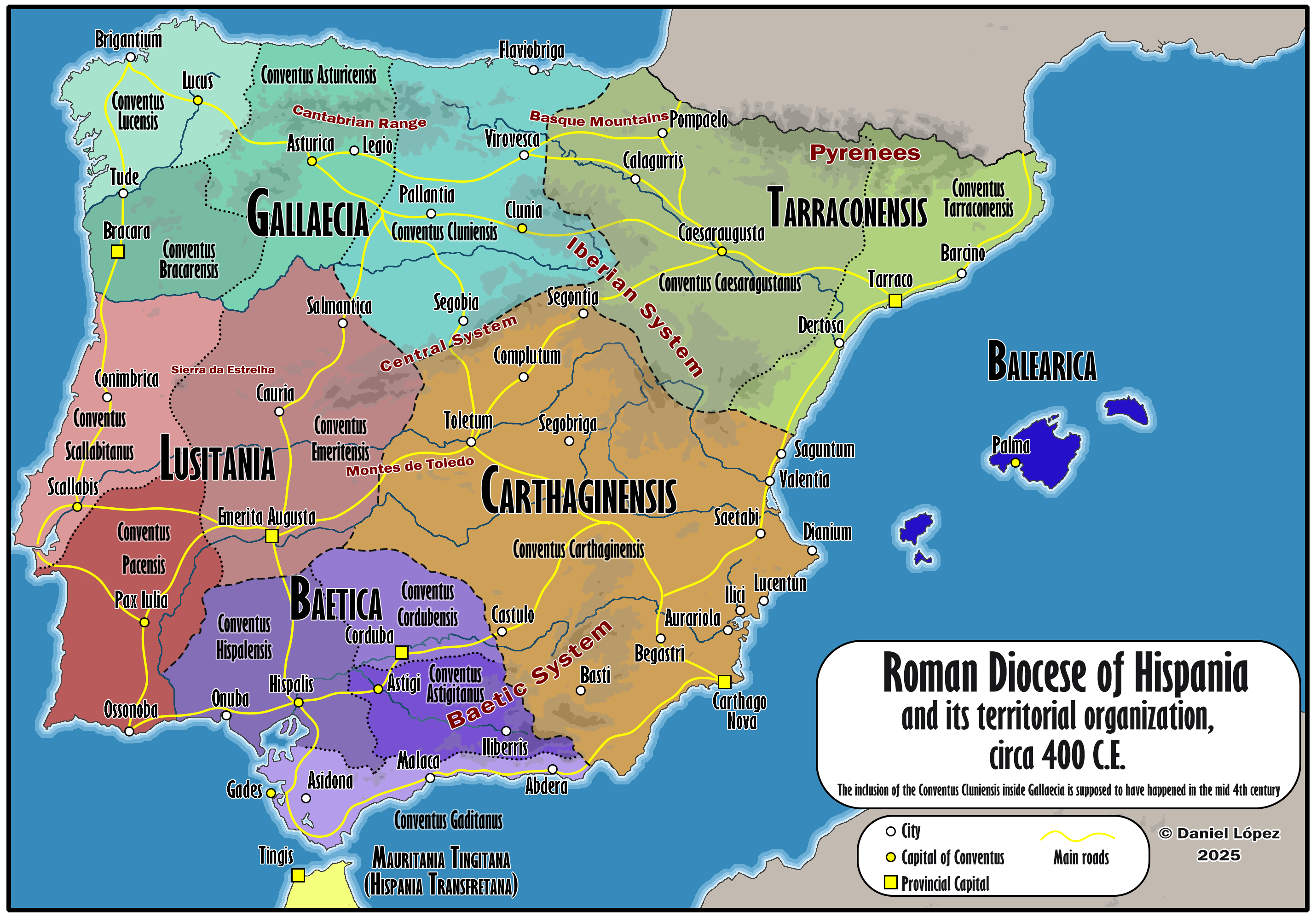
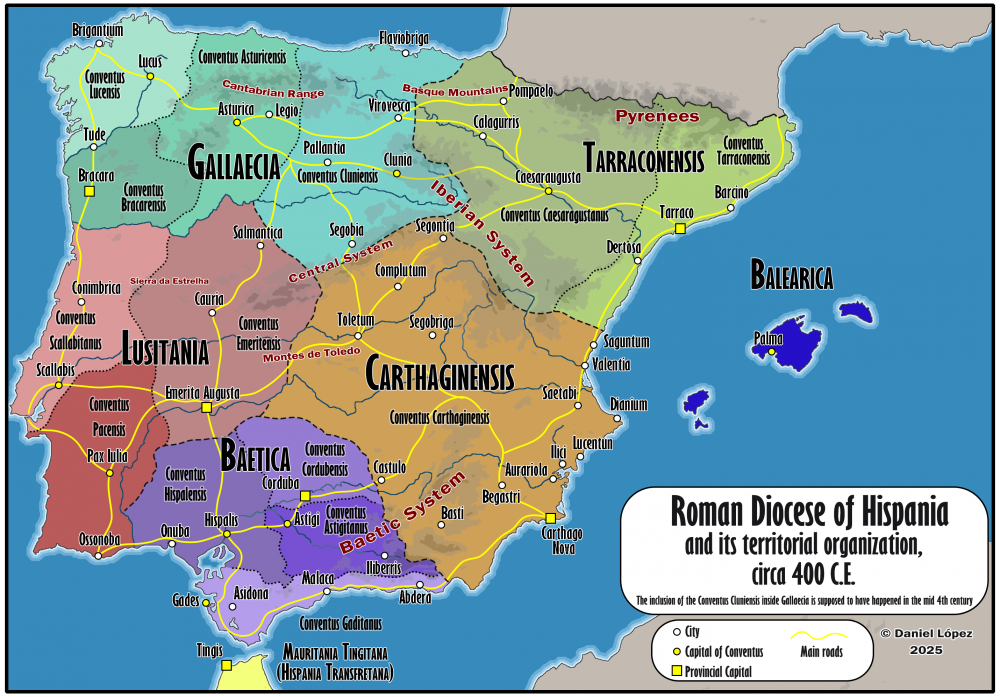
Hi @lilypoppy, I hastily rearranged things according of the placement of the tribes, and that Toletum (Toledo, one of the main towns of the Carpetani, aligned with Rome at the time), Segobia, Segobriga and mount Venus (the mountains north-west of Toletum) appear in the text or commentary, and using this map: Resulting in: You can add Complutum if you want (it would be nice to have a couple of towns north of the Tagus), it was a Carpetani town, although I have not specifically read about it. The Arevaci, Titthi and Belli could be represented by very small settlements or camps, since that wouldn't be their main territory (maybe the edge of them). As things stand, the raiding of Itucca and the Bastitani by Viriathus won't be part of this Scenario, but can be mentioned in the introduction of Scenario 3.
-
I'm on this page also. I don't think it really changes gameplay in a meaningful way, and I think it's nice to know the game version if a screenshot appears around (knowing right away how old is what is being shown can be useful), more so at this (possibly permanent) stage of constant development. I agree with the other @manowar modifications, whatever is immediately "not intuitive at all" seems easy enough to learn and have some use.
-
When someone writes "already the case for", it's evidently because another case will be compared with what you say ("kill all units before resign"). The present case already looks awful. You propose to extend that to intentional resign. Luckily, that has been "declared as 'Won't fix'".
-
Ok, but I see you said "I know longer have any conversations between us before may 15th. If it was in a previous CWA post, remember all my posts got wiped accidentally cause they thought i was a spam bot", meaning, that from before May 15 your inbox didn't get wiped out, right? You deleted the multiple pages of messages on purpose because you took the necessary notes, right? Then, you should have the corrections you haven't implemented yet still written around, right? What I tell you is always pretty clear, extensive, and sourced, you just choose to not pay attention, dismiss it, forget it, ask again, write unintelligibly, and repeat from the start, for then use ChatGPT for it to tell you whatever you want to hear. But even ChatGPT will tell you things like (just testing it): Sparta: Limited/occasional use of stakes; not a defining tactic. Macedon: More reliance on sarissa pikes than ground spikes; obstacles used defensively when useful. Rome: Most systematic use of stakes and other field obstacles, thanks to strong military-engineering traditions. So, as I've told you before with many things: you are wasting your energy and not being more accurate than vanilla if you indiscriminately add at the same level stuff that is irrelevant for some and characteristic for others.
-
@Emacz, why is that added from vanilla? Where did you read that Spartans are characterised by this? What difference does this have between, let's say, other Greeks and Romans?
-
That's the date I mentioned. You mean that's exactly the date of the oldest messages you have? Which one is your oldest message from me? If you tell me that I can copy paste previous useful information, which you should have asked instead of keeping asking the same things over and over again.
-
Newbie Questions - I can't beat Easy AI as Romans
Thalatta replied to Satevis's topic in Gameplay Discussion
I'm thinking now that the target area idea I proposed could have the modifiers "target reset" and "cycle reset" (the latter solving what's being discussed). Without modifiers, area targeting resources would make the selected units first focus on them, and continue gathering the same resource around, as usual. With the "target reset" modifier, only the resources inside the selected area are targeted, nothing outside it. With the "cycle reset" modifier, the selected gatherer randomly chooses between the targeted resources after reaching a dropsite. Some of these would have uses in combat also, for example when selecting ranged units and area targeting some enemy units with the "cycle reset" modifier, each missile would be aimed at a random targeted unit, acting as an "aim at will" command to homogeneously weakening them, instead of attacking some unit until it dies and then switching. -
Looks really good! I doubt the apron (parablema) would have been added to the aspis. I guess you didn't switch the sword not to have everything on the left? One possibility is to rotate it a bit backwards. Also, I guess the game in general assumes that swords hanged from belts, when they did so from a shoulder strap, as in the picture I posted.
-
@lilypoppy I'll go through Richardson's commentary to refine each scenario. He states that Appian thinks Carpessus is Tartessus, but "it is often assumed that Appian here means Carteia, on the bay of Algeciras, close to Gibraltar". This means that Carpessus/Carteia should be in the south of the map, and Tribola in the north: Also checked A Historical Commentary on Polybius, by F. W. Walbank, but there's no more info regarding the Titthi and Belli, while in Hispaniae, also by Richardson, it's stated that "might be that there was a division between those of the Belli and Titthi who supported Rome and those who sided with the Arevaci", meaning, maybe not all of them were pro-Roman (there are contradictions between Appian and Polybius anyway). Finally in The Decline of the Roman Republic, by G. Long, I find: "The quaestor of Vetilius was with the troops which fled to Carpessus. Appian says that he applied to the Belli and Titthi for five thousand men, that he received them and sent them forward against Viriathus, who killed them all. The quaestor himself kept quiet within his walls waiting for help from Rome. We cannot understand how a man shut up in a town on the south coast could communicate with people in the centre of Spain, and receive troops from them. If the Belli and Titthi fought with Viriathus, it may have been in their own country and in self-defence. Appian's narrative is here unintelligible". Trying to follow Appian as closely as possible (not to overcomplicate ourselves), I'd leave things mostly as stated before, assuming that somehow the Titthi and Belli are at the scene already, or arrive after being called upon before these events, or just after but a long time has been compressed. I'm thinking then, as I said before, to "move the Titthi and Belli colonies closer to the Romans", but maybe instead of colonies they should be rally points from where their armies will enter the map after triggered. That would be great, thanks a lot! I have no problem writing whatever needed.
-
@lilypoppy yes, this is quite on point! I'd just move the Titthi and Belli colonies closer to the Romans than to the player (while keeping them on the edge of the map), but for now I don't know where they were standing by really (their territories of origin were quite far away, and I don't think those particular forces came from there, but I have to check if this is better known). Is the CC meant to be Tribola specifically?: yes. Is the fight against Vetilius at the CC a real battle, or a scripted event on arrival?: a real battle would be enough as long as they are aggressive and move towards the CC, while being possible to distract them with skirmisher cavalry.
-
Newbie Questions - I can't beat Easy AI as Romans
Thalatta replied to Satevis's topic in Gameplay Discussion
Still have to make a git account for this -
Newbie Questions - I can't beat Easy AI as Romans
Thalatta replied to Satevis's topic in Gameplay Discussion
How things stand right now, certainly there has to be a line stating "Regenerates: 1 Food / 5 seconds" (seemed that rate, and trying to emulate correct nomenclature). -
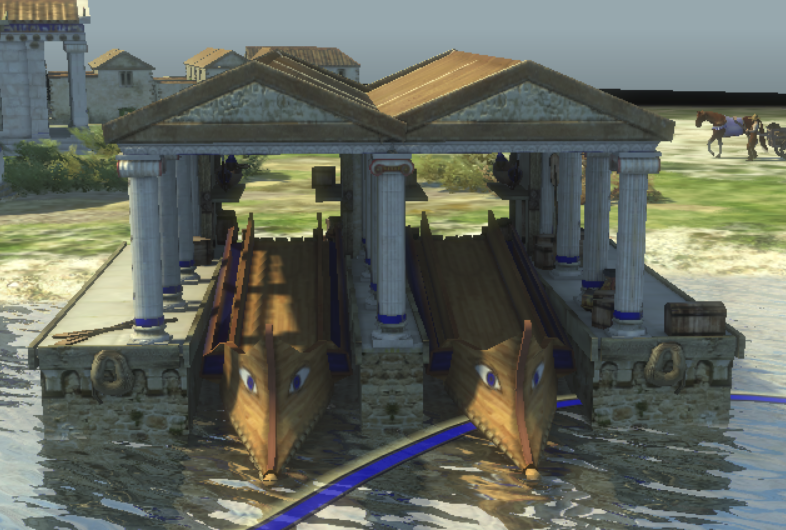
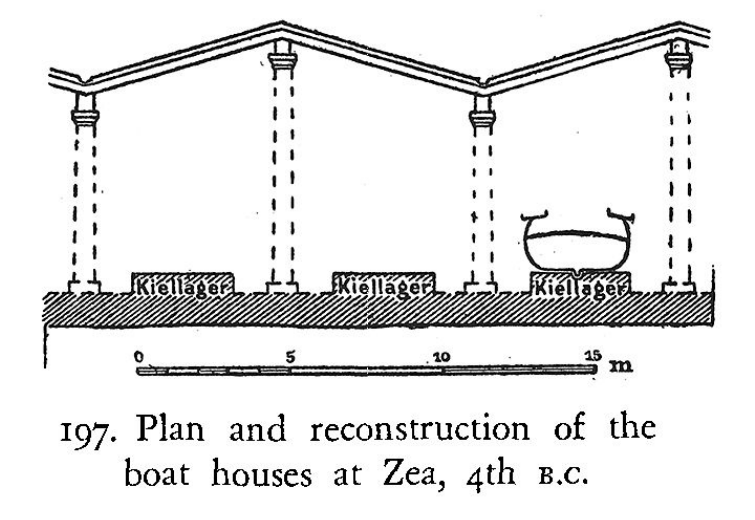
Shipsheds should be rotated 90°, that way you can easily make them longer in the correct direction to fit the ships inside. Vanilla follows this idea, but it's also wrong there, because the game does this: When it should be like this (more efficient): These are Athenian structures, built monumentally, most other Greeks (like the Thebans, who were not good at sea) would use impermanent timber shipsheds.