
Thalatta
Community Members-
Posts
381 -
Joined
-
Last visited
-
Days Won
10
Everything posted by Thalatta
-
Indeed, I always want to do the opposite, fill fields one by one. And if I send them to a filled farm, they already go to a nearby empty farm (not sure how far away the farms have to be for this to work). What!? How was I supposed to know this... there has to be some indicator for this kind of stuff (maybe there is?). I haven't played this game for too long. I agree that it would be nice for this kind of stuff to be added to the base game. I like this, although if the point filled first are the ones closer to the dropsite, not to add micro. They should. Actually, I'd like for unit abilities to be added, and them making a sound could have a temporal aura effect (maybe increased damage stats for now, but more realistically enemy morale decrease if this is added). I'd like to see day and night, seasons, weather, and other natural phenomena, eventually. In line with what was said before, I think they meant that they just become inefficient, since storehouse and farmstead techs would apply only to civilians. I think the idea is interesting (considering specialisation of trades), but faction considerations should be taken into account, since not everyone had the same dynamics between civilian and soldier. This could be solved by fine tuning which civilian, citizen-soldier and soldier units each faction has access to (and at which cost). For example, around the timespan of the game, Greeks and Romans would indeed mostly progress from civil militias to professional soldiers (that would find mercenary service more profitable than farming), but other factions like the early Germanics wouldn't make this shift in the same scale, and their armies (and male civilians) would mostly consist of farmer warriors even towards the end of the period (only later being more influenced by the Roman ways). All this would influence how the different factions should be played.
-
Well I thought pressing them in somewhat fast sequence (just like a dobule-click can be distinct form two clicks), but I see that when you press a given number in fast sequence it centers the camera on that group. Maybe it can't be done in a clean way (not disrupting what's already established). One possibility could be that repeated numbers can't be allowed (no 00, 11, 22... groups). Another that two different click speeds could be implemented: faster clicking for double digit numbers, a bit slower for centering on groups, the fast clicking working as the slower one if there are no double digit groups, making things work as they do now when you only have groups form 0 to 9.
-
@Genava55, I was on vacation, and then had things to do. I had a partial answer written down, which I’ll post now considering your new posts. Chronologically: A. Starting with Proto-Indo-European, according to Ringe, haimaz, “settlement”, comes from ḱóymos, “resting place”, while þurpa, “farmstead, village”, comes from treb-, “building” (this is your own source), which fits with the first Proto-Germanic dictionary entries for haimaz, “home”, and þurpa, “village, rural settlement”. Even in PIE my main concern is reflected: haimaz appears mainly as an ambiguous term, not necessarily structural, while þurpa appears mainly as a physical place, and not preferentially reconstructed as a single unit. B. Regarding your “6.3. The Household” screenshot of my source (Lehmann), you fell for a mistake there. It states that in Old Norse þorp means “farm, estate”, and that only in later West Germanic texts it means village. But ON texts are not earlier than OE, and you can check that ON þorp translates as village (this is something I’ve mentioned before, that basically only Gothic and Old High German support your view). The whole point of the discussion is, taking (the cognates of) haimaz, þurpa and wīhsą, how would they be urbanistically ordered? Both PGmc sources I cited (Lehmann and the dictionary) state that þurpą and wīhsą are more similar to each other than to haimaz (as can be read in your screenshot of my source, and from others). The only outlying source I find is Kroonen, who gives haima- as “village, home” and þurpa as “crowd”, which anyway blatantly contradicts your “singular first” interpretation (making all 4 sources mentioned against it), and what is a crowd of either houses or people anyway? Maybe he went for something figurative (I then found that the ON dictionary alings with this, more later on). C. You complain that, centuries later, Gothic þaurp translates as “farmland” (only once, which is not very useful), but disregard that the same can happen for weihs (at least twice). In fact, it also even happens with haimom. Now I see you addressed that “it seems Weihs was equivalent to Haims”, but sometimes looks even worse, in Mark 6:56 one has haimos as “villages” and weihsa as “country”, exactly the other way around of your proposal. Again, luckily Gothic is not the only thing used to reconstruct PGmc, if we rely too much on it no decision could be taken. D. The next reference seems to be the Old English one from 725 AD, which treats þrop closer to a village than a single farm. Basically all languages (except Gothic and OHG, as far as I can remember) follow this position, which is the position of the PGmc sources already cited. E. You dismiss the PGmc entry ordering, but insist on the OHG one, from a millenia after the fact, thinking a semantic shift right there can be traced back unchanged, independent from all context. You choose 2 datapoints there and just draw a linear function going all that way back, ignoring points A, B and D, instead of trying of harmonising all sources, since it could have been that what was a collection in PGmc times (as Ringe, Kroonen, Lehmann and the dictionary state) became singular for Gothic and OHG, and then OHG collected it again (a known behaviour in evolutive systems like linguistics and biology). Niemeyer might have referred to the previous singular stage when he stated “originally”, otherwise he would be contradicting all PGmc sources mentioned. You are only relying on a couple of languages from many centuries later, and that’s not that chronologically close, much less with something so subtle and apparently oscillating as what we are discussing here. That’s why “‑heim names are usually assigned to the oldest naming layer” is not only not old enough, but in a previous post of yours it is even clear the many meanings “heim” had. You even say the “only reason” wīhsą was your “second choice is that it seems to have been used much later, in the early Middle Ages, to refer in some cases to small Roman towns”, and this is nonsense to me, that’s way too late. I find this “critical approach” flawed for this reason, combined with that you give zero credence to what the experts have already reconstructed for reasons and with knowledge well beyond what has and will be discussed in this thread (this attitude doesn’t seem quite “mainstream”), and as if they have not already considered all that you have been saying. As if they don’t know what the Gothic Bible says! To finish this post (I dislike writing so much since Brandolini's law is BS, one can refute the Flat Earth theory with a couple of sentences, no matter how many books are written on it, so, it’s never a matter of quantity), I see you commented on the git commit https://gitea.wildfiregames.com/0ad/0ad/pulls/8722, and the problem with your points are: 1) We are not discussing the exact word reconstructions forms, but their meanings. For this, many disciplines were indeed used, it’s just wrong to state that it's “based solely on phonological rules and sound laws”. 2) Gothic is chronologically closer, but that doesn’t mean it’s enough, and as I’ve shown, it has sentences that directly contradict your proposal. The PGmc reconstruction takes into account all available knowledge. 3) Basically what I said on 2), and þaurp cannot be given much importance since it’s only used once, it was rare for them. 4) Just confirms that haimaz can be (and has been) many things, which makes it not specific enough. 5) Again, centuries after the fact, and doesn’t add anything to the issue of multiple and ambiguous meanings of haimaz. 6) Yet again, it cannot be said that þurpą “does not seem to have been used immediately to designate villages in place names” by citing a few examples centuries after the fact. 7) It is not true that the “oldest writings in Germanic languages” (as if that goes beyond Gothic) support your point, as B and D prove. As mentioned in E, with OHG you are a millenia off already, any shift happening right there means nothing. Points 2, 3, 5, 6 and 7 are just milking the same cow over and over again with Gothic and OHG, while completely ignoring the rest, which as I’ve said an infinite amount of times, has been taken into account for the PGmc reconstructions we have. As I explained in B, I did not contradict myself, you just fell for a clear mistake in that source (about something I wasn't even pointing out). 8) Since those few places you posted would be maxed out “Phase III” settlements (given you didn’t come up with anything bigger), then what would “Phase I” be? Seems you realised that and tried to preemptively explain things away, but the whole thing is unclear. Either you are saying that there was not much differentiation between types of dwellings (kind of my point), or that they had both farms and non-farm hamlets (which doesn’t seem right). In “The Germanic People”, Francis Owen states that there were basically two forms of settlement: the individual farm and the farm village (https://babel.hathitrust.org/cgi/pt?id=mdp.39015008272570&seq=176), so, hamlets again fall back to (a collection of) farms, which is how things were kind of everywhere actually. It’s clear that this early all those concepts are not that far removed given the context, translations, and witnesses. That’s why Lehmann says that Tacitus says that they were basically farms, not just because they were a bunch of isolated buildings, but surely because of all the crops and animals around. Caesar also talks about their annual land redistribution for farming, so, again, I don’t understand where you are trying to get with this paragraph. All this explains why the reconstructions are what they are (sometimes overlapping), and why one cannot just focus on particular choices one or two languages took centuries later. Many things I've said can be nicely wrapped up with what the (largest) ON dictionary says regarding þorp (https://cleasby-vigfusson-dictionary.vercel.app/word/thorp): “turba is taken to be the same word, this word, we think, was originally applied to the cottages of the poorer peasantry crowded together in a hamlet, instead of each house standing in its own enclosure”, “the etymological sense being a crowd”, “a hamlet, village, rarely of an isolated farm”. Although this proves Lehmann’s mistake, I’m not making the mistake of claiming one can extrapolate this all the way back to PGmc (even when I could point out the "originally" and "etymological sense" phrases being used), although I think that’s the right conclusion given what the reconstructions using all available knowledge state (and that ON comes from a separate North Germanic branch). Thus, the question is the same: which term is closer to wīhsą: þurpą or haimaz? Just go back to points A and B, which relate directly to PGmc, given that one can’t rely only on Gothic, where haims and weihs appear in interchangeable urbanistic order, and þaurp appears only once. The following instance this word appears in sources is OE þrop, "village".
-
@Genava55 As I said, literally, "proper villages [...] in the eyes of the Romans", you can just go and read Tacitus: "It is well known that the nations of Germany have no cities, and that they do not even tolerate closely contiguous dwellings. They live scattered and apart, just as a spring, a meadow, or a wood has attracted them. Their villages they do not arrange in our fashion, with the buildings connected and joined together, but every person surrounds his dwelling with an open space, either as a precaution against the disasters of fire, or because they do not know how to build", he's trashing their way to do it, for him they looked like big farms (and the ones you posted seem to be the biggest ones, a few extended families). But all this is, yet again, not even the point. The point is, according to A Grammar of Proto-Germanic, and the PGmc dictionary, and whatever other Proto-Germanic source we can cite, and if we agree that wīhsą can describe some kind of big farm or small village (which, again, could also be put into question according to yet another one of your cherry-picked criteria, since weihs has been used to translate agrós), then which term is closer to it, þurpą or haimaz? That is the ONLY question, and for whoever reads those sources the answer should be clear, as I already stated in my previous post.
-
I do check my info and make an effort I shouldn’t even do because I’m really not interested in arguing if the accepted Proto-Germanic reconstruction is wrong, which it isn’t, and what you have to check is your tone. Re-read my comments and realise that it’s not me stating you are “defending something weird that nobody talks about”, that’s you when for example called BS on the opinions I quoted from experts in the field. “Once again” it is you who acts like a condescending 12-year-old brat that feels the disgusting need to make pseudo-patronising “Brandolini's law” comments. It's not my fault if you can’t check info properly, just go to https://archive.org/details/diealthochdeutsc01steiuoft/page/n7/mode/2up, the column header meanings are on page 1. From there (and volume 3) you get the Sg. 911 and Sg. 242, which are dated from the very late 8th century (around 790 AD) and the 8th-11th centuries, respectively, as can be checked in https://www.e-codices.unifr.ch. It took me 20 minutes, no library needed (perfect place to make a condescending comment, I know, but lets have some class, shall we?). I only missed giving more span to the latter, because, again, I really don’t give a darn about spending time questioning the accepted reconstruction. I’m just giving evidence on why things are how they are, while you keep digressing towards centuries apart changes and ignoring any source that contradicts you regarding what matters: Proto-Germanic, from 500 BC to 1 BC. The only relevant thing is if haimaz is better or not for what is wanted. Nothing else. Luckily, I think I found exactly what’s needed: https://folksprak.org/common/material/pdf/A-Grammar-of-Proto-Germanic.pdf, which states that the Germans did not form villages but rather lived in isolated homesteads. Old Norse heimr, Old English hām and Old High German heim mean house or home, while Gothic uses haimos (only appearing in accusative plural) for village, and translates agrós 'land' to þaurp 'land, lived-on property', like Old Norse þorp 'farm, estate'. In West Germanic it means 'village', as in Old English þorp, Old High German dorf. In Gothic weihs 'village' also translates agrós. This is exactly what I meant with the demographic change, þurpą means what we need because there were no such things as proper villages, and both it and wīhsą seem to refer to whatever was there, call it land, property, farm, estate, with surely an extended family or more, and in the eyes of the Romans. I don’t see how any of them would be smaller or less appropriate than haimaz (taking from ON, OE and OHG). All this is exactly what the preferential reconstructions (are ordered entries important or not? Or is it just cherry-picking?) from the PGmc dictionary are telling us: haimaz is “house” first, “home” second, and “village” last, for þurpą the order is “village, settlement”, “gathering of people, crowd”, and “cleared land”, and for wīhsą it’s just “village, settlement”. All fits perfectly. If one travels in time it will look like a big farm or estate, conceptually it was the closest you could get to a village. They were not thinking in Phase I, II and III. And, as I said before, some branches kept it literal, while others kept the concept (which is what matters), and depending on each word. You are not going to convince me that the dictionary is wrong because, considering the source I cited and all the methodologies used that go way beyond your knowledge, it just isn't. If you have a problem with that, just take it to the ones that put it together, and use whatever word you want, I have better things to do honestly.
-
I agree, that's kind of my point 9 of the 20 points I suggested a couple of weeks ago
-
This sounds like just going with what the dictionary states, which is my position, mostly because in general it would be too much work to question what they say, and because things beyond our knowledge were also taken into account. In any case, I find using warją for the fortress a more pressing issue, I don’t think it is good to have repeated words if there are alternatives, all these situations deserve a second look given that @Vantha said “that's the case for some other civs too already”.
-
I’m just skeptical in ignoring what the Proto-Germanic dictionary says because of what Gothic says (which seems to have made choices opposite than the rest regarding this), when clearly this was already considered when the consensus was reached. It’s like reinventing the wheel. An interesting thing is that þurpą has been proposed to be related to the Latin turba, and for any Spanish speaker this is clearly related to a collective (meaning something like a mob). The Italic-Germanic split happened over 3000 years ago. Uncertain, but on the table, and shows that it is not generally assumed that þurpą was a singular unit early on. Only Gothic does that (as said, “in anderer Bed.”). With haimaz the Proto-Germanic reconstructions are home, house and village. I think there’s no way around that. It’s just like modern “home”, I could refer to my house, my hometown, or my homeland. That’s why I questioned it a bit, not that it can’t mean village (not from -heim though, but directly), but that it seemed too ambiguous. I don’t have a better alternative, I think we have exhausted what the PGmc dictionary has to offer. Alhs can mean settlement, but it seems too singular, and many other meanings are preferred https://kaikki.org/dictionary/Proto-Germanic/meaning/a/al/alhs.html.
-
@Genava55 Definitions 1 and 2 refer to Gl 1 and 3, both from the 8th century, so the meanings seem more simultaneous than sequential (one would need to believe the shift happened exactly there). The second line states "got. thaúrp (in anderer Bed.)", showing that in Gothic (the black sheep in all this) the meaning is different. Looking at the Old English lexicon: https://wehd.com/94/Thorp.html, the earliest reference, from 725 AD, treats conpetum, tuun, and þrop as equivalent, closer to a village than a single farm. The ending -heim doesn’t originally refer to a settlement, it’s the genitive ending of a singular personal name, as in Mannheim and Ingenheim meaning "Manne’s home" and "Ingo’s home" (or homeland), with the settlement meaning derived later.
-
@Genava55 The Codex Abrogans is from the 8th century. I shortened “villa worker” to “villager”, maybe changing the exact meaning, but the point remains that these things happened, even when they are later examples. I’m just trying to make sense of what the dictionaries actually say. Another issue could be how big these settlements are in context. You say the original meaning is farmstead, but what if a very small collection of farmsteads is also valid? At Proto-Germanic times this would have been the equivalent of a village (again, there has to be a reason why this has been reconstructed as such, besides commonality), and what meaning exactly had on the different branching languages could have turned out to be quite arbitrary and relative, Gothic could have retained a more farmstead position, while all the others considered the increased demographics. And related to this, coming back to the very beginning, what does say that þurpą has to be smaller than haimaz, which is primarily reconstructed as home? Maybe you can quote the relevant passages from the Codex Argenteus and Abrogans.
-
@Genava55 But Euler’s work comes after Ringe’s. Downgrading happens particularly with things perceived as "less than": ‘villain‘ comes from Latin ‘villanus‘, meaning ‘villager‘ (which would give credence to ‘village‘ being downgraded to ‘farmstead‘ and not the other way around), or ‘sinister‘, coming from Latin ‘left-handed‘, obvious for Italian speakers. So, what happened? A downgrading for Gothic or a collection for West and North Germanic languages? Even if Gothic was the more conservative, a consensus considering many other variables was reached and written down in Proto-Germanic dictionaries. If we grab a time machine we might find out that this was the wrong call, but it wouldn’t be an error on our part, but the academic consensus, and what can one really do about that but guess.
-
@Genava55 those books are over 20 years old (almost 40 in the first case), studies now support the notion that they were mutually unintelligible, for example linguist Wolfram Euler’s (curiously, yes, related to the famous mathematician) Das Westgermanische summary, https://www.verlag-inspiration.de/euler-das-westgermanische, already states “by the time of the Gothic translation of the Bible, Western and Eastern Germanic were already so dissimilar that Gothic and for example Frankish people could not have held a fluent conversation”. He got his PhD in 1979 but maybe you can send him an email stating that his work is BS anyway :P. Philologist Friedrich Maurer states that Old English, Old Dutch, Old Saxon, Old Frisian and Old High German (which has the word dorf) were already quite different early on, instead of just branching off from a common Proto-West Germanic, and for all those languages the meaning is village. In any case, even if we are dealing with scholars not agreeing among themselves (and we can cite their books ad infinitum), the elephant in the room is still the same: why not to think that Gothic was the one that suffered the semantic shift? And, more importantly, why has þurpą been reconstructed in PGmc dictionaries as village? (https://kaikki.org/dictionary/Proto-Germanic/meaning/%C3%BE/%C3%BEu/%C3%BEurp%C4%85.html).
-
@Genava55 but þurpą has been reconstructed as village because many other languages that come from Proto-Germanic have been studied and that was the conclusion reached. Gothic is an example of East Germanic languages, which were already unintelligible to West and North Germanic languages by around 200 AD, and for almost all of them the meaning is village, þorp in Old Norse for example. That Gothic is the "earliest Germanic language with significant information" doesn't mean it is the one that kept the original meaning, this would imply that all the others changed, even when they split before the time of the Codex Argenteus.
-
Warją could be used for the fortress, it means fortification (also embankment or dam), and it's the root of the German "Wehr", meaning defence.
-
Maybe wīhsą could be written like that. There’s also þurpą (the root of thorp and German Dorf), and alhs can also mean settlement. I’m not sure what would be the size ordering for all these and haimaz, which sounds too much like home for me, but it apparently did mean village also.
-
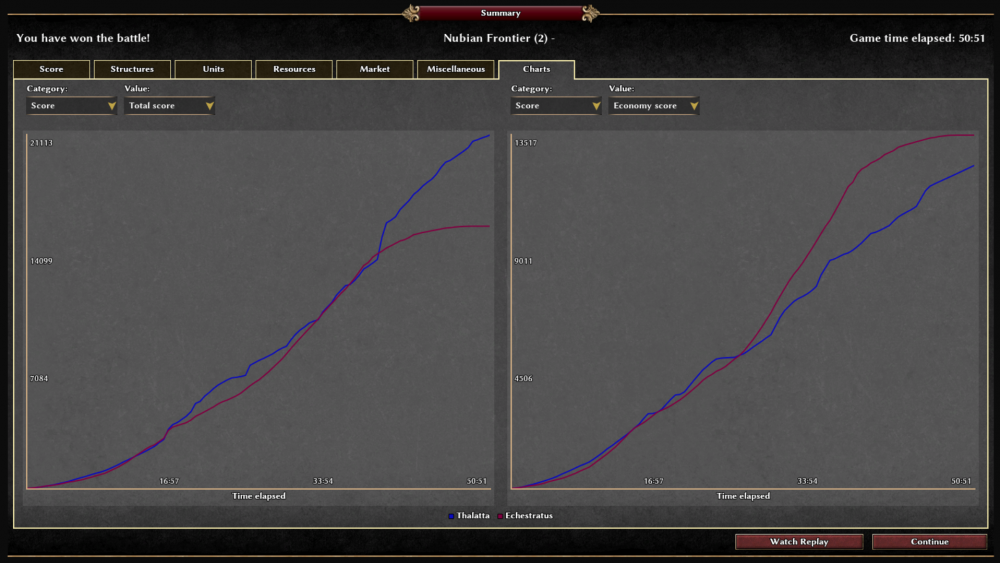
I just won the Coast Range scenario on Very Hard AI Difficulty when I thought I was about to lose because towards the end Petra seems to give up for no reason. I managed to repel a big attack (losing like a third of my territory, which was almost half of all land) and from then on it was a walk in the park... not sure what's the underlying issue, but I feel I should have lost. Open maps are a bit hard to defend with such a low population cap, unlike the Isthmus of Corinth, but I guess I have to be more aggressive. In short, it seems I just have to hold my ground until the AI has an existential crisis.
-
Narrative Campaign General Discussion?
Thalatta replied to Lion.Kanzen's topic in Gameplay Discussion
@Vantha@ShadowOfHassen well it seems I was going for historical accuracy when historical ambiguity was decided, which I find suboptimal since it misses the opportunity of teaching history. That's why I was thinking for each scenario to be specific historical events, like Hamilcar gaining control of the gold and silver mines of Sierra Morena, subduing certain Iberian tribes, and expanding to the east, for people to learn more things besides Hasdrubal and the (re)founding of Carthago Nova. At least these things are what I find interesting in historically themed RTS. I agree with not doing “the great commanders a bit of a disservice if you scale them back for a beginners tutorial”, but that's the opposite of what I proposed with the prelude concept (in case a proper Hannibal campaign was also wanted). -
Indeed I think this will be a problem if implemented as proposed, and that there are solutions that could be also applied to other things (I've proposed a base garrison that can't be controlled for ships, siege engines and buildings), but maybe people complaining that the feature is broken will need to happen first.
-
Narrative Campaign General Discussion?
Thalatta replied to Lion.Kanzen's topic in Gameplay Discussion
@Vantha I think your idea around Carthago Nova as a tutorial is really good, but I wonder if this could be put in the framework of a larger campaign. Stories are interesting when they are character driven, and one of the most interesting characters around that time is Hannibal Barca, and as I see it there are 3 options: to have just Carthago Nova and miss Hannibal's story, to have both separate and risk being thematically repetitive, or what I like most, for the tutorial to be a prelude of a Hannibal campaign. The whole campaign wouldn't need to be ready for just the tutorial to be released first, it could later on be incorporated into the campaign when it's finished. Regarding how to narrate it, I was thinking about how the Mongol campaign in AoE II is done, the author of The Secret History of the Mongols (as revealed at the beginning) narrates it in cutscenes for each scenario. No cinematics, just drawings, which is how things could be done at first. I think movies like The Last Samurai are nicely told (historical accuracy apart), with the narrator (who takes part in the movie, one realising it at the end) saying something just at the beginning and the end, as an epilogue and prologue. The middle of the campaign would be like a movie, or Starcraft campaigns, for more immersion. Hannibal’s campaign would be the only one with a prelude (tutorial). In it, hints would be given to the player (checkboxes is a great idea, like StarCraft II), but not by the narrator since I feel that cheapens the experience (having some ancient author telling you to click here and there). So, I’d structure them like a book, also with a foreword and afterword (explained in a bit). Combining all these ideas for a Hannibal campaign, a foreword would briefly explain the contents of it, then as prologue a narrator with drawings could tell about Carthage’s defeat in the First Punic War, and the prelude would be the tutorial, starting with Hamilcar (Hannibal’s father) and Hasdrubal the Fair (his son-in-law) taking Hannibal as a child to Europe, founding Carthago Nova, etc. Then the main campaign would start with Hannibal in command, and end with his defeat in the Second Punic War, with many battles being interesting to have (I hope camouflage will be a thing in the future, for Lake Trasimene, and an ability of Numidian cavalry for Cannae). An epilogue would mention his exile and the later destruction of Carthage in the Third Punic War, that the narrator, revealed around this time to be The Histories author, Polybius, witnessed. An afterword would then mention that he’s remembered as one of the most brilliant tacticians of all time, that Rome would end having his monuments because they considered him their most worthy foe, and that later on the Roman emperor Septimius Severus would be born in those lands, being himself a native Punic speaker, to end on a not so grim note. I hope all this is somewhat relevant and doesn't deviate too much from the present plans. -
"However, artillery being captured, turned around in the heat of battle, and starting firing on the troops of its previous owners? Unlikely." That's probably right (can't remember any counterexample), but the same argument could be applied to ships, and that's going to be in the game now. It’s like proposing removing the building of towers because that didn’t happen while a battle was taking place meters away. It's all a representation of things, numbers and time are shrunk with respect to what in reality would have been, it seems to me that completely removing something that happened just because it didn’t happen in the same battle is the wrong call. Capture times would have kind of prevented turning things around in the heat of battle, and if not, a “use cooldown” could be implemented, one being able just to move the piece in the meantime. Edit: I think something like that was proposed for towers and fortresses, to avoid turning them around fast, although more from a gameplay perspective than a realistic one. For ships it would also make sense to have a use cooldown.
-
If one's civilisation has the arsenal, then it should be assumed that there would be engineers in the army that know how to handle equipment, it makes no sense to remove something that happened in reality because there’s not a differentiated engineer unit in the game. I’d even argue that even some things like rams could have been used by anyone. Without the arsenal maybe one could capture and move, but not use (the Rhodians captured very complex siege equipment from the Macedonians, which they sold to finance the Colossus). In reality equipment was even reverse engineered (the Romans used Carthaginian techniques after capturing one of their ships), but this would be too much, so what I mentioned before (having the arsenal) should be a reasonable minimum requirement for using captured equipment, without altering what one’s civilisation can build (which is harder than just using), to make things simple.
-
I think capture for siege units is a great idea and should be part of the main game (now that capturing ships has been also proposed). It would be a way to force a realistic use of them.
-
I never stated nor implied the opposite, just that since this is far less profitable than plundering a city, simplifications could be considered (like they are on many other things).
-
From what I've read, loot doesn't have a big impact in the game anyway. I'd leave loot just for buildings being captured (would have been less probable to salvage something from a destroyed one), after all plundering a city would have been way more profitable than scavenging a battlefield. One gets experience from fighting and surviving already. And no need for small treasure icons to appear on the ground. Also, capturing and deleting would stop being a troll move and would make sense in many situations, just like in reality, plunder first and set ablaze later. Although, deviating from the present game, I'd prefer if no self-destruct button was there, and one would have to destroy buildings manually (attacking them, setting them on fire, or dismantling them and getting resources back).
-
I've tried to Watch Replay a couple of times after a game, and in both instances the same thing happened: my units do absolutely nothing and I lose the game. But that's certainly not what happened