Nicolaus_von_Kues Posted October 2 Share Posted October 2 On 28/09/2026 at 8:38 PM, Thalatta said: Well these are the most interesting. The first are, from left to right, Athena, Hera, Aphrodite, Paris (with a Phrygian hat) and Hermes (with the Caduceus, or staff of Hermes, which many pharmacists use instead of the Rod of Asclepius as their symbol, tragicomically indicating commerce instead of medicine). The orb in that case is just the golden apple he gives to Aphrodite to declare her the fairest goddess (she promised him the most beautiful mortal, and we all know how that ended). The second is Mithras grabbing Helios crown. Both are solar deities, Mithras coming from the East, and I don't know much about this situation in particular, but it does seem like he's taking rulership over the Sun. Apparently this image comes from a Mithraeum, underground temples dedicated to him (I remember seeing at least one, in Ostia Antica). In principle everything was chill between these deities after that, somehow. They are seen interacting with the moon god in some reliefs. With the jars I try to imitate colors and artistic style. I really like this one. What colors did they paint with? There wasn't a way to make many colors back then. Egyptian blue, for example, I understand was lost, I don't know how many centuries ago. https://historia.nationalgeographic.com.es/antiguo-egipto/cientificos-recrean-pigmento-azul-egipcio-hace-5000-anos_23801 Link to comment Share on other sites More sharing options...
Nicolaus_von_Kues Posted October 14 Share Posted October 14 Other things I want to do and need advice from historians for are: What would all the archer levels look like, from basic to elite? Link to comment Share on other sites More sharing options...
Thalatta Posted October 14 Share Posted October 14 33 minutes ago, Nicolaus_von_Kues said: Other things I want to do and need advice from historians for are: What would all the archer levels look like, from basic to elite? As I mentioned, maybe try your luck with the sources listed at the end of Chapter 12 (Palmyra and the Military, From the Roman Period to the Islamic Conquest) of The Oxford Handbook of Palmyra (if not illustrations, maybe descriptions). Possibly even the military roles I described before are more fleshed out in some of those. Link to comment Share on other sites More sharing options...
Nicolaus_von_Kues Posted October 14 Share Posted October 14 2 hours ago, Thalatta said: As I mentioned, maybe try your luck with the sources listed at the end of Chapter 12 (Palmyra and the Military, From the Roman Period to the Islamic Conquest) of The Oxford Handbook of Palmyra (if not illustrations, maybe descriptions). Possibly even the military roles I described before are more fleshed out in some of those. I need a visual reference to draw a version; I'll draw it by hand. First, I'll do the basic version. What I see are auxiliary archers from the 1st-2nd century; I don't think they'd be wearing that. And then the closest thing is the sagittari from the 4th century. Do you have the link to the text ? I'll paste what I've read first. And if I find any visual support related to the text, I'll paste that too. https://doi.org/10.1093/oxfordhb/9780190858117.013.37 I found it but I don't have access to the chapter and the rest of the book. If someone could chat and take a look, that would be great. Link to comment Share on other sites More sharing options...
Nicolaus_von_Kues Posted October 14 Share Posted October 14 Local_Auxiliary_Units_in_Roman_Syria_Ico.pdf I found another strong one through Researchgate. Link to comment Share on other sites More sharing options...
Thalatta Posted October 14 Share Posted October 14 Google "The Oxford Handbook of Palmyra pdf", first link (dokumen.pub). Chapter 12 start at page 179 (198 of the pdf). 1 Link to comment Share on other sites More sharing options...
Nicolaus_von_Kues Posted October 18 Share Posted October 18 (edited) I found a copy... Edited October 18 by Nicolaus_von_Kues Link to comment Share on other sites More sharing options...
Nicolaus_von_Kues Posted October 18 Share Posted October 18 (edited) Quote ‘ Painting representing the sacrifice of the tribune Julius Terentius and his men of the Cohors XX Palmyrenorum to statues of three Palmyrene deities on pedestals, accompanied by the Tyche of Palmyra and Dura, respectively. Wall painting from the pronaos of the so-called Temple of the Palmyrene gods, ca. AD 240.’ —Rubina Raja;, “The Oxford Handbook of Palmyra”, p. 304 Spoiler look this.. Quote Ink drawing of cult scene of Iarhibol. Drawing after Tead , pl. i was not so wrong. Quote the first paintings that Henry Breasted discovered in Dura-Europos in , in the Temple of Bel or Temple of the Palmyrene gods, was the depiction of the sacrifice of Julius Terentius. Julius Terentius was tribune of the th Palmyrene cohort, and the painting-that represents him and his men in an act of worship-sheds light on the religious behaviour of a group of soldiers, a group largely comprising people whose roots lay outside Dura-Europos. 1 The identity of the three figures on the pedestals depicted as the objects of this worship has, however, been the subject of debate from the painting's first publication in until the present day. Edited October 18 by Nicolaus_von_Kues Link to comment Share on other sites More sharing options...
Nicolaus_von_Kues Posted October 18 Share Posted October 18 https://www.persee.fr/doc/syria_0039-7946_1986_num_63_1_6923 I will find Dura europos' discoveries useful. Link to comment Share on other sites More sharing options...
Nicolaus_von_Kues Posted October 18 Share Posted October 18 (edited) By searching for Julius Terentius you can find images of artistic recreations. By the third century, this seemed to be the standard. Edited October 18 by Nicolaus_von_Kues Link to comment Share on other sites More sharing options...
Nicolaus_von_Kues Posted October 18 Share Posted October 18 (edited) This was the most eastern archer I found. He's from Cyprus. Quote Figurative monuments are rich in evidence, especially the life-size statues of Roman cavalrymen recently found in the necropolis of Merkez- Kizilkoyun, near Urfa, which probably represent horse-archers. These wear long Persian sleeved tunics and loose trousers, and in some cases protective ‘gaiters’ as well as Persian calf-length boots, together with a short riding cape (chlamys) or mantle (himation or pallium). The tunic and trousers are sometimes ornamented with wide decorative strips, forming on the tunic a pattern of crossed horizontal segmenta and vertical clavi, with vertical segmenta on the trousers. The colours have disappeared from the Urfa statues, but the colours of similar garments are still visible in the Dura Europos frescoes Edited October 18 by Nicolaus_von_Kues Link to comment Share on other sites More sharing options...
Nicolaus_von_Kues Posted Monday at 20:49 Share Posted Monday at 20:49 (edited) On 18/10/2026 at 1:04 PM, Nicolaus_von_Kues said: This was the most eastern archer I found. He's from Cyprus. I definitely have an idea now for developing a concept drawing for the archer. First, the basic version will come without a helmet. From Total War: Rome II: Empire Divided, I took a concept that I needed to validate, and I have now done so. In the early imperial period, the Auxiliaries wore a Syrian-Roman helmet. I don't remember the name, and I see now that helmets have changed somewhat due to recent wars. There are several possibilities. In Total War I saw several troops using Intercisa, but in the Wargaming miniatures I saw that they used Niederbieber (that's probably the rarest thing to see). This is what I already knew about Total War Rome II. In the game, many archers were generic figures from the 3rd century. There were archers with a Hamian appearance. Edited Monday at 21:38 by Nicolaus_von_Kues Link to comment Share on other sites More sharing options...
Nicolaus_von_Kues Posted Monday at 21:47 Share Posted Monday at 21:47 54 minutes ago, Nicolaus_von_Kues said: I definitely have an idea now for developing a concept drawing for the archer. First, the basic version will come without a helmet. From Total War: Rome II: Empire Divided, I took a concept that I needed to validate, and I have now done so. In the early imperial period, the Auxiliaries wore a Syrian-Roman helmet. I don't remember the name, and I see now that helmets have changed somewhat due to recent wars. There are several possibilities. In Total War I saw several troops using Intercisa, but in the Wargaming miniatures I saw that they used Niederbieber (that's probably the rarest thing to see). This is what I already knew about Total War Rome II. In the game, many archers were generic figures from the 3rd century. There were archers with a Hamian appearance. I doubt there were Hamians archers at this time, I mean with those long robes, what I've seen in live drawings and frescoes are trousers. Link to comment Share on other sites More sharing options...
Nicolaus_von_Kues Posted Monday at 23:23 Share Posted Monday at 23:23 (edited) In the military field, we know that Palmyra was famous for having great and very good archers. Its use was very important to protect the caravans on their trade routes. In addition, there is evidence that the Roman armies were nourished by troops native to the city. This is evidenced by the creation of a fixed cohort that was based in the nearby fortress city of Dura Europos. https://www.sergioalejogomez.com/el-reino-de-palmira/ --- Apparently, after the cataphracts, they had a number of very good archers. Camel, horse, and on foot. https://www.livius.org/sources/content/zosimus/zosimus-new-history-1/zosimus-new-history-1.53/ I found something on FB. I'm going to save the article before it disappears. ---- ARROWS FROM DURA-EUROPOS: ANCIENT ROMAN ARCHERY TECHNOLOGY PRESERVED ARROWS AT DURA-EUROPOS At Dura-Europos, in Roman Syria during the 3rd century AD, archaeology preserved something exceptional: arrow fragments complete with their shafts, nocks, and fletching. Organic material that typically vanishes at other sites survived there under extraordinary conditions. The specimens studied by Simon James reveal meticulous craftsmanship: reed shafts, wooden reinforcements at the front end, a reinforced joint to prevent the shaft from splitting, and three feathers attached to the shaft. Some also retain painted decoration in red, black, and, on certain examples, white or pink: the so-called “cresting.” Here, one of the most fascinating details emerges: we do not know for certain what purpose these markings served. They could have been decorative or personal, or used to distinguish specific arrows; a possible symbolic significance has even been suggested. The motifs on some nocks resemble small “eyes.” However, this remains an interpretation rather than a proven fact. The fletching was long and low-profile, and there is no evidence that the feathers were deliberately spiraled to induce arrow spin. The natural twist of the feathers themselves could have caused such rotation during flight. We are not looking at a modern reconstruction. We are looking at the archery technology of Dura-Europos, preserved for nearly two millennia. How much would our understanding of the Roman arrow change if we could always preserve its organic materials? Main sources: Simon James, The Excavations at Dura-Europos 1928–1937, Final Report VII: The Arms and Armor and Other Military Equipment (British Museum Press, 2004); Yale University Art Gallery, Dura-Europos Collection. https://www.facebook.com/groups/arcierideiduemari/posts/4551749171817918/?seo_visit=1 Edited Monday at 23:51 by Nicolaus_von_Kues Link to comment Share on other sites More sharing options...
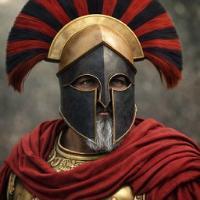
Nicolaus_von_Kues Posted 49 minutes ago Share Posted 49 minutes ago (edited) I'm going to share something I didn't plan to share based on RTW2. Archer, third century. Theory should have a long lorica hamata, third-century helmet, oriental trousers. I couldn't agree on the helmet. It took me many tries. I'm going to use it as a base for drawing it. Edited 45 minutes ago by Nicolaus_von_Kues Link to comment Share on other sites More sharing options...

Recommended Posts
Create an account or sign in to comment
You need to be a member in order to leave a comment
Create an account
Sign up for a new account in our community. It's easy!
Register a new accountSign in
Already have an account? Sign in here.
Sign In Now